
ACCA4025 CertHE Computing Skills for Workplace Assignment Sample
Importance Of Teamwork In Academic And Career Success
- 92650+ Project Delivered
- 1500+ Experts 24x7 Online Help
- No AI Generated Content



Introduction - ACCA4025 CertHE Computing Skills for Workplace Assignment
Working collectively thus means the ability of a group of people to act in unison to turn a specific activity into a success. Culturally, it aids the students in expressing information learned in class as well as cultivating concepts in their minds. In professional life, many projects and many are done in groups so it helps the projects to run effectively. Teamwork helps in communication, and conflict resolution and identifies how to come up with solutions to any arising problems. This poster outlines the features of teamwork, the advantages, and the potential problems resulting from teaming for academic and career goals with the help of the available theories and case-lets.
Struggling with tight deadlines? New Assignment Help is here to rescue you! Get expert assistance on essays, dissertations, and coursework from professionals who care about your academic excellence.
Team development stages (Tuckman’s Model)
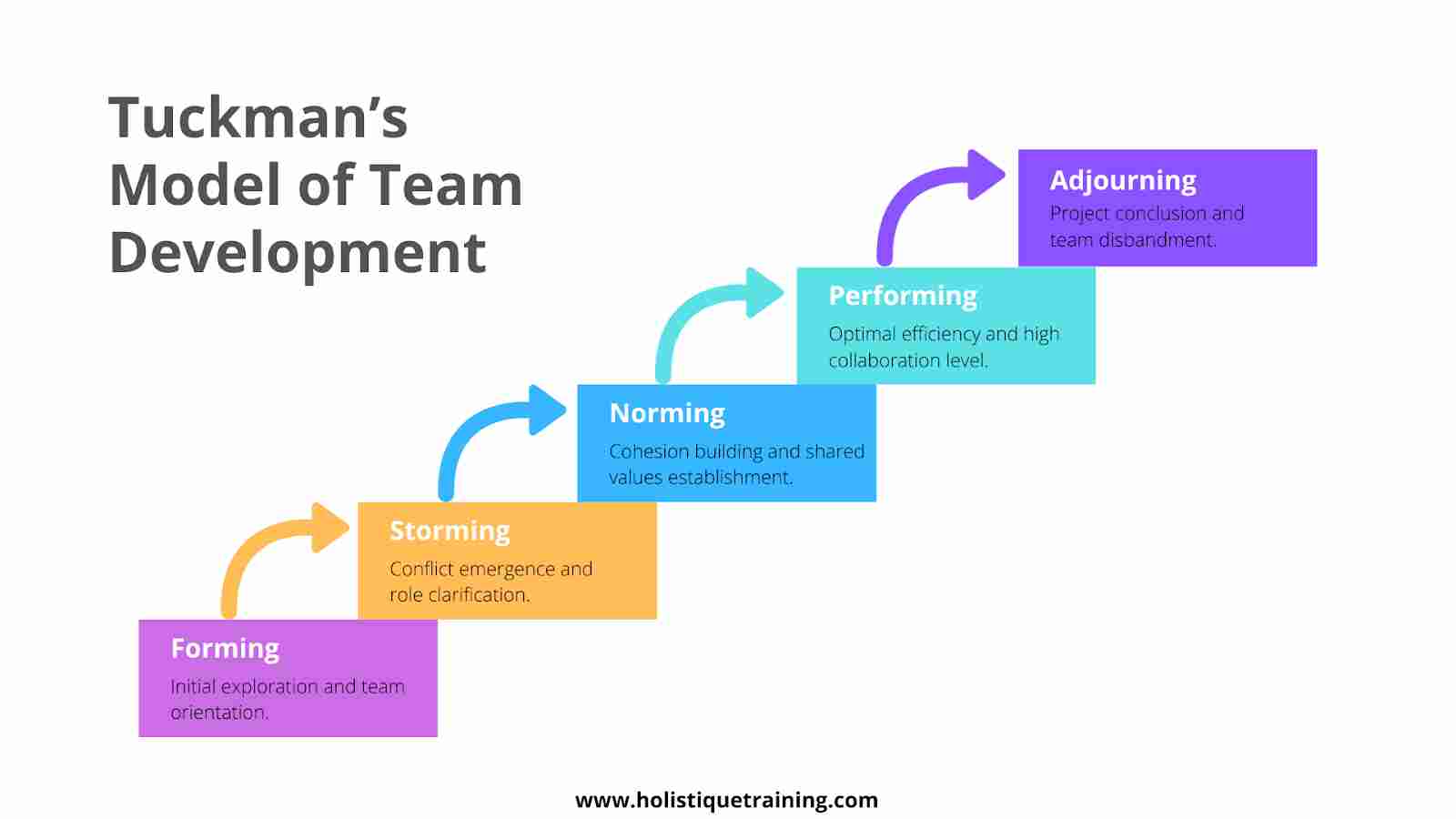
Figure 1: Team development by Tuckman model
(Source: https://holistiquetraining.com/storage/tuckmans-model-1.png)
Tuckman’s model describes how a structure evolves in a group. 1st task is the identification of desirable qualifications for the team members and the team’s general gatherings to introduce the goals of the team and how the tasks will be accomplished [1]. Conflicts therefore come when roles and expectations which people have are tested. The idea of forming a team comes as a natural response to work on the problems that the given materials present, formulate rules, and build trust necessary for effective cooperation. The current assignments are accomplished and the assembled team disassembles and dissipates. Every phase is critical in handling issues surrounding the team, and the explanation enables the achievement of objectives.
The Roles of the Team (Belbin’s Role)
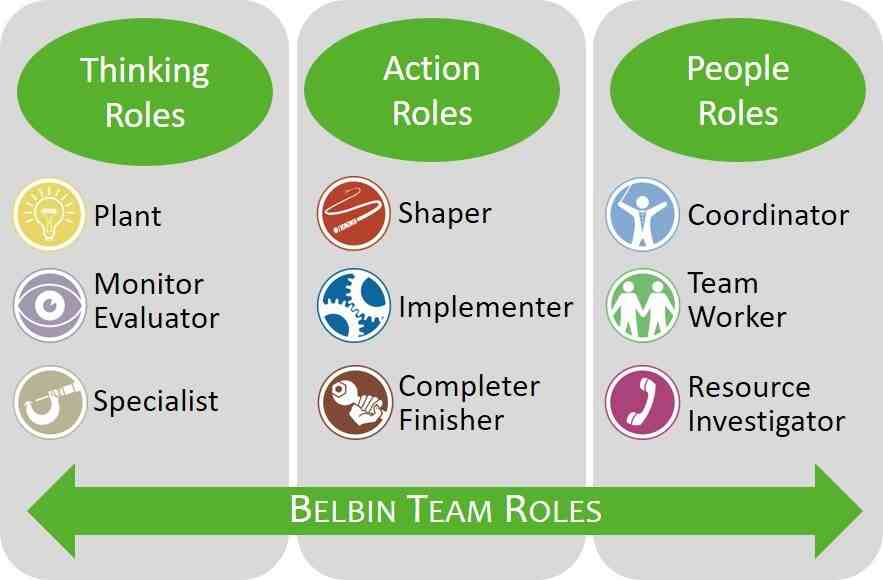
Figure 2: Roles of the Team by Belbin
(Source: https://experianta.com/wp-content/uploads/2023/04/Belbin-Team-Roles.png)
According to Belbin, there are some imperative team roles that can be a part of a successful team. The Coordinator monitors the tasks and ensures the group is on track. The Implementer takes things into practice by making use of efforts. Creativity contributes to idea generation, and problem-solving skills so that one is able to come up with unique solutions [2]. A completer-finisher makes sure that every item is as flawless as it should be and as on time as humanly possible. Finally, Teamwork encourages the staff members to collaborate and help in overcoming internal issues and disputes. Applying these roles makes it easier to foster more effective communication, and cooperation and increases the overall chances of achieving a positive outcome within an academic or workplace group.
Learning essential business network troubleshooting steps is simplified with Computer Network Assignment Help Services.
Benefits of the teamwork
Teamwork has been acknowledged to have a number of advantages in academic and organizational environments. It fosters creativity in addressing issues since individuals come up with different solutions from different angles. By sharing information that is exchanged within the course of the project, individuals are able to observe how others like them are thinking and respond to it. It relieves the burden on the person who is involved and ensures that all are involved put in equal effort. It also allows members to be able to gain some sort of strength from other members, hence improving on talent. Confidence and cooperation are established, thus, making the working climate very conducive for production and accomplishment.
Challenges
No matter how beneficial teamwork is, it is essential to understand that it has its Project Management ideas that contain certain challenges that require proper management. Each person has his viewpoint and temperament, and that is why conflicts may interfere with teamwork. Another conflict is that there can be unequal contributions, some of them may not contribute fully in the process, making others get frustrated [3]. This is coherent to the fact that whenever there is a misunderstanding the impacts can be terrible or lead to mistakes. Also, sympetalous schedules can also bring about problems such as the fashioning of time. These challenges are easy to fix when they are recognized so that members can work together and deliver positive results on projects.
Concept of the Mind Map
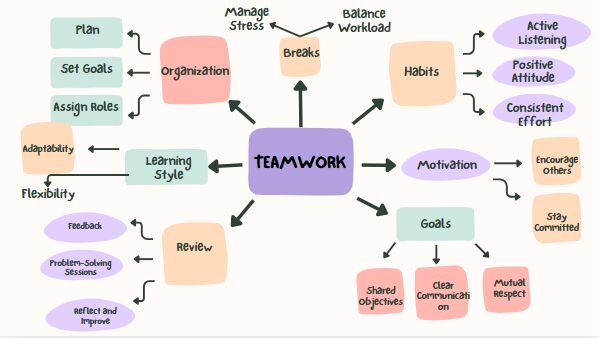
Figure 3: Mind Map
(Source: https://www.canva.com/design/DAGiuEMv1r8/5G05QDOZeKdXbhNkFM25bA/edit?ui=eyJBIjp7fX0)
The following is the mind map that shows main issues that relate to the ability of individuals to work effectively in groups. Globally, Teamwork is focused, and divides it into Organization, Habits, Motivation, Goals, Review, Learning Style, and Breaks. Every branch defines the prerequisites that bring various teams together, aiming at a common goal and a successful outcome. This paper aims to discuss how organization is important in the aspect of teamwork experienced during the completion of a project. It includes scheduling of activities, target setting, and role assignment. An orderly team is one in which the members understand their areas of jurisdiction and function cohesively towards set goals and objectives [4]. This way, it becomes easier to avoid confusion and everyone knows what precisely they are expected to do during the process. Some of the habits are vital in as much as organizational effectiveness and functionality of team is concerned. Practices like focusing on the speaker and being positive as well as persistently engaged in appropriate work as expected in a humane way help the team to remain polite. Engaging listening promotes appreciation of each other and fosters mutual understanding on the part of the team members; on the other hand; positivity and unrelenting efforts go a long way in making the team feel valued. Motivation is what gives energy and drive to efforts among the individuals making up a team. The motivation of the teams makes them push each other, get excited whenever they achieve the set goals and most importantly remain focused even in areas that seem to be challenging. Learning style means that one is ready to adapt to any other mode of learning if he or she is uncomfortable with the current one [5]. As different people, team members often have different ways of learning, learning something new, celebrating diversity and fostering collaboration.
Conclusion
It goes without saying that cooperation is something that is very much in demand and needed throughout one’s lifetime. It helps in communication, leadership, and cooperation, thus preparing its users for academic environments as well as various careers. Although individual and teamwork have been defined in a number of ways, a common definition that can be generalized is that by learning how to work with others, individuals increase their problem-solving capacity, plus learn to adjust to various circumstances. In any field, one will find that the concept of teamwork forms the basic framework for the attainment of objectives, growth, and sustainability in today’s society and global village.
Reference List
- [1] de Prada Creo, E., Mareque, M. and Portela-Pino, I., 2021. The acquisition of teamwork skills in university students through extra-curricular activities. Education+ Training, 63(2), pp.165-181.
- [2] King, R., Taylor, B., Talpur, A., Jackson, C., Manley, K., Ashby, N., Tod, A., Ryan, T., Wood, E., Senek, M. and Robertson, S., 2021. Factors that optimise the impact of continuing professional development in nursing: A rapid evidence review. Nurse education today, 98, p.104652.
- [3] Zainuri, A. and Huda, M., 2023. Empowering cooperative teamwork for community service sustainability: insights from service learning. Sustainability, 15(5), p.4551.
- [4] Detgen, A., Fernandez, F., McMahon, A., Johnson, L. and Dailey, C.R., 2021. Efficacy of a college and career readiness program: Bridge to employment. The Career development quarterly, 69(3), pp.231-247.
- [5] Etherington, C., Burns, J.K., Kitto, S., Brehaut, J.C., Britton, M., Singh, S. and Boet, S., 2021. Barriers and enablers to effective interprofessional teamwork in the operating room: A qualitative study using the Theoretical Domains Framework. PloS one, 16(4), p.e0249576.
- [6] Khasawneh, Y.J.A., Alsarayreh, R., Al Ajlouni, A.A., Eyadat, H.M., Ayasrah, M.N. and Khasawneh, M.A.S., 2023. An Examination of Teacher Collaboration in Professional Learning Communities and Collaborative Teaching Practices. Journal of Education and e-Learning Research, 10(3), pp.446-452.