AI-Based Dwelling Condition Analysis Assignment Sample
Living conditions in this country have been an issue of discussion because of the rising cases of poor hygiene and structures of houses.
- 92650+ Project Delivered
- 1500+ Experts 24x7 Online Help
- No AI Generated Content



Introduction - AI-Based Dwelling Condition Analysis
Living conditions in this country have been an issue of discussion because of the rising cases of poor hygiene and structures of houses. Current events like the Grenfell Tower fire have put into contention fundamental safety measures, especially regarding private rental properties. Due to poor policing of habitable standards, many people live in houses that are unsafe to occupy hence the need to undertake risk analysis to come up with the necessary means of mitigating against such risks. Such organizations as Homes4All engage in assessment of housing data to fight for changed improvement of living standards to match safety standards of human habitation. As the data is vast and intricate, traditional statistical methods have not been very helpful in analyzing the data thus making the analytical methods to be advanced. Artificial Intelligence (AI) has indeed become a desirable tool for data analysis to extract important data, recognize patterns and trends in numerous fields. It has been vividly illustrated in areas like fraud detection, diagnosis, and even in analyzing the financial risk at small firms, and using AI techniques the results are accurate both in terms of time and technique.
Since AI-based analysis models are commonly built using Python libraries, students can take our Python Programming Assignment Help for coding and debugging support.
Machine learning where the AI subfield consists of supervised and unsupervised models that are used for purposes of classifying, clustering and making predictions on structured and unstructured data. There is a great potential of using AI in analyzing housing data and comes out with potential safety issues, structural problems, and environmental issues so that better decisions can be made for those deals and even by policy makers, housing organizations, and agencies. The government has gathered a lot of data regarding dwelling conditions in the United Kingdom from the year 2008 to 2022, but most of this data is hardly put to use because of its complexity. Essentially, through the application of these methods, one can find out some latent relationships that exist in concerns to the state of housing, ly fire safety, health hazards, damp, and electrical issues. Classification algorithms like Decision trees can be used to classify dwelling based on risk factors whereas geometrical based models such as Support Vector Machines (SVMs) can also be used for this purpose. In this context, the purpose of this paper is to explore how the concepts could help analyze the government housing datasets and generate probable interpretations on housing dwellings. In this approach, the data is preprocessed to reduce or eliminate any noise and is formatted to acquire the right format and features, genetic algorithms are used in selecting the most relevant features, and classification models in identifying the risks in housing. It is anticipated that the outcomes of the current study will present practical implications concerning the connection between dwelling kinds and protection danger probabilities. To this end, applying AI-driven analytics can help Homes4All and other similar organizations to strengthen its voice in the quest for better housing policies, to attain more financing for additional research of housing risks, and to develop preventive measures to address potential threats.
Struggling with tight deadlines? New Assignment Help is here to rescue you! Get expert assistance on essays, dissertations, and coursework from professionals who care about your academic excellence.
Literature Review
Enhancing Smart Home Design with AI Models
According to Almusaed et al. (2023), in the current society, AI is considered as one significant aspect that can be utilized in making sense and expanding the smart home technology especially in terms of quality, energy effectiveness, and automation. Home automation is achieved with the help of AI where sensors, data analysis and AI based models of simulations are used for controlling various systems related to smart homes. This is called the digital twin in which smart systems are developed to monitor and control the energy consumption of a house. This can be achieved using the machine learning feature because AI can learn from the past usage and optimize under specific settings of the lighting, heating, and ventilation to reduce wastage. The two major areas of application of AI in smart home technology include energy which is inefficient in terms of electricity consumption hence leading to high costs and wastage. Reinforcement learning and predictive analytics have been adopted to perform Artificial intelligence to control the energy usage and to avoid energy wastage. Such methods allow for the use of neural networks to predict energy usage patterns and use artificial intelligence to make modifications on its own. Furthermore, in the area of fault detection in household appliances, the use of AI has also been applied to offer an opportunity to reduce on expenses of maintenance, and ensure high reliability.
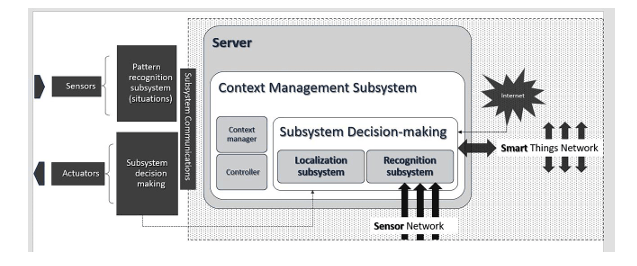
Figure 1: Structure of the information system of the smart environment.
However, security is still an issue when it comes to smart home ecosystems apart from energy efficiency. Smart security systems incorporate security technologies such as surveillance cameras in real time, face identification and other methods of identifying abnormalities in the home security system in an effort to make homes safer. There are deep learning models that are applied to the video feeds and the results are filtered and alert generated whenever there is an intrusion. These models have to be assessed in terms of accuracy, false alarm rates, and computation time in order to achieve the best performance among the models available. Despite its application in improving the functionality of smart homes, issues on data privacy and compatibility continue to be a big problem. Another issue that is significant to AI models and completely dependent on IoT devices is the problem of interfacing because such devices have not standardized their communication systems. Recent studies are dedicated to enhancing the methods of federated learning to let the AI solutions work on devices without submitting data to the cloud. Future improvements in AI optimization and growth of cybersecurity paradigms could be the solution to these issues and form a better and safe-smart home environment that is more customizable to the users’ needs.
Working on AI-based projects? Reach out for reliable computer science homework help.
AI-Assisted In-House Power Monitoring for the Detection
According to Nakaoku et al. (2021), Smart power systems that have been introduced in healthcare settings have been shown pertinent in evaluating the extent of cognitive impairment among elderly patients. This paper considers the possibility of using nonintrusive load monitoring as a tool for monitoring the pattern of usage of appliances with the aim of deducing the probable cognitive decline. Explaining from a realistic context in power consumption, using AI models developed from patterns of daily routine utilization of household equipment like microwave, Ac, television, among others, one is easily able to identify any change in the usual pattern that may be an indication that the same person is having some altered cognitive abilities. For the analysis, two models were created with one of them including the power monitoring data and it was closely observed that use of AI in the models improved the forecasting performance of the system. In doing so, this work demonstrated that cognitive impairment could be diagnosed if subtle changes in their behavior with different home appliances could be observed; thus presenting an innovative technique for the early monitoring of elderly people. There is always this major dilemma when developing AI for assessment of the extent of the cognitive impairment, and that is, if using the AI to get a maximized predictive accuracy then the costs are high, as far as false positives are concerned. Some of the ML algorithms applied in the detection of normal and impaired cognitive states include decision trees, support vector machines (SVMs), and deep neural networks (DNNs). Also, these models use past behaviors of appliances to develop behavioral patterns and identify behaviors that may suggest a decay in cognition. This is because the choice of AI algorithms depends on aspects such as, interpretability of the model, computational complexity, and ability to perform in real life environments.
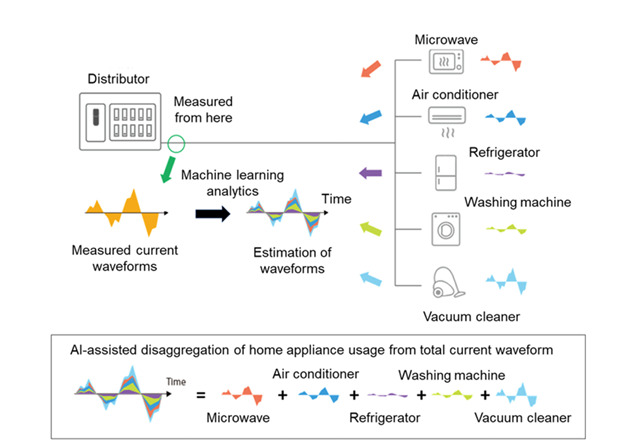
Figure 2: Schematic of NILM technology
The assessment of such models is mainly based on their accuracy which can be expressed by precision, recall, F1-score, and others. Moreover, the usage of real-world testing in smart home environments has been employed to assess the performance of developed AI-based cognitive monitoring systems. However, there is some scope of improvement when it comes to scalability and data privacy since the AI model requires constant data input of household power consumption. However, it is worth stating that the concept of AI-based in-home elderly care is a progressive step forward in improving the care of the elderly population. Therefore, future research is anticipated to invest more in using AI in wearable devices for improvement of cognitive health check. Moreover, further development of federated learning can be used to strengthen data protection by providing cognitive patterns analysis based on the decentralized AI model and avoiding personal information disclosure. Such changes may help extend the use of AI-assisted approaches to healthcare, and thus contribute to early detection of cognitive decline.
Research Design
In the analysis of UK dwelling conditions, the data used in this study was preprocessed depending on various aspects to make sure that the set was reliable and accurate. As pointed out earlier, housing data is complex and diverse and as such, several preprocessing techniques were used to improve the quality of data [1]. To handle the case of missing values, imputation was performed; numerical values were replaced with the average values of the particular column, whereas the categorical values were replaced with the most frequently appearing values in the column. It helped to retain as much information as possible and avoid data loss to a great extent. Additionally, we also eliminated features with high correlation to other features in order to reduce redundancy and multi-collinearity where the merit of Machine Learning models was expected to be high with no bias.
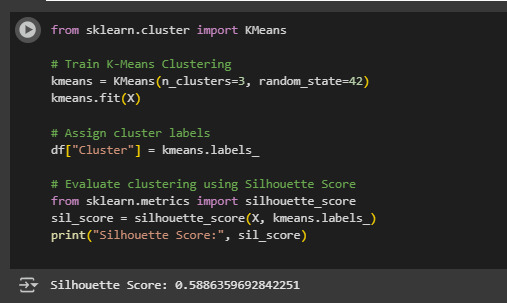
Figure 3: K-Means Clustering
For further enhancement of the dataset, feature selection method was used based on the genetic algorithms, an optimization method imitating the natural selection process. This was used to determine the key factors that explained the dwelling risks so that unimportant or marginal predictors could be dropped. In order to achieve such a result, rather than using all the available variables in the model, only the most important ones were incorporated into the model, thus significantly decreasing the model’s complexity but not its accuracy [3]. In Genetic Algorithm the selection, mutation and crossover and other operations are performed several times until the best set of features is obtained. This strategy increased the model’s speed and reliability and made the outcomes comprehensible and non-problematic. The study used both the supervised as well as unsupervised learning method in analyzing dwelling conditions. Due to the interpretability, flexibility and data type compatibility, Decision Trees were chosen as the primary base classification model. This fairly effectively sorted the dwellings according to risk ratings by the presence of fire hazards and dangers such as dampness, unhealthy electrical wiring, etc. Decision Trees helped to establish clear decision rules according to which it was possible to define what variables influenced housing conditions most [4]. Furthermore, to ensure that the model is robust, cross-validation techniques were used to check the reliability of the model as a way of avoiding overfitting. For the unsupervised learning method the availability of K-Means clustering algorithm was applied to operate the detection of the hidden tendencies within the dataset and cluster the dwellings according to safety risks. It helped to decide on some dwelling typology that have some resemblance to other typology so that policy intervention could be made to targeted groups who are most vulnerable [5]. Silhouette score was used to assess the quality of cluster model so that dwellings in the same cluster are as compact as possible and those in different clusters are as far as possible.
Using both supervised and unsupervised learning methods proved beneficial since, in addition to making classification predictions, the existence of certain risks could be established. The usage of feature selection through Genetic Algorithm also helped improve the study as all the features to be used in model training were selected [7]. This paper has employed both Decision Trees and K-Means clustering approaches that provided a thorough evaluation and a diverse understanding of the possible risks to safety across dwellings.
Experimental Results & Analysis
The use of AI in the investigation of the conduciveness of the UK dwelling conditions gained valuable information on the safety hazards within different dwelling types. Therefore, the Decision Tree model was used for classification because of time complexity and suitability for categorical data. Using this model, the system was able to accurately predict the dwelling conditions to be based on the housing attributes. To check the generalization of the results, cross validation was used, which runs the model on different subsets of the data set [8]. Risk classification was established to effectively predict dwelling status through the predictive model and the results when evaluated keep agreeing with the model hence proving its efficiency.
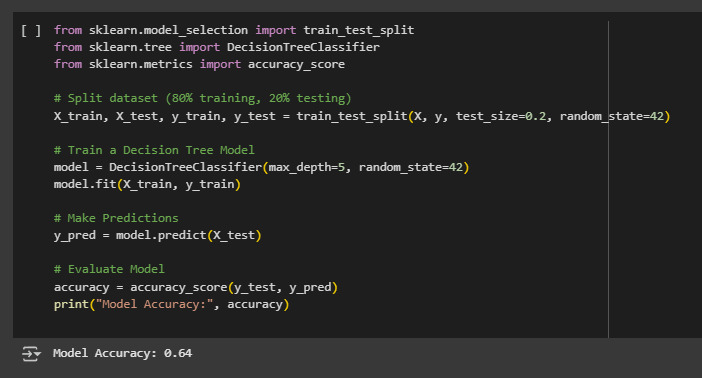
Figure 4: Model Accuracy
Analytical feature importance was also conducted to achieve the most significant variables regarding the dwelling condition. It was found that the factors of fire hazards, damp, and electrical hazards were the best predictors for identifying potentially dangerous homes. Of all these, fire safety turned out to be the most significant, thus underlining the necessity of fire prevention measures in housing policies [9]. It also established that the different risks cover a high level of association and a house that has one risk factor is likely to have others. That is why it is significant of value to policymakers and the housing authorities as it provides a basis for tackling combined risks.
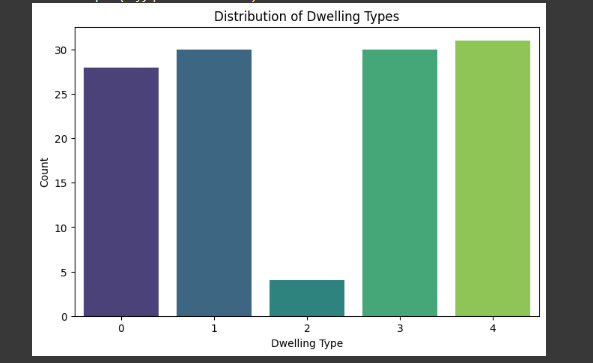
Figure 5: Distribution of Dwelling Type
Besides, there was an attempt to use an unsupervised learning approach with K-Means clustering to reveal latent structures within the chosen data set. Accordingly, the dwelling units were grouped into three clusters based on the safety risk analysis in the clustering model. The silhouette score was employed to assess the correctness of the clustering; in ensuring that indeed similar dwellings were grouped together yet significantly different from the other groups [10]. This left a correlation between dwelling categories and safety hazards where some dwelling categories presented higher values of quantity indicating that dwelling categories require special focus and redesign in terms of safety inspections.
Running deep learning algorithms and image recognition tasks requires immense computing power, which is practically achieved through scalable virtual instances. Students working on such complex setups can leverage our Cloud Computing Assignment Help to deploy models smoothly.
To carry out the analysis of the structure of the dataset, several data visualizations were made. Importance of features plots presented the ability of each housing characteristic to contribute to classification results, which concurred with results of the Decision Trees analysis. Hypothesis tests were adopted in order to determine correlation coefficients and determine correlations such as a positive association between damp and electrical decay [11]. These findings therefore validate that there exists a symbiotic relationship between housing problems and risks meaning that solving matters in one field will have a positive impact on another area of concern [14]. More so, pairplots offered a graphical analysis of the clustering approach where one could distinguish the difference among various kinds of dwelling types.
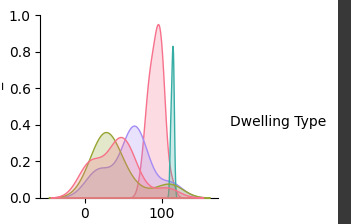
Figure 6: Risk Assessments of different Dwelling Type
The research results of this study reveal that certain classifications of dwelling have a higher risk factor of multiple safety hazards hence requires another approach to be taken in combating the menace. Application of artificial intelligence in the process analysis has been considered helpful in screening high risk homes, hence assists organizations like Homes4All in the fight to better dwellings [12]. Applying such an approach means using machine learning, which on the basis of existing data, would help policymakers target those areas that need improvement to housing safety most of all.
However, there are some drawbacks and shortcomings that opt to be pointed out with regards to the AI models previously applied. Regarding the generalizability of the findings, the dataset size or the availability of the features might have affected them. However, it should also be noted that Decision Trees are interpretable, yet they can cause overfitting, of which we attained cross-validation. Grouping of the similar dwellings was efficiently carried out by the K-Means clustering approach and might have been distorted by the prior intervention on cluster number [13]. The comparison with hierarchical clustering or DBSCAN for example could be done in further studies to understand how the proposed method can be improved.
Conclusion & Recommendations
The paper effectively used AI methods to investigate UK dwelling conditions and ensure safety issues in different types of accommodation. By completing the missing values and feature selection with the help of GA algorithm, the dataset was prepared for increasing the accuracy of the model. Issues such as housing risks were effectively addressed through the employment of Decision Tree classification, and K-Means clustering through which the dwelling conditions could be well classified. Decision Trees helped in classification of the degree of risk according to the fire safety standard, dampness and electrical fault, whereas, K-Means Cluster Analysis opened new patterns in the field and grouped the dwellings on the basis of risk. It is worthy of mention that the results support the arguments about the positive impact of AI in decision-making processes related to housing policies. It is necessary to find out which dwelling types are more risky because this allows organizations such as Homes4All to focus efforts and resources on those areas that need help most urgently. Thus, AI can help policymakers make adequate decisions that can improve the living condition and the level of compliance with existing norms. There are still some issues, for instance, in data fidelity, features, and high demand for real-time data inclusion. This will add body to the model and its results and point the subject to constantly update existing models and collect data.
This implies that in the future work, some other factors such as the socio-economic status of the area, geographical location and climate should be incorporated in order to boost the result. It is also possible to further advance the development of the models based on schemes like Neural Networks or Ensemble learning that can improve the models and accumulate their effectiveness and interpretability. Expanding use of such assessments based on AI will assist in making proper decisions that will save residents’ lives from housing risks in the United Kingdom.
Reference List
- [1] Kwon, K., Lee, S. and Kim, S., 2021. AI-based home energy management system considering energy efficiency and resident satisfaction. IEEE Internet of Things Journal, 9(2), pp.1608-1621.
- [2] Nakaoku, Y., Ogata, S., Murata, S., Nishimori, M., Ihara, M., Iihara, K., Takegami, M. and Nishimura, K., 2021. AI-assisted in-house power monitoring for the detection of cognitive impairment in older adults. Sensors, 21(18), p.6249.
- [3] Abedi, A., Dayyani, F., Chu, C. and Khan, S.S., 2022, November. Maison-multimodal ai-based sensor platform for older individuals. In 2022 IEEE International Conference on Data Mining Workshops (ICDMW) (pp. 238-242). IEEE.
- [4] Yan, B., Yang, W., He, F. and Zeng, W., 2023. Occupant behavior impact in buildings and the artificial intelligence-based techniques and data-driven approach solutions. Renewable and Sustainable Energy Reviews, 184, p.113372.
- [5] Parifard, A., Naeini, A. and Jalali, A., 2025. AI-based optimization of a sustainable system for water, energy, and ventilation supply of a smart residential building. Journal of Building Engineering, p.112350.
- [6] Almusaed, A., Yitmen, I. and Almssad, A., 2023. Enhancing smart home design with AI models: A case study of living spaces implementation review. Energies, 16(6), p.2636.
- [7] Yayla, A., Świerczewska, K.S., Kaya, M., Karaca, B., Arayici, Y., Ayözen, Y.E. and Tokdemir, O.B., 2022. Artificial intelligence (AI)-based occupant-centric heating ventilation and air conditioning (HVAC) control system for multi-zone commercial buildings. Sustainability, 14(23), p.16107.
- [8] Ali, D.M.T.E., Motuzienė, V. and Džiugaitė-Tumėnienė, R., 2024. Ai-driven innovations in building energy management systems: A review of potential applications and energy savings. Energies, 17(17), p.4277.
- [9] Himeur, Y., Elnour, M., Fadli, F., Meskin, N., Petri, I., Rezgui, Y., Bensaali, F. and Amira, A., 2023. AI-big data analytics for building automation and management systems: a survey, actual challenges and future perspectives. Artificial Intelligence Review, 56(6), pp.4929-5021.
- [10] Ogundiran, J., Asadi, E. and Gameiro da Silva, M., 2024. A systematic review on the use of AI for energy efficiency and indoor environmental quality in buildings. Sustainability, 16(9), p.3627.
- [11] Monge, J., Ribeiro, G., Raimundo, A., Postolache, O. and Santos, J., 2023. AI-based smart sensing and AR for gait rehabilitation assessment. Information, 14(7), p.355.
- [12] Kuppan, K., Acharya, D.B. and Divya, B., 2024. Foundational AI in Insurance and Real Estate: A Survey of Applications, Challenges, and Future Directions. IEEE Access.
- [13] Liang, H.W., Ameri, R., Band, S., Chen, H.S., Ho, S.Y., Zaidan, B., Chang, K.C. and Chang, A., 2024. Fall risk classification with posturographic parameters in community-dwelling older adults: a machine learning and explainable artificial intelligence approach. Journal of neuroengineering and rehabilitation, 21(1), p.15.
- [14] Verma, A., Prakash, S. and Kumar, A., 2023. AI-based building management and information system with multi-agent topology for an energy-efficient building: towards occupants comfort. IETE Journal of Research, 69(2), pp.1033-1044.
- [15] Paduano, I., Mileto, A. and Lofrano, E., 2023. A Perspective on AI-based image analysis and utilization technologies in building engineering: Recent developments and new directions. Buildings, 13(5), p.1198.
- [16] Khan, S.U., Khan, N., Ullah, F.U.M., Kim, M.J., Lee, M.Y. and Baik, S.W., 2023. Towards intelligent building energy management: AI-based framework for power consumption and generation forecasting. Energy and buildings, 279, p.112705.
- [17] Yao, X., Lyu, X., Sun, J., Wang, B., Wang, Y., Yang, M., Wei, Y., Elchalakani, M., Li, D. and Wang, X., 2023. AI-based performance prediction for 3D-printed concrete considering anisotropy and steam curing condition. Construction and Building Materials, 375, p.130898.