
Dementia Care In The Uk: A Research Analysis Assignment Sample
Dementia is the UK’s biggest sickness-related public well-being issue
- 92650+ Project Delivered
- 1500+ Experts 24x7 Online Help
- No AI Generated Content


- Introduction - Dementia Care In The Uk: A Research Analysis Assignment Sample
- Statement of the Problem
- Literature Review
- Existing Research on Dementia Care in the UK
- Strengths of Current Research
- Identified Gaps in Research
- The rationale of the Study
- Aim & Objectives
- Methodology
- Data Collection
- Data Analysis
- Ethical Considerations
- Gantt Chart
- Expected Outcome
- Limitations of Research
Introduction - Dementia Care In The Uk: A Research Analysis Assignment Sample
Dementia is the UK’s biggest sickness-related public well-being issue, influencing in excess of 900,000 individuals and is envisioned to grow (Aranda et al., 2021) immensely. The involvement of patients is not only for the benefit of patients but also compromises caregivers, healthcare technology and the healthcare system at large. Dementia care depends on an integrated approach (from medical, social and policy levels). This research aims to review the current dementia care models in place and, by identifying the gaps, propose improvements that will help provide patients with more well-being and support systems.
Transform your grades with New Assignment Help! Our experienced writers deliver high-quality, plagiarism-free assignments tailored to your requirements. Academic success is just a click away!
Statement of the Problem
The UK has several problems in dementia care, such as inadequate resources, caregiver burden, and various care models (Gilsenan, Gorman and Shevlin, 2022). For many patients, social isolation, lack of personalised care and limited access to community support services occur as a result. Home-based care and technological intervention research is also poorly developed (Karrer et al., 2021). It is essential to address these problems to improve the quality of life for dementia patients and their caregivers.
Literature Review
Existing Research on Dementia Care in the UK
The UK research on dementia care is interested primarily in models of healthcare, policy interventions, and social impacts. The studies demonstrate that care homes, community-based support services and medical interventions are all practical. Nevertheless, there is much work in developing personalized and sustainable dementia care for home-based patients who may lack near-immediate access to specialized settings (Livingston et al., 2020).
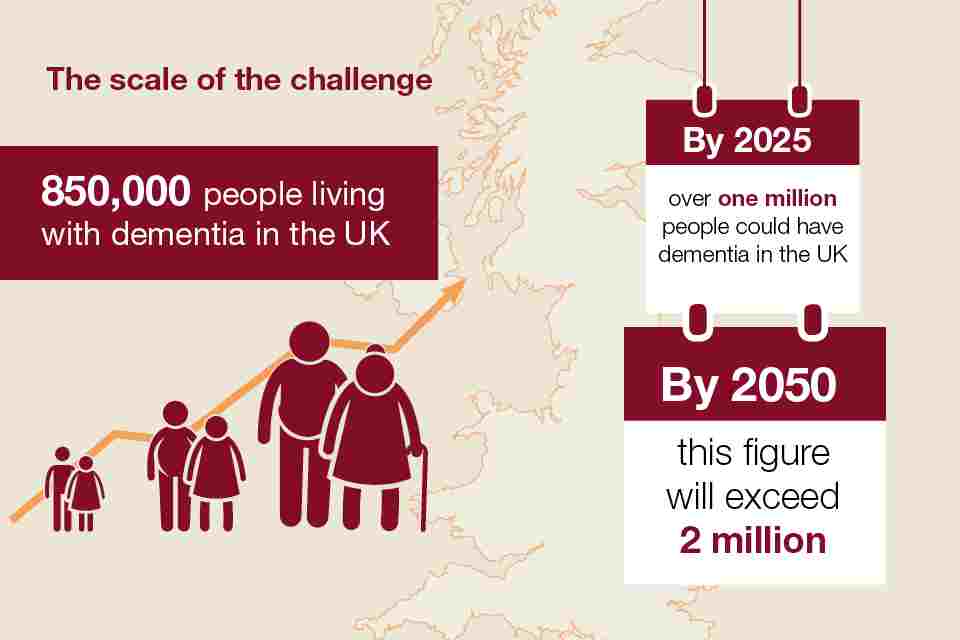
Figure 1: The scale of the challenges of Dementia
Source: (Public Health England, 2021)
There are around 676,000 people in England living with dementia, placing a tremendous drain on the National Health Service and social care systems (Soilemezi et al., 2017). Dementia has a substantial economic impact. In 2015, the total annual cost of dementia in England was calculated to be £24.2 billion, with unpaid care representing 42 per cent (£10.1 billion) (Alzheimer's Society, 2024).
However, research is underway to develop a new diagnostic method. This has seen the UK launch a world-first trial trialling the provision of dementia blood tests to over 3,000 people, who are hoping this will provide the solution to diagnosing Alzheimer’s and other forms of dementia (Alzheimer's Society, 2024).
Strengths of Current Research
UK dementia research delivers well-documented statistics on the prevalence, the economic burden on the healthcare system, and the effectiveness of government policies (Wittenberg et al., 2019). The adoption of dementia-friendly initiatives and structured care programs in care homes are studied, and their impacts on such patient support are understood.
Identified Gaps in Research
Therefore, current research does not offer comprehensive insights into personalized dementia care strategies for home settings. The role of dementia-friendly communities and digital health tools to better engage patients and caregivers is under-emphasized (Innes, Smith and Bushell, 2021). Interdisciplinary research on medical, technological, and social perspectives weakens the development of more effective care models.
The rationale of the Study
The prevalence of dementia is rising, and there is enormous pressure on health services, both of which are reasons for growing concern about dementia care (Aggarwal, Chaware and Aggarwal, 2022). Such knowledge is critical to strengthening the dementia care models by understanding what is effective and what is not and developing patient-centred models. The evaluation models of dementia care will analyze its strengths and weaknesses and assess the difficulties encountered by the patients, caregivers and healthcare providers (Culberson et al., 2023).
Aim & Objectives
The primary aim of this study is to evaluate dementia care in the UK critically, identify existing research gaps, and propose recommendations to enhance care models.
Objectives
- To assess the strengths and weaknesses of current dementia care models, including care homes, community-based programs, and home care services.
- To identify key limitations in existing studies, particularly regarding caregiver support, technology integration, and patient-centred approaches.
- To investigate the social and economic impact of dementia on patients, families, and healthcare systems.
- To explore potential solutions for improving dementia care, including policy recommendations, advancements in technology, and new models of support for caregivers.
Research Questions
- What are the key challenges in dementia care in the UK, and how do they impact patients, caregivers, and healthcare services?
- How effective are current dementia care models in meeting the needs of individuals living with dementia?
- What are the social and economic consequences of dementia for families and healthcare providers?
- How can technology and policy interventions improve the quality of dementia care in the UK?
Methodology
This study is of secondary research that employs qualitative and quantitative data from existing literature to assess dementia care in the UK. The interpretivist research philosophy leads to the study of subjective experiences and the effectiveness of the care models (Bonache and Festing, 2020). The key available databases are Google Scholar, Taylor & Francis, and Open-access Journals, which grant extensive access to the peer-published articles.
Data Collection
Search terms such as “Dementia AND Elderly UK,” “Dementia Care Homes”, and “Impact of Dementia” were used to determine relevant studies. Search for targeted results was done with Boolean operators (AND, OR, NOT). The included studies were peer-reviewed, English language, published in the last 10 years, and with ethical approval. However, studies with inadequate ethical clearance, written in a non-English language and with a small sample size were excluded.
Data Analysis
Quantitative and Thematic Analysis was used. The prevalence of dementia and the effectiveness of care models were quantitatively assessed, while the thematic analysis resulted in recurring themes like loneliness, caregiver burden and social exclusion (Lillekroken et al., 2024). These analyses gave us some insights into how well-existing dementia care frameworks stood.
Ethical Considerations
All the research was based on published studies, which were ethically approved, complying with ethical standards. All images selected were credible, so data was maintained and confidential and no personal data was to be handled directly. Data manipulation was also avoided in the study, and all principles of academic integrity were maintained.
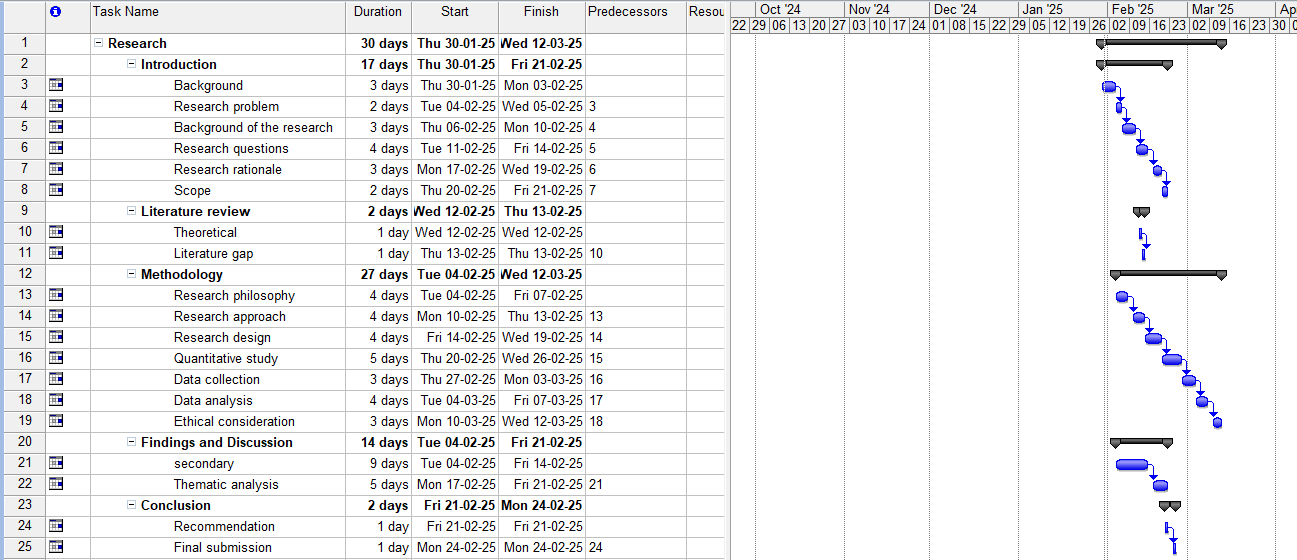
Gantt Chart
Expected Outcome
This study aims to examine the current models of dementia care in the UK to gain a complete understanding of how they can improve as well as gaps within those data. The results are expected to outline issues in personalised dementia care, the cost of healthcare systems and how well policy interventions work (Vinay and Biller-Andorno, 2023). The study will critique the present literature using evidence-based stance recommendations for bettering dementia care. Solutions may include more technology integration, caregiver support, and developing communities that support people with dementia.
Limitations of Research
This study solely depends on secondary data and did not involve in any gathering of primary data from patients or caregivers. Thus, the findings are dependent on it own bias and the methodological constraints of existing studies. The geographical and contextual limitations are also considered, with many studies limited to certain geographical regions within the UK, and these findings need to be generalized.
References
- Aggarwal, H., Chaware, S. and Aggarwal, H. (2022). A Critical Study on the Impact of Dementia on Older People Undergoing Treatment in Care Homes. Cureus, [online] 14(10). doi:https://doi.org/10.7759/cureus.30056.
- Alzheimer's Society (2024). The economic impact of dementia Module 1: Annual costs of dementia. [online] Available at: https://www.alzheimers.org.uk/sites/default/files/2024-05/the-annual-costs-of-dementia.pdf [Accessed 31 Jan. 2025].
- Aranda, M.P., Kremer, I.N., Hinton, L., Zissimopoulos, J., Whitmer, R.A., Hummel, C.H., Trejo, L. and Fabius, C. (2021). Impact of dementia: Health disparities, Population trends, Care interventions, and Economic Costs. Journal of the American Geriatrics Society, [online] 69(7), pp.1774–1783. doi:https://doi.org/10.1111/jgs.17345.
- Bonache, J. and Festing, M. (2020). Research paradigms in international human resource management: An epistemological systematisation of the field. German Journal of Human Resource Management: Zeitschrift für Personalforschung, [online] 34(2), pp.1–25. doi:https://doi.org/10.1177/2397002220909780.
- Culberson, J.W., Kopel, J., Sehar, U. and Reddy, P.H. (2023). Urgent needs of caregiving in ageing populations with Alzheimer’s disease and other chronic conditions: Support our loved ones. Ageing Research Reviews, [online] 90, p.102001. doi:https://doi.org/10.1016/j.arr.2023.102001.
- Gilsenan, J., Gorman, C. and Shevlin, M. (2022). Explaining caregiver burden in a large sample of UK dementia caregivers: The role of contextual factors, behavioural problems, psychological resilience, and anticipatory grief. Aging & Mental Health, 27(7), pp.1–8. doi:https://doi.org/10.1080/13607863.2022.2102138.
- Innes, A., Smith, S.K. and Bushell, S. (2021). Dementia Friendly Care: Methods to Improve Stakeholder Engagement and Decision Making. Journal of Healthcare Leadership, Volume 13, pp.183–197. doi:https://doi.org/10.2147/jhl.s292939.
- Karrer, M., Schnelli, A., Zeller, A. and Mayer, H. (2021). A systematic review of interventions to improve acute hospital care for people with dementia. Geriatric Nursing, [online] 42(3), pp.657–673. doi:https://doi.org/10.1016/j.gerinurse.2021.03.006.
- Lillekroken, D., Halvorsrud, L., Bjørge, H., Gandhi, S., Sivakumar, P.T. and Goyal, A.R. (2024). Caregivers’ experiences, challenges, and needs in caring for people with dementia in India: a scoping review. BMC Health Services Research, 24(1). doi:https://doi.org/10.1186/s12913-024-12146-x.
- Livingston, G., Huntley, J., Sommerlad, A., Ames, D., Ballard, C., Banerjee, S., Brayne, C., Burns, A., Cohen-Mansfield, J., Cooper, C., Costafreda, S.G., Dias, A., Fox, N., Gitlin, L.N., Howard, R., Kales, H.C., Kivimäki, M., Larson, E.B., Ogunniyi, A. and Orgeta, V. (2020). Dementia prevention, intervention, and care: 2020 report of the lancet commission. The Lancet, 396(10248), pp.413–446. doi:https://doi.org/10.1016/S0140-6736(20)30367-6.
- Public Health England (2021). Health matters: midlife approaches to reduce dementia risk. [online] GOV.UK. Available at: https://www.gov.uk/government/publications/health-matters-midlife-approaches-to-reduce-dementia-risk/health-matters-midlife-approaches-to-reduce-dementia-risk [Accessed 31 Jan. 2025].
- Soilemezi, D., Drahota, A., Crossland, J. and Stores, R. (2017). The Role of the Home Environment in Dementia Care and Support: Systematic review of Qualitative Research. Dementia, 18(4), pp.1237–1272. doi:https://doi.org/10.1177/1471301217692130.
- Vinay, R. and Biller-Andorno, N. (2023). A Critical Analysis of National Dementia Care Guidances. Health Policy, [online] 130, p.104736. doi:https://doi.org/10.1016/j.healthpol.2023.104736.
- Wittenberg, R., Knapp, M., Hu, B., Comas‐Herrera, A., King, D., Rehill, A., Shi, C., Banerjee, S., Patel, A., Jagger, C. and Kingston, A. (2019). The costs of dementia in England. International Journal of Geriatric Psychiatry, [online] 34(7). doi:https://doi.org/10.1002/gps.5113.