
U10474 Contemporary Issues in Law Sample
This topic is going to be discussed about discrimination on the grounds of the “Women’s work” and the gender pay gap in the United Kingdom.
- 92650+ Project Delivered
- 1500+ Experts 24x7 Online Help
- No AI Generated Content


- Introduction - U10474 Contemporary Issues in Law
- Discussion
- The concept of the women's work and gender pay gap
- Discussing the historical context of women's works and how it has contributed to the gender pay Gap
- Providing the statistics and examples of the Gender pay gap in the different industries and occupations in the UK
- Analyzing How the Gender Pay Gap Affects Women's Empowerment and in Wellbeing.
- Presenting the equal legislative regime in the UK
- Outlining the key provisions of the Equal Pay Act of 1970 and the Equality Act of 2010
- Discuss the concept of equal pay for equal work and how it has affected the practice
- Presenting the equal legislative regime in the UK
- Critically examine the role of employment tribunals and the courts to ensure equal pay legislation
- Limitations of the Equal Pay Legislative Regime
- Presenting the limitations of the equal pay legislative regime to address the gender pay gap
- Presenting the failures to address the systematic and overall structural factors that contribute to the gender pay gap
- Critically evaluate the limited enforcement mechanism and penalties for non-compliance
- Provide examples and case studies to illustrate the limitations
- Case studies
Introduction - U10474 Contemporary Issues in Law
This topic is going to be discussed about discrimination on the grounds of the “Women’s work” and the gender pay gap in the United Kingdom. To stop this discrimination several laws were passed and later on, amended but the discrimination exists still today even after having those amendments. The gap in gender payment has become a result of the choices of the individual on several factors based on the segregation of occupation, lack of access to their training and education, and other practices, and for all these issues the life of women is deteriorating economically, socially and also on moral grounds.
Experience stress-free academics with our reliable Assignment Helper team! We combine expertise, dedication, and timely delivery to ensure your complete satisfaction and academic growth.
Discussion
The concept of the women's work and gender pay gap
Women workers are associated with very little pay, limited in the progression of careers, and also, they are having recognition lack. The discrimination in the gap in their payment has created individual injustice and also has an impact on them economically and socially (Cook et al. 2021). Even after significant advancements for equality in payment, payment discrimination among the genders still exists in the United Kingdom.
Discussing the historical context of women's works and how it has contributed to the gender pay Gap
The work of women throughout history has played an important role in the gap for the payment of gender. The gap in the payment of gender is reflected in household labor taking care of the elderly and sick people and children, and the work in the houses is considered the work of women. Their work was transferred to the factory from agriculture and domestic work (Clinch,2001). During that period women usually got less salary than men even after doing the same work and it has begun the payment gap of the gender which still exists today. Their work in the late 19th and 20th centuries did not come under much more value than that of men and sometimes they did not get their payment and also sometimes they remained unpaid. Their work is usually seen as not deserving of any fair compensation. The employment of women increased during the time of the Second World War, mainly in the sector of service. The women gave more concentration on their pay, and they faced lots of barriers to their advancement. From the period between the 1960s and 1970s, the attention to equal payment for women came from the movement led by the feminists and they were being pushed for their equal payment. The legislation of the United Kingdom passed the Act of Equal Pay in the year 1970, and the Act of Equal Pay was passed in the year 1960 by the United States and these had played an important milestone which was pushed for their equal payment (Honoré,1996). However, even after passing the laws and the advancement of societies, the payment gap between the genders still exists today. According to the report of ONS, in the year 2020, the average hourly earnings of women were 17.9% less than that of men in the United Kingdom.
Contemporary legal issues require up-to-date case knowledge; students frequently use law assignment help UK to stay aligned with current UK judicial developments and legislation.
Providing the statistics and examples of the Gender pay gap in the different industries and occupations in the UK
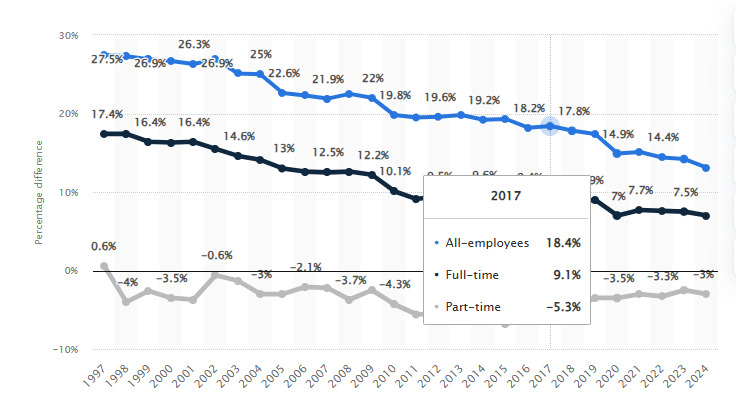
Figure 1: Gender pays gap 1997 to 2024
(Source: Statista.com,2025)
As per the above given statistical data, it is going to be discussed that the period from the year 1997 to 2024 has shown the average earnings between men and women. Here, it has shown the payment gap for gender in the year 1997 was 27.5% for all the workers, whereas it decreased to 13.2% for all the workers and 9.7% for the full-time workers. It has been mentioned that the average earnings for all the workers in the year 2024 were 13.1%, 7% for the full-time workers and -3% for the part-time workers. In the year 2023, the gap of younger people was comparatively small, the gap between the older people comes under the gap at an overall high level. The age between 18 to 21 was -0.2% in comparison with the people of the age group of 50 years was around 11.2%. In addition, the number of people aged 60 years changed from 1997 to 2023 was reduced to 0.5% in comparison with a 12.8% reduction of the age of 40 years. As per the data of 2023, women were unable to achieve any of the leadership positions of the top position of businesses in the United Kingdom. Among the FTSE 100 companies, 11% of the CEOs were females which is compared to the reduction of 4% for FTSE 250 companies (Statista.com,2025). The representation of women was 42.6% to FTSE 100 boardrooms whereas it was 41.8% in comparison to FTSE 250 companies. In the case of political position, the number of female MPs has reached the highest level of 41% which was 3% in the comparison of 1979.
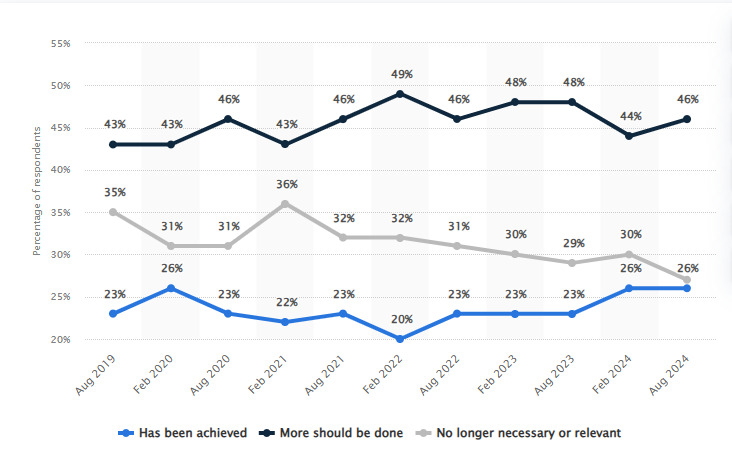
Figure 2: Gender equality
(Source: Statista.com,2025)
The above graph presents the overall value of Gender Equality and in the year 2024, it was noticed that 46 percent of the women in Great Britain were addressed equal payment which was about their gender inequality in comparison to 26% has already been achieved.
Analyzing How the Gender Pay Gap Affects Women's Empowerment and in Wellbeing.
The gap between the payment of gender has impacted the empowerment of women economically, it has decreased the potentiality of women’s earnings and become very difficult for them to achieve their independence financially and gain security. The gender gap has affected very badly in the careers of women, their opportunities are limited, and they face difficulty in achieving the position of leadership, which also impacts their decision-making and control in their lives. It caused them to come under jobs of lower groups and it led them to come below poverty level and financially insecure. It is impacting their health mentally, anxiety, stress, and depression.
The gap in the gender payment has affected the ability of women to save for retirement, and they started living their lives in poverty even after retirement due to this gender gap regarding the payment.
The objective for the well-being of women is being damaged by the gender payment gap in the gender pay, based on their economic security, economic savings in older age, health, and stability in their jobs. The gap in payment has made the women’s stage temporarily as well as permanently for leaving the workforce resulting in an important loss for the contribution of women. The gender gap for payment has become a big issue which is being studied in the literature extensively. There are a few factors which include the discrimination of gender on the mode of hiring, in the case of their promotion,
Presenting the equal legislative regime in the UK
Outlining the key provisions of the Equal Pay Act of 1970 and the Equality Act of 2010
In this context, the primary key provisions of the Equal Pay Act 1970 and the other Equality Act 2010 have been provided below.
Equal Pay Act (1970)
Equal pay and equal work
The act mainly requires employers to pay the remuneration salary equally. It has been noted in similar pieces of work and also noticed in the different pieces of work (Horsey,2001).
Comparison among the male comparators
Women mainly compare with their payments in the field of the male comparator, and it might happen for doing the same piece of work (Hutchinson,2010).
Value in equal
This act mainly provides equal pay for work and equal value in the different sectors. Apart from the different jobs which are mainly related to work. Apart from that jobs are not identical and for that reason, the value of equality in certain fields is not maintained effectively.
Exemptions
The Act mainly allows exemptions in certain circumstances, and it directly impacts the differences in pay and directly affected with the portions of genuine material factors
Working in a like
The act mainly defines the like of work, and it mainly discloses the same piece of work, and it also discloses the factors of efforts. Skills and in the decision-making
Equality Act (2010)
Harmonization of the equality legislation in the UK by combining many separate anti-discrimination laws in one single act. This legislation provides a unifying structure for protection against discrimination based on nine protected characteristics of humans.
Protected characteristics are the nine characteristics that the law prohibits discrimination against including gender reassignment, disability, age, pregnancy, marriage and civil partnership and maternity, sex, region of belief, race, and sexual orientation (Llewellyn,1960).
Direct and indirect discrimination
The act mainly prohibited situations indirect and indirect discrimination, and it includes the pay-for-discrimination
Pay in equal
The act mainly retains the Equal Pay Act of 1970, and it mainly includes the requirements of equal pay, equal; work, and equal value (McBride,2014).
Gender pays gap reporting
Gender pays gap reporting requires employers with 250 or more employees to annually publish data on the difference in earnings.
Positive actions
The act mainly allows employers to take positive actions
Discuss the concept of equal pay for equal work and how it has affected the practice
Equal pay for equal work means that both men and women who were performing in the same organization and working the same work should get equal payment irrespective of their gender and it has been mentioned in the Act of Equality in the year 2010 that it is mandatory in a legal way. As per the historical context, the Act of Equal Pay in the year 1970 and the impact of the law of the European Union have played an important role in it. There are many challenges which include the schemes for the evaluation of jobs, bias of hidden and enforcement.
The legislation has impacted equal pay based on a reduction in the payment gap, gender, an increase in women's employment opportunities, and accountability of the employer (Kabeer, 2021).
Presenting the equal legislative regime in the UK
Critically examine the role of employment tribunals and the courts to ensure equal pay legislation
In the UK, the Equality Act 2010, employment tribunals, and the courts to ensure equal pay legislation, work together. This act needs women and men to be paid similarly for similar work. The Equality Act (EA) also applies to non-contractual matters or conditions including discrimination in training, promotion, and recruitment. The Equality Act of 2010 combined with the Equal Pay Act of 1970 for the reason of the right to equal pay for men and women. The sex discrimination Act of 1975 laws that protects people from discrimination based on sexual orientation. The equal pay legislative regime presents an employment tribunal, and the courts play a vital role in making sure equal pay legislation by allowing a forum for employees to build claims. This act protects employees from being paid less than others for equal work (Hayes,2022). The Equality Act protects an employee from discrimination depending on disability, religion, sexual orientation, and other protected characteristics. The Equality Pay Act of 1970 allows women and men to be paid quality for equal work. Part-time workers are entitled to equal pay as full-time workers (legislation.gov.uk, 2024.).
Employment tribunals are forums for equal pay for employees to make claims. Employment tribunals allow a path for employees to resolve disagreements with employees. An employee can compare their condition and pay to an indicator who works equally for the same employer. The courts play a role in ensuring equal pay legislation by interpreting the law on cases in the UK. The European Court of Justice (ECJ) and the Supreme Court have ruled on equal pay cases which rule that equal pay discloses the work value in the workplace (European-union.europa.eu,2025). An employee can claim the same pay if their job is not equal but similar in terms of efforts, responsibilities, and decision-making. The Equality Act 2010 usually protects people from discrimination within the organisation workplace and also in society. It replaced past anti-discrimination rules with a separate act, and it established the laws to easily understand the same conditions.
Limitations of the Equal Pay Legislative Regime
Presenting the limitations of the equal pay legislative regime to address the gender pay gap
The equal pay legislative regime in the UK, while mainly focused on addressing the gender pay gap, faces potential limitations that make it challenging to tackle the gender pay gap in practice. Based on The Equality Act 2010 aims to address the gender pay gap when the equal pay legislative regime in the UK, faces potential limitations. The current legal structure priorities comparing individuals performing work including like for like can fail to notice border systematic issues. Bringing an equal claim, an employee shows that they are doing like-for-like work in contrast to male workers which can be challenging due to difficulties in job roles. The gender pay gap is significantly pronounced for part-time workers and women taking career breaks due to their childcare responsibilities, it can be a complex issue for equal pay legislation. The law usually does not enable using a hypothetical comparator which means that employee cannot compare their pay to equal roles and responsibilities that do not recently exist in the organisation, limiting the scope of claims (Murray,2016). Based on material factors that means employees can justify pay differences depending on their performance, experience, and qualifications. It can be used to mask discriminatory practices (Saari et al. 2021). Many organisations do not openly disclose pay information, for employees to investigate potential pay disparities. Equality Act 2010 contributes to legal structure, the enforcement mechanisms cannot be fast enough to discourage employers from enhancing discriminatory practices. The recent legal structure first mentions individual same-pay claims that comprehensively overlook broader systemic facts including career progression, and gender-biased work evaluations that promote the gender pay gap (Christopherson et al.2022). The burden of proof on the employee to show that pay disparity is due to sex and religious discrimination which can be challenging and also time-consuming (Sánchez-Mira et al.2022). The gender pay gap is in place that provides a snapshot of the gap and that cannot capture the underlying causes for improvement. Bringing equal pay claims through employment tribunals can be time-consuming and expensive which potentially discourages individuals from tackling cases.
Presenting the failures to address the systematic and overall structural factors that contribute to the gender pay gap
In the UK, the equal pay legislative regime focuses on addressing gender pay disparity and faces potential limitations. Despite legislation's priorities for closing the gender pay gap, there are systemic and structural factors that remain to be addressed. Based on occupational segregation, women are disproportionately intense in lower-paid sectors including administration, care, and retail that consider women's work. The lack of flexible working options that indicates especially in higher-paying jobs forces women to select between family responsibilities and career progression causing career disruption and less income. A lack of transparency surrounding pay structure makes it complex for women to investigate, and potential challenges pay interrupts within their organizational workplace b(assets.publishing.service.gov.uk,2018.). Unconscious bias in the promotion can create issues for women that promote fewer women meeting peer leadership positions where money is higher. Men's demoted workplace culture can create an atmosphere that is not favorable to women's career progression including a lack of support. Women who take time off work due to family responsibilities and childcare can face challenges returning to the workplace at the same level of pay as their seniors (Kräft,2022). The concentration of women in lower-paid sectors who sometimes consider women to work and contribute specifically to the pay gap is not enough to address recent policies. Insufficient approaches to flexible working arrangements that significantly for childcare responsibilities needs, disproportionately affect women's career progression as they can need to minimize working time hours and take career breaks (Je et al.2023). Limited interventions on career development that mean when some initiatives can provide training on gender equality, sometimes they can lack targeted tactics to support women's career development. Gender stereotypes can impact career choice early on with women sometimes choosing for lower paying ground due to societal demands. The societal demand that women manage domestic childcare contributes to a second shift that can potentially limit their available working hours and also careers. A woman typically pushes a big burden of unpaid care work including eldercare which can limit their available working hours.
Critically evaluate the limited enforcement mechanism and penalties for non-compliance
The Equality Act 2010 ensures pay for women and men performing equal work in the UK. The Equality Act also prohibits discrimination depending on protected characteristics including gender. The equal pay legislative regime, governed by the Equality Act has limitations in its enforcement mechanisms with penalties for non-compliance relying on employment tribunal and reputational decrease rather than financial sanctions. The limited enforcement mechanism includes a lack of proactive enforcement which means the Equality and Human Rights Commission relies on complaints from individuals to initiate proactively enforcing compliance. Voluntary reporting indicates employers need to report on their gender pay gap, but this is a voluntary procedure and there is no guarantee (Chen and Tanaka, 2024). The limited role of regulatory bodies indicates when the Equality and Human Rights Commission has a role in contributing to equal pay The enforcement powers include investigations, taking legal action in cases, and issuing guidelines but not direct sanctions (Ciminelli et al.2021). Organisation can be more concerned about the negative public perception of not regaining equal pay than financial penalties that can incentivize compliance to an equal degree. A complex legal process that indicates providing unequal pay can be difficult and it needs details exploring of work roles, responsibilities, and skills that can be time-consuming for employees to seek. The burden of proof on the employees that bring equal pay claims the employee identifies an indicator of the opposite sex who doing equal work and shows that their pay is lower without a reason than the other sex.
Provide examples and case studies to illustrate the limitations
Case studies
Case 1 BBC: In the year 2020 the BBC has been found to signify the gender pay gap with portions of some female presenters earning up to 50% and it is less than their male counterparts.
Counterparts. The BBC case studies were criticized for their management of the complex issues and some high-profile female presenters resigned in protest.
Case 2: HSBC: In the year 2020 HSBC has been discovering £45000 for failing to report its gender pay gap data on significant time. The fine was also criticized for being too small and this case study was accused of not taking the issues seriously.
In the UK, the equal pay legislative regime, at first the Equality Act 2010 focuses on protecting women from pay discrimination. Moreover, despite this legislation that refers that the recent regime cannot be sufficient to protect women. There is one vital limitation which is the complexity of equal pay claims. Woman identifies indicators of their opposite sex who work in equal employment and build that their pay and conditions are worse. This can be a discouraging task without approaches to legal resources. There are other limitations including lack of transparency in pay practices. The Equality Act needs employers to report on their gender pay gap. The Equal Pay Portal emphasizes the obligation of public sector bodies due to the need for discrimination.
Conclusion
The equal pay legislative regime outlined in the Equality Act 2010, focuses on protecting women from gender pay differences in the UK. The equal pay legislative regime has made steps in addressing the gender pay gap, but it is not sufficient to protect women. Despite legislation women's gender pay gap remains in the UK the emphasis on recent laws is not enough to eliminate the complex issue. Organisations can implement pay for women, a transparent salary framework, training career development programs, and flexible work options to address the causes of gaps.
Reference
- assets.publishing.service.gov.uk, 2023. Enforcement and sanctions for non-compliance. available at: https://assets.publishing.service.gov.uk/media/651435bbb23dad000de7076e/Enforcement_and_sanctions_for_non-compliance.pdf [Accessed on:21.01.2025]
- assets.publishing.service.gov.uk,2018. The gender pay gap in the UK: evidence from the UKHLS. Available at: https://assets.publishing.service.gov.uk/media/5af4261440f0b622dae8dd44/Gender_pay_gap_in_the_UK_evidence_from_the_UKHLS.pdf [Accessed on:21.01.2025]
- Browne, K., Banerjea, N., McGlynn, N., Bakshi, L., Beethi, S. and Biswas, R., 2021. The limits of legislative change: Moving beyond inclusion/exclusion to create ‘a life worth living’. Environment and Planning C: Politics and Space, 39(1), pp.30-52.
- Chen, Y.Z. and Tanaka, H., 2024. Women’s empowerment. In Encyclopedia of quality of life and well-being research (pp. 7749-7751). Cham: Springer International Publishing.
- Christopherson, K., Yiadom, A., Johnson, J., Fernando, F., Yazid, H. and Thiemann, C., 2022. Tackling legal impediments to women’s economic empowerment. International Monetary Fund.
- Ciminelli, G., Schwellnus, C. and Stadler, B., 2021. Sticky floors or glass ceilings? The role of human capital, working time flexibility and discrimination in the gender wage gap.
- Clinch, P. (2001), Using a Law Library: A Student’s Guide to Legal Research Skills, 2nd ed. – Sooner or later you’re going to have to do legal research (i.e., find your way around a law library quickly and competently in order to look up material). This is a useful guide
- Cook, C., Diamond, R., Hall, J.V., List, J.A. and Oyer, P., 2021. The gender earnings gap in the gig economy: Evidence from over a million rideshare drivers. The Review of Economic Studies, 88(5), pp.2210-2238.
- Devine, P., Kelly, G. and McAuley, M., 2022. Equality and Devolution in the United Kingdom: A Story in Three Acts and a Sequel. Social Policy and Society, 21(4), pp.612-626.
- European-union.europa.eu,2025, Court of Justice of the European Union (CJEU), Available at: https://european-union.europa.eu/institutions-law-budget/institutions-and-bodies/search-all-eu-institutions-and-bodies/court-justice-european-union-cjeu_en [Accessed on 21.01.2025]
- Grabham, E., 2023. Decertifying gender: The challenge of equal pay. Feminist Legal Studies, 31(1), pp.67-93.
- Hand, J. and Hooton, V., 2024. Equal Pay and the Equality Act 2010: An Accidental Paradox in Need of Change?. Liverpool Law Review, 45(1), pp.105-123.
- Hayes, L., 2022. Discrimination by Legal Design? UK Supreme Court in Mencap v Tomlinson-Blake Finds Care Workers are Not Protected by Minimum Wage Law for Sleep-in Shifts. Industrial Law Journal, 51(3), pp.696-716.
- Honoré, T. (1996), About Law: An Introduction, Oxford: Oxford University Press.
- Horsey, K. and Rackley, E. (2017), Tort Law, 5th ed., Oxford: Oxford University Press
- Hutchinson, A. (2010), Is Eating People Wrong? Great Legal Cases and How They Shaped the World, Cambridge University Press – all the chapters are useful, but see particularly chapters 1, 2, 6, 8 and 10
- Je, J.S., Khoo, C. and Yang, E.C.L., 2023. Gender issues in tourism organisations: Insights from a two-phased pragmatic systematic literature review. Gender and Tourism Sustainability, pp.205-228.
- Kabeer, N., 2021. Gender equality, inclusive growth, and labor markets. In Women's Economic Empowerment (pp. 13-48). Routledge.
- Kräft, C., 2022. Equal pay behind the “Glass Door”? The gender gap in upper management in a male‐dominated industry. Gender, Work & Organization, 29(6), pp.1910-1926.
- Llewellyn, K. (1960), The Bramble Bush: On Our Law and Its Study, Oxford: Oxford University Press
- McBride, N. (2014), Letters to a Law Student: A Guide to Studying Law at University, 3rd ed., Pearson.
- Murray, A. (2016), Information Technology Law: Law and Society, 3rd ed., Oxford: OxfordUniversity Press
- Saari, M., Kantola, J. and Koskinen Sandberg, P., 2021. Implementing equal pay policy: Clash between gender equality and corporatism. Social Politics: International Studies in Gender, State & Society, 28(2), pp.265-289.
- Saari, M., Kantola, J. and Koskinen Sandberg, P., 2021. Implementing equal pay policy: Clash between gender equality and corporatism. Social Politics: International Studies in Gender, State & Society, 28(2), pp.265-289.
- Sánchez-Mira, N., Serrano Olivares, R. and Carrasquer Oto, P., 2022. What slips through the cracks: The distance between regulations and practices shaping the gender pay gap. Economic and Industrial Democracy, 43(2), pp.536-558.
- statista.com,2025, Do you personally think gender equality has been achieved in relation to equal pay?, Available at: https://www.statista.com/statistics/894062/women-s-opinion-on-equal-pay-britain/ [21.01.2025]
- statista.com,2025, Gender pay gap for median gross hourly earnings in the United Kingdom from 1997 to 2024, Available at: https://www.statista.com/statistics/280710/uk-gender-pay-gap/#:~:text=In%202024%2C%20the%20difference%20between,percent%20for%20part%2Dtime%20workers. [Accessed on 21.01.2025]
- www.legislation.gov.uk, 2024. Equal Pay Act 1970 available at: https://www.legislation.gov.uk/ukpga/1970/41/enacted [Accessed on:21.01.2025]
- www.striking-women.org,2024. Gender pays gap and the struggle for equal pay Tabs. Available at: https://www.striking-women.org/module/workplace-issues-past-and-present/gender-pay-gap-and-struggle-equal-pay [Accessed on:21.01.2025]
- www.truelancer.com,2024. The Gender Pay Gap in the UK. Available at: https://www.truelancer.com/article/womens-work-and-the-gender-pay-gap-in-the-uk-do-you-think-the-equal-pay-legislative-regime-sufficiently-protects-women-35548 [Accessed on:21.01.2025]