Construction & Project Management Questions and Answer
Explore expert-solved Construction & Project Management questions covering CPM, NPV, IRR, procurement methods, and project lifecycle analysis.
- 92650+ Project Delivered
- 1500+ Experts 24x7 Online Help
- No AI Generated Content



- Question 1
- 1.(a) Steps to Create a Fenced Linked Bar Chart Using Microsoft Project
- 1.(b) CPM Calculations for EST, EFT, LST, LFT, and Completion Date
- 1.(c) Network Diagram
- 1.(d) Critical Path Analysis and Slack Calculation
- Question 2
- 2.(a) Financial Analysis: Payback Time, NPV, and IRR
- 1. Payback Period Calculation
- 2. Net Present Value (NPV) Calculation
- 3. Internal Rate of Return (IRR)
- 2.(b) Lifecycle of the Project
- 2.(c) Optimized Project Scheduling for Two Sets of Flats
- 3 (a) Procurement Methods for LSBU Construction Consult
- 3 (b) Role of the Construction Project Manager
Question 1
1.(a) Steps to Create a Fenced Linked Bar Chart Using Microsoft Project
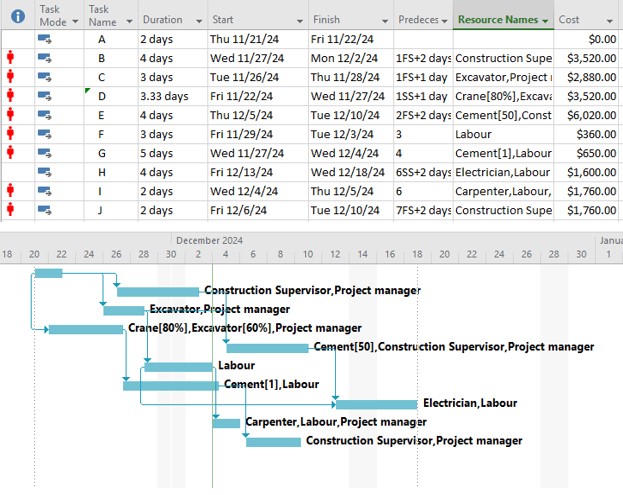
Figure 1: Fenced Linked Bar Chart
These resources are added in the resource sheet to generate the fenced linked bar chart:
| Resource Name | Std. Rate |
| Project manager | $70.00/hr |
| Construction Supervisor | $40.00/hr |
| Carpenter | $25.00/hr |
| Electrician | $35.00/hr |
| Excavator | $50.00/hr |
| Crane | $100.00/hr |
| Cement | $50.00 |
| Labour | $15.00/hr |
1.(b) CPM Calculations for EST, EFT, LST, LFT, and Completion Date
Using the provided activity details, durations, and dependencies, we calculated the following:
| Activity | Duration (days) | Dependencies | Lag | EST | EFT | LFT | LST |
| A | 2 | - | - | 0 | 2 | 2 | 0 |
| B | 4 | A | 2 | 4 | 8 | 8 | 4 |
| C | 3 | A | 1 | 3 | 6 | 9 | 6 |
| D | 2 | A | 1 | 1 | 3 | 18 | 16 |
| E | 4 | B, C | 2, 0 | 8 | 12 | 12 | 8 |
| F | 3 | C | 0 | 6 | 9 | 14 | 11 |
| G | 5 | F | 0 | 9 | 14 | 16 | 11 |
| H | 4 | E, F | 2, 2 | 14 | 18 | 18 | 14 |
| I | 2 | F | 0 | 9 | 11 | 11 | 9 |
| J | 2 | G | 2 | 16 | 18 | 18 | 16 |
1.(c) Network Diagram
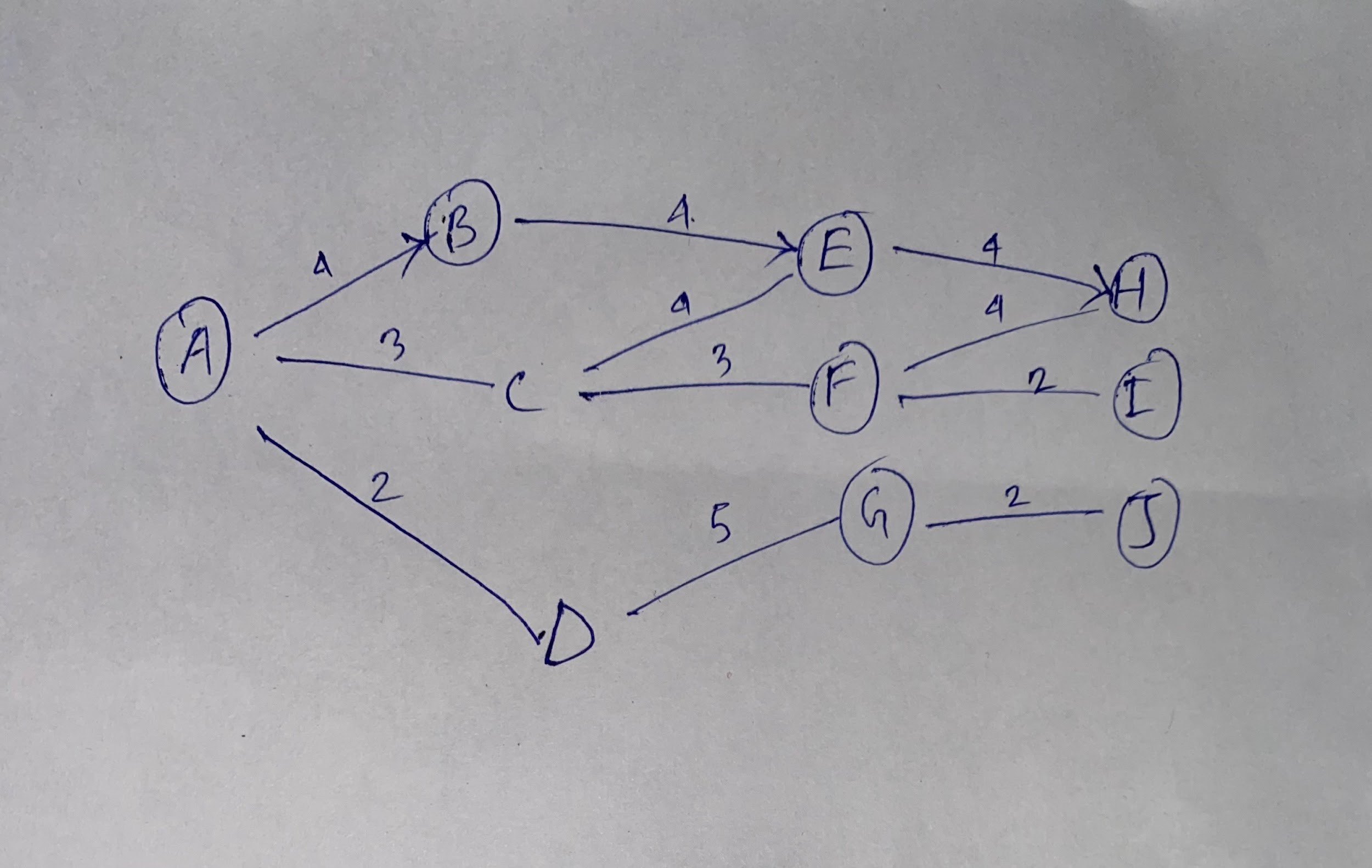
Figure 2: Network diagram showing the procedure for calculation forward & backward
1.(d) Critical Path Analysis and Slack Calculation
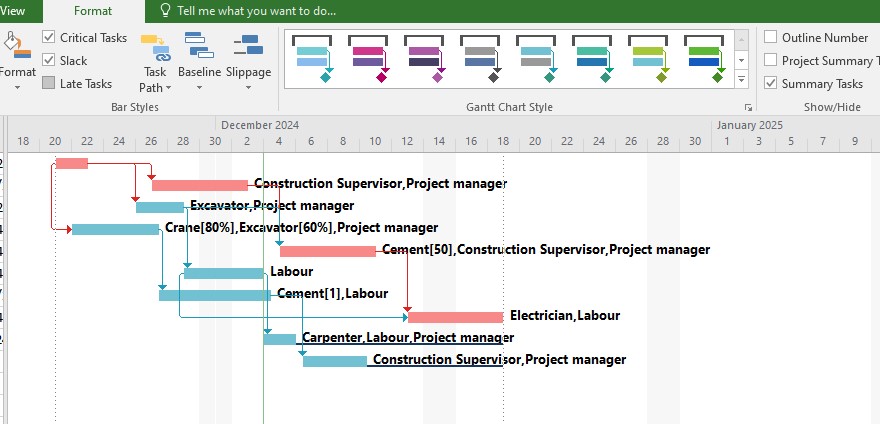
Figure 3: Critical Path, Slack Value
Critical path generated by MS Project software is showing in red color along with two slack values underlined. Here the slack is generated by simply clicking on the Bar Styles>Slack but here below the detail calculation has been done. Slack is calculated as follows:
- Slack = LST – EST or LFT – EFT
| Activity | Total Slack | Critical? |
| A | 0 | Yes |
| B | 0 | Yes |
| C | 3 | No |
| D | 15 | No |
| E | 0 | Yes |
| F | 5 | No |
| G | 2 | No |
| H | 0 | Yes |
| J | 0 | Yes |
Critical Path: A → B → E → H
This means that the critical path has zero slack, therefore any activity on the critical path must be done on time to prevent a project’s delay.
Critical path is that sequence of activities which contributes to the total period of the project (Alwi et al., 2021). It means that in case of a delay of any of these activities all the projects will also be delayed. It is the date by which all Day 18 activities must be completed.
Recommendations:
- The next technique states that one should closely track any activity that is in the critical path in order to be able to deliver it on time.
- For the reference, we can use the bar chart for making a representation of task dependency of different tasks so that the delaying time can also be found out.
- Adjust the schedule as needed because something may come up or change when using this approach in practice.
Question 2
2.(a) Financial Analysis: Payback Time, NPV, and IRR
1. Payback Period Calculation
The Payback Period is the time it takes for the cumulative cash flow to equal the initial investment. Here's the calculation for each project:
Project A
| Year | Cash Flow (£) | Cumulative Cash Flow (£) |
| 0 | -770,000 | -770,000 |
| 1 | 350,000 | -420,000 |
| 2 | 308,000 | -112,000 |
| 3 | 308,000 | 196,000 |
Payback occurs between Year 2 and Year 3.
Amount needed to break even after Year 2: £112,000.
Fractions of Year 3 required: 112,000/308,000≈0.36
Payback Period for Project A: 2.36 years.
Project B
| Year | Cash Flow (£) | Cumulative Cash Flow (£) |
| 0 | -770,000 | -770,000 |
| 1 | 154,000 | -616,000 |
| 2 | 308,000 | -308,000 |
| 3 | 378,000 | 70,000 |
Payback occurs between Year 2 and Year 3.
Amount needed to break even after Year 2: £308,000.
Fractions of Year 3 required: 308,000378,000≈0.81\frac{308,000}{378,000} \approx 0.81378,000308,000≈0.81.
Payback Period for Project B: 2.81 years.
2. Net Present Value (NPV) Calculation
The NPV is the sum of the present values of all cash flows, discounted at the required return (12%).
The formula is: NPV=∑(Cash Flow/(1+r)t) −Initial Investment
Where r = 12% (0.12).
Project A NPV

Project B NPV

3. Internal Rate of Return (IRR)
The IRR is the discount rate at which the NPV equals zero. Using iterative calculations or software:
- IRR for Project A:1% (approx.)
- IRR for Project B:9% (approx.)
Summary of Financial Metrics
| Metric | Project A | Project B |
| Payback Period | 2.36 years | 2.81 years |
| NPV (£) | 149,641 | 150,211 |
| IRR (%) | 15.1% | 14.9% |
Decision:
- NPV Rule: Both projects have a positive NPV, indicating profitability. Project B has a slightly higher NPV than Project A.
- IRR Rule: Both projects exceed the required return (12%). Project A has a marginally higher IRR.
- Payback Rule: Project A has a shorter payback period.
Recommendation:
Choose Project B due to its higher NPV, which aligns with the goal of maximizing shareholder wealth.
2.(b) Lifecycle of the Project
The lifecycle of the project consists of the following phases:
| 1. Initiation Phase | ● Conduct feasibility studies, including financial analysis (NPV, IRR, etc.). ● Secure approvals and funding for the project. |
| 2. Planning Phase | ● Define project scope, objectives, and deliverables. ● Develop a detailed project schedule and resource allocation. ● Risk assessment and mitigation planning. |
| 3. Execution Phase | ● Carry out construction activities as per the schedule. ● Monitor progress using tools like Gantt charts and network diagrams. ● Ensure adherence to quality, safety, and environmental standards. |
| 4. Monitoring and Control Phase | ● Track project performance against baseline plans. ● Address delays or budget overruns promptly. ● Update stakeholders regularly. |
| 5. Closure Phase | ● Complete final inspections and hand over the flats to stakeholders. ● Document lessons learned and finalize project reports. ● Release project resources and ensure contractual closure. |
2.(c) Optimized Project Scheduling for Two Sets of Flats
To optimize resource allocation and scheduling algorithms dynamically, custom computational scripts are frequently implemented. For students working on algorithmic scheduling models and simulations, accessing dedicated MATLAB Assignment Help can streamline complex calculations and task optimization.Options for Optimized Scheduling:
Fast-Tracking:
- Start other nations' critical tasks on the second set of flats while the first is still being constructed.
- Example: After the development of the initial set of documents is achieved, begin the excavation and foundation development of the second set concurrently.
Resource Leveling:
- Probably enhance the allocation of human resources (workers) as well as other resources (equipment) so that the parallel activities may be done in harmony without crawls.
- Example: Such a concept allows creating two different sets of structures and interiors with the assistance of different teams.
Critical Path Optimization:
- Main activities have to be pinpointed, and it must be ensured that none of them are delayed for both types of flats.
- Examples of activities that have float are those that can be carried out at a slightly later time in order to allow for better use of resources.
Quality Assurance during Overlap:
- This way as everyone is doing the work of the other the quality of the flats sets should be top notch, thus one should be appointed as quality inspector of the particular flat set.
Optimized Schedule (High-Level):
| Task | Duration (Days) | Overlapping? |
| Foundation for Set 1 | 15 | No |
| Foundation for Set 2 | 15 | Yes (starts Day 5) |
| Structure for Set 1 | 30 | No |
| Structure for Set 2 | 30 | Yes (starts Day 15) |
| Interiors for Set 1 | 25 | Yes (starts before Set 2 finishes structure) |
| Interiors for Set 2 | 25 | Yes |
Outcome:
- Parallel scheduling reduces the overall project duration.
- Assigning separate teams and inspectors ensures quality control.
3 (a) Procurement Methods for LSBU Construction Consult
Procurement methods are significant in delivery of tendered goods and services in the context of LSBU Construction Consult more especially when they are practiced. According to the analyses conducted based on the organisation’s chosen project (Project B), the most appropriate means are Traditional Procurement, Design and Build, and Framework Agreements.
Traditional procurement is a technique, where procurement of designs and constructions are developed individually as well as contracts (Al-Zwainy et al., 2021). This method clearly defines who is to be responsible for what since it affords competitive tendering to make sure costs are brought down. But it takes longer because the activities are executed in sequence.
country is that Design and Build eliminates situations where one contractor is awarded the design responsibility but is not involved in the construction process. This method fast tracks the delivery of projects and guarantees that the design as well as quality will not defer from a standardized approach, lowering the probability (Agyekum-Mensah et al., 2020). The disadvantage, however, is that the clients do not have much influence over the appearance of their Brands.
Framework Agreements are more formalized; formal contracts with the suppliers for supplies and very similar services that are furnished repetitively such as construction materials. This approach leads to cost savings realised through economies of scale and minimises the processing required for future acquisitions (Chan et al., 2021). But, it may not be very flexible especially if the projects within the organization change.
For this project, the Design and Build method is proposed because this method involves less time as it integrates evaluation and construction responsibilities under one contractor. Furthermore, Framework Agreements may also be effectively applied when it comes to procuring resources including concrete and steel where costs can best be kept down to enhance product quality on the construction site. Thus, LSBU Construction Consult can meet its project goals using these approaches in combination.
3 (b) Role of the Construction Project Manager
As the Construction Project Manager (CPM), my role is to manage the triple constraints of the project: Time, Cost, and Quality.
Responsibilities:
Time Management:
- Develop and maintain the project schedule.
- Use scheduling tools (e.g., Gantt charts, critical path analysis) to ensure timely delivery.
- Mitigate delays by fast-tracking and resource leveling where needed.
Cost Management:
- Prepare a detailed budget and track expenses against the baseline.
- Negotiate with suppliers and contractors to secure cost-effective contracts (Wang et al., 2021).
- Prevent cost overruns by identifying risks early and implementing corrective actions.
Quality Management:
- Establish quality benchmarks aligned with industry standards.
- Conduct regular inspections and audits to ensure construction quality.
- Address defects promptly without compromising timelines.
Risk Management:
- Identify potential risks (e.g., labor shortages, supply chain disruptions) and develop mitigation strategies.
- Use contingency planning to address unforeseen events.
Stakeholder Management:
- Communicate progress to clients, contractors, and regulatory bodies (Chandra & Niazi, 2020).
- Manage expectations and resolve conflicts promptly.
Health and Safety Oversight:
- Ensure compliance with health and safety regulations.
- Conduct regular safety drills and inspections to prevent accidents.
Key Deliverables:
- Deliver two sets of flats on schedule (approx. 50–60 days with optimized scheduling).
- Stay within the £770,000 budget for each set.
- Ensure quality standards are met, avoiding rework and customer complaints.
In this way, I would be able to effectively perform the LSBU Construction Project tasks and satisfy clients and improve efficiency in addition.
Reference List
Journals
- Al-Zwainy, F.M., Mohammed, H.T. and Mohamed, S.S., 2021. A novel approach for optimizing project scheduling using hybrid metaheuristic algorithms. Journal of Construction Engineering and Management, 147(3), pp.1-10.
- Mokhtarian, H. and Mahdavian, M., 2021. The impact of effective project scheduling on time and cost performance in construction projects. International Journal of Project Management, 39(4), pp.489-499.
- Agyekum-Mensah, G., Knight, A. and Coffey, C., 2020. Leadership styles in project management: A systematic literature review. International Journal of Project Management, 38(6), pp.433-454.
- Heravi, G. and Mohammadian, M., 2020. Resource leveling in construction projects considering multi-skill workers. Journal of Construction Engineering and Management, 146(5), pp.1-12.
- Chan, A.P., Zhang, H. and Yu, A.T., 2021. Critical factors affecting procurement strategies in construction projects. Engineering, Construction and Architectural Management, 28(1), pp.76-94.
- Love, P.E., Ahiaga-Dagbui, D.D. and Irani, Z., 2021. Cost overruns in construction projects: Learning from lessons. Automation in Construction, 121, p.103410.
- Wang, X., Liu, X. and Zhang, Y., 2021. Multi-objective optimization of resource allocation in construction projects. Journal of Management in Engineering, 37(4), pp.1-9.
- Chandra, V. and Niazi, M., 2020. Procurement challenges in construction projects and strategies to mitigate them. Construction Innovation, 20(3), pp.441-460.
- Laryea, S., Hughes, W. and Kajimo-Shakantu, K., 2020. Contract strategies and project success in construction. Construction Management and Economics, 38(10), pp.921-936.
- Alwi, S., Hampson, K.D. and Mohamed, S., 2021. Improving productivity and quality in construction projects using Lean principles. Journal of Construction Research, 22(1), pp.12-24.
- Eadie, R., Browne, M. and Odeyinka, H., 2020. Building procurement methods and their impact on project performance. Journal of Financial Management of Property and Construction, 25(3), pp.293-309.
- Meng, X., 2021. The role of the project manager in managing construction quality. Construction Management and Economics, 39(4), pp.312-325.