
The Impact of Trauma-Informed Care on Mental Health Dissertation Sample
This dissertation sample explores how trauma-informed care influences mental health, emotional well-being, and patient recovery, highlighting key approaches to compassionate and effective support.
- 92650+ Project Delivered
- 1500+ Experts 24x7 Online Help
- No AI Generated Content


- Introduction to The Impact of Trauma-Informed Care on Mental Health Dissertation Sample
- 1.2 Problem Statement
- 1.3 Research aim and objective
- 1.4 Research rationale
- 1.5 Research Significance
- 1.6 Overview and road map
- 1.7 Relevance of the topic
- 1.8 Methodology and approach
- 1.9 Empirical Studies
- 1.10 Models and Theory
- 1.11 Conceptual Framework
- 1.12 Data sources and the data Collection Methods
- 1.13 Data analysis method
- 1.14 Project Question
- 1.15 Definition of the topic in general
- 1.17 Summary
- 2.1 Introduction to Literature Review/ Methodology
- 2.2 Selection methods and Search methods
- 2.3 Historical perspectives
- 2.4 Background
- 2.5 Selection Criteria
- 2.6 Process of Screening and Procedure of Selection
- 2.8 Critical Appraisal
- 2.9 Research method
- 2.11 Research Philosophy
- 2.12 Research Design
- 2.13 Ethical Consideration
- 2.14 Research Limitation
- 2.15 The collection and the assessment of the information
- Start of recording using the logs table
Introduction to The Impact of Trauma-Informed Care on Mental Health Dissertation Sample
Children are the vulnerable group in this society, where the children often experience long-lasting trauma, abuse, neglect, with disrupted attachments from their parents, which are responsible for the behavioral changes, impacting on the mental health, and emotional behavior. “Trauma-informed care (TIC) is an approach which acknowledges the existence of trauma to human beings and the need to provide comprehensive support to anyone that has been through this event (Evans et al. 2023).
Overview of the topic
Within the setting of children’s services in UK, TIC is progressively regarded as a fundamental practice model for addressing the multifaceted needs of children in care. The research of this dissertation is aimed at identifying how TIC is practiced in care organisations in the UK and the effects it has on the psychological state of the children in care.
Importance of the topic
The significance of this topic is that traumatized children in care incur effects on their “mental health and development”. “Trauma-informed care” provides a response to such needs. An investigation into its use can enhance the outcomes and direct towards better practices in children social work services in the UK.
1.2 Problem Statement
“Mental health problems” and emotional issues affecting the children in care remain on the high end, a revelation that has put more emphasis on the existing and available resources (Evans et al. 2021). Further, there is not enough of the research about the influence of TIC in the UK context.
This dissertation sample explores the impact of trauma-informed care on children’s mental health, emotional well-being, and development within UK care services. An Assignment writing helper can support students in understanding trauma-related challenges, research gaps, and effective child-centred care practices.
1.3 Research aim and objective
Research Aim
The purpose of the dissertation is therefore to examine the effectiveness of the concept known as “trauma-informed care” in helping children in care in the “United Kingdom.
Research objective
- To identify and categorize the general principles, paradigms, and frameworks of understanding of “trauma in relation to children” in care within the UK.
- To map out challenges and facilitators of trauma informed care in children services in the “United Kingdom” in relation to training, resource, and culture.
- To assess knowledge of social workers regarding TIC and to identify how principles TIC are implemented and supported in practice decision making.
- To determine how much the UK policies and legislations enhance or hinder contact of “trauma informed care” in the protection of children and the care context.
1.4 Research rationale
The subject of “trauma-informed care (TIC)” and the effects on the mental health and well-being of children in care was selected due to its increasing nature in social work in the UK. Children under care usually experience traumatic events like abuse, neglect or broken families (Shankley et al. 2023). Such experiences may cause emotional and mental health problems in the long run. Although the care system is designed to take care of such children, they do not necessarily deal with trauma (Stewart et al. 2024). TIC presents the possibility to enhance the recovery process through comprehending trauma and reacting to it with care and organization. Its use is not yet consistent or fully developed in children services yet. This qualifies it to be a significant and useful area of research.
This project is investigating the meaning of trauma-informed care, the importance of trauma-informed care, applications of trauma-informed care in practice, and concerns of social workers implementing trauma-informed care to aid looked-after children.
1.5 Research Significance
The issue is important since child trauma within the care system is increasingly becoming a problem of concern in “UK social work”. It is being increasingly realised by scores of social workers that the conventional care approaches are not sufficient to cover the emotional needs of the traumatised children (Mestsaninova, 2022). Consequently, “trauma-informed care” is becoming an issue people discuss as an essential practice change. The implementation of TIC should be understood in order to enhance training, policy, and daily care and it is one of the crucial areas of social work activities now and in future as well.
1.6 Overview and road map
Outline of the structure
It contains sections of “introduction, literature review through a thematic approach, description of search strategy and selection methodology, description of findings” on five key themes and conclusion that covers findings summarisation, implications to social work and practical recommendations. This dissertation has seven chapters as follows.
Table 1: Overview and road map
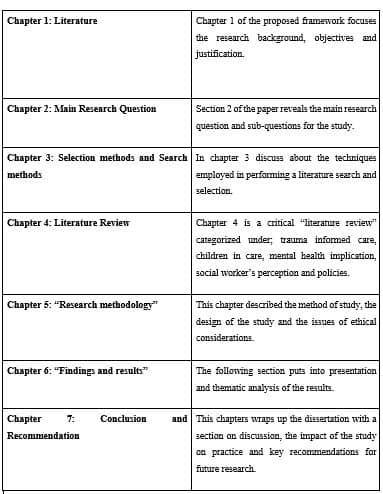
(Source: Self-created in MS Word)
1.7 Relevance of the topic
The area of emphasis to focus on is “trauma-informed care” which is relevant to social work. A social worker is a “frontline care giver” whose services are often required to be engineered towards children who have been through harrowing experiences (Bargeman, 2021). Several studies highlighted the general impact of social workers’ “trauma-informed practice” to greatly affect the children in care. It needs to be noted that there remain gaps in relation to the training, support, and the use of research and evidence, particularly within the services.
1.8 Methodology and approach
This study employs a research approach of a “structured narrative, literature review”. A “literature review” was conducted through databases using specific terms and forums based on inclusion criteria of articles. It also involved the identification and grouping of the data garnered from the study into themes that comprised of subthemes (Culshaw and Bodfield, 2024). There is no primary data collected and the research was done within the ethical perspectives of secondary research only.
Research approach
This project adopts an idea by utilizing an “inductive approach” whereby the findings are constructed based on patterns and themes identified through the chosen literature. The review itself does not start with a “predetermined theory” but creates a comprehension of the evidence discovered (Tyack, 2023). A narrative literature review approach is used to gather, sort and synthesize literature on trauma-informed care and children in care. The study aims at finding out the common concepts, problems, and results in various sources to positively respond to the research question in a concise and clear manner.
1.9 Empirical Studies
Discussion of the empirical studies
According to Saunders et al. (2023) describes the scope of the “trauma-informed approaches” is described and identified in emergency, crisis situations in the context of “mental health care”. The authors reviewed almost 31 articles and the authors determined that there are many “evidence-based practice models” in use; however, some of the most frequently employed include “Six Core Strategies for the Delivery of Evidence-Based Practice” and the “Sanctuary Model”. Such measures contributed towards the reduction of restraint and isolation, promotion of perceived trust from service users and brought about empathy among the staff (Saunders et al. 2023).
Prevalence of trauma for the “children in care”
According to Facer-Irwin et al. (2022), identified the two “common PTSD and complex PTSD (CPTSD)” among the sentenced male prisoners in the UK, many of who have been placed in care during childhood. In the clinical interview conducted on 221 prisoners, it was revealed that 7.7% fulfilled the “diagnosis of PTSD”, and “16.7% CPTSD”. CPTSD was closely associated with early, multiple and interpersonal traumatization familiar to children in care. That indicates its connection with several mental disorders including anxiety, depression, and substance use disorders (Facer-Irwin et al. 2022). This study shows that trauma in children raises significant mental health issues in the later years, and an argument for institutional care that is sensitive to traumatized children.
Evidence-based discussion on “trauma-informed care”
Similarly, Emsley et al. (2022) the author has analyzed how “trauma-informed (TI) care” is perceived and implemented in the context of the “UK health policies” and amongst the health care professionals. It was revealed that even though policy makers have embraced TI care across the 24 “health policy papers”, its deployment is patchy more so in “Scotland and Wales”; however, it is peculiar in England (Emsley et al. 2022). There were calls for the development of a national vision, coordination, and funding of programs on writing by the various professionals.
The key enablers of success under consideration involved organisational culture, leadership, incorporation of service users and experienced government support. However, there is some disagreement over the specific details of this implementation, but all seemed to be in consensus that greater planning and more investment were needed to ensure “trauma-informed care programmers” in the UK.
Barriers of implementation of “trauma-informed care”
Roberts et al. (2023) have aimed at investigating the processes occurring when the “social care professionals” in the “United Kingdom” manage to apply the attachment and “trauma-informed care” after the training. The researcher retrieved questionnaire questionnaires from 98 staffs and examined their perception on them (Roberts et al. 2023). The four issues derived from them include: subjects that affect children and families such as the “incidence of trauma”, inadequate finances, organisational culture, and collaboration. It need to be significant to do better to support them, to improve understanding and to adopt integrated approach across all services. The study insists on the necessity for a “multipronged approach” to support staff in “implementing TIC principles” into their practice when working with children and families.
Overview of the policies
According to Mongey, (2024) described about how the subject ‘‘Trauma-informed training and psychological consultation” for foster careers impacted on their “day to day parenting” and relationship with the cared for children. Seven male and four female foster careers aging from 30 to 65 years were interviewed, and from the results of the interviews and boot camp two main thematic areas were identified. The first type of struggle was related to “careers’ emotions and roles” in relationships and friendships within the network (Mongey, 2024). Second, “trauma-informed training” assisted them in gaining knowledge about trauma, regulation of the self, in addition to regulation of relationships. Third, the use of “therapeutic parenting” enhanced their confidence, as well as their ability to have a healthy relationship with the children. The conclusions stress more for the continuity of the “psychological intervention” to strengthen foster careers knowledge, self-esteem and bonding with the child.
1.10 Models and Theory
Two theories of understanding care for children in cares are “the Attachment Theory” and “the Resilience Theory”.
Attachment Theory
“Attachment Theory” to give a detail account of close relationship between a child and caregiver as being compulsory for “emotional and social growth” was formulated by “John Bowlby” (Thorpe et al. 2025). “Trauma informed care involves” the replenishing of the injured “clients’ trust, security and safety” which is very important when addressing clients with attachment issues.
Resilience Theory
“Resilience Theory” on the other hand deals with factors that enable a child to be strong and succeed in life despite facing negative experiences in his or her life. It is based on resilience assets such as nurturing relationships, safe and healthy environment and activities within and outside a classroom (Lewis, 2023). The concept of “trauma-informed care” revolves around understanding the resilience and how a child can be helped to go back to his or her own strengths despite the traumatic experiences that he or she has been subjected to.
Models
The two critical structural trauma models which are implemented are: “The Sanctuary Model” and the “Therapeutic Crisis Intervention (T.C.I.) Model”.
Sanctuary Model
The “Sanctuary Model” means that all the organisation’s practices must be oriented to provide the necessary physical and structural safety for both the children and the staff. It supports such qualities as non-violence, emotional, and social skills, and communication as well as self-development (Atkinson et al. 2023). It may assist children and careers understand easily and handle trauma related behaviors among children.
“Therapeutic Crisis Intervention (T.C.I.) Model”
Thus, the primary purpose of creating the “TCI Model” was to assist the caregivers to prevent crises and safely manage them in case they occur. Some of the training it offers to staff include training them on children’s sign of anger, training children on when to say when, training on how to defuse aggression and training them on how to teach children to manage anger (Nikopaschos et al. 2023).
Thus, these theories and models effective for the purpose of creating the “trauma-informed practices” and support “mental health of children in care”, according to the context of the UK.
1.11 Conceptual Framework
Dependent variable
The “dependent variable” is the one that a particular research aims at forecasting or explaining. In this regard, “Well-being and mental health of the children in care” is the main dependent variable.
“Well-being and mental health of the children in care”
The “dependent variable” in this study is the “health and self-health of children in care” and it deals with the children’s psychological health, their “emotional well-being”, their overall ability to control their behavior and their “psychological or psychological development”.
Independent variable
“Independent variable” is defined as the variable which is changed or controlled or measured to see it affected on a dependent variable.
“Principles of the Trauma-Informed Care”
The first independent variable is that of “trauma informed care” of patient, the concept of which is based on the idea of building “safe, trustful, empowering, collaborative and ones that are built around a patient’s choice” (MacDonald et al. 2025).
Training for the “Social Workers”
The second “independent variable” is named as “training and preparedness of social workers”. When these social workers are educated in trauma informed practice, assessment of trauma, implement the right intervention and foster positive relationships with client can be made. Implementation of TICs without the adequate training may not even produce the needed impact as required.
“Resources and Institutional Supports”
The technique used to measure the third independent variable is by assessing the level of “institutional support and resources”. Finally, sufficient funding, leadership support, and the application of flight data to obtain more trauma-centric programs guarantee the provision of children’s trauma informed care consistently.
1.12 Data sources and the data Collection Methods
All the data was sourced from the “secondary sources” which included scholarly journals, textbook, UK government documents, and policy papers. The “Google Scholar, JSTOR and relevant website” have been used in collecting the databases.
1.13 Data analysis method
This paper employed “thematic analysis” to synthesize the selected literature as a way of categorizing and gauging patterns or themes. These themes were consistent with the research aims and topics like “trauma informed models”, future of children in care and the practitioners’ observations were among them. This is also made possible through the “thematic analysis” to gain deeper understanding of how different research pursue the idea of trauma and its effects on children in care as well as how the models of the trauma-informed care are looked at.
1.14 Project Question
Research Question
- What is the key role of the “trauma-informed care” play in developing the well-being and mental health of the children who attend the “children in care” in the UK?
Sub questions
- What are the significant differences that the children received from the “trauma-informed approaches” compared to the “traditional care practice”?
- In what ways can the “efficacy of trauma-informed care” be assessed in improving the “mental health” of children in care and in which regional contexts of the “United Kingdom”?
- What issues arise and how is it difficult to provide and practice “trauma-informed care” in homes for children and in foster homes?
1.15 Definition of the topic in general
Keywords definition
In order to focus this literature review, a number of key terms were selected and defined according to their relevancy to the subject. he former significant term is “trauma-informed care” (TIC)”. Here this translates to a framework that recognizes the high incidence of trauma and integrates the recognition in policy, procedures and practices (Boulazreg, 2022).
The goals of TIC in children services are to prevent re-traumatisation and Facilitate healing by providing secure, helping relationships and environments.
The second keyword is “children in care”, also seen as looked-after children in the UK. They are children that, because of certain reasons like neglect, abuse, or failure to provide a safe home, are taken into the care of the local authority. This population is especially susceptible to the trauma, so TIC is quite applicable in regards to their treatment and management.
Another important concept is “mental health”. It encompasses emotional health, the capability to manage stress and whether or not there are psychological disorders, like anxiety, depression, or post-traumatic stress. The prominent factor that might be linked to mental health outcome in the case of children in care is early trauma and instability (Stewart et al. 2024).
The UK children services can be defined as the public or local authority systems which offer help as well as protection to children and families. These are “foster care, residential care, social work interventions, and mental health services”. Finally, the term social work practice defines the occupational endeavors conducted by social workers, such as evaluation, support planning, intervention, and advocacy, especially the protection and child welfare.
These keywords were used together to mold the aim and scope of the literature search.
2.16 Literature Gap
Many benefits of TIC, including those discussed in Saunders et al. (2023) and Emsley et al. (2022) are seen in the UK; however, both papers suggest that the organization of such an approach is irregular throughout the regions and areas of what kinds of care. Indeed, the author of this research, Roberts et al. (2023) present the message that “social workers embrace general systemic barriers”, which is true; however, they do not go to the extent of tracking concrete impact of implementing certain institutional barriers on the delivery of TIC in practice.
1.17 Summary
In short, the current project is concerned with the application of the concept of the so-called “trauma-informed care (TIC)” to the promotion of the “mental health and well-being” of the children on care in the UK. It states why the topic is important, describes what children need, what are the gaps in the current practice. The chapter presented critical concepts, policies, and the justification of the choice of this topic. Now the research shall proceed in discussing the procedures applied to seek and review the literature and continued by a critical narration of results with the identification of main themes found in the studies gone through.
2.1 Introduction to Literature Review/ Methodology
The following section describes the discussion on “empirical studies”. This literature review aims at establishing whether ‘’trauma-informed care (TIC)’’ is effective in the welfare of “children in care” in the “United Kingdom” (Fernández et al. 2023). It focuses on literature on “trauma-informed models”, ‘‘post-traumatization rate” among children, mental health, corresponding social workers points of view, and related policies, presenting an analysis of current state and gaps in the research within this field.
2.2 Selection methods and Search methods
2.2.1 “Search Strategy”
In this study, a structured narrative review has been applied so as to identify and include the relevant literature. The Google scholar, PubMed, JSTOR, and “Anglia Ruskin university library portal” were sampled because they have a potential to access peer reviewed research, policy documents and the books on social work subject (O Brien et al. 2025). To bring the search to date and make it relevant, the search has been narrowed into the books that were done between 2020 and 2024 only. In order to reduce the search result Boolean operators were applied to merge search terms and obtain AND and OR. In order to filter results to the ones conducted in the UK only, written in English, and specifically interested in children services, trauma-informed practice, and mental health outcomes would be found, filters: trauma-informed practices and mental health outcomes were applied. The availability of academic credibility, portions that could be applied to the UK situation of care, and implications to provide information about social work practice were tested by each of the chosen sources.
2.2.2 Search terms
Based on the topic of research, identification of the keywords was met and narrowed down with the aid of preliminary scoping searches. The key words were searched as: the trauma-informed care, children in care, looked-after children, mental health, emotional wellbeing, UK children services, and social work practice (Baumgartner et al. 2023). Synonyms and spell variation served as well in order to expand into the search. These keywords were used in such a manner that they could be able to access the most concentrated and relevant literature into the review.
2.2.3 Evidence sources
To get access to the relevant literature, the corresponding academic databases including: “Google Scholar, JSTOR, PubMed” and “Anglia Ruskin University Library” were exploited. These resources were chosen as they feature wide access to both peer-reviewed journals and scholarly books and grey literature (Farha, 2024). Besides the scholarly literature, such documents like the policy documents of the UK government, children welfare, and social work guidelines were looked into in order to provide a balanced perspective between theory and practice.
2.3 Historical perspectives
“Trauma-informed care (TIC)” is a concept that surfaced in the early 2000s and was influenced by rising understanding of the effects of “adverse childhood experiences (ACEs)” on development and mental health. In the past, children in care would be dealt with using behavioural models which did not take into consideration the effects of trauma behind this behaviour (Handrup et al. 2024). In UK, policy changes like the “Children act 1989” and the “Every child matters (2003)” were among the initial moves towards addressing the emotional needs of looked-after children. Trauma-specific interventions in residential and foster care setting, however, were not common until recently. The trend towards TIC is part of the bigger change towards proactive models of safeguarding, as opposed to reactive ones, to promote emotional regulation, attachment repair and the longer-term psychological health of at-risk children.
2.4 Background
“Trauma-Informed Care (TIC)” helps to develop the well-being and mental health by identifying the potential effects of past trauma situations. Collaboration, empowerment, and a supportive environment. The UK care system helps those children who cannot stay with their families for some reasons, including abuse, neglect, or other issues with the family. Such children are also likely to suffer from developmental disorders including “anxiety disorders, depression, attachment disorder, and behavioral problems” (Bürgin et al. 2022). Children in care are a vulnerable population group with very complex “emotional and psychological” needs in the UK. Multiple placement moves, interrupted education and poor access to specialist mental health services have affected many. These increase the chances of long-term tendency of social and emotional harm. The outcomes are supposed to be improved through government initiatives such as the “Children and Social Work Act or 2017” which are, thus, not consistently implemented by region (Stewart et al. 2024). It is necessary to understand how TIC can be used in a useful way in this system. The review examines the application of “trauma informed approaches” in care set ups and checks out the gaps that should be addressed to make sure they provide effective support that is consistent.
2.5 Selection Criteria
To ensure the quality and relevance of literature that will be included in this review, there were obvious selection and eligibility criteria which will be applied.
Inclusion
The origins of the inclusion criteria were the peer-reviewed articles, policy paper, and books about academics published during the 2020-2024 epoch. The studies were only included when they were in the English language, and the study specifically examined the United Kingdom or when the study involved the trauma-informed care or mental health outcome or children in care services (Randazzo et al. 2023). Other than this, the policy reports and guidelines on the topic of the child welfare and social work practice developed in the UK were found to be appropriate.
Exclusion
The exclusion criteria eliminated the studies that existed prior to 2020, with the exception of the theoretical background that was found essential. They excluded the studies that were aimed at adults, non-UK population and the study in question was not linked to a health and social care (Quinton et al. 2025). The other sources that were not academically credible or relevant to the trauma informed practice in children setting obviously were excluded as well. These standards were used to ensure that the review was concise, current and relevant to the UK social work practice.
2.6 Process of Screening and Procedure of Selection
The screening exercise involved various stages in order to help include quality and relevant literature. After the initial search that depicted 1,500 articles, 220 duplicate articles were omitted, leaving 1,280 records to be screened according to the titles and the abstract. The articles were excluded where it was not peer-reviewed or written in English or irrelevant to the trauma-informed care in children services in the “United Kingdom”. Inclusion and exclusion criteria were used to measure the rest 46 full-text articles. On the basis of the population focus, study design and relevancy to the UK, studies were summarised. Finally 15 articles were selected to be carried out to the final review.
2.8 Critical Appraisal
In terms of evidence type, “relevance, credibility and methodological approach”, method, all the selected sources were evaluated according to the “Critical Appraisal Skills Programme (CASP)” tool. Relative criteria applied include the enhancement of the clarity of aims, the relevance of the methodological approach selected, data retrieved from the selected cases and the strength of analysis according to operational themes (Ozan et al. 2022). Importantly, more attention was paid to the sources containing either sound empirical data or elaborate theoretical frameworks. These consisted of determining that only relatively poor or outdated trials were included in the review to capture a contemporary picture of the state of affairs in the UK. [Referred to Appendix: 1].
2.9 Research method
This study follows a research type that is classified under the scope of “secondary qualitative research” with a “structural narrative review research design” (Yildiz et al. 2024). This present research study employ analysis of the existing literature, and case studies to examine the concept of “trauma informed care” and “mental health and wellbeing” of the children in care in the UK.
2.11 Research Philosophy
The study adopted the “interpretivist research epistemology” as the primary position since the study relies on gaining insights of the experiences and perceptions that the outsiders have on the insiders who are usually affected by the instances of trauma (Brierley-Sollis, 2022). This philosophy takes into account the “human behavior and social” context that is relevant to exploring children in care and carding practices involving these vulnerable groups.
2.12 Research Design
A “qualitative method,” was used in order to answer the research question by synthesizing academic and policy literature. This has facilitated consideration of perspectives of the authors, understanding of historical progression of TIC, and an evaluation of its effects on “mental health of children” in care.
2.13 Ethical Consideration
This research study did not support any biased findings and responsible for any environmental degradation. As for ethical consideration, every effort was made in order to protect the research credibility. In this respect, the study complied with “ethical considerations” so as to avoid ill treatment of the individuals or community this for instance addressing issues concerning “childhood care” particularly when dealing with issues such as “childhood trauma” (Flaherty et al. 2024). Also, the research in the use of “secondary data” has made certain that such information was not used or disclosed in a wrong way, or in a way that a subject or a group would not want it to be disclosed. It is also in compliance with the “ethical standard of accuracy and clarity” of the research process information where everything that is presented, analyzed or concluded must be truthful.
2.14 Research Limitation
Some limitations include utilization of “secondary data” meaning that this research is locked to existing data sources and has no access to current information which could be obtained through surveys or interviews. However, there may be some useful databases that could have been left out due to some certain restrictions. Nevertheless, all steps were made to provide this review as comprehensive, balanced, and critically sound as possible. This may limit the research in the sense that it may not capture the first-hand experiences or the most occurring at the time of the research. However, “secondary data” may not reflect the detail information of the research area as the data used may have been collected for a different reason. These gaps could include, for example, more local research review or data from specific understudied populations that, however, might be of utmost importance when it comes to trauma-informed care (Noroña-Zhou et al. 2023). These sources include both primary and secondary sources that such research tried to capture in an attempt to ensure that available data was well scrutinized enough to reduce the effects of the aforementioned limitations.
2.15 The collection and the assessment of the information
Start of recording using the logs table
The search and selection process of this literature review were visually map in a “PRISMA (Preferred Reporting Items for Systematic Reviews and Meta-Analyses) chart”. The initial number of records identified as a result of database searching amounted to 1,500. Following the exclusion of 220 duplicates, 1,280 records were sifted through reading of titles and abstracts (Tyack,, 2023). Among them, 1,234 articles were removed because they did not fulfill the inclusion criteria. 46 full-text articles were evaluated based on their eligibility, and 31 were excluded because of such reasons as relevance absence, focus outside the UK, or absence of addressing trauma-informed care. In the end, 15 studies were incorporated in the review. The PRISMA chart provides a vivid and clear picture of the process of selection of sources subjected to a critical analysis and synthesis.
3.0 Conclusions and Recommendations
3.1 Findings summary
This study establishes the benefits of TIC in enhancing the “emotional and behavioral development as well as social interactions” of children under care. In contrast to “traditional techniques”, TIC trust, “empathy and psychological safety”. However, issues in training, implementation and policy interferes with its effectiveness.
The above section, studies have identified the key strength that TIC resulted in an improvement of the “psychological well-being of children in care”, and increased emotional safety as compared to “traditional care practices”. It is also found that, TIC also increases “emotional self-regulation”, promotes trustful relationships with caregivers that are important for traumatized children. TIC has been associated with the decrease in the number of behavioral incidents as well as with the improvement of overall mood. Additionally, it was revealed in this study that, even though TIC is supported at the policy level, its implementation in practice across organisations in the country is not seamless because of various barriers related to organization and systems.
3.2 Implication practice
It can be concluded that the application of TIC has to become more consistent and substantial in social work. Employees need constant skills, whilst training and services should establish affectively positive settings (Facer-Irwin et al. 2022). Practice needs to be able to translate policy to the direct delivery to the patients, along with the application of trauma-informed principles within the process.
“Trauma Informed Care (TIC)” thus cloud based interventions that focus on the reason behind such behavior, encouraging social workers and careers to approach individuals under their care with relationship-based, patient attention. In the practical terms, it requires institution wide modification of “organizational culture” where every contact with a child involves consideration of “trauma and its impact”. TIC should become obligatory in the regions of the UK for the training of foster careers, residential staff, and social workers since policy set the standard of the service across the country. This awareness of trauma can give “better chances for successful outcomes” in adopting children and to avoid such placement disruption.
3.3 Conclusion
Therefore, from the above discussion, it is identified that TIC plays an important role for providing support in the “mental health system” of children. Identification of systematic barriers, gaps helps to make sustainable “trauma-informed care” for the care system of the UK. Thus, the present research study is useful to contribute to investigate the integral role of “Trauma-Informed Care” in improving the “psychological health” of the children who is under care services in the United Kingdom. Such findings affirm that TIC provides countless “emotional, relational and psychological benefits” that lead to safer and improving “endowments for care” compared to the “traditional models” of care. Nevertheless, the study also reveals some current issues like “regional disparities, structural factors and absence of harmonised” assessment frameworks. Identifying these challenges, TIC has a capacity for becoming one of the reliable and efficient tools in practice of the child welfare in the UK.
3.4 Recommendations
Thus, although this work has shown the effectiveness of “Trauma-Informed Care (TIC)” for the “well-being and mental health” of children in care in the UK, the gaps in the evidence are to be noted. Additional requirements during the “training of social workers”, foster careers, and residential staff are mandatory; and it has to be continuous; emphasizing on therapeutic communication, understanding of trauma and the regulation of emotions. It is also important to enhance “emotional and psychological support” for the careers as many of the become ‘burnt out’ or suffer from secondary traumas themselves. Besides, one has to appreciate the need for more funding so as to enable enhanced caseload, staffing and the aim of creating “trauma-sensitive environments”. There is a need for improved and enhanced “multi-disciplinary cooperation” with the representatives of the ‘ ‘health, education and social care sectors in order to provide coherent further “trauma informed” approaches. Finally, policy recommendations must be consistent with “children’s multicultural backgrounds” when applied to “trauma-informed practices”. It is also recommended that therefore, efforts should be made to undertake long-term longitudinal studies in order to establish better knowledge regarding the effects of the “trauma-informed approaches” in the “mental health” of the children as well as their future wellbeing.
Reference List
Journals
- Almazan, A.N. and Keuroghlian, A.S., 2021. Association between gender-affirming surgeries and mental health outcomes. JAMA surgery, 156(7), pp.611-618.
- Asmussen, K., Masterman, T., McBride, T. and Molloy, D., 2022. Trauma-Informed Care. Understanding the Use of Trauma-Informed Approaches Within Children's Social Care. London: Early Intervention Foundation.
- Atkinson, S., McKeown, A., Caveney, D., West, E., Kennedy, P.J. and Macinnes, S., 2023. The SECURE STAIRS Framework: Preliminary evaluation of trauma informed training developments within the Children and Young People’s Secure Estate. Community Mental Health Journal, 59(6), pp.1129-1135.
- Atkinson, S., McKeown, A., Caveney, D., West, E., Kennedy, P.J. and Macinnes, S., 2023. The SECURE STAIRS Framework: Preliminary evaluation of trauma informed training developments within the Children and Young People’s Secure Estate. Community Mental Health Journal, 59(6), pp.1129-1135.
- Baumgartner, S., Hurley, B., Senter, L., Melanie Steilen, B.S.N., Hyland, M. and Cicatelli, B., 2023. Evaluating Take 5: Virtual Learning Sessions on Trauma Informed Care for Healthcare Staff During COVID-19. Online Journal of Issues in Nursing, 28(2), pp.1-13.
- Berring, L.L., Holm, T., Hansen, J.P., Delcomyn, C.L., Søndergaard, R. and Hvidhjelm, J., 2024, April. Implementing trauma-informed care—settings, definitions, interventions, measures, and implementation across settings: a scoping review. In Healthcare (Vol. 12, No. 9, p. 908). MDPI.
- Berring, L.L., Holm, T., Hansen, J.P., Delcomyn, C.L., Søndergaard, R. and Hvidhjelm, J., 2024, April. Implementing trauma-informed care—settings, definitions, interventions, measures, and implementation across settings: a scoping review. In Healthcare (Vol. 12, No. 9, p. 908). MDPI.
- Bishop, J.P., 2023. Trauma-informed Instruction and How it Influences Mental Health Outcomes in Students With Disabilities.
- Bishop, J.P., 2023. Trauma-informed Instruction and How it Influences Mental Health Outcomes in Students With Disabilities.
- Boulazreg, S., 2022. Evaluating the Impact of a Mental Health Literacy Course on Pre-Service Teachers' Self-Efficacy, Attitudes Toward Trauma-Informed Care, Classroom Management, and Relationship Building (Master's thesis, The University of Western Ontario (Canada)).
- Ellmaker, L. and Thorns, A., 2024. Applying a trauma-informed care framework to courtroom practice: An analysis of judges' perspectives.
- Emsley, E., Smith, J., Martin, D. and Lewis, N.V., 2022. Trauma-informed care in the UK: where are we? A qualitative study of health policies and professional perspectives. BMC Health Services Research, 22(1), p.1164.
- Facer-Irwin, E., Karatzias, T., Bird, A., Blackwood, N. and MacManus, D., 2022. PTSD and complex PTSD in sentenced male prisoners in the UK: Prevalence, trauma antecedents, and psychiatric comorbidities. Psychological Medicine, 52(13), pp.2794-2804.
- Farha, S., 2024. The Role of Acculturation and Trauma in the Psychological Well-Being of Palestinian Adults in the United Kingdom.
- Fernández, V., Gausereide-Corral, M., Valiente, C. and Sánchez-Iglesias, I., 2023. Effectiveness of trauma-informed care interventions at the organizational level: A systematic review. Psychological Services, 20(4), p.849.
- Fernández, V., Gausereide-Corral, M., Valiente, C. and Sánchez-Iglesias, I., 2023. Effectiveness of trauma-informed care interventions at the organizational level: A systematic review. Psychological Services, 20(4), p.849.
- Flaherty, H.B., Henshaw, L.A., Lee, S.R., Auerbach, C., Beckerman, N.L., Toumarides, E., Miskiewicz, M.K. and Rose, A., 2024. Understanding Self-Care: Exploring its Impact of Secondary Traumatic Stress Among Social Work Students. Clinical Social Work Journal, pp.1-13.
- Flaherty, H.B., Henshaw, L.A., Lee, S.R., Auerbach, C., Beckerman, N.L., Toumarides, E., Miskiewicz, M.K. and Rose, A., 2024. Understanding Self-Care: Exploring its Impact of Secondary Traumatic Stress Among Social Work Students. Clinical Social Work Journal, pp.1-13.
- https://www.newassignmenthelp.co.uk/operational-resilience-risk-appetite-at-aramco-case-study-sample-53470