
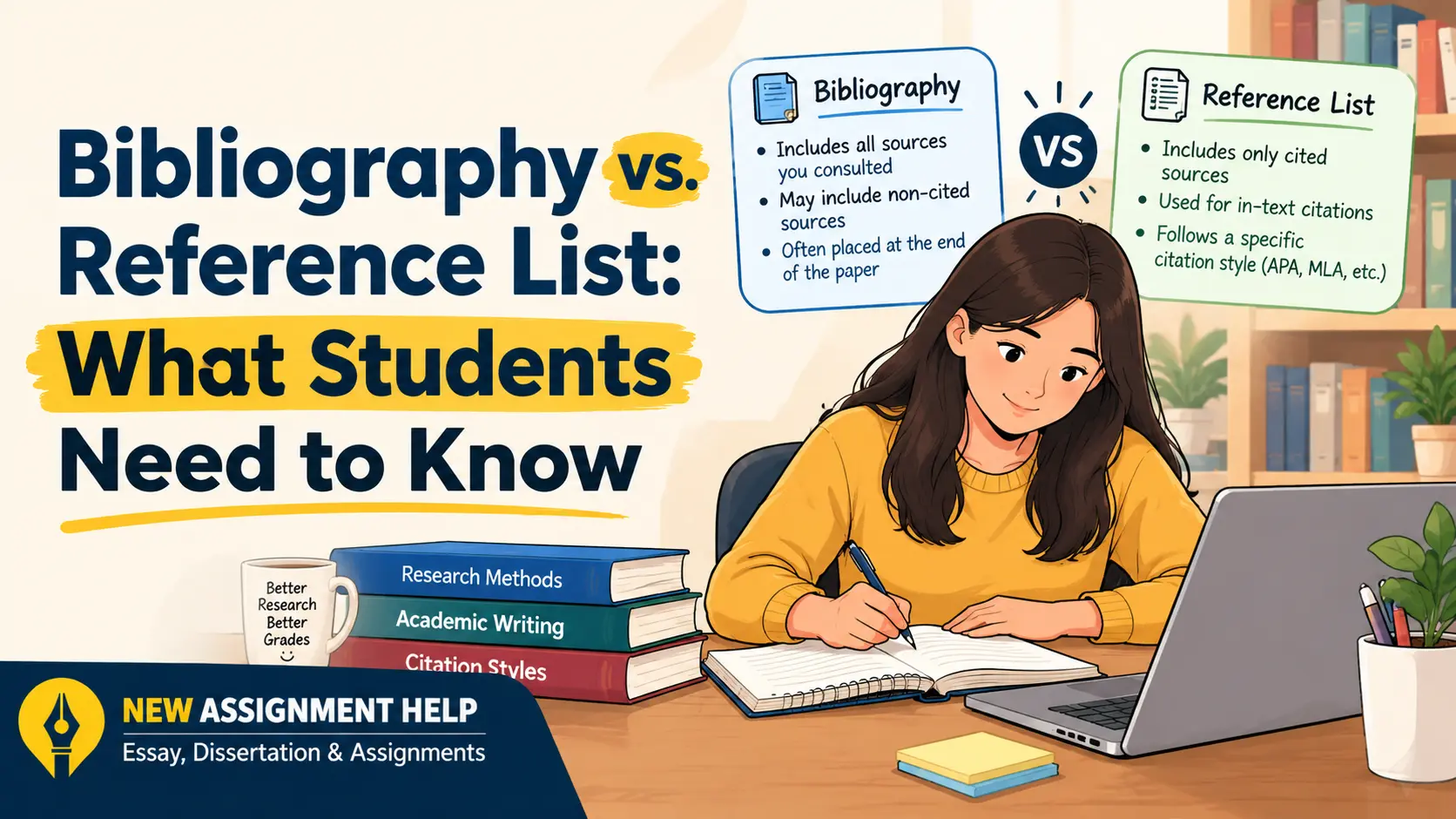
Difference Between Bibliography Vs Reference List
Difference Between Bibliography Vs Reference List
Dissertations, assignments, and other academic documents are indispensable parts of the educational system. Unfortunately, while working on such papers, students often get confused about bibliographies and references. You may already know that both terms play an important role in your academic documents. Messing up bibliography and referencing can have a bad impact on your papers.
However, both have similar functions to some extent, but there are many important things that make bibliography and referencing completely different from each other. Due to their similarities, students often get confused and either use one of them in the document or end up using neither. As a result, students face plagiarism and credibility-related issues at the time of submission.
We understand that failing in your academic papers can be stressful. Thus, in this, we will discuss the bibliography and referencing in detail. Along with that, it will clear up any confusion about both terms. So that you can submit the finest assignment with proper referencing and bibliography sections. Read further and first understand the bibliography and referencing in particular.
What Is a Bibliography? (Definition & Purpose)
The bibliography can simply be defined as a list of sources you have used in your assignment, books, etc. It is an important part of any document, and you should never forget to format it accurately without missing any details. The section of the bibliography is reserved at the end of any book, assignment, and more. You can list all the sources you have used in the document in the bibliography, whether they are cited or consulted by experts.
The bibliography is useful for both you and your readers, as you are providing them with appropriate resources to check the authenticity of the work. If you want to create a proper bibliography for your document, then you may start writing down your sources as soon as you start working on your papers. From this, you will not miss any source you have used in your assignments or any papers.
What Is a Reference List? (Definition & Purpose)
You have read the brief on the bibliography. Now we will continue discussing what the reference list is in detail. Well, the section of the reference list also contains a detailed list of all the sources you have used in your document, but only cited sources. If you are a student, then you should understand that referencing/citation is an important component of academic writing. You just can’t miss it while working on your document.
When you provide proper referencing/citation in your academic document, you are dodging all the changes of plagiarism in your work. By making use of accurate referencing/citation in the document, you are giving full credit to the original writer. Along with that, it also helps in maintaining academic authenticity and virtue. Let us also clarify that the referencing/citation list is also created at the end of your document with proper details: the original writer's name, page number, publication and year.
Comparison Table: Bibliography vs. Reference List
You may have understood that the bibliography and the referencing list are two different things. However, to give you a better understanding of both the bibliography and the referencing list, we are highlighting some major differences between both of them.
| Bibliography | Referencing List |
|---|---|
| The bibliography involves every source writers have cited in the document, including other sources. | The referencing list only includes cited sources used by writers. |
| A bibliography helps writers keep a record of their work. | Referencing helps to give credit to the original author. |
| The bibliography covers books, articles, websites, etc. | The referencing covers only authoritative academic sources such as books and journals. |
| The bibliography is organised in alphabetical order. | The referencing is arranged in APA order or MLA order. |
| The bibliographies are very long. | The references have a minimum number of words. |
Common Elements of a Bibliography and Reference List!
Now you have understood the major difference between the bibliography and reference list. However, there are also some common factors among both of these. Let's understand what they are in the following points:
- Both the bibliography and reference list are used to maintain academic integrity.
- Writers give credit to original authors from both the bibliography and referencing list.
- Readers can easily trace the record from the given citation in both the bibliography and referencing list.
- The bibliography and referencing list both include sources that have been cited in the document.
- The bibliography and referencing list both have a formal format so that readers can read and understand them easily.
Concerned About These Terms? Allow Us to Assist You.
Understanding and using the bibliography and referencing list is easy. However, some of you are still getting confused about how to format them properly. Don’t get yourself worried because we are here to assist you with assignment-related problems. You can reach out to New Assignment Help for better assistance, and our experts will give you the best guidance. They will help you create an accurate bibliography and references for your academic document. We assure you that with our assistance, you will not face any plagiarism-related problems in your document work.
Along with this, you can also get assistance with your academic documents. Our experts have assisted thousands of students with their assignments, dissertations, theses, etc. You will be surprised to know that New Assignment Help UK has a great team consisting of more than 500 writers who have expertise in their subject specialisation. They will help you create the finest and 100% plagiarism-free documents for your academic work. You can also share your subject or assignment concerns with our writers, and they will provide you with the best solutions. We are available 24/7 for your assignment queries; contact us when you are comfortable.
5 Quick Formatting Tips for References and Bibliographies
- 1. Alphabetical order is essential: Always arrange entries by the author's last name, regardless of whether you're creating a bibliography or reference list. If no author exists, use the title's first significant word.
- 2. Maintain consistent indentation: Use a hanging indent where the first line starts at the margin and subsequent lines are indented. This improves readability and follows academic standards.
- 3. Pay attention to punctuation: Different styles use different punctuation patterns. APA uses periods between elements, while Harvard uses commas. Double-check your required style guide.
- 4. Include DOIs for academic sources: Digital Object Identifiers help readers locate online sources quickly. Always include them for journal articles when available, formatted as complete URLs.
- 5. Double-check dates: Publication dates appear in different positions depending on your citation style. In APA, dates come immediately after the author's name; in MLA, they appear near the end.
Consistency is key. Choose one citation style and apply it uniformly throughout your document. Use citation management tools like Zotero or Mendeley to automate formatting and reduce errors.
Bibliography vs Reference List: Which Do UK Universities Prefer?
- UK universities don't have a universal preference, but trends exist across different academic disciplines. Most science and social science departments prefer reference lists using Harvard or APA styles, focusing only on cited sources to maintain precision.
- Humanities departments, including history, literature, and philosophy, often request bibliographies to demonstrate broader research engagement. This allows examiners to assess your background reading and contextual understanding.
- Top UK institutions like Oxford, Cambridge, and Imperial College London typically specify requirements in their departmental style guides. Law students usually follow OSCOLA (Oxford Standard for Citation of Legal Authorities), which uses footnotes rather than bibliographies.
- Business schools commonly require Harvard referencing with a reference list, while medical schools prefer Vancouver style. Creative writing and arts programmes may request annotated bibliographies that include brief source evaluations.
- Before starting your assignment, always check three sources: your assignment brief, your department's style guide, and your module handbook. When requirements remain unclear, email your module coordinator for specific guidance. Different markers may have different expectations, so clarification prevents unnecessary mark deductions.
Check out the detailed reference list/bibliography to understand their unique purposes.
A reference list and a bibliography serve different but related purposes in academic writing. A reference list includes only the sources you have directly cited in your work, while a bibliography can also include additional materials you consulted but did not quote or paraphrase.
A reference list is designed to give precise credit to original authors and allow readers to locate every cited source easily. It usually follows a strict style guide (such as APA, MLA, or Harvard) and must match the in‑text citations used in your document.
A bibliography, on the other hand, presents a broader picture of all the reading and research that informed your assignment. It may contain books, articles, reports, and websites that helped you understand the topic, even if they are not mentioned directly in your text.
By checking both the reference list and the bibliography together, readers can see which sources shaped your thinking and which ones you relied on explicitly in your arguments. This not only strengthens the credibility of your work but also helps maintain academic integrity by being transparent about all the sources behind your ideas.
.jpg)
 5 | Masters
With a passion for helping students excel in their studies, I specialise in crafting clear, concise, and well-structured reference lists and bibliographies. Hi guys, I am Slavoj holds a Masters and I have been working as an academic writer with New Assignment Help for the last 3 years. I have honed my skills in various citation styles, including APA, MLA, Chicago, and Harvard. Whether you're struggling to distinguish between reference lists and bibliographies or need assistance with formatting your citations, I'm here to provide expert guidance and support. You can contact me to get guidance on any of your academic papers.