
How to Apply Porter's Five Forces: Management Guide & Real World Examples
- How to Apply Porter’s Five Forces in a Management Assignment: A Practical Guide
- What Are Porter’s Five Forces and Why Do They Matter?
- How to Apply Porter's Five Forces in a Management Assignment Using Real-World Examples
- 1. Threat of New Entrants
- 2. Bargaining Power of Buyers
- 3. Bargaining Power of Suppliers
- 4. Threat of Substitutes
- 5. Intensity of Competitive Rivalry
How to Apply Porter’s Five Forces in a Management Assignment: A Practical Guide
Nobody tells you how genuinely confusing it feels to stare at a Porter's Five Forces question and not know where to start. You have attended the lectures. You have read the textbook chapters. You even highlighted the important bits. But the moment your assignment asks you to apply it, that confidence disappears faster than you expected. This guide is here to close that gap. Whether you are looking for structured management assignment help or want a clear breakdown of these five forces, you will find everything here.
No recycled theory. No textbook language that puts you to sleep. Just honest, practical guidance written for students who want to do well in their management assignment. So, use this guide as your academic toolkit to achieve excellence in your career.
What Are Porter’s Five Forces and Why Do They Matter?
Think of Porter’s Five Forces as a map. It shows the competitive pressures that shape an industry's growth. Michael Porter, a professor at Harvard Business School, created this framework in 1979. It is still one of the most used strategic tools in business and management decades later.
In management, understanding your competitive environment is just as important as understanding the business itself. Porter's Five Forces helps you do exactly that. It gives your analysis depth, direction, and academic credibility, which separate an average assignment from one that scores well.
If you are also working on research-based tasks, browsing marketing dissertation topics can actually sharpen your thinking about frameworks like this one.
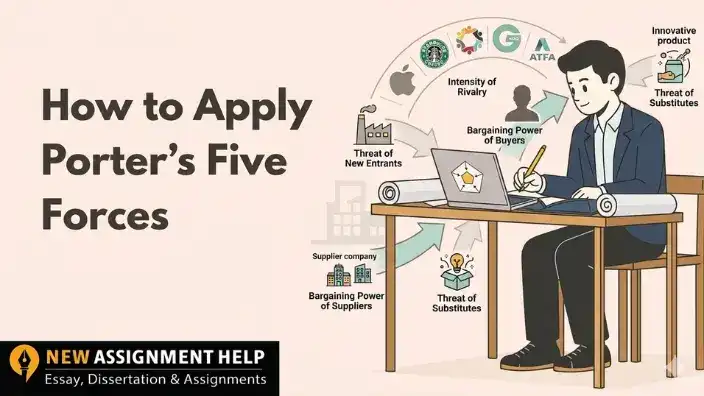
Let's have a quick review of what Porter's Five Forces are:
- Threat of new entrants – How easy is it for new companies to enter the industry?
- Bargaining power of buyers – How much influence do customers have over price and terms?
- Bargaining power of suppliers – How much leverage do suppliers hold?
- Threat of substitutes – How easily can customers meet the same need with a different product or service?
- Intensity of competitive rivalry – How fierce is competition between existing players?
When you look at all five together, you get a genuine, well-rounded picture of the environment any business is operating in. This blog will explain its application to you in the most understandable way.
How to Apply Porter's Five Forces in a Management Assignment Using Real-World Examples
How to Structure Your Analysis
Treat the five forces as interconnected rather than five isolated paragraphs. A clear structure that markers reward looks like this:
- Brief introduction to the chosen industry and why the framework is useful.
- Analysis of each force (definition → key factors → high/medium/low judgement with evidence → implications for the business).
- Discussion of how the forces interact.
- Overall industry attractiveness conclusion linked back to the assignment question.
- Optional short critical evaluation of the framework’s limitations.
Most students understand the five forces when they read about them. The real challenge shows up when they have to apply them to an actual industry in an assignment. Here in this section, we will guide with all five forces along with real company examples. You can also look at a few management assignment sample papers to see how strong analytical writing actually reads in practice.
1. Threat of New Entrants
Before writing about this force, ask yourself one honest question. How hard would it actually be for a completely new business to enter this industry today?
- Key factors to cover: Capital requirements, economies of scale, loyalty of the brand, and government regulations.
- Real-world example: Take the example of the Barclays and HSBC banking sector in the UK. For over a century, they have built up customer trust, branch networks, and digital infrastructure. So when a new bank enters, it faces issues with the FCA authorisation process and convincing people to move their money somewhere unfamiliar.
- In your assignment: Do not simply label the threat as high or low. In this, identify the specific barriers that exist in your chosen industry and explain what they mean practically.
2. Bargaining Power of Buyers
This force is about one thing: how much control customers have over the price they pay and the service they expect.
- Key factors to cover: Number of competing options available, how easily customers can switch, and how much pricing information they have access to.
- Real-world example: In the UK broadband market, providers like BT, Virgin Media, and Sky are all competing for the same households. Switching deals are widely advertised, and many providers even cover exit fees to win new customers. Buyers know their power here, and providers have no choice but to respond to it.
- In your assignment: Go beyond identifying buyer power. Show how the business you are writing about actually adapts its strategy in response to the bargaining capabilities of buyers.
3. Bargaining Power of Suppliers
Shift your perspective here. Instead of thinking about customers, think about the businesses that supply the company you are analysing. And ask how much leverage those suppliers can actually hold.
- Key factors to cover: How many suppliers exist, how replaceable their product or service is, and what it would cost to switch to an alternative.
- Real-world example: Airlines like British Airways and Ryanair source their aircraft from essentially two manufacturers, which are Boeing and Airbus. That duopoly gives both manufacturers considerable power over pricing and contract terms. An airline cannot simply shop around when they require new aircraft.
- In your assignment: Ask whether your chosen company has real supplier alternatives or whether it is operating within a dependency that limits the chances of negotiation.
4. Threat of Substitutes
This is the force most commonly misunderstood in student assignments. Consider how quickly customers can fulfil their needs.
- Key factors to cover: How accessible substitutes are, how their cost compares, and how much effort it takes for a customer to make the switch.
- Real-world example: A gym like PureGym is not only competing with other fitness chains. It is competing with YouTube workout channels, home exercise equipment, and subscription fitness apps like Peloton or Nike Training Club. None of these are direct competitors, but every one of them works in the same area. That is a substitute threat that became very visible during and after the pandemic.
- In your assignment: Deliberately look beyond the obvious. The substitutes that carry the most weight are often the ones hiding just outside the industry's direct boundaries.
5. Intensity of Competitive Rivalry
This tends to be the force students feel most comfortable with. That is why it so often ends up the weakest section. Saying the market is competitive does not actually say anything. What your examiner wants to know is what that competition looks like in practice.
- Key factors to cover: Number and relative size of competitors, how similar their products or services are, market growth rate, and how difficult it is for struggling businesses to exit.
- Real-world example: Costa, Starbucks, Caffè Nero, and Pret A Manger are all chasing the same customers. The products are similar enough that price, location, and atmosphere become the real battlegrounds. Seasonal drinks, app-based rewards, and lunchtime meal deals are not just marketing tactics. But they are direct responses to the competitive pressure faced by every brand.
- In your assignment: Draw a picture of what rivalry actually looks like in practice. The more specific and grounded your description, the more convincing your analysis becomes.
These five forces are not five separate boxes to tick. When buyers hold strong power, rivalry between existing competitors tends to intensify. When entry barriers are genuinely high, some of that pressure eases over time. Spotting and explaining those connections is the kind of thinking that lifts a management assignment from solid to genuinely impressive.
Conclusion
Porter's Five Forces is not just another framework to memorise before an exam. When it is used properly, it is one of the most powerful thinking tools you have in your academic arsenal. Before you submit your next management assignment, run through this quick checklist:
- Have you analysed each force with a real example?
- Have you explained why each force is high or low?
- Have you shown how the forces connect?
- Have you linked your findings back to the assignment question?
If you are still confused about the application of Porter’s Five Forces, New Assignment Help UK is here to help you out in the best way possible. Our management assignment professionals are available to guide you with structured and well-argued analyses prepared to reach academic excellence.

 9 | MSc in Management
Eleanor Whitfield is an academic consultant and management specialist at our Manchester headquarters. With her 9 years of experience, she has been supporting undergraduate and postgraduate students across UK universities. She holds an MSc in Management and has a particular passion for making strategic frameworks genuinely accessible to students who find them challenging. When she is not writing, Eleanor mentors first-year business students through their toughest assignments.