
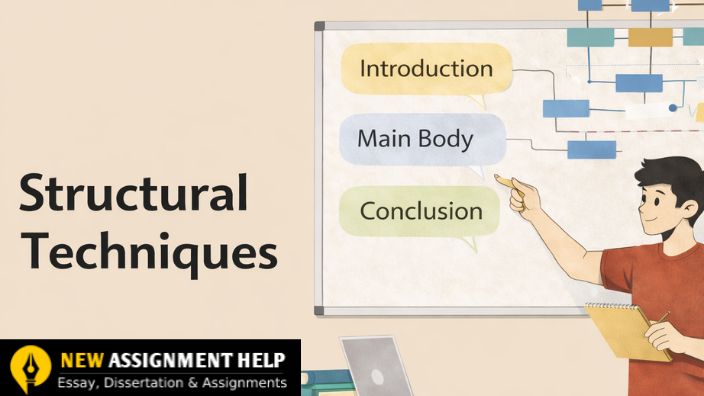
Structural Techniques: PEEL, IRAC & IMRaD in Academic Writing
- Language and Structural Techniques: A Practical Guide for UK Students
- What are language and structural techniques? (Key Purpose and Significance)
- 7 Essential Structural Techniques to Score High Marks
- How to Choose the Right Structure for Your Assignment
- Structural Techniques Across UK Academic Disciplines
- Common Structural Mistakes That Cost Students Marks
- Final Thoughts
Language and Structural Techniques: A Practical Guide for UK Students
Imagine what an assignment without proper structure and clarity will look like. They will appear disorganised and make it difficult to understand the final submissions. Many students lose marks not because of their weak ideas, but because their arguments lack structure or precision in expression. This is where professional academic writing services can make the difference. This is where language and structural techniques become essential, as they are the methods to organise and present your information.
In this blog, you will be guided on how to use appropriate language and structure to improve clarity, coherence, and academic impact. Also, you will learn a practical approach to benefit various academic disciplines in the UK. So, keep reading to adapt these techniques in your future coursework to achieve the best academic results.
What are language and structural techniques? (Key Purpose and Significance)
Language techniques refer to the specific words, phrases, tone, and rhetorical devices used to communicate your ideas. These techniques are the core of academic writing, as they determine the clarity and precision in the presentation of your ideas. On the different side, structural techniques focus on the organisation of ideas and their arrangement within your assignment. Altogether, they guide the logical flow of arguments to ensure progression from introduction to conclusion.
The following points highlight the significance of language and structural techniques:
- These techniques help in a clear understanding for readers. With precise, formal, and analytical writing, you can present your arguments clearly.
- One major focus of the technique remains on the arrangement of ideas in assignments. That’s when well-structured writing follows a logical progression that guides readers from the introduction to the conclusion without confusion.
- Together, they help organise arguments effectively and strengthen academic writing. Similarly, they improve the reader’s engagement to enhance their understanding through a logical flow.
- They are directly related to the assessment criteria in UK universities. Their proper use demonstrates your control over ideas and awareness of the academic conventions required for academic significance in the UK.
Hence, they are not optional additions to academic writing; they are essential components of high-quality work. Now, let's understand different structural techniques to develop your writing skills and gain academic confidence.
7 Essential Structural Techniques to Score High Marks
Strong academic writing is based on the effective structure of the assignments. To prepare such writing, apply the following techniques to improve your academic performance:
- Clear Introduction Structure: Start by outlining the context and main arguments to develop a roadmap of the assignment. This will prepare the reader for the direction of your discussion from the start.
- PEEL Paragraph Method: The PEEL structure (Point, Evidence, Explanation, Link) ensures an analytical approach in your work. Hence, using it will support your claim with relevant evidence and reasoning.
- Logical Sequencing: Your ideas should be aligned in a progressive order. Therefore, use logical sequencing to develop efficient arguments to avoid repetition and confusion.
- Compare and Contrast Structure: This technique is used to analyse the similarities and differences between theories, models, or case studies. As a result, it allows a balanced discussion useful for critical interpretation.
- Problem–Solution Framework: In this type of framework, identify issues and causes in your assignments. So, this improves analytical depth and applied understanding to reach practical solutions.
- Counterargument Integration: A high-scoring essay includes opposing views to justify its arguments. Therefore, presenting the counterarguments strengthens credibility and shows critical engagement with the topic.
- Strong Conclusion Structure: For an effective conclusion, use key arguments to summarise the purpose behind your work. Avoid new ideas in the closing statement to leave a confident final impression on the readers.
These techniques are not rigid formulas; you can use them to demonstrate academic maturity in your assignments. However, students must understand the logical development of arguments to achieve higher grades in UK university assessments.
How to Choose the Right Structure for Your Assignment
Appropriate structure reflects the question, subject requirements, and assessment criteria. Instead of guessing, you must follow these steps to present an effective structure of the assignment:
- Analyse the Command Word: Identify whether the prompt asks you to evaluate, critically discuss, compare, or analyse.
- Understand the Assignment Type: Determine whether your assignment is an essay, report, case study, or research paper. Then prepare your format with the structural expectations of UK universities.
- Review the Marking Criteria: Examine the allocation of marks before writing. Focus on the areas that carry greater weight to achieve higher grades with an effective structure.
- Identify Your Main Argument: Before drafting, decide your central position. Therefore, to ensure academic growth, your structure should support and develop this argument logically throughout the assignment
- Plan Before Writing: When you know what to do next, you prevent repetitions. That’s why your work must start with an outline of headings and logical progression for clarity.
Therefore, selecting the right structure is a strategic decision to strengthen your work. Now, let’s explore how structural techniques differ across various academic fields in the next section.
Structural Techniques Across UK Academic Disciplines
Structural techniques vary across academic disciplines in UK universities. Therefore, in this section, you will explore different correct frameworks for every subject in the following way:
- Law: Law assignments commonly follow the Issue, Rule, Application, Conclusion (IRAC) structure. In this, you have to identify the legal issue, explain the relevant rule, and apply it to the current scenario for a logical conclusion.
- Nursing and Healthcare: In this practical subject, you should use reflective frameworks such as Gibbs’ Reflective Cycle in your work. These models guide you through different stages of description, analysis, evaluation, and action planning in assignments.
- Business and Management: Business reports usually follow a structured approach that defines a problem and presents clear recommendations. Therefore, use headings, data integration, and logical sequencing to show practical decision-making skills.
- Engineering and Sciences: These subjects include the IMRaD format, that is, Introduction, Method, Results, and Discussion in assignments. This technique helps to present a systematic structure to guide analysis in a clear and organised manner.
- Humanities and Social Sciences: Subjects such as history and sociology often use thematic organisation. Hence, arguments are developed around key themes to support critical discussion and balanced evaluation.
- English Literature and Language: In English studies, essays often follow an analytical layering structure. So, rather than describing, use English language techniques to link interpretations with the main thesis.
While all disciplines require a different academic structure, you must reflect the appropriate academic priorities and structural techniques to achieve excellence. For this, you should recognise these differences and common mistakes to produce well-developed assignments for UK universities.
Common Structural Mistakes That Cost Students Marks
Even well-researched assignments can lose marks due to a weak structure. In this particular section, we will help you recognise your common issues to improve academic performance:
- Weak Introduction: Without a proper outline, the structure appears unfocused and disconnected. So you must start with an effective introduction to build engagement with the readers from the beginning.
- Poor Paragraph Development: A paragraph must contain a focus area to strengthen its structure. For this, each paragraph should develop one central point supported by evidence and explanation.
- Lack of Logical Flow: A logical flow of arguments is necessary to build a connection between paragraphs. Therefore, ideas must be arranged with proper transitions to avoid gaps in your work.
- Ignoring Counterarguments: A high-scoring university essay requires critical engagement. However, a one-sided approach in the assignment reduces the credibility of existing perspectives.
- Repetition Without Progression: Repetitive words and phrases make your assignment look bulky. So each paragraph should add new insight or analysis, showing progression rather than duplication.
- Introducing New Ideas in the Conclusion: A conclusion should summarise and support the main argument. However, adding new evidence or arguments at this stage disrupts the structural balance of the assignment.
If you make structural mistakes, common or minor, you should be aware of their impact on grades, which is huge. By identifying and correcting these common errors, you can present ideas more confidently and improve the overall quality of your assignments.
Final Thoughts
Learning effective language and structural techniques benefits you in developing clarity, control, and confidence in your academic writing. They also help you to organise your ideas and express them with precision to ensure credibility in your work. However, having this knowledge is not enough; you must know its proper application in your work.
That could be truly complex, but still, you have an option. Choose the academic support of New Assignment Help UK, where professionals will guide you with the right techniques for your subject. This is how you can avoid errors by availing of their tailored support today.

 8 | Masters
Oliver Spencer is an academic writing consultant specialising in essay composition and structural techniques holds Masters. With over 8 years of experience, he has helped students and professionals improve clarity, organisation, and argument flow in their written work. His expertise includes paragraph structuring, thesis development, logical sequencing, critical analysis, and proofreading. He has contributed to platforms like New Assignment Help UK and other educational blogs, and is known for translating complex writing strategies into actionable guidance for learners. Oliver focuses on creating content that is practical and evidence-based, helping readers enhance their writing efficiency and achieve academically polished work.