
How to Solve Accounting Problems Step by Step
- Accounting Problems Made Simple: A 9-Step Method That Works
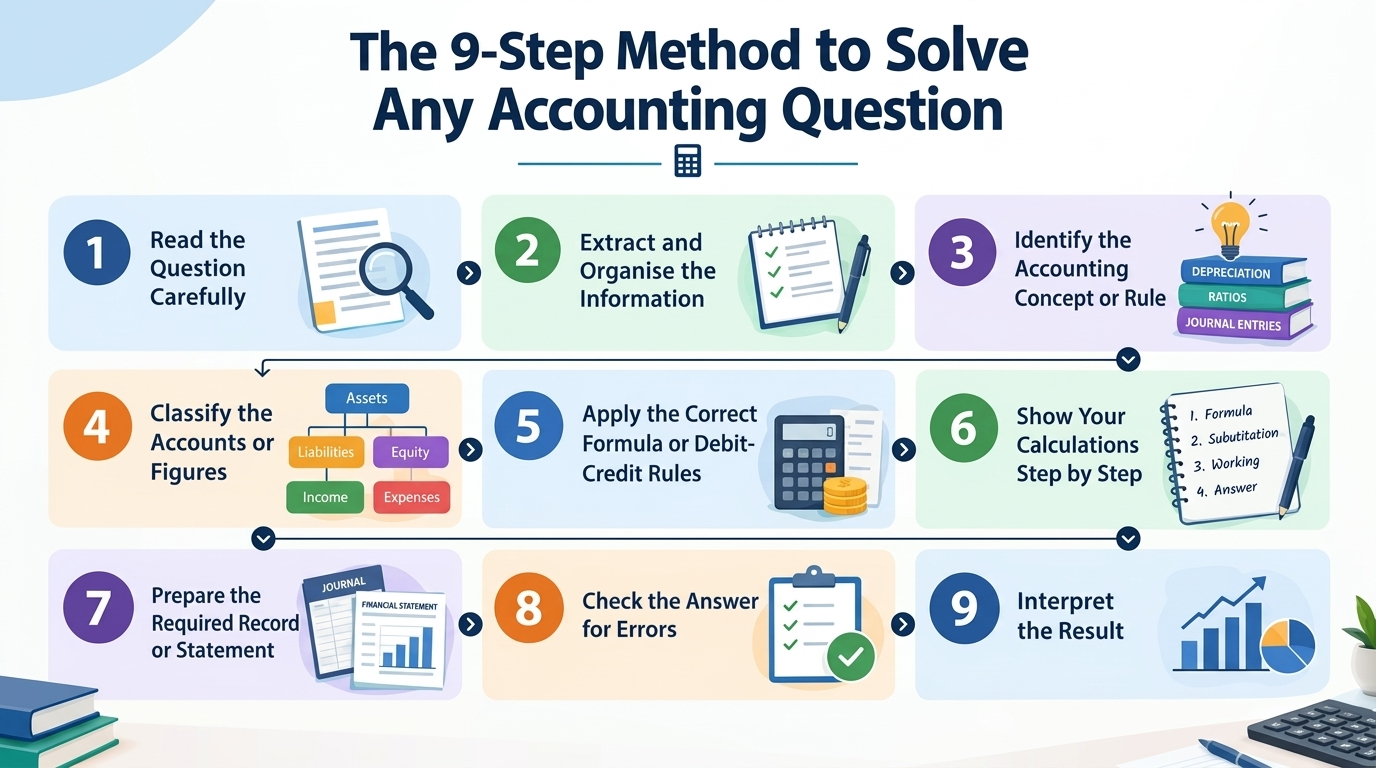
- The 9-Step Method to Solve Any Accounting Question
- 1. Read the Question Carefully
- 2. Extract and Organise the Given Information
- 3. Identify the Accounting Concept or Rule
- 4. Classify the Accounts or Figures
- 5. Apply the Correct Formula or Debit-and-Credit Rules
- 6. Show Your Calculations Step by Step
- 7. Prepare the Required Accounting Record or Statement
- 8. Check the Answer for Errors
- 9. Interpret the Result
- Worked Example: Solving an Accounting Problem
- Ending Note
Accounting Problems Made Simple: A 9-Step Method That Works
Accounting questions can feel heavy. You get numbers, dates, rules and extra notes all at once. Many students jump straight into sums and end up in the wrong account. Here is the good news. Once you know how to solve accounting problems with a set routine, you feel much calmer. Use this one: Read, Organise, Identify, Classify, Calculate, Record, Check, Interpret for better understanding. Now let's walk through each step by step.
The 9-Step Method to Solve Any Accounting Question
Whether your question is about journal entries, depreciation, ratios, financial statements or adjustments, the same steps work for every task. Take them one at a time.
1. Read the Question Carefully
Start by finding out what the question wants. Look for words like calculate, prepare, determine, record or analyse. Each one asks for something different. Note the accounting period, such as the year ended 31 March. Check the final answer needed, and read every adjustment. Do not calculate until you know what you must produce. Once the goal is clear, you can sort out the facts.
2. Extract and Organise the Given Information
Pull the useful facts out of the wording and write them down. List account names, amounts, dates, adjustments, rates and the required output. A small table or simple working notes keep everything in one place. This stops you from missing a figure halfway through. With your facts listed, name the type of problem next.
3. Identify the Accounting Concept or Rule
Ask yourself what kind of problem this is. A journal entry needs debit and credit rules. Depreciation needs the right method. Ratios need the right formula. Accruals and prepayments need adjustment treatment. Inventory needs a valuation approach, and costing needs the correct cost calculation. Naming the problem first stops you from using the wrong method. Then sort your figures into groups.
4. Classify the Accounts or Figures
Every figure belongs to one of five groups: assets, liabilities, equity, income or expenses. Assets and expenses usually increase with a debit. Liabilities, equity and income usually increase with a credit. The accounting equation is a handy guide: Assets = Liabilities + Equity. You only need it to keep your thinking straight. Now you are ready for the real work.
5. Apply the Correct Formula or Debit-and-Credit Rules
Use a simple pattern: identify, decide if it goes up or down, apply the rule, then calculate or record. For number questions, write the formula, put in the figures, work out the answer and keep every step visible. For journal entries, find the accounts affected. Decide if each one increases or decreases. Choose debit or credit. Then record it. Next, make sure your working can be seen.
6. Show Your Calculations Step by Step
Always show your working, not just the final figure. Write the formula, substitute the numbers, show the middle steps and then give the answer. Add £ signs, units and the right rounding. Clear working is easier to check, and it proves you know the method. Even if you slip on one number, you can still earn marks.
7. Prepare the Required Accounting Record or Statement
Sometimes the sum is not the end. You may need a journal entry, ledger account, trial balance, income statement, statement of financial position, bank reconciliation or cash-flow statement. Each has its own layout. Follow the correct format instead of placing figures at random. A neat format shows you understand how accounts work. After that, it is time to check.
8. Check the Answer for Errors
Check before you stop. Ask yourself these questions:
- Do total debits equal total credits?
- Does the accounting equation balance?
- Are all transactions included?
- Is each figure in the right account?
- Were all adjustments applied?
- Is the maths correct?
A trial balance can catch some double-entry errors. But a balanced trial balance does not prove every error is gone. When it all checks out, explain what it means.
9. Interpret the Result
Do not stop at the number. Say what it tells you. What does the profit show? What does the ratio say about performance? How does the adjustment change the statements? What does the variance reveal? Linking your answer to the business makes it stronger and more university-level. Now let's see all of this in one short example.
Worked Example: Solving an Accounting Problem
Question: A business buys equipment for £10,000 and records £2,000 depreciation in the year. Find the carrying amount and show the entries.
- Step 1: Identify the accounts: Equipment and Cash.
- Step 2: Record the purchase: Dr Equipment £10,000, Cr Cash £10,000.
- Step 3: Calculate: £10,000 − £2,000 = £8,000 carrying amount.
- Step 4: Record depreciation: Dr Depreciation Expense £2,000, Cr Accumulated Depreciation £2,000.
- Step 5: Interpret: At year-end, the equipment's carrying amount is £8,000.
A small example can give you a big lesson. Therefore, practise every step regularly, and you are all to submit work which can score good grades.
Ending Note
A good accounting assignment requires precision in every step. So practise different types of questions, and learn the logic behind debit and credit instead of memorising it blindly. Ensure your formula sheet is clear and has regular working notes to present as per the expectations of your tutor. If anything feels tricky, then accounting assignment support is always available.

 8 | BSc in Accounting
Lily Brown is an accounting tutor based in London, with more than eight years of experience helping university students with their coursework. She holds a BSc (Hons) in Accounting and Finance and is also an ACCA member. Lily has guided students through financial reporting, management accounting, auditing and taxation assignments, and also knows exactly where learners tend to get stuck. Her guides use plain language, UK standards such as IFRS and FRS 102, and real examples that make each step easier to follow. Outside of tutoring, she enjoys following changes in financial regulation and analysing them carefully.