
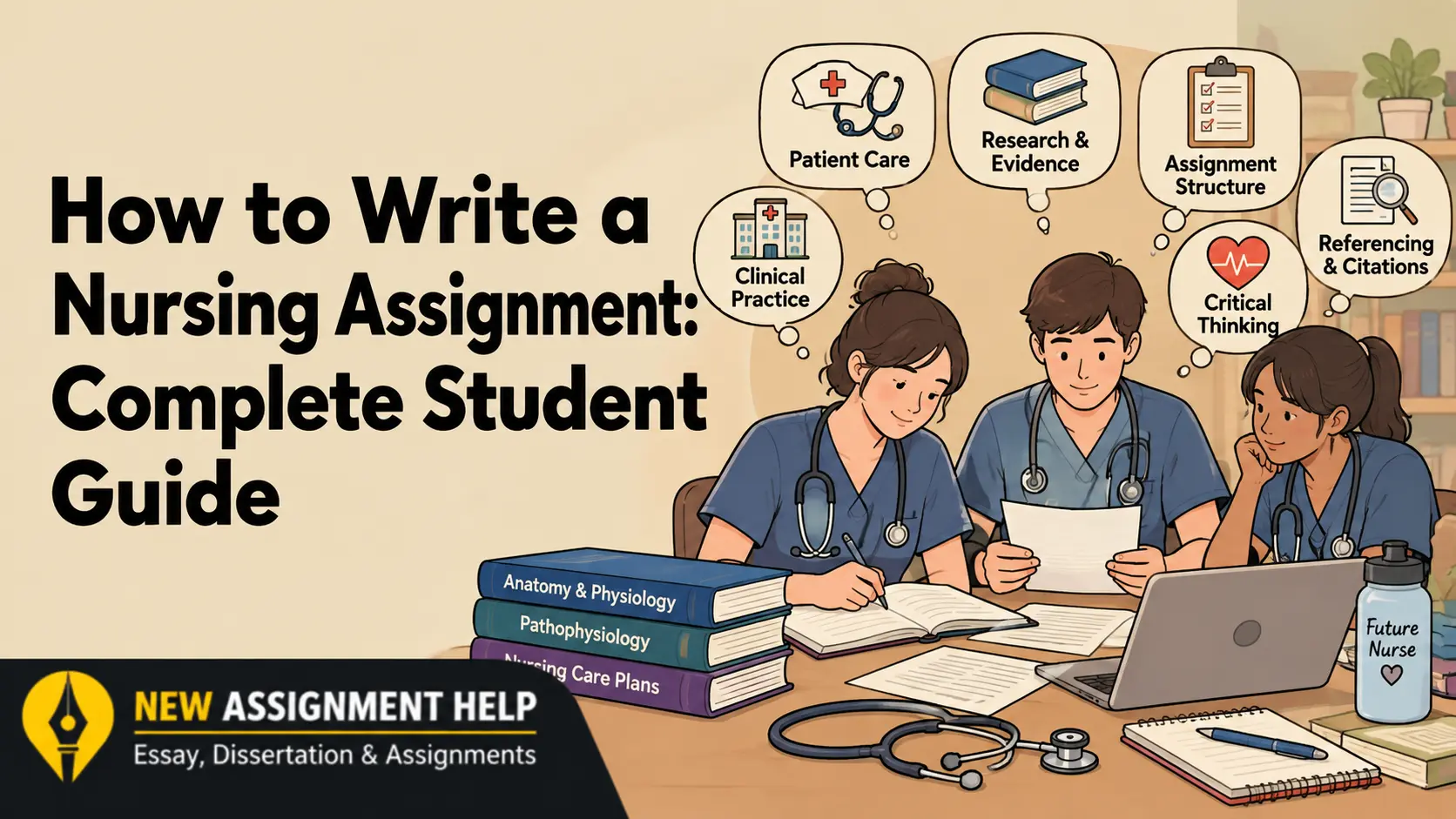
How to Write a Nursing Assignment: Complete Student Guide
How to Write a Nursing Assignment: Complete Student Guide
Writing a strong nursing assignment requires a clear understanding of the clinical evidence, structured academic writing and compliance with professional standards. However, you must follow these five things: understanding the brief, choosing a focused topic, using current evidence-based sources, organising your ideas before you write, and following your university's referencing style closely. Get these right, and the rest of the process becomes far less stressful.
So let’s understand each step in a detailed manner to build your clinical writing skills as per the expectations of your university. This will help your work separate from your placement work, and you will feel much more confident.
Start With the Assignment Brief
Before you write a single word or begin any research and analysis, read the brief twice. Look closely at the instruction words your tutor has used, such as discuss, evaluate, critically analyse, or apply. Each word tells you exactly what kind of thinking is expected, and markers will notice quickly when a student has answered the wrong type of question.
While you're reading, check the practical details as well, including word count, referencing style, and how many sources you need. Most UK nursing programmes also publish a marking rubric alongside the brief, so notice that too. Match your effort to where the marks actually sit, rather than spreading your time evenly across every section.
Once the brief is clear, the next step is picking what you'll actually write about.
Choose a Focused Topic for Your Assignment
If your tutor has given you the topic, move straight to research. If you have a choice, pick something specific rather than broad. For example, "pain management in post-operative care" is easier to write well than "pain management", because a narrow topic pushes you towards analysis instead of description.
It also helps to link your topic to a real clinical situation, something you've seen on placement or in a case study. This makes the writing more natural and shows your tutor you can connect theory to practice, which is a core expectation across NMC-aligned programmes.
With a topic settled, it's time to build the evidence behind every point you are going to make in your work.
Research Using Evidence-Based Sources
Nursing assignments are judged on the basis of the quality of your evidence, not just the quantity. Therefore, always use peer-reviewed journal articles, NICE guidelines, and NHS or Royal College sources wherever possible, and aim for research published within the last five years unless you're discussing a foundational study.
This is also where reflective models earn their place. If your assignment involves a placement experience, Gibbs' Reflective Cycle is widely used across UK nursing courses to move your writing beyond simply describing what happened. It pushes you to analyse your feelings, evaluate the outcome, and identify what you'd do differently next time, which is exactly the kind of critical thinking markers are looking for.
Once you've gathered strong sources, don't start drafting immediately; organise all the evidence and build a clear outline in the very beginning.
Build a Simple Outline First
List all your main points under your thesis statement before you start writing anything in full. Group them into your introduction, two or three core body themes, and your conclusion to make your draft clear and precise. This step feels slow, but it will save far more time later, because you won't need to restructure half-finished work when this step is followed properly.
Now that your outline is ready, you're set up to draft with confidence.
Draft Your Assignment With a Clear Structure
Your introduction should state your purpose and thesis in a few sentences, without lengthy background. In the body, give each paragraph one main idea, and always link theory back to patient care or practice, since this is where UK nursing tutors usually look for real depth in your work. For the conclusion, you should summarise your key points and briefly note why the topic matters for nursing practice. Do not write new or any additional information, as it will decrease the credibility of your assignment.
Keep your language plain and professional. Avoid slang, and also avoid stuffing in complicated words just to sound academic. Clear writing always scores better than dense writing almost every time.
Once the draft is complete, the final stage is polishing it properly.
Format and Proofread Carefully
Most UK nursing courses use Harvard referencing, though some ask for APA, so it is better to check your module handbook rather than assuming. Format your reference list consistently, and double-check in-text citations match your reference list exactly.
Before the final submission, you must read your assignment against the marking criteria. This will ensure the accuracy of your work, and you will be able to catch clunky sentences or missing words. A short break between finishing your draft and proofreading it also helps you spot mistakes you have otherwise missed.
Final Thoughts
A well-structured nursing assignment isn't about writing more. It's about writing with purpose at every stage, from the brief to the final proofread. Make sure you follow every step precisely while writing your nursing assignment because clear work always differentiates strong from average work. You can also look at your nursing assignment guidance for better understanding.

 8 Years | BSc (Hons) Adult Nursing
Claire Anderson holds a BSc (Hons) in Adult Nursing from King's College London and has been supporting UK nursing students for eight years. Her degree from one of the most respected nursing programmes in the country gave her a solid clinical foundation that she brings to every assignment she works on. Over her academic career, she helped students with Care Planning, Evidence-Based Practice, NMC Code of Conduct, Adult Nursing Interventions, and Reflective Practice. She is particularly good at helping students write reflective pieces that feel genuine and analytical rather than just descriptive. At New Assignment Help, Claire writes nursing assignments that are clinically accurate, clearly argued, and built around what the marking criteria actually asks for.