
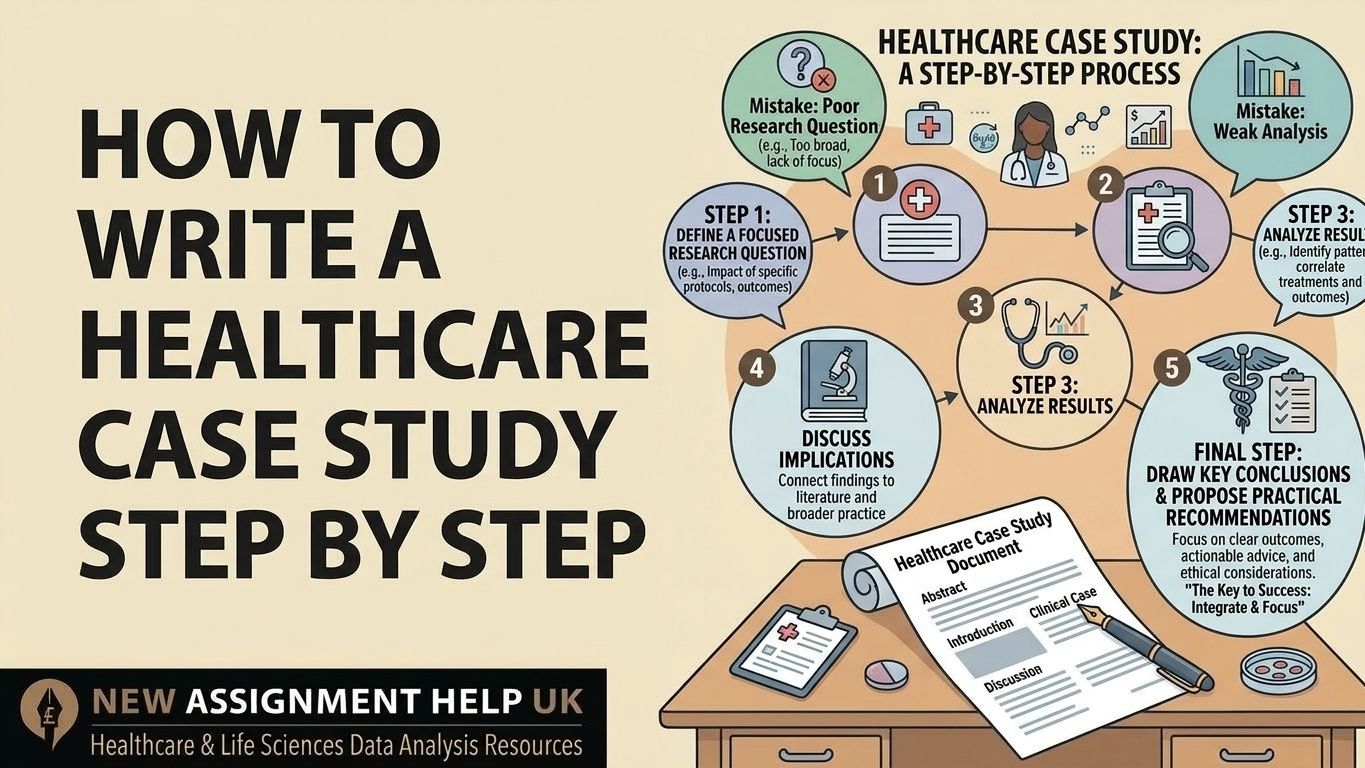
How to Write a Healthcare Case Study Step by Step
- How to Write a Healthcare Case Study: 7 Simple Steps for Students
- What Do Examiners Look For in a Healthcare Case Study?
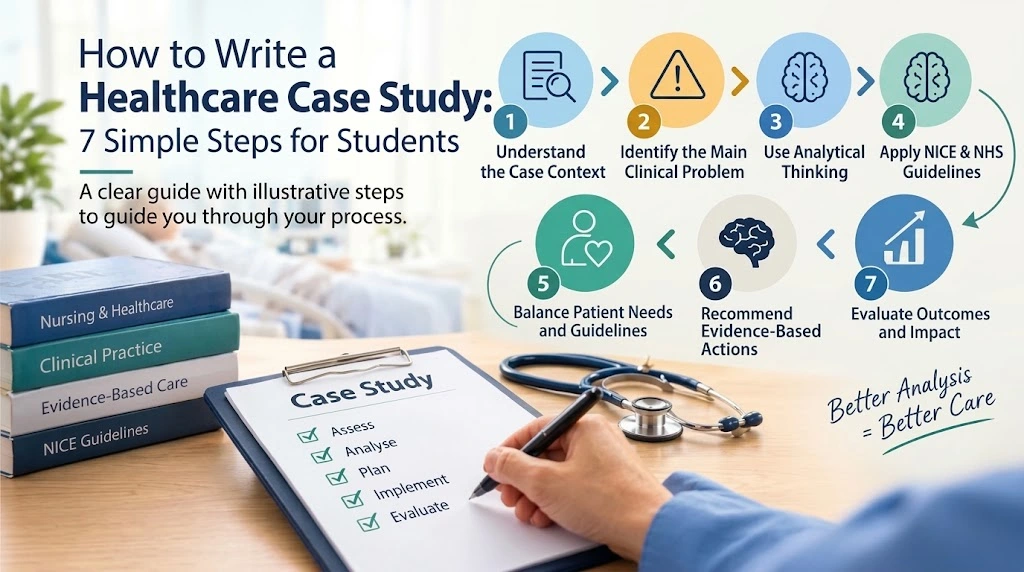
- Seven Steps to Write a Healthcare Case Study
- Step 1: Understand the Case Context
- Step 2: Identify the Main Clinical Problem
- Step 3: Break Down the Case With Analytical Thinking
- Step 4: Use Evidence From NICE and NHS Guidelines
- Step 5: Balance Patient Needs and Guidelines
- Step 6: Recommend Evidence-Based Actions
- Step 7: Evaluate Outcomes and Impact
- How to Turn Description Into Critical Analysis
- Conclusion
How to Write a Healthcare Case Study: 7 Simple Steps for Students
A healthcare case study is a close look at one real patient or a made-up patient scenario. You find the problem, explain your thinking, choose the best care, and check the result. That is what a healthcare case study means in simple words.
If you are stuck on a patient case study assignment, then this guide is for you only. You will get to know what examiners want, along with the seven steps to write healthcare case study analysis with short examples. We will help you with problem identification, clinical reasoning, evidence-based decisions, and patient outcomes, necessary for these assignments. Let's start with what your tutor really looks for.
What Do Examiners Look For in a Healthcare Case Study?
Examiners look for clear thinking, not long stories. Many students lose marks because they describe instead of analysing it and often skip NICE and NHS sources. Here is what they expect instead: clinical reasoning over description, evidence to back every choice, a clear decision-making process, and a focus on the patient's results.
Your markers are less interested in what happened and more focused on why decisions were made. Keep this in mind as we move into the steps for better clarity.
Seven Steps to Write a Healthcare Case Study
Look at the steps given below and start writing your healthcare case study with confidence.
Step 1: Understand the Case Context
Always read criteria for analysis before starting anything. Note the patient's condition, the healthcare setting (hospital, GP clinic, or community care), and the purpose of your case study. Ask yourself, "What is this task really asking me to do?" A clear picture of the situation makes every later step easier.
Step 2: Identify the Main Clinical Problem
It basically refers to finding the core issue that needs care first. So, divide the problems into two groups. The primary problem is the biggest threat to the patient. Whereas secondary problems are important but can wait. Then check how severe and urgent each one is. Write down what needs attention right now.
Step 3: Break Down the Case With Analytical Thinking
You do not need to memorise a framework like ADPIE. Try this simple flow instead: Problem, Cause, Impact, Solution. You can also use the biopsychosocial model, which looks at the body, the mind, and the patient's social life. For this, ask yourself these questions as you write:
- What is the main clinical issue?
- Why is this action right for this patient?
- What evidence supports it?
- What are the risks or other options?
Good answers to these questions show that you have pursued real reasoning.
Step 4: Use Evidence From NICE and NHS Guidelines
Evidence-based healthcare writing is not about adding a reference at the end of a sentence. It is about linking a guideline to an action. Say what the guideline states, then say what you would do because of it and why it fits your patient.
For example, a NICE guidelines case study might say, "NICE advises early referral for active diabetic foot problems, so I would refer the patient to the foot care team without any delay." In this you will see how the guideline leads to a clear action without any jargon.
Step 5: Balance Patient Needs and Guidelines
Guidelines are strong tools, but for two patients, they cannot be the same. It is based on age, health history, culture, and personal choices. If a patient cannot follow the standard plan, explain why and suggest a safe change in that routine. This will show personalised care, and it makes your work stand out.
Step 6: Recommend Evidence-Based Actions
Now tell the reader what should happen next. Use action words such as "consider", "offer", and "initiate". Keep each healthcare recommendation short and specific. Add who will do it and why it helps. Good healthcare recommendations writing is clear enough that another nurse could follow it.
Step 7: Evaluate Outcomes and Impact
Finally, look at the results. What got better? What did not work? What could be done differently next time? Talk about the patient's health, comfort, and safety. Honest reflection shows maturity, and examiners love it. Now let's see how this looks in real writing.
How to Turn Description Into Critical Analysis
Descriptive writing tells. Analytical writing explains. Look at the example given below to understand this in detail.
Descriptive: "The patient had high blood sugar and was given insulin."
Analytical: "The patient's high blood sugar raised the risk of infection, so insulin was started. This followed NICE advice and helped protect the wound from slow healing."
The second version gives a cause, an action, evidence, and an impact. Use this before-and-after test on every paragraph you write to make your work more credible.
Conclusion
Writing a strong healthcare case study comes down to three habits. Analyse instead of describe. Back your choices with evidence you can explain. Keep the patient and their outcome at the centre. Follow the seven steps, use the before-and-after test, and practise with small cases first to build your confidence with every assignment you work on. You can also seek healthcare assignment guidance if you are looking for a better understanding of case study analysis.

 9 | MA in Health and Social Care Management
Thomas Kershaw is a healthcare expert and holds an MA in Health and Social Care Management. He has spent over nine years supporting university students with nursing, health and social care, and healthcare management coursework. Thomas specialises in case studies, evidence-based practice and critical analysis, with a strong focus on NICE and NHS guidance. He has helped hundreds of UK students turn descriptive drafts into clear, well-evidenced work that meets marking criteria. At New Assignment Help UK, Thomas writes practical guides that explain what UK markers in simple words, so students can write their own with confidence