
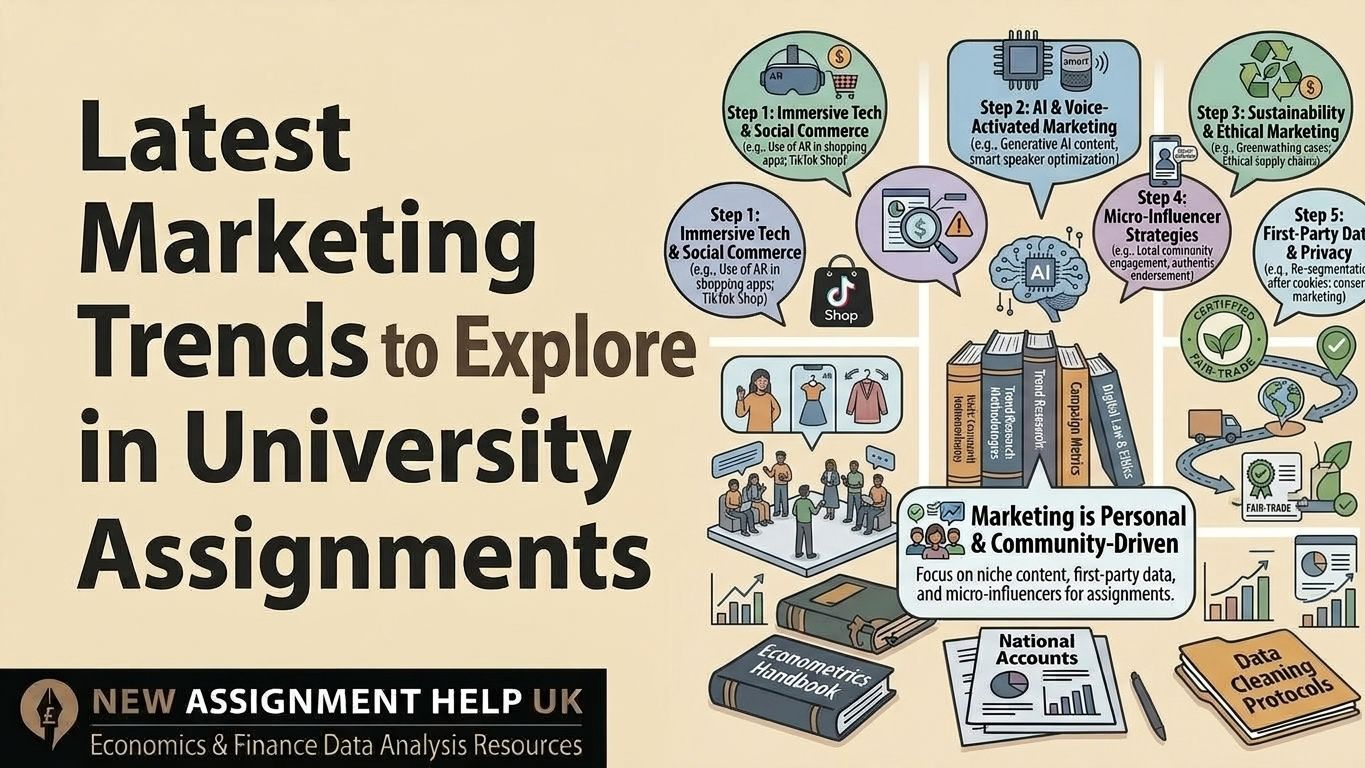
Latest Marketing Trends to Explore in University Assignments
- Best Marketing Trends for UK University Assignments
- What Is a Marketing Trend in an Assignment?
- Current Marketing Trends Worth Writing About in Your Assignment
- Omnichannel Marketing and Content Repurposing: One Brand, Many Places
- Social Commerce and Influencer Marketing: Selling Inside the Apps
- Ethical and Sustainable Marketing: Trust Comes First
- AI Personalisation: Marketing That Knows the Customer
- How to Use Marketing Trends in Your Assignment
- Common Mistakes Students Make With Marketing Trends
- Final Thoughts
Best Marketing Trends for UK University Assignments
Marketing trends refer to shifts in consumer behaviour, technology, and strategies of industry that define how brands connect with their audience. If you are searching for marketing trends for university assignments, you have likely seen the problem already. Many students name a trend, write one line about it, and move on. Markers see this all the time, and it rarely earns good marks. This blog shows you which trends are worth your time and how to turn them into real academic points. So, let's begin with understanding this in detail.
What Is a Marketing Trend in an Assignment?
A marketing trend is a change in the industry that affects how businesses reach out to their customers and how long they will keep them. When it comes to your assignment, a trend backs up your argument, shows you know what is happening in the real world, and gives your case study more depth. Think of it as proof for your points, and you will clearly understand what it means in your assignments.
Current Marketing Trends Worth Writing About in Your Assignment
Below are four key areas. Choose one or two, and support each with a theory, an example, and your own analysis. This approach will help you earn more marks than simply listing many trends.
Omnichannel Marketing and Content Repurposing: One Brand, Many Places
Many students ask, "Is omnichannel just being on lots of apps and sites?" Not exactly. Using many platforms is called multichannel. Omnichannel means all those platforms work together as one smooth experience. Say you add shoes to your cart on the app. You can pay for them later in the store, and nothing is lost. Content repurposing is a helpful partner here. It means taking one idea, like a blog post, and turning it into a short video, a social post, and an email. You can use both ideas in your Integrated Marketing Communication (IMC) and brand strategy answers. Nike is a great brand to study for this.
Social Commerce and Influencer Marketing: Selling Inside the Apps
Social commerce means people can buy without leaving the app they are scrolling. Think Instagram Shops or TikTok Shop. Here is where it fits in your work:
- Customer journey: show how "I saw it" turns into "I bought it" in just a few taps.
- Digital marketing strategy: explain why brands pay creators, since followers often trust them more than ads.
- Reach and trust: compare a huge celebrity with a small creator and ask who really moves sales.
Pick one platform and stay with it. Your analysis will feel much sharper.
Ethical and Sustainable Marketing: Trust Comes First
Shoppers today like brands that are honest and also care about the planet. This trend works well under corporate social responsibility (CSR) and brand positioning. But show both sides, because that is what is required to earn top marks.
What works
- Clear claims that are backed by facts
- Brands that actually live their values
What backfires
- Greenwashing, where a brand only pretends to be eco-friendly
- Big promises with no proof
Trust takes years to build and one bad headline to lose. Say that in your own words, without being complicated
AI Personalisation: Marketing That Knows the Customer
AI personalisation is when a brand uses data to guess what you want and then shows it to you. Open Netflix and you will see it right away. Your homepage looks different from your friend's. Most big brands now use this idea to sell more and keep people coming back. In an essay, it fits well with consumer behaviour and data-driven decisions. Here is an additional tip for you: don't just praise it. Ask whether customers feel helped or watched. That one question shows your real thinking, and markers always praise it.
How to Use Marketing Trends in Your Assignment
Here is a simple path to follow every time you write.
- Choose a trend that suits your topic. Writing about a fashion brand? Social commerce is a smart pick.
- Link it to theory. Use STP, the 4Ps, or a consumer behaviour model to give your point an academic base.
- Add a recent example. Choose a real brand and a campaign from the last year or two.
- Analyse its impact. What worked, what did not, and why?
Remember this one thing. Describing a trend gets you a pass. But judging it gets you the higher grade.
Common Mistakes Students Make With Marketing Trends
Most lost marks come from four habits. Some students list trends with no explanation, so the page reads like a shopping list. Others skip theory, which makes the work sound like a casual blog post instead of an assignment. A few use old examples, like a campaign from 2015, which is easily noticed by your markers. And many forget critical thinking, so they never mention risks or limits. Fix these four, and you are already ahead of most of your class.
Final Thoughts
A trend alone won't lift your grade. Theory alone can feel dry. Thus, put both of them together, and your work feels current and academic at the same time. Need a little extra help? Marketing assignment support can guide you through everything and make writing feel smoother.
.jpg)
 9 | MBA in Marketing Management
Oliver White is a Manchester-based marketing academic and assignment specialist with an MBA in Marketing Management and more than nine years of hands-on experience. He works with university students at undergraduate, postgraduate and MBA level across the UK, helping them produce clear, practical coursework that meets what markers actually look for. His core strengths sit in marketing plans, case-study analysis, consumer behaviour, digital marketing and brand strategy. Oliver’s approach is straightforward: take the theory, ground it in real business thinking, and turn it into well-structured, persuasive work. The result is writing that feels confident and helps students achieve better grades.