
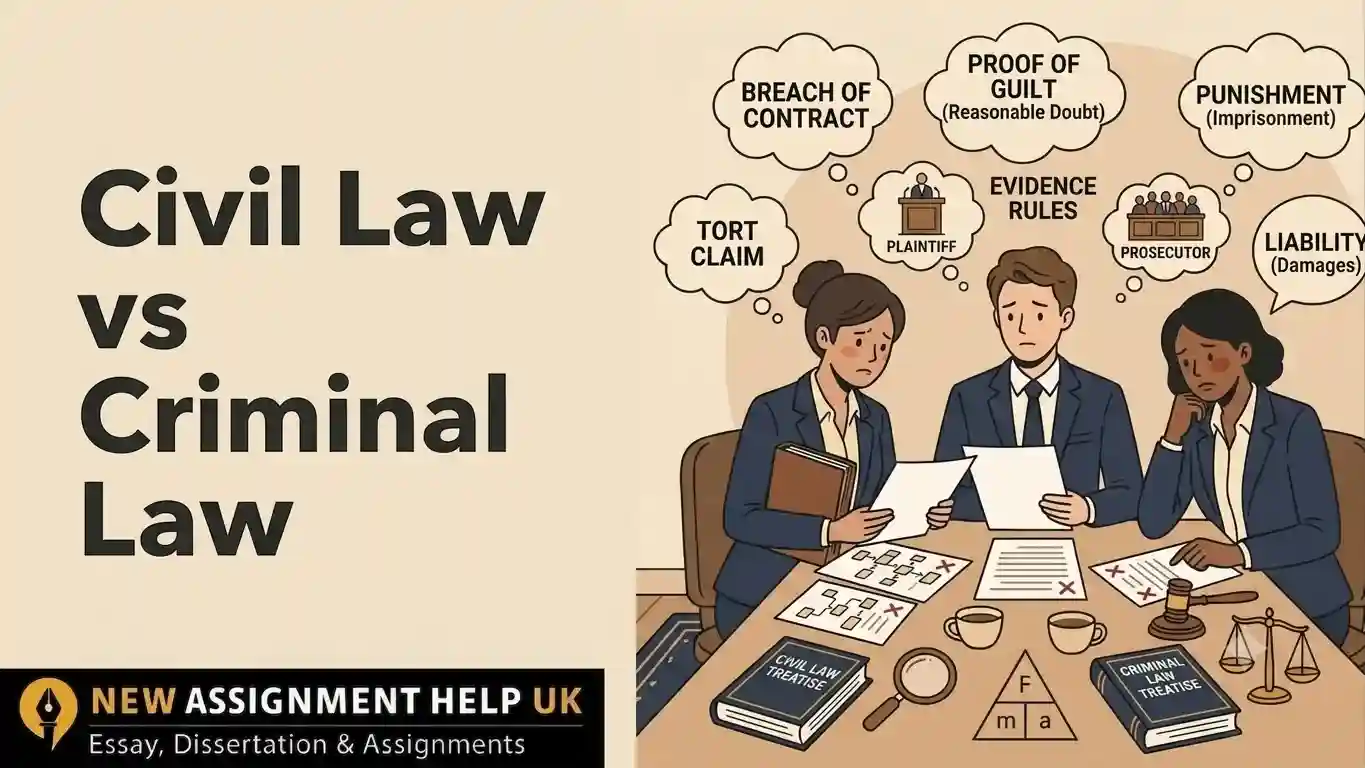
Civil Law vs Criminal Law
The two main areas of the legal system are criminal law and civil law. Criminal law deals with crimes against the state, whereas civil law addresses conflicts between people or groups. This resource provides straightforward explanations of their major distinctions, examples, and legal implications.
Civil Law vs Criminal Law: Key Differences Every UK Law Student Must Know
Your neighbour's tree falls on your car in a storm, and you want them to cover the damage. Down the street, someone smashes a car window and steals the stereo inside. Both feel like something "the law" should sort out. But only one of those situations can end with a person standing in a dock facing prison, and if you're new to studying law, it's not always obvious which. That's really the core of civil law vs. criminal law, and it's a distinction you'll be leaning on for the rest of your legal education.
In this guide, we will break down how the two systems actually differ, from the standard of proof each one relies on to how they play different roles in real, messier cases where the lines start to blur. So keep reading this blog, and you'll walk away with a much clearer picture than any textbook definition gives you.
What Civil Law and Criminal Law Are Actually For
Civil law exists to sort out disputes between people, businesses, or organisations. When someone breaks a contract, a company's carelessness leaves you injured, a marriage ends, and the assets need dividing, all of them come under the criteria of civil law. Criminal law does something different. It punishes conduct which Parliament has decided harms society as a whole, not just the individual on the receiving end of it. Theft doesn't just cause losses in the shop, but it affects every person related to it, and the law treats it as an offence against public order that everyone else relies on too.
That difference in purpose is really what drives everything downstream. Once you see civil law as being about putting things right and criminal law as being about punishing wrongdoing, most of the technical distinctions stop feeling like a list to memorise and start feeling like logical consequences of two systems doing two different jobs. If you are currently dealing with legal cases, our support for law assignments can help you navigate the challenges.
The Core Differences at a Glance of Civil Law vs Criminal Law
Here's a simple breakdown of how the two systems differ. It's worth keeping close by before any exam, because a lot of first-year coursework tests this without saying so directly.
| Criteria | Civil Law | Criminal Law |
|---|---|---|
| Purpose | Resolve disputes, compensate the wronged party | Punish offenders, protect society. |
| Who brings the case? | The claimant | The state, via the Crown Prosecution Service |
| Standard of proof | Balance of probabilities | Beyond reasonable doubt |
| Verdict language | Liable / not liable | Guilty / not guilty |
| Typical outcome | Damages, injunctions, court orders | Prison, fines, community orders |
| Main courts (England & Wales) | County Court, High Court | Magistrates' Court, Crown Court |
| Case name format | Claimant v Defendant | R v Defendant |
| Right to appeal | Either party | Mostly the defendant only |
That table is a good quick reference, but two of its rows deserve a closer look, since they're the ones students tend to get wrong under exam pressure:
Standard of proof:
- "Beyond reasonable doubt" means the jury has to be almost completely sure before convicting someone.
- "Balance of probabilities" just means more likely than not, so barely over 50%.
- Because the bar is so different, the same set of facts can lead to two different outcomes. Someone could walk free from a criminal trial because the prosecution couldn't remove all doubt, then still lose a civil case over that exact same conduct, because the civil claimant only needed to tip the scales slightly in their favour.
Case names:
- Criminal cases in England and Wales are written as R v Defendant's Name. The "R" stands for Regina or Rex, since the Crown is the one prosecuting.
- Civil cases are written as Claimant v Defendant, with both real parties named.
- So R v Brown is a criminal case, while Donoghue v Stevenson is a civil one between two named people.
- It sounds like a small detail, but getting it right (or wrong) is often what separates a confident exam answer from a shaky one.
Still confused about the difference and cases in civil and criminal law? Browse our free law assignment samples to gain an in-depth understanding of how they are used in assignments.
Where the Two Systems Collide: Civil Law vs Criminal Law
Real cases rarely stay as tidy as the table above suggests. The same incident can pull in both systems at once, appeal rights don't work the same way for both sides, and the rules themselves shift depending on which part of the UK you're in. Here's where things get a bit messier and a bit more interesting.
- One event, two cases: If someone assaults you, the CPS might prosecute them criminally, while you separately bring a civil claim for compensation. The criminal case punishes, the civil case pays you back, and running both isn't double punishment. They're just answering different questions.
- Appeals aren't equal: Broadly, only the defendant can appeal a criminal conviction, with narrow exceptions for serious cases. That's not an oversight. It stops the state from simply retrying someone until it gets the verdict it wants.
- The UK isn't one system: England and Wales share a legal framework, but Scotland and Northern Ireland each run their own. Scotland's criminal courts can even return a "not proven" verdict, and civil cases there go through Sheriff Courts and the Court of Session instead of the County Court and High Court.
This is the layer most revision guides skip, and it's exactly the layer that comes up when a problem question doesn't behave like a textbook example.
Why This Split Matters Beyond the Exam Hall
If you're working toward the SQE, this isn't something you just learn once and forget. It's actually part of how the exam is organised.
- Dispute resolution and tort are covered in FLK1, which is mostly civil law.
- Criminal Liability and Criminal Law and Practice have their own section in FLK2.
- Knowing which court a case starts in, who decides it, and what the outcome actually means isn't just useful for passing a seminar.
All these points build the foundation of everything your legal training builds on, no matter where you end up, whether that's litigation, criminal defence, or something else entirely. If you are working on the criminal dissertation, we have a full list; browse it now.
Conclusion
If civil law and criminal law ever felt like a blur of definitions you were just meant to memorise, that confusion should feel a lot more settled now. Civil law puts people back in the position they were in before something went wrong. Criminal law holds people accountable to society as a whole. Once that distinction sits properly, the courts, the terminology, the standards of proof, even how cases are named, all start to make sense as one connected system rather than a list of random facts.
In case you're still working through a specific problem question, revising for the SQE, or just want a second opinion on where a scenario fits, New Assignment Help UK is happy to help you think it through. Just get in touch with us today.
.jpg)
 9 | Law
Greeting Students. I am Lauren Smith from Queen Mary University of London. I am your writer for law and I have 7 years of experience in this field. I hold an LLM, Commercial & Corporate Law. If you are facing problems with assignments, legal reports, dissertations, etc. then you can reach out to me. I can assure you of High-quality work with no errors and 0% plagiarism.
Frequently Asked Questions On Civil Law vs Criminal Law
Clear up common confusion regarding the UK legal system. Explore expert answers on burden of proof, court structures, legal remedies, and the distinct roles of civil and criminal courts.