
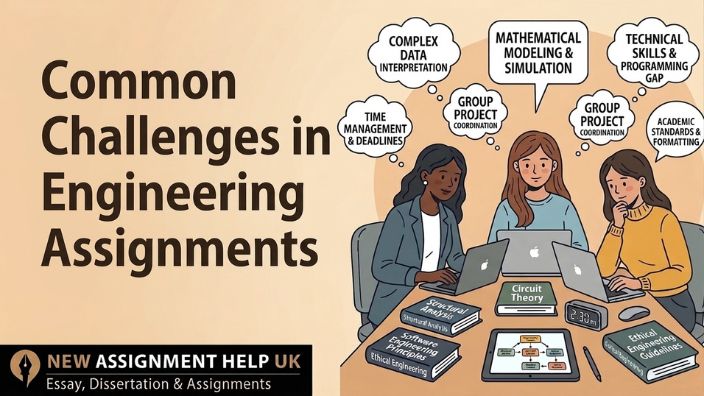
Common Challenges in Engineering Assignments and How Students Can Solve
- 1. Understanding Complex Technical Concepts
- 2. Mathematical and Calculation-Heavy Problems
- 3. Technical Writing and Report Structure
- 4. Referencing and Academic Integrity
- 5. Software and CAD Tool Proficiency
- 6. Time Management Across Heavy Workloads
- 7. Group Project Dynamics
- 8. Language and Communication Barriers for International Students
- 9. Bridging Theory and Real-World Application
- Pro Tips from UK Engineering Experts
Assignments in engineering require technical accuracy, clear mathematical and logical calculations and proper use of industrial resources. Most of the engineering students in the UK struggle with the same expectations over and over again due to subject complexities. It consists of dense theory that moves too fast, calculations that fall apart from one small error, and reports marked down for structure. None of these means that you are bad at the subject, but they are the normal bumps which trouble you more often.
So in this guide on “common challenges in engineering assignments”, you will get to understand struggles in a detailed manner. With this, you are also paired with the actual fixes and pro tips which can be useful for your understanding. If you are an engineering student and want to learn about the mistakes your assignment is facing, keep reading this blog till the end and get an idea of them with practical tips to solve them precisely.
Let's understand each of the challenges in engineering assignments step by step.
1. Understanding Complex Technical Concepts
Lectures in the engineering classroom move fast. Assignments often expect way more depth than what got covered in class, and that gap troubles a lot of students in the following way:
- Topics like thermodynamics move very quickly and leave less time for revision
- A single lecture on the second law of thermodynamics has to carry an entire assignment
- Circuit theory concepts like Thevenin's theorem require practical understanding
- Structural mechanics problems build on earlier topics, so one gap causes several
- Textbooks use dense language that's hard to unpack alone
What helps: Focus on joining a small study group to explain and understand the ideas out loud. You can also use free resources like MIT OpenCourseWare or The Efficient Engineer on YouTube for clear, visual explanations of your doubts.
Once the theory clicks, the numbers are next.
2. Mathematical and Calculation-Heavy Problems
One wrong unit early in a long calculation, and the whole thing falls apart. It's happened to basically everyone at some point because:
- Long, multi-step problems in engineering assignments leave more room for small mistakes
- Unit conversions are an easy place to lose marks
- Picking the right formula for the situation is not always obvious
- You often don't spot the error in the middle of the calculation until the final incorrect answer
What helps: Practising old problem sets regularly can help you understand the pattern instead of cramming them right before exams. Run your answers through MATLAB or Wolfram Alpha to double-check. If something's off, you can seek support from engineering assignment help services to find exactly where it went wrong.
Numbers sorted; now comes the part where you have to explain them clearly.
3. Technical Writing and Report Structure
Nobody really teaches engineers how to write. But reports still get marked based on structure, referencing, and writing style, which often trips a lot of students.
- Lab reports have a set format, and most students never learned it properly
- Design justifications need precise wording that feels difficult to understand
- Every department works on different criteria, which creates confusion
- Losing marks on formatting, even when the actual work is solid
What helps: Stick with the template your department gives you. The university often marks your assignment on how well defined you have followed the structure. You can also look at the past reports or the assignments to see what strong work looks like.
Writing is sorted, but there's still the question of where your sources come from.
4. Referencing and Academic Integrity
Harvard referencing seems simple until you try to cite a datasheet or an engineering standard using this. Then it gets messy fast. Here is how it seems to be a challenge:
- Most referencing guides don't cover technical, non-standard sources well
- Paraphrasing a technical description seems like copied work
- Small citation mistakes add up across a long report
- Doing it all by hand is slow and easy to get wrong
What helps: Use a reference manager like Zotero or Mendeley from the very beginning. And check your university's engineering-specific referencing guide for technical sources. Always run your draft through an originality checker before submitting your final work.
Beyond writing, plenty of assignments also expect you to already know the software.
5. Software and CAD Tool Proficiency
Assignments often expect fluency in tools which courses barely cover. This gap troubles many first and second-year engineering students.
- AutoCAD and SolidWorks are often assumed to be understood, not taught
- MATLAB and Python skills vary widely across student cohorts
- Software errors can waste their hours of assignment time
- Free licences exist, but nobody tells you where to find them
What helps: You can claim your free student software licence as soon as the term starts. Follow official tutorials from Autodesk or MathWorks, as they are specially built for beginners. And attend departmental software workshops whenever they're offered, since they save significant self-study time.
Even strong technical skills won't help if your time runs out.
6. Time Management Across Heavy Workloads
Deadlines in engineering degrees have a habit of landing all in the same week. Students often struggle to manage between lab reports, engineering dissertations, coursework, and exams in the following way:
- Labs, coursework, and revision often overlap on the calendar in the exact same week
- Long practical sessions consume all your time and leave no time for writing
- Procrastination feels tempting when workload feels overwhelming
- Rushed last-minute work usually leads to a lower grade
What helps: For an efficient working break, break every assignment into small, weekly milestones instead of working on the whole at the same time. You can use planner tools like Notion or Google Calendar for structuring your time. Apply a simple priority system, such as the Eisenhower matrix, to decide daily focus.
Managing your own time is one thing; managing a group is another.
7. Group Project Dynamics
Group work sounds easy in theory. In practice, it's usually one person doing most of the work while everyone else disappears.
- Effort rarely splits evenly, no matter how the group starts out
- Vague roles mean tasks get duplicated or missed completely
- Poor communication slows every decision down
- Combining everyone's sections into one report is often a mess
What helps: Assign clear roles in writing when you start working on any group project. Shared tracker tools like Trello or Google Sheets can be used for clear visibility on the completion of tasks. Document the deadlines and responsibilities in the early stage so expectations are clear for everyone involved.
For a lot of students, there's another layer on top of all this: writing in a second language.
8. Language and Communication Barriers for International Students
UK engineering courses attract many international students. Technical English is its own challenge, separate from just speaking it with fluency.
- Technical vocabulary doesn't match everyday conversational English
- Academic phrasing can feel stiff or unnatural to write
- Small grammar slips can distract from genuinely strong ideas
- Constant struggles in your writing chip away at confidence
What helps: Use your university's free language and academic English support centre to improve your language. Go for free grammar tools to refine your own writing. And set up a proofreading exchange with a classmate to catch issues before submission.
Beyond language, many students also struggle to connect theory with real practice.
9. Bridging Theory and Real-World Application
Courses can be heavy on exams and light on real practice. So when an assignment suddenly asks for an open-ended design decision, it feels unfamiliar.
- Textbook theories often show the messy trade-offs of real engineering decisions
- Some assignments expect industry knowledge which is never taught in coursework
- Limitation to real-world exposure makes practical tasks even harder
- Design choices are tough without having seen real examples
What helps: Read case studies related to your current studying module carefully. Even a short internship or placement builds instincts which textbooks can't. And joining a student chapter of IMechE, IET, or ICE gets you around people solving real problems.
These are the common challenges faced by students in their engineering assignment journey. And now that the challenges are covered, here's what actually works according to people who've lived through it.
Pro Tips from UK Engineering Experts
Here is an additional advantage for you. We asked engineering tutors and recent graduates what actually improves assignment grades. Their advice was practical, consistent, and easy to apply immediately. You can use them as your checklist while writing these assignments.
- Start assignments the same day they're set, even briefly
- Read the brief twice before planning any actual work
- Keep a short "mistakes log" for each individual module
- Book tutorials before struggling for hours, not after
- Read the marking rubric before writing a single word
These small habits build real momentum over an entire term. Students who follow them consistently report fewer last-minute panics and stronger final grades.
Every engineering assignment challenge here is common, and every one has a fix that's already worked for someone. You don't need to struggle through theory, calculations, or reports alone. If you'd rather get expert support, New Assignment Help UK offers guidance from experienced engineers, plagiarism-free work, and on-time delivery.
References
- Institution of Mechanical Engineers
Institution of Mechanical Engineers (2026) University students. Available at: https://www.imeche.org/careers-education/careers-information/university-students (Accessed: 20 August 2026). - Institution of Engineering and Technology
Institution of Engineering and Technology (2026) Student membership. Available at: https://www.theiet.org/membership/become-a-member/student-membership (Accessed: 20 August 2026). - Referencing guide
Pears, R. and Shields, G. (2019) Cite them right: the essential referencing guide. 11th edn. London: Macmillan. - MathWorks
MathWorks (2026) MATLAB Onramp. Available at: https://matlabacademy.mathworks.com/details/matlab-onramp/gettingstarted (Accessed: 20 August 2026).

 12 | MEng, Civil Engineering
Jamie Crawford is a Chartered Engineer (MEng, Civil Engineering, University of Manchester) with over 12 years of experience across structural design and academic mentoring. After working with engineering consultancies in Manchester and Leeds, he now spends part of his time helping UK engineering students untangle tricky coursework and technical reports. His approach is simple: break big problems into small, manageable steps and explain the "why" behind every formula, not just the method. He's guided hundreds of UK engineering students and always pushes them to understand the logic rather than just copy a solution.