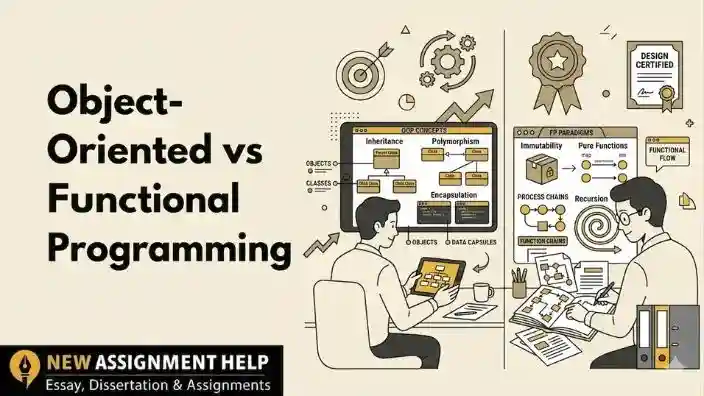
Object-Orientated vs. Functional Programming for UK Students
- What is Object-Orientated Programming (OOP)?
- Understanding the Four Pillars of OOP:
- What is Functional Programming (FP)?
- FP has four building blocks:
- Object-Orientated vs Functional Programming: What's Actually Different?
- How to Choose the Right Programming Style for Your Assignment
- Object-Orientated Programming: Build It Like the Real World
- When to Use Functional Programming
- Procedural Programming: You just need step-by-step
- Conclusion
If your assignment brief landed in your inbox right now and asked you to choose object-orientated vs. functional programming, could you confidently make that call? If the answer is "not really", don't worry. Most students can't, and it's not because they're bad at programming. It's because this specific decision rarely gets the attention it deserves in lectures or textbooks. OOP and functional programming are built on different ways of thinking. And choosing the wrong one doesn't just affect your code; it affects your logic, your structure, and ultimately your marks.
This guide is here to close that gap. We're going to break down both paradigms clearly, along with real-world assignment examples. Whether your assignment involves building a system, processing data, writing algorithms, or something in between, by the end of this blog, you'll know exactly what to do. So, keep reading until the end!
What is Object-Orientated Programming (OOP)?
Object-orientated programming is a software design model that organises your code in classes and objects. You group related data and actions together into something called an object. And you create objects using a class; you can think of it as a mould or template. If you've ever felt stuck at this exact point, you can look for programming assignment support before you've even written a single line of code.
Understanding the Four Pillars of OOP:
- Encapsulation: Your data and the code that uses it live together
- Inheritance: one class can pass its features down to another
- Polymorphism: the same method can behave differently for different objects
- Abstraction: you show only what matters and hide what doesn't
Languages like Java, Python, and C++ all use OOP heavily, and so do most university assignments. Once you understand this structure, picking the right approach for your assignment becomes much easier.
What is Functional Programming (FP)?
A lot of students avoid functional programming because it sounds abstract. Here's the simplest way to understand it. In normal programming, you often change data as you go, updating a variable here and modifying a list there. In this, write functions that take data, work with it, and return a result without ever touching the original. This makes your code more predictable. Unless something unexpected happens, your program will do exactly what you expect it to do.
FP has four building blocks:
- Pure functions: same input, same output always
- Immutability: data is immutable; you build new data rather than changing existing data
- Higher-order functions: functions that are flexible, taking and returning other functions
- Recursion: a method where a function solves a problem by calling itself with a simpler version of the problem
All the languages, such as Python, JavaScript, Haskell, and Scala, support FP. Python in particular allows you to freely mix functional and object-orientated styles in the same assignment.
Object-Orientated vs Functional Programming: What's Actually Different?
A lot of students assume these two are basically the same thing with different names. They're really not. They handle data differently and suit different types of assignments. Once you see where they actually split apart, choosing between them becomes much less stressful.
The easiest way to see where they split apart is to look at them side by side, so here's a straightforward breakdown:
| Feature | Object-orientated Programming | Functional Programming |
|---|---|---|
| Core idea | Objects and classes | Functions and transformations |
| How data is handled | Data can be updated freely. | Data stays the same once set |
| Code structure | Organised into classes | Organised into functions |
| Best suited for | Systems, simulations, real-world models | Algorithms, data tasks, logic problems |
| Common languages | Java, C++, Python | Haskell, Scala, Python, JavaScript |
| Learning curve | Moderate | Steeper early on, but clicks with practice |
The real difference comes down to how each approach treats data. OOP lets data change as your program runs, whether it is a grade update, a balance change, or a user logs in. It tracks the current state of things, which works really well when you're building a system with moving parts.
FP does the opposite. Data never gets changed; it gets transformed. A function takes something in, produces a fresh result, and leaves the original completely untouched. This makes your code far easier to debug because nothing changes unexpectedly behind the scenes.
Both of them are just different tools for different jobs. The students who pick the right one for their assignment are simply the ones who understood what their task was actually asking for, and students working with Java often find that expert Java assignment support helps them structure this understanding into clean, academic-grade code.
That's what the next section is going to walk you through properly.
How to Choose the Right Programming Style for Your Assignment
Object-Orientated Programming: Build It Like the Real World
OOP is your best option when your assignment involves modelling real-world things that have properties and behaviours attached to them. If your brief refers to users, students, accounts or anything that interacts with something else, OOP fits naturally.
Best for: Group work, simulation-based assignments, video game logic, or any task that maps real-world entities into code.
Example of Object-Orientated Programming in Python:
Python
class Student:
def __init__(self, name, grade):
self. name = name
self.grade = grade
def get_status(self):
return f"{self.name} has a {self.grade}"
Usage
alice = Student("Alice", "A")
print(alice.get_status())
Before you start looking for an example of a good OOP assignment, check out our programming assignment sample to get a good idea of how classes and objects should be laid out for academic submission.
When to Use Functional Programming
FP is great when your assignment is not so much to build a system but to process, transform or analyse data. Functional is the cleaner approach if the task is logic-heavy or if you are working through datasets and don’t need to track changing states.
Best for: Data manipulation problems, concurrency problems, algorithm problems, and any problem where you want to avoid unpredictable bugs.
Example of Functional Programming in JavaScript:
JavaScript
const numbers = [1, 2, 3, 4];
const doubled = numbers.map(num => num * 2);
console.log(doubled); // Output: [2, 4, 6, 8]
If your brief contains phrases like "process this dataset", "apply a transformation" or "implement using recursion", then you have a green light to go functional.
Procedural Programming: You just need step-by-step
Not all assignments need OOP or FP. Sometimes your job is simple, a linear sequence of steps, with no complex data structures or system modelling involved. That’s where procedural programming enters the scene.
Best used for sorting algorithms, basic scripting, maths calculations and top-down linear problems.
Here's a simple example in C:
#include <stdio.h>
int calculateArea(int width, int height) {
return width * height;
}
int main() {
int area = calculateArea(5, 10);
printf("The area is %d\n", area);
return 0;
}
They're the difference between code that looks like a student who understands their craft and code that just about works. So make sure to keep this blog as a guide for you while writing your code in different programming languages.
Conclusion
Most students spend more time worrying about object-orientated vs functional programming than actually needed. And this guide has shown you exactly why. OOP works best when you are building systems and modelling real-world entities. Whereas FP helps when your task is based on large data and logic. And when you use both of them together, it is actually the smartest move. The key is reading your assignment brief properly and matching your approach to what the task genuinely needs.
If you're still unsure or simply short on time, New Assignment Help UK is here to help. Our programming specialists don't just help you in completing your assignment, but they also make sure you understand the approach taken. So the next time a similar task lands in your inbox, you'll already know exactly what to do.
References:
- Gamma, E., Helm, R., Johnson, R., & Vlissides, J. (1994). Design Patterns: Elements of Reusable Object-Orientated Software. Addison-Wesley. (Supports the OOP section – foundational text on object-orientated design)
- Hughes, J. (1989). Why Functional Programming Matters. The Computer Journal, 32(2), 98-107. (Supports the functional programming section – a widely cited academic paper)
- Sebesta, R. W. (2015). Concepts of Programming Languages (11th ed.). Pearson. (Supports the comparison section – covers all major programming paradigms)

 8 | M.Sc in Computer Science
Alex Carter holds a Master's degree in Computer Science from the University of Manchester and has spent over eight years helping university students navigate the real challenges of programming. From choosing the right paradigm to submitting clean, well-structured code he guided students with his efficient coding skills. Carter has supported hundreds of UK students through complex assignments and genuinely believes that every student can learn programming better when it is explained in the right way; that's exactly what he does.