
Reproductive System Structure Functions Processes Assignment Sample
Understanding reproductive organs structure, endocrine control, menstrual cycle phases, spermatogenesis mechanisms made easy through professionally written assignments with detailed diagrams
- 92650+ Project Delivered
- 1500+ Experts 24x7 Online Help
- No AI Generated Content



- Task 1: Reproductive System Structure Functions Processes Assignment Sample
- 1.1 Structure and Function of the Male and Female Reproductive System
- 1.2 Role of Hormones in the Reproductive System
- Task 2: Gamete Pathways and Fertilisation
- 2.1 Journey of Gametes
- 2.2 Fertilisation and Implantation Process
- Task 3: Information Leaflet on the Placenta
- 3.1 Functions of the Placenta
- 3.2 Placenta in Multiple Births
Task 1: Reproductive System Structure Functions Processes Assignment Sample
1.1 Structure and Function of the Male and Female Reproductive System
Male Reproductive System
- Testes (Testicles): Containing the testes and the main male sex hormone, testosterone and sperm.
- Scrotum: A sac consisting of skin, which functions to control the testes’ temperature and provides the perfect environment for the generation of sperm (Gurung et al., 2023).
- Penis: The external organ that transports sperm into the female reproductive system during sexual activity, is the penis. Additionally, it hastens the passing of urine within the body.
- Epididymis: The epididymis is a tube coiled above each testis in storing and developing the sperm.
- Vas Deferens: Mature sperm are carried by the vas deferens from the epididymis to the urethra to prepare for ejaculation.
- Urethra: The urethra is a tube which transports semen from the reproductive system and urine from the bladder to the exterior.
- Prostate Gland: Produces seminal fluid that nourishes and transports sperm.
Female Reproductive System
The female reproductive system includes both external and internal structures:
- Ovaries: Tiny, oval-shaped glands called ovaries are present on either side of the uterus. However, they also produce progesterone and oestrogen and generate eggs or ova.
- Fallopian Tubes (Oviducts): Fertilisation normally happens in the fallopian tubes (oviducts) which bring eggs from the ovaries up to the uterus (Rudmann et al., 2025).
- Uterus (Womb): A fertilised egg implants and grows in the muscular, hollow organ called the uterus (womb).
- Endometrium: The uterine lining that thickens during its monthly menstruation to make room for the possible implantation of an embryo.
- Cervix: In women, the small, lower portion of the uterus opens into the vagina; it allows the passing of sperm, menstrual blood, and baby through during birth.
- Vagina (Birth Canal): A muscular tube from the cervix to the outside of the body, which takes in the penis during intercourse and function as a tube through which an infant is born, or menstrual fluid flows from.
Structure and Function Relationship
Each organ's structure is intricately linked to its function:
- Testes and Ovaries: Glandular structures testing and ovaries that help produce gametes (sperm and eggs) and hormones.
- Penis and Vagina: They are meant to function together; for the transfer of sperm to occur, they assist each other.
- Uterus: It is muscular and expandable to support and nurture the developing fetus.
1.2 Role of Hormones in the Reproductive System
- Testosterone: This hormone is mainly produced by the testes to produce sperm and helps develop secondary sexual characteristics in males including facial hair and a deeper voice (Manocha et al., 2018).
- Estrogen: Most of the hormone oestrogen that is circulating in the bloodstream is produced in the ovaries as a key indicator of the menstrual cycle, and to help women develop secondary sexual traits like breasts.
- Progesterone: Progesterone is also made in the ovaries and helps to make an early pregnancy and to put the endometrium in a condition ready to proceed with a pregnancy following ovulation.
Comparison of Hormonal Effects in Males and Females
| Hormone | Primary Source | Effects in Males | Effects in Females |
| Testosterone | Testes | - Development of secondary sexual characteristics - Sperm production | - Present in lower levels - Contributes to muscle strength and libido |
| Estrogen | Ovaries | - Present in lower levels - Necessary for modulating libido and erectile function | - Development of secondary sexual characteristics - Regulation of menstrual cycle |
| Progesterone | Ovaries | - Present in minimal amounts - Precursors for other steroid hormones | - Regulation of menstrual cycle - Maintenance of pregnancy |
Assignment deadlines piling up? Let New Assignment Help ease your burden with expert Assignment Help in UK tailored for student success.
Task 2: Gamete Pathways and Fertilisation
2.1 Journey of Gametes
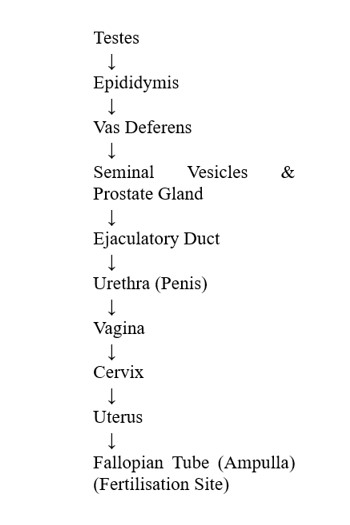
Flowchart 1: Sperm Pathway (Testes to Uterine Tube)
Flowchart 2: Ovum Pathway (Ovary to Uterus)
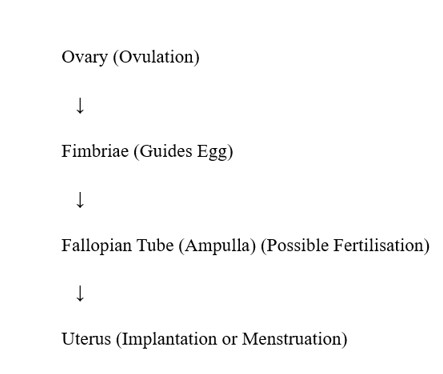
Fertilisation Point: Typically occurs in the ampulla of the fallopian tube within 24 hours of ovulation.
2.2 Fertilisation and Implantation Process
Changes in Sperm and Ovum before Fertilisation
- Sperm Capacitation: Sperm become metabolically different to improve its motility and its power of penetration of the egg in the vaginal tract.
- Acrosome Reaction: The enzymes (Montgomery and Arnesen, n.d.) break the outer layer of the ovum called the zona pellucida.
- Ovum Activation: The ovum finishes meiosis 2 to develop a zygote when the sperm enters.
Stages from Fertilisation to Implantation
- Fertilisation: In the fallopian tube, one sperm joins the ovum.
- Zygote Formation: A diploid zygote is created when the male and female nuclei combine.
- Cleavage: As the zygote approaches the uterus, it divides mitotically.
- Morula Stage: The dividing cells solidify into a ball after three to four days.
- Blastocyst Formation: By day 5, a hollow ball of cells known as a blastocyst forms.
- Implantation: Pregnancy is started when the blastocyst embeds into the uterine endometrium on days 6–7.
Task 3: Information Leaflet on the Placenta
3.1 Functions of the Placenta
The placenta is a vital organ that develops during the pregnancy to support the growth and development of the fetus. It performs several key functions:
- Nutrient and Oxygen Transport: The placenta facilitates the transfer of essential nutrients (glucose, amino acids, fatty acids) and oxygen from the mother’s bloodstream to the fetus via the umbilical cord. This enables the development of the fetus in a proper way (Bamberg, and Hecher, 2022).
- Waste Removal: By helping to transfer carbon dioxide and metabolic waste (urea) into the mother’s bloodstream for excretion by her kidneys and lungs it also removes waste from the fetus.
- Hormonal Functions: One of the important roles of the placenta is to produce key hormones, which include the human chorionic gonadotropin (hCG) (for maintaining pregnancy), progesterone (preventing contractions in the uterus), and oestrogen (for supportive development of the fetus and changes in the mother).
3.2 Placenta in Multiple Births
The placenta performs differently in twin pregnancies, depending on whether the babies are monochorionic (with one placenta) or dichorionic (with their own).
- Monochorionic Twins: Identical twins share the same placenta and are at an increased risk of Twin to twin-to-twin transfer Syndrome [TTTS] in which one twin receives more blood than the other (Bamberg and Hecher 2022).
- Dichorionic Twins: If people are fraternal (united at the abdomen and not the uterus) or identical (sharing a placenta but separate prenatal, or in utero development) twins, people have lower risks of complication as each fetus has its own nutritional and oxygen supply from the placenta.
References
- Bamberg, C. and Hecher, K., 2022. Twin-to-twin transfusion syndrome: Controversies in the diagnosis and management. Best Practice & Research Clinical Obstetrics & Gynaecology, 84, pp.143-154.
- Gurung, P., Yetiskul, E. and Jialal, I., 2023. Physiology, male reproductive system. In StatPearls [Internet]. Statpearls publishing.
- Manocha, A., Kankra, M., Singla, P., Sharma, A., Ahirwar, A.K. and Bhargava, S., 2018. Clinical significance of reproductive hormones. Current Medicine Research and Practice, 8(3), pp.100-108.
- Montgomery, S. and Arnesen, R., Fertilisation Methods. In Mastering Clinical Embryology (pp. 150-155). CRC Press.
- Rudmann, D.G., Vidal, J.D. and van Esch, E., 2025. Female reproductive system. In Haschek and Rousseaux's Handbook of Toxicologic Pathology Volume 5: Toxicologic Pathology of Organ Systems (pp. 743-817). Academic Press.
- Cindrova-Davies, T. and Sferruzzi-Perri, A.N., 2022, November. Human placental development and function. In Seminars in cell & developmental biology (Vol. 131, pp. 66-77). Academic Press.