
CILT Unit 2 Sustainable Resource Management Assignment Sample
Explore this CILT Unit 2 Sustainable Resource Management assignment example, offering practical strategies, insights, and guidance to help students submit well-structured, high-quality work efficiently.
- 92650+ Project Delivered
- 1500+ Experts 24x7 Online Help
- No AI Generated Content


- Executive Summary Of CILT Unit 2 Sustainable Resource Management Assignment
- Task 01
- (a)- Discussing an appropriate leadership style and change management model with reference to previous change in organisation
- Leadership style
- Change management model
- (b)- Assessing supply chain activity and analysing organisational culture and motivational theories that assist and hider the activity
- Task 02
- (a)- Evaluating the influence of digital transformation on demand management activity
- (b)- Evaluating the impact of resource implication on identified activity
- (c)- Ways in which financial models and techniques can impact cost efficacy of activity
- Task 03
- (a)- Evaluating current stakeholders' relationship with contractors, third parties and customer along with recommending possible areas for improvement
- Ethics
- Sustainable practice
- Conclusion
- Recommendations
Executive Summary Of CILT Unit 2 Sustainable Resource Management Assignment
Supply Chain Management [SCM] is delineated as the coordination and management of good, it oversees the movement of materials, finished goods and processes. This is considered as an important domain within organisations as SCM enhances the operational efficacy. The current report was based on assessing supply chain activities within NHS. Core focus was implied on identification of change undertaken in supply chain procedure and afterwards, leadership style and change management model for implementing the change has been assessed. The Implied change was associated with reducing cost production and enhancing service delivery which was accompanied by transformational leadership style and Lewin's change management model.
The purpose of the report was to analyse the importance of supply chain practice and its impacts on organisation practices. Significant focus implied on demand management activity and it has been witnessed that digital transformation, resource implication and financial models has the potential to influence demand management. Findings of the assignment depicted that varied factor impacts supply chain practices and it is important to develop focus on associated components such as leadership, change management, ethics, sustainable practices and so on. The major recommendations for NHS are aligned with adopting transparency and ethical practices within their supply chain. Moreover, automation should be adopted that helps in facilitating faster activities.
Struggling with deadlines? Turn to New Assignment Help for reliable Best Assignment Help that takes the pressure off and boosts your academic success.
Task 01
(a)- Discussing an appropriate leadership style and change management model with reference to previous change in organisation
The recent change within supply chain operation of NHS are associated with delivering clinically safe and high-quality products to service users with regards to gaining desired value. The motive is to realise £2.4bn of savings within first five year of operation and using it for reinvestment purpose (NHS, 2023). The consideration of contextual change aligns with adopting a suitable leadership style and change management model which can led to develop desired outcomes-
Leadership style
NHS has been consistently evolving and varied changes are undertaken in the operations of organisation (NHS, 2023). Similarly, previous change related to supply chain operation is holding up the notion of enhancing healthcare services and reducing healthcare costs by increasing re-investment. In order to implement a change, it is highly important to adopt a significant leadership style so that consistent support can be ensured to staff (Zekhnini et al., 2021). The change in NHS is developing significant pressure on staff which might lead to demotivation in them and impacts their practices in a drastic manner. In this context, transformational leadership proves to be significant, it refers to that leadership style which focuses on encouraging, motivating and inspiring employees for performing in effective manner (NHS, 2023). By employing this leadership style organisation has focused on undertaking in-depth discussion with staff and further their opinion was taken in consideration which are important for enhancing their motivation level (Wieland, 2021). The extreme pressure has been faced by staff members as they were told to enhance their services by attending varied service user in a single day so this can lead to reduce healthcare cost and optimum utilisation of the resources can be undertaken.
However, this created significant pressure on employees and transformational leadership supported in gaining effectual outcomes as consistent discussion with staff members was undertaken and based on their requirements training was organised in the organisation.
Change management model
Change management refers to the implication of structured process and set of tools that supports in implementation of change in effective manner. In current context of change within NHS supply chain operation Lewis's change management model proves to be appropriate. It is considered as widely accepted change management framework that supports in gaining desired outcomes (Sodhi and Tang, 2021). It is comprised with three stages and those are unfreezing, changing and refreezing. In unfreezing stage, focus implied on communicating the importance of change to staff members in the organisation. Importance of reducing healthcare cost and enhancing healthcare services communicated with employees so that urgency for implementing change can be developed (NHS, 2023). Afterwards, second stage associated with changing stage in which actual change was implemented and staff members were trained so they can enhance their practices along with reducing healthcare cost. During this stage, transformational leadership proves to be highly effective as consistent support was ensured to team members (Sharma et al, 2022). The last stage of the model is refreezing stage; in this phase change was considered as the part of organisational practice. This means that staff members started to perform their practices by delivering high-quality services to patient along with reducing healthcare cost and attending multiple patients on single day.
(b)- Assessing supply chain activity and analysing organisational culture and motivational theories that assist and hider the activity
NHS supply chain activities are concerned with varied activities such as-sourcing, delivering, supplying healthcare products, demand management, capacity planning, procurement and so on activities (NHS, 2023). The foremost focus will be implied on demand management, there is rising prevalence in healthcare products and services witnessed which is creating huge complexities for NHS. In comparison to demand the supply is less that develops significant influence on the health outcomes of people. Organisational culture and motivation theories are playing pivotal role in assisting and hindering the activity (Chowdhury, 2024). For example- there is increase in the demand of healthcare services but in comparison to NHS is lacking in workforce allocation and this build pressure on existing staff members. In order to comply with demand management existing workforce needs to experience huge pressure that creates demotivation in them. In such situation an effective organisational culture supports in encouraging employees and further it helps in planning recruitment strategy as well.
Organisational culture reflects about the set of beliefs, attitudes and values that shapes employee's behaviour at the workplace. NHS organisational culture revolves around the patient-centredness and responsiveness which means that NHS guides everyone to adopt such practice that led to enhance patient outcomes (Queiroz et al, 2023). This culture assists nurses and healthcare professionals to emphasise on service users and their demand so that significant steps can be taken and effectual support could be ensured to patients.
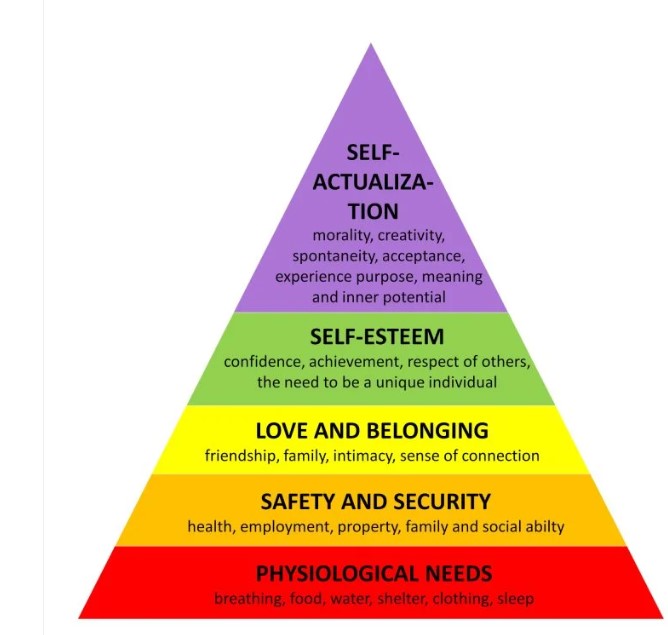
Figure 1- Maslow hierarchy of needs
Motivational theories such as Maslow hierarchy of needs prioritise the needs of staff members all the five needs; physiological, safety, social, esteem, and self-actualization needs has been focused out and consistent support ensured to staff members (Schwieterman and Welter, 2023). This often helps in retaining healthcare workers, practitioners and professionals at the setting. Another motivational theory is of Herzberg that focuses on that emphasis on the factors which directly impacts job satisfaction level of individuals. By considering their theory it can be said that, if focus implied on taking appropriate actions such as appreciating staff members, increasing their salary and reducing work load then, it led to enhance their job satisfaction. On the other hand, when consistent pressure is developed on the employees then this leads job dissatisfaction among them (Toorajipour et al, 2021). NHS focuses on enhancing the job satisfaction of staff members due to which they were able to focus on demand management. However, varied struggles have been faced by staff members and therefore, consistent support needs to be ensured to them and NHS focusing on this area and thereby, organisation is assisting in supply chain activity.
Task 02
(a)- Evaluating the influence of digital transformation on demand management activity
Demand management is considered as one of the prominent supply chain activities that focus on overseeing and managing customer demand. This further supports in analysis of upcoming demand so that prior actions can be taken and significant support can be ensured to patients (Tirkolaee et al, 2021). From the sources it has been reviewed that in NHS demand management is considered as an important component and the purpose of demand management comprised with maintaining continuity in the supply of critical products to NHS so that rationale decision making can be done along with providing necessary medical products and services (Supply chain of NHS, 2024). Digital transformation is at the forefront of demand management as it is focusing on meeting the requirements of patient and consequently, this is enhancing health outcomes of people. Digital transformation is enabling healthcare provider in terms of tailoring their services for meeting individual needs and preferences and further support in prioritising personal preferences of patient (Shao et al, 2021). The digital transformation is supporting in demand management procedure by eliminating important paperwork and makes data accessible by reducing the time for attending patients. Thus, it also promotes effective remote communication that enhances conversation pattern between healthcare provider and service provider.
Digital transformation is equipping NHS with real time information and data analytics that supports in undertaking informed decision which directly meets demand of patient. Most importantly the change related to reducing healthcare cost can be meet through digital transformation (NHS, 2023). Through technology, patient medical history and records can be assessed which saves time of healthcare providers and enable them to undertake fast-decision making (Bhandal et al, 2022). Hence, in this manner significant support can be ensured to patient and their demand can be meet. Most importantly, digital transformation supports in optimum utilisation of the resources that lead to staff scheduling and accordingly patients can be attended. Using advanced analytic results in predicting patient admissions, trends and further supports in capacity planning process (Supply chain of NHS, 2024). The supply chain activities are linked with each other, for instance- effective demand management supports in capacity planning activities. Therefore, it is highly important to implement significant focus on each of the supply chain activity. From the presented contextual information, it has been identified that digital transformation is creating positive impact on demand management activity (Hazen et al, 2021).
However, there are certain challenges which can develop significant barriers in the whole process. These barriers are associated with lack of expertise in digital transformation and huge cost. It is important to focus on these barriers so that appropriate decision making can be done and training could be organised in the NHS. This result in creating consistent support for healthcare providers and enhance their knowledge with respect to using digital platform. Thus, it can be said that digital transformation is creating positive impact on demand management activity.
(b)- Evaluating the impact of resource implication on identified activity
Resource implication refers to those important resources which are needed to achieving a significant objective. In order to undertake demand management activity, it is crucial for NHS to allocate their resources in a significant manner, major resources are comprised with financial, human and physical components (NHS, 2023). Demand management can be done by accumulating finance and investing it whereas, experts are needed to who can manage demand while providing training to staff members for using digital platform (Asamoah et al, 2021). The physical resource associate with the infrastructure and materials such as computers system, internet, documents and so on that is important for managing the demand. Thus, these are the important resource implication required for managing identified supply chain activity.
Resource implication has the potential to create drastic impact on demand management. For instance- if NHS does not have mandatory resources such as manpower allocation and finance then, it is not easy to manage multiple patients. The topmost resource is manpower and research has shown that, NHS often faces shortage of staff due to lack of retention strategies (Sallam, Mohamed and Mohamed, 2023). Henceforth, this leads to create adverse impact while managing the patient's demand. On the other hand, lack of finance also influences the abilities to update the system and adopting modern healthcare practices. In this manner, negative influence will be developed on demand management activities.
Hence, there is no doubt in stating that resource implication has the potential in relation to creating drastic impact on demand management activity. Therefore, it is essential for organisation to focus on this area and accordingly, appropriate strategies should be adopted that supports in the management of demand. In this manner, effectual outcomes could be gained and resource would be allocated.
(c)- Ways in which financial models and techniques can impact cost efficacy of activity
Financial models and techniques have the ability to impact the cost efficacy of demand management. Finance is at the forefront of implementing any change or activity within NHS, it decides about the efficacy of supply chain practices (Hall, Lister and Mercer, 2020). The three-statement model is used by NHS it is consist of income statement, balance sheet and cash flow statement, these aspects support in providing financial information to stakeholders regarding performance of company. Realistic presentation of financial information leading to gain the trust of stakeholders and as a result, they prefer to invest in organisation that ultimately supports in managing the cost while focusing on demand management (Utama et al, 2022). NHS shows accurate information in their financial statement and accordingly, organisation becomes able to identify the areas in which extreme expenses are occurring. This supports in taking corrective measures for reducing the cost and ultimately demand can be managed. Thus, it can be said that financial models and techniques can create major influence on cost efficacy of demand management activity.
Another financial model used by NHS is budget methodology, it is used for determining about the distribution of resources which are important for prioritising the funds which have been allocated (Tirkolaee et al, 2021). Further, it supports in taking strategic initiatives which contributes in maintaining the cost within organisation. Appropriate budget has been set by NHS that adheres with using appropriate fund for each activity (Nandi et al, 2020). Hence, this eases the task related to demand forecasting and management, individuals become able to use allocated fund which reduces the issues related to huge expenses. In this manner, cost efficacy within demand management can be undertaken.
Task 03
(a)- Evaluating current stakeholders' relationship with contractors, third parties and customer along with recommending possible areas for improvement
Stakeholders are considered as important within organisation as they influence and promote the advancement of projects and helps in supply chain procedure. It is pivotal to implement effectual relationship with stakeholders so that appropriate actions can be taken and consistent support can be ensured to people (Supply chain of NHS, 2024). The topmost stakeholders of NHS are healthcare professionals, public, volunteer providers, community services, acute trust, government, suppliers, investors and local authorities (Hugos, 2024). The healthcare consulting contractors are responsible for providing consistent guidance to healthcare providers so they can perform their task in effective manner. They focus on assisting staff members and healthcare professionals in terms of enhancing their operational efficacy and planning. Stakeholders within NHS such as nurses, healthcare professionals, supply chain manager, healthcare workers and other members implements contract with contractor and third parties. The third parties involve family members of patient and consistent interaction has been implemented with them (Leuschner et al, 2023). From the research it has been identified that NHS staff members consistently interact with contractors and consequently, participates in training programs so they can learn about important aspects which are essential to imply in practices. It is important to develop consistent connection among stakeholders and this can be done by undertaking communication on consistent note (Cheung Bell and Bhattacharjya, 2021). Thus, NHS focuses on developing effective connection between stakeholders and contractor by organising sessions, meetings, workshops and training. This provides consistent opportunities to staff members so they can effectively enhance their practices.
The relationship of stakeholders with third parties such as family members proves to be important. Staff members are assisted in terms of communicating with family members and they should be involved in decision-making. From the sources it has been identified that staff members in NHS involve family members in the care procedure of patient and this shows that stakeholder has maintained effectual connection with family members and they have been consistently involved in the treatment of patients (Chowdhury, 2024). In terms of customers this can be said that stakeholders of NHS are playing effective job as all the practices are significantly undertaken for patients. They have been involved in decision making and accordingly patient empowerment is undertaken. Based on the presented contextual information this can be said that prior focus has been implied on maintaining consistent interaction with consumers and accordingly their needs and requirements are prioritised.
There are certain areas within NHS that requires consistent improvement. The possible areas of improvement for NHS are associated with-
Ethics
Ethics are considered as set of morals which are important to be followed, in supply chain procedure it plays important role. It ensures that organisation has been performing all the practices within maintaining the ethical components. NHS needs to implement focus on this area and accordingly, organisation should adhere with ethical practices (Kshetri, 2021). The supply ethics aligned with treating workers in fair manner while respecting human rights. The environmental standards are needed to be met and supplier is accountable for performing these actions. Considering these actions, it can be said that supply chain ethics are important for performing appropriate practices within business.
NHS must implement focus on this area and subsequently, ethical sourcing should be undertaken. This aligns with actively holding the rights of labour along with providing safe working conditions to them. Findings have shown that staff at NHS faces varied issues related to extreme work pressure that often results in creating huge stress for them (Kshetri, 2021). Henceforth, it is important to undertake an ethical approach and manpower allocation should be planned so that pressure on existing workforce can be reduced and consistent support must be assured to them. In this manner, NHS would be able to maintain the ethics at the workplace along with undertaking ethical practices within supply chain management (Daghighi and Shoushtari, 2023). Furthermore, procurement of goods or healthcare products should be done in ethical manner and black marketing should not be followed. The products and services are specifically for general public and this must be provided to them without undertaking any kind of illegal practices.
Sustainable practice
Sustainable practices in supply chain practices are aligned with the varied elements which need to be focused out. It covers different elements such as transparency, collaboration, sustainable packaging, ethical sourcing, sustainable transportation, establishing sustainable goals, energy efficiency, waste reduction, educating staff on sustainable healthcare practices and enhancing patient care (Wisner, Tan and Leong, 2021). These are the core areas that entails with sustainability practices and these are important to be considered. NHS should focus on engaging staff members in sustainable practices and this can be done through educating them by organising trainings and workshops (Katsaliaki et al, 2022). The consistent meeting with suppliers and other stakeholders must be organised so that appropriate actions related to sustainable practices can be undertaken. This helps in taking significant actions which are essential for enhancing supply chain practices within organisation. In current era, it has become highly essential for business to focus on adopting sustainable practices as this enable them to focus on varied elements which are crucial for meeting customer requirements.
Therefore, significant focus must be implied on this area and appropriate decision related to treating staff and consumer in fair manner should be implied. Most importantly, focus must be implied on reducing the extreme work pressure on existing staff and consistent support requires to be ensured to them. In this manner, organisation will be able to perform sustainable practices with regards to their supply chain practices.
Conclusion
Conclusively; this can be said that supply chain management is crucial process within organisations; it focuses on varied elements which are important to be focused out. The present assessment has focused on assessing the supply chain management within NHS by emphasising on recent change undertaken within organisation. The change related to maintaining cost and enhancing services delivery are linked with improving supply chain procedure of NHS. In order to imply this change, transformational leadership style and Lewin's change management model proves to be appropriate. Within adopting transformational leadership style organisation has become able in terms of increasing the engagement of employees along with considering their opinion. It supported in implementation of change in effective manner by providing consistent support to staff members. Furthermore, Lewin's change management model helped in understanding the requirement of change and accordingly, implication was done.
Demand management is one of the foremost activities of NHS supply chain that has been assessed in the assignment. Digital transformation, resource implication and financial models are playing important role in managing the demand within organisation and further enabling NHS to enhance their practices. Moreover, organisation's stakeholders have effectively managed their interaction with contractors, third parties and customers. This is enabling NHS to develop effectual image in the market and furthermore, practices of organisation are improved to greater extent. However, there are certain areas such as ethics and sustainable practices have been identified that requires improvement. NHS must focus on this area so that effectual outcomes can be gained and consistent support can be assured to patients. Also, it supports is adhering with supply chain ethics which are important for gaining the attention of stakeholders and consequently, appropriate actions could be taken in the NHS.
Recommendations
Based on the analysis below mentioned are the major recommendations for NHS in order to improve their supply chain activities-
- Transparency: NHS should focus on maintaining consistent transparency in their procedure. This helps in gaining attention of customers and other stakeholders. Maintaining transparency is the key component of supply chain practices, it is important for depicting that ethics are maintained in supply chain procedure (Mastos et al, 2021). Therefore, it is recommended to NHS that they must maintain consistent transparency with so that mutual trust can be developed and it further helps in providing consistent support to stakeholders.
- Forecasting demand and supply: Forecasting demand and supply helps in predicting the demand of products and services so that accordingly, output could be produced. It is an important element in supply chain s it reduces wastage therefore, this must be considered (Spieske and Birkel, 2021). However, in order to forecast demand and supply elements it is important to use latest technology within supply chain procedure so that appropriate prediction can be done. Moreover, experts should be hired who can look upon this area and subsequently, significant decision-making can be undertaken in the organisation.
- Automation: Automation system can help in processing orders and demand faster. Thus, it supports NHS for scheduling the appointments of patients and accordingly, staff members would be informed about their appointments (Mardani et al, 2020). In this manner, work allocation can be done in effective manner which results in reducing pressure on staff members. Thus, it is recommended to organisation that they must use automation process for gaining desired results.
- Managing contracts: It is important for NHS to maintain contract so task allocation could be done in significant manner without having any kind of confusion. Data-driven technologies should be used for keeping the records related to contracts. In this manner, organisation will be able to maintain contracts and associated requirement with this. Thus, it is highly important to focus on this area so that effectual outcomes could be gained.
- Distribution network: NHS should increase their distribution network as it enables organisation to manage their supply and demand components. This distribution networks will create wider scope for NHS in terms of enhancing their supply chain practices (Zekhnini et al, 2021). Furthermore, guidance from different experts and professionals can be taken after increasing the network. Therefore, NHS must comply in this context as it results in enhancing their supply chain practices.
- Ethical practices: Organisation should focus on enhancing their practices by treating employees in effective manner. Staff member faces extreme pressure due to shortage of workers within NHS and this creates stress for them. Thereby, organisation should focus on adopting ethical practices by developing a favourable work environment in which employees can feel productive rather than feeling stressed-out (Moosavi et al, 2021).
- Communication with stakeholders: NHS should develop consistent communication with stakeholders and they must be informed about each domain (Alzoubi et al, 2022). This supports in maintaining fair work practices along with gaining the trust of stakeholders.
References
Books and Journals
- Alzoubi, H.M., Ghazal, T.M., Sahawneh, N. and Al-kassem, A.H., 2022. Fuzzy assisted human resource management for supply chain management issues. Annals of Operations Research.
- Asamoah, D., Agyei-Owusu, B., Andoh-Baidoo, F.K. and Ayaburi, E., 2021. Inter-organizational systems use and supply chain performance: Mediating role of supply chain management capabilities. International journal of information management, 58, p.102195.
- Bhandal, R., Meriton, R., Kavanagh, R.E. and Brown, A., 2022. The application of digital twin technology in operations and supply chain management: a bibliometric review. Supply Chain Management: An International Journal, 27(2), pp.182-206.
- Cheung, K.F., Bell, M.G. and Bhattacharjya, J., 2021. Cybersecurity in logistics and supply chain management: An overview and future research directions. Transportation Research Part E: Logistics and Transportation Review, 146, p.102217.
- Chowdhury, R.H., 2024. Automating supply chain management with blockchain technology. World Journal of Advanced Research and Reviews, 22(3), pp.1568-1574.
- Chowdhury, R.H., 2024. Automating supply chain management with blockchain technology. World Journal of Advanced Research and Reviews, 22(3), pp.1568-1574.
- Daghighi, A. and Shoushtari, F., 2023. Toward Sustainability of Supply Chain by Applying Blockchain Technology. International journal of industrial engineering and operational research, 5(2), pp.60-72.
- Hall, D., Lister, J. and Mercer, H., 2020. Privatised and unprepared: The NHS supply chain.
- Hazen, B.T., Russo, I., Confente, I. and Pellathy, D., 2021. Supply chain management for circular economy: conceptual framework and research agenda. The International Journal of Logistics Management, 32(2), pp.510-537.
- Hugos, M.H., 2024. Essentials of supply chain management. John Wiley & Sons.
- Katsaliaki, K., Galetsi, P. and Kumar, S., 2022. Supply chain disruptions and resilience: A major review and future research agenda. Annals of Operations Research, pp.1-38.
- Kshetri, N., 2021. Blockchain and sustainable supply chain management in developing countries. International Journal of Information Management, 60, p.102376.
- Leuschner, R., Choi, T.Y., Rogers, D.S., Hofmann, E. and Templar, S., 2023. ‘To fund'as a new purpose of supply chain management: Making a case for supply chain financing. Journal of Purchasing and Supply Management, 29(5), p.100881.
- Mardani, A., Kannan, D., Hooker, R.E., Ozkul, S., Alrasheedi, M. and Tirkolaee, E.B., 2020. Evaluation of green and sustainable supply chain management using structural equation modelling: A systematic review of the state of the art literature and recommendations for future research. Journal of cleaner production, 249, p.119383.
- Mastos, T.D., Nizamis, A., Terzi, S., Gkortzis, D., Papadopoulos, A., Tsagkalidis, N., Ioannidis, D., Votis, K. and Tzovaras, D., 2021. Introducing an application of an industry 4.0 solution for circular supply chain management. Journal of Cleaner Production, 300, p.126886.
- Moosavi, J., Naeni, L.M., Fathollahi-Fard, A.M. and Fiore, U., 2021. Blockchain in supply chain management: a review, bibliometric, and network analysis. Environmental Science and Pollution Research, pp.1-15.
- Nandi, M.L., Nandi, S., Moya, H. and Kaynak, H., 2020. Blockchain technology-enabled supply chain systems and supply chain performance: a resource-based view. Supply Chain Management: An International Journal, 25(6), pp.841-862.
- Queiroz, M.M., Wamba, S.F., Pereira, S.C.F. and Jabbour, C.J.C., 2023. The metaverse as a breakthrough for operations and supply chain management: Implications and call for action. International Journal of Operations & Production Management, 43(10), pp.1539-1553.
- Sallam, K., Mohamed, M. and Mohamed, A.W., 2023. Internet of Things (IoT) in supply chain management: challenges, opportunities, and best practices. Sustainable Machine Intelligence Journal, 2, pp.3-1.
- Schwieterman, M. and Welter, C., 2023. Supply chain from start to finish: the implications of supply chain management for entrepreneurs. International Entrepreneurship and Management Journal, 19(4), pp.1947-1964.
- Shao, X.F., Liu, W., Li, Y., Chaudhry, H.R. and Yue, X.G., 2021. Multistage implementation framework for smart supply chain management under industry 4.0. Technological Forecasting and Social Change, 162, p.120354.
- Sharma, R., Shishodia, A., Gunasekaran, A., Min, H. and Munim, Z.H., 2022. The role of artificial intelligence in supply chain management: mapping the territory. International Journal of Production Research, 60(24), pp.7527-7550.
- Sodhi, M.S. and Tang, C.S., 2021. Supply chain management for extreme conditions: Research opportunities. Journal of Supply Chain Management, 57(1), pp.7-16.
- Spieske, A. and Birkel, H., 2021. Improving supply chain resilience through industry 4.0: A systematic literature review under the impressions of the COVID-19 pandemic. Computers & Industrial Engineering, 158, p.107452.
- Tirkolaee, E.B., Sadeghi, S., Mooseloo, F.M., Vandchali, H.R. and Aeini, S., 2021. Application of machine learning in supply chain management: a comprehensive overview of the main areas. Mathematical problems in engineering, 2021(1), p.1476043.
- Tirkolaee, E.B., Sadeghi, S., Mooseloo, F.M., Vandchali, H.R. and Aeini, S., 2021. Application of machine learning in supply chain management: a comprehensive overview of the main areas. Mathematical problems in engineering, 2021(1), p.1476043.
- Toorajipour, R., Sohrabpour, V., Nazarpour, A., Oghazi, P. and Fischl, M., 2021. Artificial intelligence in supply chain management: A systematic literature review. Journal of Business Research, 122, pp.502-517.
- Utama, D.M., Santoso, I., Hendrawan, Y. and Dania, W.A.P., 2022. Integrated procurement-production inventory model in supply chain: A systematic review. Operations Research Perspectives, 9, p.100221.
- Wieland, A., 2021. Dancing the supply chain: Toward transformative supply chain management. Journal of Supply Chain Management, 57(1), pp.58-73.
- Wisner, J.D., Tan, K.C. and Leong, K., 2021. Principles of supply chain management: A balanced approach. South-Western, Cengage Learning.
- Zekhnini, K., Cherrafi, A., Bouhaddou, I., Benghabrit, Y. and Garza-Reyes, J.A., 2021. Supply chain management 4.0: a literature review and research framework. Benchmarking: An International Journal, 28(2), pp.465-501.
Online
- NHS, 2023. Online. Available through: < https://www.nhs.uk/ >
- Supply chain of NHS, 2024. Online. Available through: < https://www.supplychain.nhs.uk