
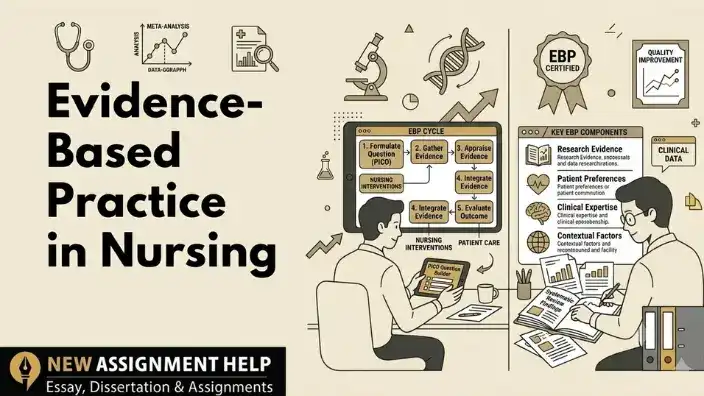
Evidence-Based Practice in Nursing
- What Is Evidence-Based Practice in Nursing? The NMC Code & NICE Explained
- What Does Evidence-Based Practice Actually Mean in Nursing?
- Why Do Good Sources Really Matter in Your EBP Assignment?
- Effective Steps to Apply EBP to Your Assignment
- How to Turn Your Assignment Topic into a Focused Research Question
- Conclusion
What Is Evidence-Based Practice in Nursing? The NMC Code & NICE Explained
"Why does every nursing assignment ask for evidence-based practice, but nobody explains what it actually looks like?" If that question has crossed your mind, you are in the right place. Most nursing students hear "use EBP" in every lecture. But when it comes to writing it down, the page stays blank. That is not a knowledge problem. That is a gap between the theory and what you are actually doing.
This guide walks you through what evidence-based practice in nursing really means. With this, it will also give you an overview of why your sources matter more than you think and how to use EBP properly in your next assignment. So, without taking a pause, let's get into it quickly.
What Does Evidence-Based Practice Actually Mean in Nursing?
Evidence-based practice (EBP) in nursing means making decisions based on available research, your clinical knowledge, and what the patient actually needs. It is not just about finding a journal article and sticking it in your citing list. It is about thinking. It is about asking, "Does this research actually support what I am arguing? Is this care approach backed by strong proof or just by habit?" Think of it this way.
In the UK, using EBP in your nursing assignment is not just an academic idea you can describe in your work. Even the NMC Code (2018) also states that every registered nurse has a personal responsibility to keep their practice up to date with the best evidence available. NICE (the National Institute for Health and Care Excellence) produces guidelines that translate research into practical standards.
So when your brief says "use EBP", it is really saying, "Show that your argument is backed by verified, current research. " If you are finding it difficult to frame your argument, our nursing assignment support team works with UK students on exactly this.
Why Do Good Sources Really Matter in Your EBP Assignment?
This is one of the most searched questions among nursing students, and it is worth answering properly. Not all sources are equal. This is not just a rule your university made up. It comes from a real concept in healthcare called the hierarchy of evidence. So think of it as a pyramid. The sources at the top are the strongest. The ones at the bottom are the weakest. Here is how it works, from weakest to strongest:
- At the top: Systematic reviews and meta-analyses. These are the gold standard. Researchers pull together findings from dozens of studies and draw broader conclusions. The Cochrane Library is the go-to place for these.
- Just below: Randomised Controlled Trials (RCTs). A well-designed RCT tests one intervention against a control group under careful conditions. This evidence has meaningful authority in clinical arguments.
- Middle ground: Cohort and case-control studies. These studies follow groups of people over time and analyse past records to identify patterns. They are genuinely useful, but they are considered less reliable than a controlled trial.
- Further down: Case reports and expert opinion. A case report is essentially a detailed record of one patient's experience. However, they should support your argument, not anchor it.
- At the base: Anecdotal accounts and personal clinical experience. These are the weakest form of evidence in academic terms. They are not worthless, but they cannot stand alone.
When you anchor your argument in a NICE guideline or a Cochrane systematic review, your marker can see that you understand what the evidence is saying and why it is credible. That is the difference between describing EBP and actually demonstrating it.
Effective Steps to Apply EBP to Your Assignment
Knowing what EBP means is one thing. However, actually using it in your assignment is a different skill altogether. And that is where most students get stuck. Think of EBP as a five-step journey, not a checklist you rush through. Here is how to frame your evidence-based assignment in nursing:
- Step 1: Ask a focused question. Do not start with a broad topic. Use the PICO framework to narrow it down. A tight question gives your whole assignment direction before you write a single word.
- Step 2: Search for the right evidence. Go straight to PubMed, CINAHL, or the Cochrane Library. Use specific keywords from your PICO question and filter results to the last five to seven years.
- Step 3: Appraise what you find. Not every study deserves a place in your assignment. Check the sample size, the methodology, and any obvious limitations. A source you can critique is far more valuable than one you just accept.
- Step 4: Apply and synthesise. This is where most marks are won or lost. Do not just report what studies say, connect them to your clinical scenario, link them to NICE guidelines or the NMC Code, and build an actual argument.
- Step 5: Evaluate your conclusion. End by asking whether the evidence is strong enough to change practice. What are the gaps? What would real-world implementation look like?
Follow these five steps in order, and your assignment will not just mention EBP; it will genuinely demonstrate it. Not sure what a well-applied EBP argument actually looks like on paper? Browse through our nursing sample papers to see how it actually works.
How to Turn Your Assignment Topic into a Focused Research Question
Here is something most students do not realise. Your assignment topic is not your research question. Your module brief might say: "Discuss evidence-based approaches to infection prevention in nursing." That is a topic. It is too wide to search for properly, and it is too wide to argue clearly. What you need is a focused question, and the best tool for building one is the PICO model, which is explained below:
- P → Population: Who is your patient group? (e.g., adult patients in surgical wards)
- I → Intervention: What care approach are you exploring? (e.g., alcohol-based hand rubs)
- C → Comparison: What is it being compared to? (e.g., soap and water)
- O → Outcome: What result are you measuring? (e.g., reduction in hospital-acquired infections)
So after using the PICO model, your question will become: "In adult surgical ward patients (P), does the use of alcohol-based hand rubs (I) compared to soap and water (C) reduce the rate of hospital-acquired infections (O)?"
Now you have something you can actually search for. Type the keywords from that question into PubMed, CINAHL, or the Cochrane Library. Use AND between different concepts (hand rubs AND infection AND surgical patients) to connect distinct clinical concepts. That search will give you focused, relevant results.
Once you have your question and your sources, the next challenge is putting it all into a structured piece of written work. If your assignment is a case study specifically, our guide on nursing case study assignments will surely help you write it.
Conclusion
Evidence-based practice in nursing is not a box you tick. It is a way of thinking. It is about knowing which sources deserve space in your argument and which do not. With this, it also requires you to mention honest reviews of your research while connecting all of them to real patient care and UK professional standards like the NMC Code and NICE guidelines.
Most students who struggle with EBP assignments are not struggling because the topic is too hard. They are struggling because nobody showed them the practical steps. But you now have those steps. Go back to your assignment brief. Write your PICO question. Find your sources at the right level of the hierarchy. Apply the evidence; do not just describe it.
If you are still not sure where to start with your specific assignment, our team at New Assignment Help UK works with nursing students every day on exactly this. You do not have to figure it all out alone.

 14 | PhD in Clinical Nursing Practice
Dr James Whitfield has dedicated over 14 years to helping UK nursing and healthcare students guide the academic side of their professional training. With a PhD in Clinical Nursing Practice from the University of Birmingham and direct experience supporting students across adult nursing, mental health, and community care programmes. He has a sharp understanding of where students lose marks and why. Whitfield specialises in breaking down the nursing process, evidence-based practice, and academic citing into clear, manageable steps that students can apply immediately in their written assignments and on clinical placement as well.