
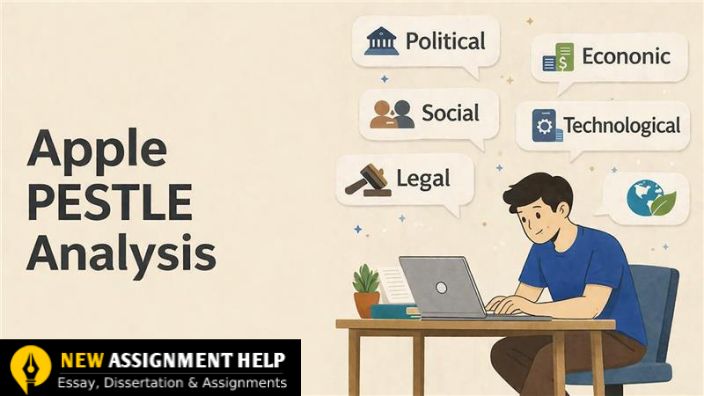
Apple PESTLE Analysis: A Complete Guide for Business Students
- Apple PESTLE Analysis: A Complete Framework Guide for Business Students
- What Is PESTLE Analysis? (A Brief Overview)
- The Six PESTLE Factors That Influence Apple
- P- Political Factors
- E- Economic Factors
- S- Social Factors
- T- Technological Factors
- L- Legal Factors
- E- Environmental Factors
- How Do Global Market Trends Shape Apple’s Business Strategy?
- The Role of PESTLE Analysis for Apple’s Future Growth?
- Why Do Students Struggle with PESTLE Analysis in Business Assignments?
- Final Thoughts
Apple PESTLE Analysis: A Complete Framework Guide for Business Students
Have you ever used PESTLE analysis in your business assignment? If so, then you might have struggled. This is because identifying the correct external factors and connecting them to a real company often feels confusing. Many students struggle to distinguish between political, economic, or technological influences while analysing a large global organisation like Apple Inc. However, PESTLE analysis provides a clear structure to guide you with an analytical approach to business.
In this blog, we will provide you with a clear overview of how the PESTLE framework works in different business environments. Therefore, by exploring each external factor step by step, you will learn its effectiveness in understanding the framework. So keep reading to gain the benefit of tailored support for business assignments or project work today!
What Is PESTLE Analysis? (A Brief Overview)
It is a strategic framework which is used to examine external macro-environmental factors that affect the performance of organisations. It guides students in studying market trends, risk management, and competitive advantages, which are essential for marketing and management.
Let's have a look at the key aspects of PESTLE analysis in detail:
- This analysis focuses on factors outside the direct control of the company and may affect its operations, growth, and competitiveness.
- The framework studies political, economic, social, technological, legal, and environmental factors that influence industries and organisations such as Apple Inc.
- PESTLE analysis helps businesses and students evaluate risks, recognise opportunities, and understand how external conditions affect strategic planning.
Understanding the key aspects of PESTLE analysis is only one thing, but it is more than that. Now, look at the section below to explore its six major factors in detail.
The Six PESTLE Factors That Influence Apple
PESTLE analysis is a strategic framework that is used to evaluate the external environment of an organisation by its key factors. It helps the companies to estimate risk, market opportunities and strategic planning by understanding current economic trends. Here is the breakdown of the six PESTLE factors:
P- Political Factors
This factor is based on the government policies and trade regulations in the countries. Apple sells its products in a global market and is highly dependent on international manufacturing networks. Therefore, changes in government decisions directly affect the production cost and disrupt the global supply chain of the company.
- Practical Scenario 1 – Trade Policies and Tariffs: Trading policies affect the market significantly and can influence Apple’s manufacturing and pricing strategies on a large scale. For example, tariffs on imported electronics or components may increase production costs, which could affect product pricing and profit margins.
- Practical Scenario 2 – Government Regulations and Market Access: Countries in the world impose different rules related to data security, digital services and product standards. To sustain itself in the market, Apple follows these policies to operate in global markets by adapting its services and software policies.
E- Economic Factors
The economic sector involves financial conditions that influence consumer purchasing power and business performance. These factors are inflation, exchange rates, economic growth, and employment levels. As a technology brand, Apple's sales often depend on global economic stability and consumer spending patterns.
- Practical Scenario 1 – Consumer Purchasing Power: During periods of economic growth, consumers purchase high-end devices such as smartphones, laptops, and tablets. As inflation rises, spending on premium electronics declines.
- Practical Scenario 2 – Currency Exchange Rates: Companies often sell their products in a global market, so fluctuations in currency exchange rates can affect their revenue. This also reduces the earnings of Apple when prices are converted into US dollars.
S- Social Factors
Social factors such as cultural trends, lifestyle preferences, demographics, and consumer behaviour influence product demand. Technology companies like Apple must recognise the changing consumer expectations to remain competitive.
- Practical Scenario 1 – Demand for Premium Technology Products: Many consumers link Apple products with innovation, design and product quality. As a result, the demand among users for these high-quality products and integrated digital ecosystems increases with time.
- Practical Scenario 2 – Changing Digital Lifestyles: With the increasing dependency on smartphones, remote work tools, and digital services, individuals are choosing a comfortable lifestyle. Thus, it raises the demand for Apple devices and software platforms.
T- Technological Factors
Technological factors involve advancements in innovation, research and development, and digital infrastructure. Therefore, Apple works in a highly competitive technology sector where continuous innovation is necessary to maintain leadership in the market.
- Practical Scenario 1 – Product Innovation and R&D: Apple invests heavily in research and development to introduce new technologies. As a result, it improves device performance and expands its ecosystem of hardware and software products.
- Practical Scenario 2 – Emerging Technologies: With the evolving digital world, developments in artificial intelligence, cloud computing, and wearable technology influence the product strategy. This provides an innovation opportunity to Apple for its future work.
L- Legal Factors
In the legal factor of the PESTLE analysis, elements such as laws and regulations are mentioned. These may involve intellectual property rights, consumer protection laws, competition regulations, and data privacy policies, which are followed by businesses.
- Practical Scenario 1 – Intellectual Property Protection: Companies protect their designs, software, and technology through patents and trademarks. This helps to defend their rights from competitors copying their innovations.
- Practical Scenario 2 – Data Privacy Regulations: Many countries enforce strict privacy laws regarding user data protection. For this, companies must ensure that their software, services, and applications comply with these regulations.
E- Environmental Factors
The factors related to the environment include sustainability concerns, climate policies, and ecological responsibilities that influence business operations. Technology companies face increasing pressure to reduce environmental impact while developing their products.
- Practical Scenario 1 – Sustainable Manufacturing: Apple has introduced initiatives to reduce carbon emissions and use recycled materials in the process of manufacturing. This is mainly to improve energy efficiency for the sustainable development of the company.
- Practical Scenario 2 – Electronic Waste Management: The company also focuses on recycling programmes and product lifecycle management. This function helps in reducing electronic waste and promotes responsible disposal of old devices.
Understanding these factors helps students to evaluate how external conditions influence the business strategies and operations of the global companies. In the next section, we will guide you with the current global market trends.
How Do Global Market Trends Shape Apple’s Business Strategy?
Global business trends play a major role in shaping the strategies of multinational technology companies. However, businesses must constantly observe shifts in consumer behaviour, technological innovation and digital adoption to sustain themselves in the market.
In this particular section, we will discuss the importance of market trends:
Growing Demand for Smart Devices
Consumers around the world are demanding devices that offer high performance and seamless integration. So, Apple positions its products as premium technology solutions, which allows the company to target customers who value advanced features.
Expansion of the Digital Ecosystem
In an increasingly digital world, modern consumers rely on interconnected digital services such as cloud storage and online entertainment. Therefore, Apple strengthens its strategy by building a connected ecosystem of devices and services, providing users with technological advancement.
Rising Influence of Emerging Markets
Developing economies provide significant opportunities for growth in the technology sector. As a result, Apple explores strategies such as improving distribution networks and adjusting pricing models to increase the availability in these regions.
Increasing Focus on Innovation
Technology companies are continuously working to attain innovation in the market. Therefore, Apple focuses on research, design, and user experience to differentiate its products from competitors.
Global market trends are continuously influencing the strategic direction of Apple, and for that, the company improves its strategies for long-term growth. For this, it is necessary to understand the futuristic aspect of PESTLE mentioned in the next section.
The Role of PESTLE Analysis for Apple’s Future Growth?
The structured PESTLE framework helps the organisation in evaluating different external factors that influence its operations. In the following segment, you will explore new opportunities in changing market environments:
- Strategic Decision Support: This analysis helped Apple in examining external influences before making major strategic decisions. By understanding regulatory changes, the company can plan long-term growth strategies more effectively.
- Risk Identification: It is essential to identify external factors, such as government policies and economic fluctuations, for risk assessments. Therefore, PESTLE analysis enables Apple to identify these risks early and develop strategies to minimise their impact.
- Market Opportunity Insights: This framework also emphasises the emerging opportunities in new markets. So, this technique will help Apple to identify the areas for expansion and innovation in its technical advancement.
- Sustainable Business Planning: PESTLE analysis guides the company with environmental and legal considerations in the world. Thus, it provided structural support to Apple in aligning its business practices with sustainability goals and regulatory expectations.
Altogether, PESTLE analysis provides a proper way to understand the external forces which affect the performance of Apple. You can also use this analysis in your business assignment to strengthen your position in the further section.
Why Do Students Struggle with PESTLE Analysis in Business Assignments?
PESTLE analysis becomes a challenging technique, as it requires more than simply defining the six factors. In this section, we will guide you through its difficulties and the following measures to develop a clear understanding:
- Difficulty Identifying Factors: Sometimes, it is very difficult to determine which external issues belong to each PESTLE category. To handle this, you must clearly define each PESTLE factor in the beginning and then categorise external events according to their primary influence.
- Lack of Practical Examples: This is a major setback, as a lack of practical knowledge makes your business assignment descriptive. Therefore, use real examples from companies like Apple Inc. to demonstrate how external conditions affect business strategies.
- Weak Analytical Depth: Students in the UK often struggle with low analytical skills when explaining the factors of the PESTLE framework. So, for a strong analysis, explain how each external factor influences business decisions, performance, or strategic planning.
- Unclear Structure: Assignments may appear disorganised when students present information randomly. Therefore, use a consistent format that explains the factors first and then supports them with specific examples to create a logical analysis.
- Limited Research Sources: This type of analysis uses credible sources to present genuine work. So, prepare a PESTLE analysis by using reliable academic sources, industry reports, and verified news to demonstrate the latest trends in business.
These are some of the challenges, and you can eliminate them by applying practical solutions in business assignments to ensure accuracy. Hence, a well-researched and structured approach leads to better evaluation and stronger assignments that reflect quality work.
Final Thoughts
From the above information, you are now enabled to create your own PESTLE analysis to ensure accuracy in your business assignments. However, it involves a variety of complex tasks that require proper structure and research. Hence, the solution to all these factors lies in following a clear framework and using a correct practical approach.
If you are still struggling with your assignment, then seeking structured academic guidance can make a difference. With the expert assistance from New Assignment Help UK, you can better understand frameworks and improve the quality of analysis. So, don’t hesitate and take the next step to complete your business assignments with greater confidence.

 13 | PhD
Prof. Claire Montgomery has dedicated the past 13 years to lecturing in strategic management and global business at UK higher education institutions holds PhD. Through years of guiding students on real-world company evaluations, she has developed a sharp eye for how macro-level forces influence major tech brands like Apple. She specialises in breaking down practical frameworks such as PESTLE to discover the opportunities and risks in political shifts, economic trends, social changes, technological advances, legal requirements, and sustainability pressures of the company. Her approachable guidance helps UK students build stronger analytical skills, craft well-supported arguments, and deliver insightful business assignments with greater confidence and clarity.