Operations Management Practices at TUI Group Assignment Sample
Operations Management is used for planning, organizing, and controlling the production and delivery
- 92650+ Project Delivered
- 1500+ Experts 24x7 Online Help
- No AI Generated Content


- Introduction - Operations Management Practices at TUI Group Assignment
- What is Operations Management?
- Background of TUI Group
- Aim and Scope of the Report
- Operations Management at TUI Group
- The Input-Transformation-Output Model
- Application
- Inputs at TUI Group
- Transformation Processes at TUI Group
- Outputs at TUI Group
- Process Design Objectives at TUI Group
- Objectives of Process Design in Operations Management
- How TUI Achieves These Process Design Objectives and Their Benefits
- Standardization in Operations Management and Its Importance to TUI
- Examples of Standard Processes at TUI
- Capacity Management at TUI Group
- The Capacity Management Framework in Operations Management
- How TUI Group Applies the Capacity Management Framework
- The Importance of People in Operations Management and How TUI Manages Its Employees
- Process Mapping at TUI Group
- What is Process Mapping?
- The Customer Journey at TUI Group
- Strategies to Enhance Customer Experience at TUI
- Planning and Control at TUI
- Enterprise Resource Planning (ERP)
- How TUI Uses ERP Systems to Manage Its Operations
- Benefits and Challenges of Implementing ERP at TUI
- Quality Management at TUI
- Quality Management in Operations
- Importance of Continuous Improvement in Operations Management
- Implementation of the PDCA Model at TUI
- Responsible Operations at TUI
- Sustainability in the Context of Operations Management
- Sustainability Initiatives at TUI
- Additional Strategies for Improving Sustainability at TUI
Introduction - Operations Management Practices at TUI Group Assignment
What is Operations Management?
Operations Management is used for planning, organizing, and controlling the production and delivery of any item or facility to achieve maximum results (Slack, Brandon-Jones and Burgess, 2023). The essence is inefficient resource management, optimum processes, and high productivity at minimum cost. The areas of OM covered include process design, supply chain management, quality control, and inventory management, which are coupled with sustainability initiatives. OM has a vital role to play while business is in the tourism industry by improving customer experience, minimizing delays during service delivery and managing the smooth flow of activity.
Integrating human resource planning with daily operational tasks is critical for hospitality leaders, making specialized
Background of TUI Group
With its vast range of services, TUI Group is dedicated to providing high-quality travel with investments and sustainable initiatives that promote digital transformation (TUI Group, 2025). As with any issues posed by the COVID-19 pandemic, TUI has successfully recovered from challenges by adopting innovative strategies in fleet management, financial automation, and service customisation.
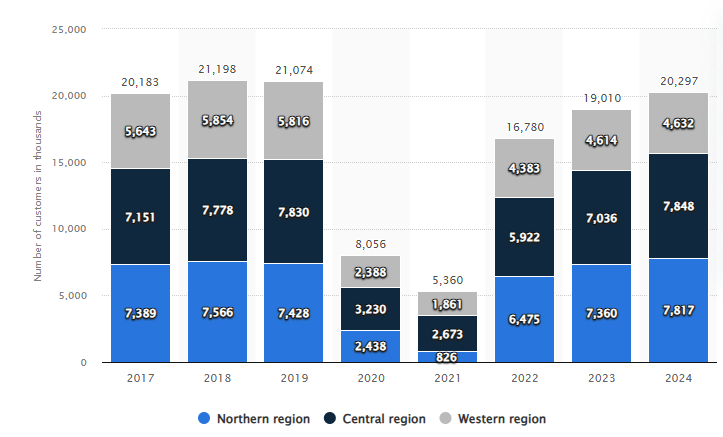
Figure 1: Customers of TUI AG worldwide 2017-2024, by market
The number of TUI AG customers worldwide grew in 2024 over the previous year but remained below pre-pandemic levels (Statista, 2023). Between October 2023 and September 2024, the Central region, which includes TUI's tour operations and airlines in Germany, Austria, Poland, and Switzerland, recorded the highest number of customers, at roughly 7.8 million. TUI Group is the world’s leading tourism group, with sales of almost 20 million customers (TUI Group, 2025). It operates an extensive tourism value chain, including hotels, resorts, airlines, cruise ships, and travel agencies. From this perspective, the company integrates its digital platforms to improve the customer experience and operational efficiency and simplify financial management.
Aim and Scope of the Report
This report aims to analyse TUI Group’s operations management practices by evaluating its processes, the purpose of designing the processes, customer experience strategies, the group's planning and quality management approaches, and sustainability initiatives. Relevant OM theories, concepts, and contemporary practices will be applied to the report by assessing TUI’s operational performance (Slack, Brandon-Jones and Burgess, 2022). Moreover, suggestions for responsible operations improvement will be given to sustain long-term business. This analysis will provide information about the role of operations management in improving service efficiency, customer satisfaction, and competitive advantage in fulfilling tourism services.
Operations Management at TUI Group
The Input-Transformation-Output Model
The key components of the ITO model are:
Inputs: These are the resources used in the production process. Inputs can be categorized into:
- Material Inputs: Physical resources such as hotel infrastructure, aeroplanes, and cruise ships.
- Human Inputs: Employees, tour guides, customer service representatives, and operational staff.
- Capital Inputs: Financial investments, technology, and digital platforms.
- Informational Inputs: Market research, customer preferences, and travel data.
Transformation Processes: These involve converting inputs into outputs through different operational activities. In the tourism sector, this includes:
- Service design and customization.
- Travel planning and logistics.
- Booking and reservation management.
- Customer service and experience enhancement.
- Supply chain and quality management.
Outputs: The final products or services delivered to customers. In TUI’s case, outputs include:
- Tangible outputs: Holiday packages, hotel accommodations, and cruise trips.
- Intangible outputs: Customer satisfaction, enhanced brand reputation, and seamless travel experiences
Application
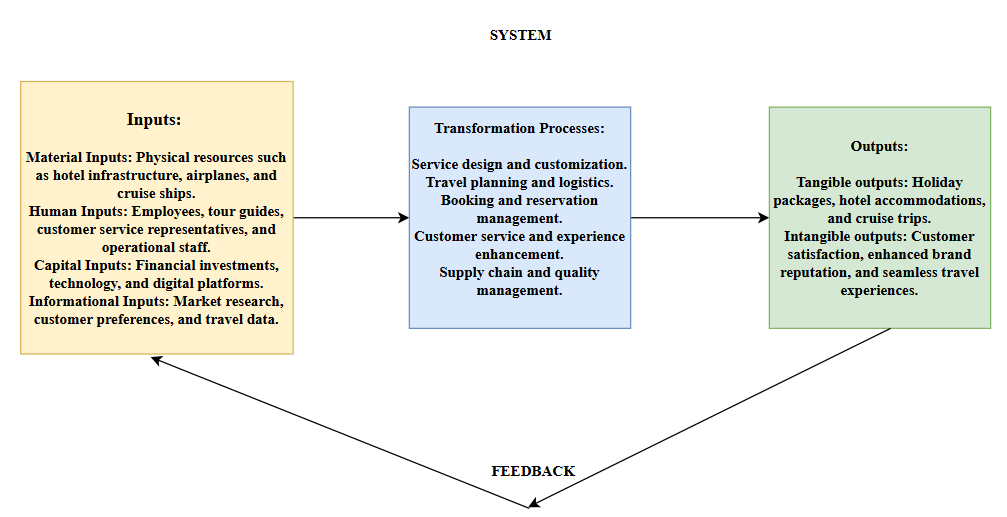
Figure 2: Input-Transformation-Output Model in TUI Group
Inputs at TUI Group
TUI Group's effective delivery of travel services depends on the combination of material, human, capital, and informational inputs. Material inputs include over 400 hotels and resorts under RIU, TUI Blue, Robinson, etc. Along with over 130 aircraft that guarantee global travel connectivity, the company operates a fleet of 17 cruise ships, including luxury and expedition vessels. TUI’s physical assets are the foundation of service delivery (TUI Group, 2025).
Over 70,000 humans worldwide play vital roles throughout operations, such as pilots, hotel staff, travel agents, and IT specialists. They all help offer a high-quality, seamless customer experience as tour guides, hospitality staff, customer support, etc.
Financial investment in a larger or more modern hotel infrastructure, maintenance of cruise ships, as well as in airline operation. However, with advanced online booking platforms and AI customer services, TUI has also been big on digital transformation (TUI Group, 2025).
Transformation Processes at TUI Group
For TUI, it uses a variety of operational strategies to change its inputs into high-quality travel experiences. It is a travel package creation that combines flights, hotel stays and excursions into appealing holiday packages designed to satisfy the varying tastes of different customers. The company has adopted service customizing strategies, offering dynamic packages and single components, enabling flexibility and personalisation (Johnston et al., 2021).
The focus is on operational efficiency, and TUI applies standardized global operations to lower costs and improve service delivery. The company’s adoption of SAP financial systems gives it more control over operating expenses and allows it to spend more accurately and insightfully (Camilleri, 2019). Furthermore, TUI has made efforts to promote sustainability through fuel-efficient aircraft, optimising cruise ship operations, and transitioning to sustainable aviation fuels to reduce emissions.
Outputs at TUI Group
TUI’s operational model is the final output of comprehensive and high-quality travel experiences. The company sells all-inclusive holiday packages, guided tours, and luxury cruises to many customers (TUI Group, 2025). It has achieved a high Net Promoter Score of 52, indicating excellent customer satisfaction and loyalty with a high focus on operational excellence.
Process Design Objectives at TUI Group
Objectives of Process Design in Operations Management
Process design is vital in operations management, facilitating efficiency, effectiveness, and consistency with organisation objectives. Process design has primary objectives: quality, speed, dependability, flexibility, costs and sustainability. These objectives define how successful an organisation is in meeting its customers with maximum value and resource optimisation (Paton et al., 2021). Quality ensures that the products and services meet or exceed customer expectations. In the tourism industry, quality is essential to customer satisfaction, brand image, and business growth. Elements included are hotel service excellence, a seamless booking process, and well-arranged travel fronts.
Operations management contains speed as how quickly products or service can be given. It is evident in the tourism sector, where speed occurs through flight operations management of the speedy process, quick hotel check-in and speedy response in customer service (Paton et al., 2021). Bettering service speed not only gives a better impression of services but also cuts down delays and bottlenecks, reducing operational cost. Dependability refers to the consistency and reliability of an organization’s services. This helps to ensure that customers receive the expected level of service with consistency or without any inconsistencies (Slack, Brandon-Jones and Burgess, 2022). A trusted tourist firm keeps the same level of standards, flight departure times, service to guests across all touchpoints.
Adaptability or flexibility is adapting to the customer’s preferences, market conditions, and operational challenges. A flexible company can stretch and modify holiday packages, alter flight schedules, and offer personalised services according to the customers' changing needs. Sustainability has now been identified as an integral objective in modern operation management (Slack, Brandon-Jones and Burgess, 2022).
How TUI Achieves These Process Design Objectives and Their Benefits
Investments in premium accommodations, state-of-the-art cruise ships, and well-maintained aircraft ensure quality. TUI’s hotels and resorts all have high service standards, and TUI’s customer service teams are trained to answer questions professionally (Robinson and Jones, 2020). This approach enhances customer satisfaction, building strong brand loyalty and repeat bookings.
The streamlined booking platforms and efficient travel logistics provide a more optimal speed. TUI’s digital transformation project involves developing a single customer account system to help customers seamlessly manage their bookings. Additionally, the company manages fleet management centrally to ensure punctual departures and reduce delays (Robinson and Jones, 2020). The resulting speed transfer enhances customer experience while maintaining operational efficiency.
Standardised operational procedures and rostered contingency planning reinforce dependability. Automated systems, which contain demand forecasting, inventory management, and real-time customer feedback analysis systems, are a core part of TUI's operations to ensure everything runs smoothly with flights, cruises, or accommodations. This is to build up customer trust and keep service delivery disruptions minimal.
TUI also shows signs of slack in its flexible packaging options, which cater to each customer’s unique preferences. The company's various flight and accommodation options make travellers better positioned to get greater convenience. In addition, its regional teams are engaged in localising marketing and customer engagement strategies (Adhikari and Bhattacharya, 2018). TUI has the flexibility to adapt its offering to the different needs of customers in other markets.
Standardization in Operations Management and Its Importance to TUI
Operations management standardisation is the practice of setting up standardised ways in the case of operations, and this is meant to make operations consistent and efficient across all areas of operations (Salah, Çağlar and Zoubi, 2023). Standardisation enables organisations to make improvements such as reducing variability, enhancing quality, and improving productivity. Standardisation is key for TUI because it is a significant and complex business. Maintaining consistency is imperative to provide a consistent customer experience for its vast network of hotels, cruise lines, airlines, and travel agencies (Agarwal and Mohan, 2021).
Standardisation has a substantial positive impact on cost inefficiency. TUI's standardisation of processes minimises unnecessary expenditures, improves supply chain coordination, and reduces operational redundancies (Agarwal and Mohan, 2021). Standardisation contributes to the reliability of services from different locations because services will have the same quality standards.
Examples of Standard Processes at TUI
Complex these improvements result from standardisation: maintenance becomes more efficient, there are fewer costs in training pilots and engineers, and fuel efficiency is improved. The German giant TUI uses a standardised customer account system in customer service, which aligns booking processes, payment methods, and digitised interaction from all channels (Alonso and Ogle, 2008). The services can be accessed quickly, and this system brings a broad range of services, improving engagement and satisfaction.
Standardisation assists with TUI's sustainability efforts. The company follows a structured method to reduce airline, cruise, and hotel emissions. Examples include implementing energy-saving technologies, adopting sustainable aviation fuel, and implementing eco-friendly waste management practices (Bozkurt and Izmir-Turkey, 2010). Stability is obtained through standardising sustainability initiatives to achieve environmental targets.
Capacity Management at TUI Group
The Capacity Management Framework in Operations Management
In operations management, capacity management ensures that an organisation has enough resources to meet customer demand sufficiently (Bustinza Sánchez et al., 2015). This means supplying and demand balance while lowering costs and retaining service quality. The framework consists of three key components in it.
Long-term Capacity Planning involves decisions on infrastructure, workforce, and resource investment to meet the demand that is ultimately projected over extended periods (Lv, 2023). Market research helps companies determine how they can accommodate growth in the future.
Seasonal Demand Fluctuations—This involves medium-term capacity planning and maintaining optimal resource allocation and adjusted workforce requirements. Such techniques optimise inventory and ensure workforce scheduling and service availability for businesses (Bustinza Sánchez et al., 2015).
In many ways, Short-Term Capacity Planning involves timeframes as short as the immediate demand, including decisions affecting flight scheduling, hotel occupancy, and cruise ship capacity. Unexpected demands or operational disruptions require businesses to respond quickly (Bustinza Sánchez et al., 2015).
How TUI Group Applies the Capacity Management Framework
TUI invests in infrastructure, digital transformation and fleet optimisation for long-term capacity planning. The company strategically expands its hotel and cruise offerings using customer demand and travel trends. TUI integrates AI-driven tools to use forecasts to know what to invest in the future. For example, its fleet modernisation strategy of spinning down many aircraft types to only a few saves long-term mission expenses and ensures operational efficiency (Lv, 2023).
TUI manages seasonal demand fluctuations in travel in medium-term capacity planning by flexibly changing the flight schedule, hotel occupancy rate and cruise ship route. Centralised demand forecasting is also used by the company to optimise seat availability and hotel bookings, as well as to optimise the allocation of resources (Godovykh and Tasci, 2020). TUI implemented a more efficient capacity-sharing strategy through its partnership with Ryanair in 2024, which incrementally increased the variety of flights without increasing the operational costs.
TUI uses real-time data analytics to track customer bookings, weather conditions, and travel disruptions for short-term capacity planning. However, an unexpected rise in demand is always good news for the company, which can boost hotel availability and add new flights with dynamic pricing and flexible reservation systems (Godovykh and Tasci, 2020). In addition to TUI’s digital customer engagement tools, instant booking trends insights provided to the company enable quick adjustments in capacity to avoid delays or overbooking.
The Importance of People in Operations Management and How TUI Manages Its Employees
Operations management is all about the people who deliver service, keep it running smoothly, and build customer satisfaction. Employees in the tourism industry are critical to positively influencing and maintaining customer satisfaction, executing logistics, and implementing plans. An organised and motivated workforce is necessary to ensure service excellence, operational reliability, and company success (Zhenjing et al., 2022). TUI Group realises that its employees are essential and that specific measures are taken to ensure workforce engagement, training, and productivity. The company leads employee development and has an inclusive work environment.
Training and upskilling are among TUI’s most essential workforce strategies. In 2024, the company trained 30,000 employees in generative AI to make them future-ready for digital transformation (TUI Group, 2025). Investing in automation processes, eliminating human errors, and making data-based decisions enhance operational efficiency and save time. An operations manager is an HR expert in upper management responsible for high-level human resources duties, including hiring new staff and setting standards for staff training.
Academic pressure weighing you down? Discover Assignment Help UK that makes a difference! From research papers to case studies, we've got your back with expert guidance.
Process Mapping at TUI Group
What is Process Mapping?
Process mapping visually represents the steps in an organisation's specific process. It lays out the route from inputs to outputs in a clear and structured layout, showing key touchpoints, decision points and opportunities for inefficiency (Jakulin and Golob, 2015). Process mapping is essential in operations management for enhancing workflow efficiency, minimising bottlenecks, and improving overall service quality. TUI Group uses process mapping to optimise customer interaction, booking process and service delivery for tourism companies like TUI (Jakulin and Golob, 2015). Mapping out operations for TUI allows it to deliver a smooth and consistent customer experience across the company’s travel, hospitality and airline services.
The Customer Journey at TUI Group
The customer journey is the consumer's relationship with a business, from initial awareness of a pain point to post-purchase interactions.
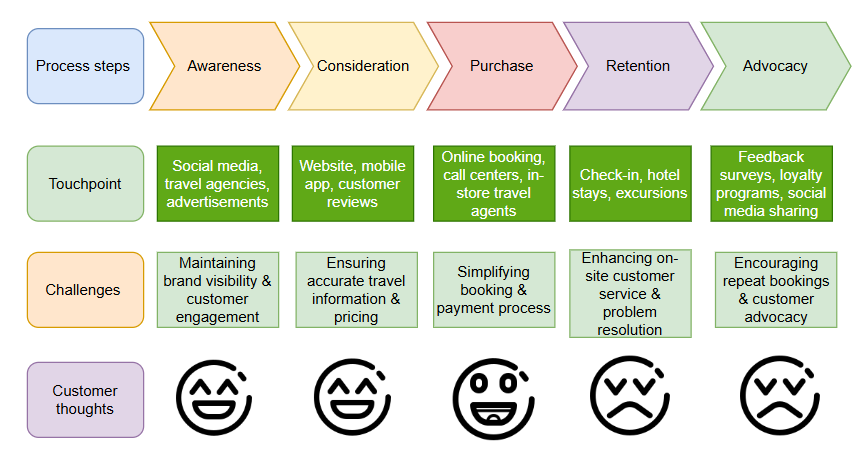
Figure 3: Customer journey
Awareness
The starting point is when potential customers first encounter TUI’s travel offerings on various channels. This stage's main hurdle is maintaining branding visibility in a fiercely competitive tourism market (Dwivedi et al., 2021). TUI allows guiding customer interest through personalised marketing strategies and the right content.
Consideration
Knowing TUI’s services prompts the customer to enter the decision-making phase by evaluating various travel options. That entails browsing the TUI website or the TUI mobile app and reading online reviews to get pricing, locations, and package inclusions.
Purchase
After customers complete their travel plans, they book their trips via TUI’s online platforms, call centres, or store-based travel agencies. To encourage successful conversions, there is no way to the booking process except to be seamless, intuitive and secure (Agarwal and Mohan, 2021). During this stage, customers complete the transactions, get the confirmations, and access details regarding the itinerary. The biggest problem is making a booking and payment process simple, spotting a tech issue, and offering flexibility in changing or cancelling a booking.
Travel Experience
TUI defines the travel experience phase as the phase where it mainly provides its core services, such as flights, cruise operations, hotel stays, guided excursions, and customer service interaction. In this stage, challenges may include a long check-in queue, flight delays, different services when arriving at various destinations, and unexpected disturbances, like weather and operational issues.
Post-Trip Engagement
Customers enter the post-trip engagement phase, reflecting on their travel experience and providing feedback (Godovykh and Tasci, 2020). TUI asks customers to share their experiences through online reviews, social media posts, and direct feedback surveys.
Strategies to Enhance Customer Experience at TUI
- Mobile Applications – Automating mobile applications and self-service portals with faster bookings and real-time travel updates.
- Dynamic pricing – Boosting revenue for airlines and hotels with changes in demand, times, and price differences.
- Integrating chatbots, AI-driven help desk and multilingual customer service team for seamless multichannel support in case of any issue.
- Incentives and Loyalty Programs – Increase rewards programs with special discounts, VIP services, and more targeted promotions for repeat customers.
- Sustainable Tourism – Featuring eco-friendly travel options, limited carbon footprints, and the inclusion of customers in sustainable travelling efforts (Godovykh and Tasci, 2020).
Planning and Control at TUI
Enterprise Resource Planning (ERP)
According to this, Enterprise Resource Planning (ERP) software is an integrated system that controls the usual working processes in businesses, including finance, supply chain, human resources, and customer service (McCue, 2024). ERP consolidates the information of various departments into a single place on a unified platform, thus catering to real-time decisions, significant use of time and efficiency, and the best utilisation of available resources (Lemon and Verhoef, 2016). ERP automates several key functions, minimising errors, coordinating workflow, and scaling up the business.
How TUI Uses ERP Systems to Manage Its Operations
TUI Group has implemented ERP systems to run smoothly for business units such as airlines, hotels and cruise operations. The company moved from Oracle as its central ERP system toward better financial management, process automation and data-driven decision-making using SAP (Li et al., 2023). TUI synchronises its travel agencies, fleet management teams, customer service departments, and supply chain networks to integrate ERP. The ERP system will manage supplier payments, financial transactions and cost efficiency. ERP automation decreases manual error and reduces time to report financials through such functions as more than five million supplier invoices processed annually. In this case, TUI also employs ERP for CRM, providing personalised services, a loyalty program, and more efficient booking systems (So, Li and Kim, 2020).
Benefits and Challenges of Implementing ERP at TUI
TUI benefits from ERP implementation, such as improved operational efficiency, cost reduction, and customer experience. TUI standardises financial processes and automates expense tracking, attaining better cost control and financial transparency. In addition, the system that supports demand forecasting also supports capacity planning and optimally minimises service disruptions (So, Li and Kim, 2020).
System implementation of ERP, however, is a long and expensive process characterised by high initial costs, complex system integration and employee adaptation to the new technology. Training and infrastructure investment in transitioning from legacy systems to a unified ERP framework is significant (AlMuhayfith and Shaiti, 2020). Safety data is also crucial to another concern added in ERP management: data security and compliance with international regulations. However, TUI’s ERP system has contributed significantly to ensuring the company's continued efficiency in utilising its resources and facilitating better decision-making and seamless service delivery.
Quality Management at TUI
Quality Management in Operations
Operations refer to quality management as a systematic way of assuring that organisations' products and services meet established benchmarks of excellence. Continuous monitoring, process optimisation, and customer feedback integration will improve service delivery (Giamos, Doucet and Léger, 2023). In the tourism industry, quality management is vital because it directly impacts customer satisfaction, brand reputation, and business success.
Importance of Continuous Improvement in Operations Management
Continuous improvement is the only way to achieve competitive advantage and long-term business sustainability. Thus, companies can regularly assess service quality, customer feedback, and operational performance to identify service and operational performance gaps and implement required changes (Gilbert et al., 2023). Maintaining high hotel accommodations, airline services, and customer support standards in the tourism industry will help us secure customer trust and loyalty.
It is all about continuous improvement with TUI, keeping its travel offerings competitive, having minimal service interruptions, and exceeding customers' expectations (Gilbert et al., 2023). Based on real-time data analytics and consumer insights, TUI is even better placed to prevent service gaps and coming up with cutting-edge solutions for enhancing the travel experience.
Implementation of the PDCA Model at TUI
PDCA(Plan-Do-Check-Act) helps to carry out the systematic process of continual improvements and works perfectly with TUI's operations.
- For TUI, planning naturally brings up some specific areas for improvement about waiting time- check-in, the digital booking system, or changes in airline schedules. The findings from the data would assist in laying down specific objectives and strategies readily.
- The next phase, Do, would consider implementing small changes or pilot projects to evaluate whether improvements could indeed be made in any aspect.. For example, TUI might automatically install automated check-in kiosks at key points and automate real-time customer support with AI-based chatbots (Jakulin and Golob, 2015).
- TUI would analyse the effect of the resulting changes during the Check phase, collect customer feedback, maintain specific key performance indicators, and evaluate operational efficiency.
- During the Act phase, the successful strategies are generalised as processes, which are further refined through ongoing performance evaluation. TUI's quality management practices can be continuously modified to satisfy changing customer desires and industry trends.
Responsible Operations at TUI
Sustainability in the Context of Operations Management
Operations management related to sustainability involves how environmental and social responsibility are integrated as part of business operations. A process to minimise the impacts on both the environment and efficient use of resources, provided with the maintenance of economic and social sustainability over a period of time (Velenturf and Purnell, 2021). In the tourism industry, sustainability is of special importance because of the industry’s use of natural landscapes, cultural heritage, and community engagement. Sustainable operations help businesses remain profitable while reducing their carbon footprint, conserving resources, and assisting with community development (Mensah, 2019).
As a global tourism leader, TUI Group has seen the need for sustainability to preserve its responsible, ethical operations (Gilbert et al., 2023). TUI embeds sustainability within its operations to reduce environmental impact, improve stakeholder engagement, and achieve business resilience.
Sustainability Initiatives at TUI
Various sustainability initiatives have been implemented to minimise its environmental footprint and the role of TUI in responsible tourism. The other important strategy it is pursuing is reducing carbon emissions (Bhatia et al., 2025). However, the company aims to drastically lower emissions from airline, cruise, and resort operations, as it has set ambitious targets for the reduction. TUI seeks to cut airline emissions by 24%, cruise emissions by 27.5% and hotel emissions by 46.2% by 2030 (Davies, 2023). Fleet renewal, use of sustainable aviation fuels and energy-efficient ship operations are these goals being pursued.
TUI is also proactively investing in renewable energy and resource efficiency. In addition to meeting some principles of environmental sustainability, TUI is also taking care of some common social sustainability principles by addressing local communities (Bhatia et al., 2025). The company offers job opportunities, helps local businesses, and works with organisations, including National Geographic Expeditions, to develop educational and cultural tourism activities.
Additional Strategies for Improving Sustainability at TUI
TUI has made massive progress with its sustainable operations, which could be improved to reduce its impact. If the effects from TUI’s airline division are reduced to nil, the company will have to expand sustainable aviation fuels and transit to carbon neutrality for flights (Almena et al., 2024). Switching to alternative energy sources for cruise ships, ly hydrogen or electric propulsion, would also enable the company to reduce emissions from shipping operations.
Conclusion
This report has analysed TUI Group's operations management through the analysis of its process design, capacity management, quality control, customer experience strategies, and sustainability. Applying the theories and models of operations management to how TUI optimises its services enhances its ability to improve customer efficiency and satisfaction while controlling its costs and challenges of sustainability. The input transformation output model showed the conversion of the resources into valuable travel experiences that TUI provides, and the PDCA model presented the framework of continuous quality improvement.
ERP systems help to bring together business functions to trade as one, and standardised operational processes are paramount in meeting deadlines and efficiency. Capacity management is also critical for balancing supply and demand. Furthermore, TUI’s sustainability efforts, which involved minimising carbon emissions, using renewable energy, and engaging with local communities, were also noted. TUI should also increase investment in alternative fuels and renewable energy sources to enhance its operations further. AI-driven customer support and automation will also help improve efficiency and personalisation. TUI would keep agile operations management as its main agenda, enabling the company to adjust rapidly to market changes, technological advances, and market requirements.
As a broader study, TUI is an example of how an international tourism company could handle its administration while prioritizing customer fulfilment and the round 'world'. TUI's position in adopting operation strategies by continuously improving and using innovative solutions will continue to ensure its competitiveness in the 21st-century tourism industry.
References
- Adhikari, A. and Bhattacharya, S. (2018). Strategic Marketing Issues in Emerging Markets. Singapore: Springer Singapore.
- Agarwal, N. and Mohan, A. (2021). Influence of Social Interaction on Customer Experience in Tourism Industry. PURUSHARTHA - A journal of Management, Ethics and Spirituality, [online] 14(2), pp.104–116. Available at: https://journals.smsvaranasi.com/index.php/purushartha/article/view/1206 [Accessed 15 Mar. 2025].
- Almena, A., Siu, R., Chong, K., Thornley, P. and Röder, M. (2024). Reducing the environmental impact of international aviation through sustainable aviation fuel with integrated carbon capture and storage. Energy Conversion and Management, [online] 303, p.118186. doi:https://doi.org/10.1016/j.enconman.2024.118186.
- AlMuhayfith, S. and Shaiti, H. (2020). The Impact of Enterprise Resource Planning on Business Performance: With the Discussion on Its Relationship with Open Innovation. Journal of Open Innovation: Technology, Market, and Complexity, 6(3), p.87. doi:https://doi.org/10.3390/joitmc6030087.
- Alonso, A.D. and Ogle, A. (2008). Exploring design among small hospitality and tourism operations. Journal of Retail & Leisure Property, 7(4), pp.325–337. doi:https://doi.org/10.1057/rlp.2008.23.
- Bhatia, M., Gugnani, R., Yaqub, M.Z., Tripathi, P.M. and Broccardo, L. (2025). Emission Reduction Strategies and Negative Emission Solutions- Pathways, Drivers, and Challenges. Journal of Cleaner Production, [online] p.145263. doi:https://doi.org/10.1016/j.jclepro.2025.145263.
- Bozkurt, A. and Izmir-Turkey, K. (2010). TOURISM INDUSTRY AND STANDARDISATION: AN IMPOSSIBLE TASK? Sosyal Bilimler Enstitüsü Dergisi, Cilt, 19, pp.331–344. doi:https://dergipark.org.tr/tr/download/article-file/50633.
- Bustinza Sánchez, Ó.F., Vendrell-Herrero, F., Baines, T.S. and Parry, G. (2015). Service business model and performance: Unpacking the complex relationship. digibug.ugr.es. [online] Available at: http://hdl.handle.net/10481/41020 [Accessed 15 Mar. 2025].
- Camilleri, M.A. (2019). Tourism Planning and Destination Marketing. Emerald Group Publishing.
- Davies, P. (2023). Tui Group outlines ambitious emissions cutting targets. [online] Travel Weekly. Available at: http://travelweekly.co.uk/news/air/tui-group-outlines-ambitious-emissions-cutting-targets [Accessed 15 Mar. 2025].
- Dwivedi, Y.K., Ismagilova, E., Hughes, D.L. and Carlson, J. (2021). Setting the future of digital and social media marketing research: Perspectives and research propositions. International Journal of Information Management, [online] 59(1), pp.1–37. doi:https://doi.org/10.1016/j.ijinfomgt.2020.102168.
- Giamos, D., Doucet, O. and Léger, P.-M. (2023). Continuous performance feedback: investigating the effects of feedback content and feedback sources on performance, motivation to improve performance and task engagement. Journal of Organizational Behavior Management, [online] 44(3), pp.1–20. doi:https://doi.org/10.1080/01608061.2023.2238029.
- Gilbert, S., Pimenta, A., Stratton-Powell, A., Welzel, C. and Melvin, T. (2023). Continuous Improvement of Digital Health Applications Linked to Real-World Performance Monitoring: Safe Moving Targets? Mayo Clinic Proceedings: Digital Health, [online] 1(3), pp.276–287. doi:https://doi.org/10.1016/j.mcpdig.2023.05.010.
- Godovykh, M. and Tasci, A.D.A. (2020). Customer Experience in tourism: a Review of definitions, components, and Measurements. Tourism Management Perspectives, 35(1), p.100694.
- Jakulin, T.J. and Golob, A. (2015). Systems Approach to Standardisation, Classification and Modelling of Managed Events for Tourism. Organizacija, 48(3), pp.188–197. doi:https://doi.org/10.1515/orga-2015-0016.
- Johnston, R., Shulver, M., Slack, N. and Clark, G. (2021). Service Operations Management. 5th ed. Harlow: Pearson Education Limited.
- Lemon, K.N. and Verhoef, P.C. (2016). Understanding Customer Experience Throughout the Customer Journey. Journal of Marketing, 80(6), pp.69–96. doi:https://doi.org/10.1509/jm.15.0420.
- Li, K., Ji, C., He, Q. and Rastegar, R. (2023). Understanding the Sense‐making Process of Visitor Experience in the Integrated Resort setting: Investigating the Role of Experience‐centric Attributes. International Journal of Tourism Research, 25(5). doi:https://doi.org/10.1002/jtr.2584.
- Lv, Y. (2023). Transitioning to Sustainable energy: opportunities, challenges, and the Potential of Blockchain Technology. Frontiers in Energy Research, [online] 11. doi:https://doi.org/10.3389/fenrg.2023.1258044.
- McCue, I. (2024). Do You Know What ERP is? Learn How ERP Can Help Your Business with This Informative Article. [online] NetSuite.com. Available at: https://www.netsuite.com/portal/resource/articles/erp/what-is-erp.shtml [Accessed 15 Mar. 2025].
- Mensah, J. (2019). Sustainable development: Meaning, history, principles, pillars, and Implications for Human action: Literature Review. Cogent Social Sciences, [online] 5(1), pp.1–21. doi:https://doi.org/10.1080/23311886.2019.1653531.
- Paton, S., Clegg, B., Juliana, H. and Pilkington, A. (2021). Operations Management. London: McGraw Hill.
- Robinson, P. and Jones, P. (2020). Operations Management. Oxford University Press.
- Salah, A., Çağlar, D. and Zoubi, K. (2023). The Impact of Production and Operations Management Practices in Improving Organizational Performance: The Mediating Role of Supply Chain Integration. Sustainability, [online] 15(20), p.15140. doi:https://doi.org/10.3390/su152015140.
- Slack, N., Brandon-Jones, A. and Burgess, N. (2022). Operations Management. 10th ed. Pearson Education Limited.
- Slack, N., Brandon-Jones, A. and Burgess, N. (2023). Essentials of Operations Management. 10th ed. Pearson Education Limited.
- Statista (2023). TUI: number of customers worldwide by market 2020. [online] Statista. Available at: https://www.statista.com/statistics/1264144/tui-ag-customers-worldwide-by-market/.
- So, K.K.F., Li, X. (Robert) and Kim, H.H. (2020). Customer engagement in hospitality and tourism: A Systematic Review and Future Research Agenda. Journal of Hospitality & Tourism Research, 44(2), p.109634801989556.
- TUI Group (2025). About us | TUI Group - One of the world’s leading tourism groups. [online] Tuigroup.com. Available at: https://www.tuigroup.com/en/about-us [Accessed 15 Mar. 2025].
- Velenturf, A.P.M. and Purnell, P. (2021). Principles for a Sustainable Circular Economy. Sustainable Production and Consumption, 27(1), pp.1437–1457. doi:https://doi.org/10.1016/j.spc.2021.02.018.
- Zhenjing, G., Chupradit, S., Ku, K.Y., Nassani, A.A. and Haffar, M. (2022). Impact of employees’ workplace environment on employees’ performance: A multi-mediation model. Frontiers in Public Health, [online] 10(890400). doi:https://doi.org/10.3389/fpubh.2022.890400.