
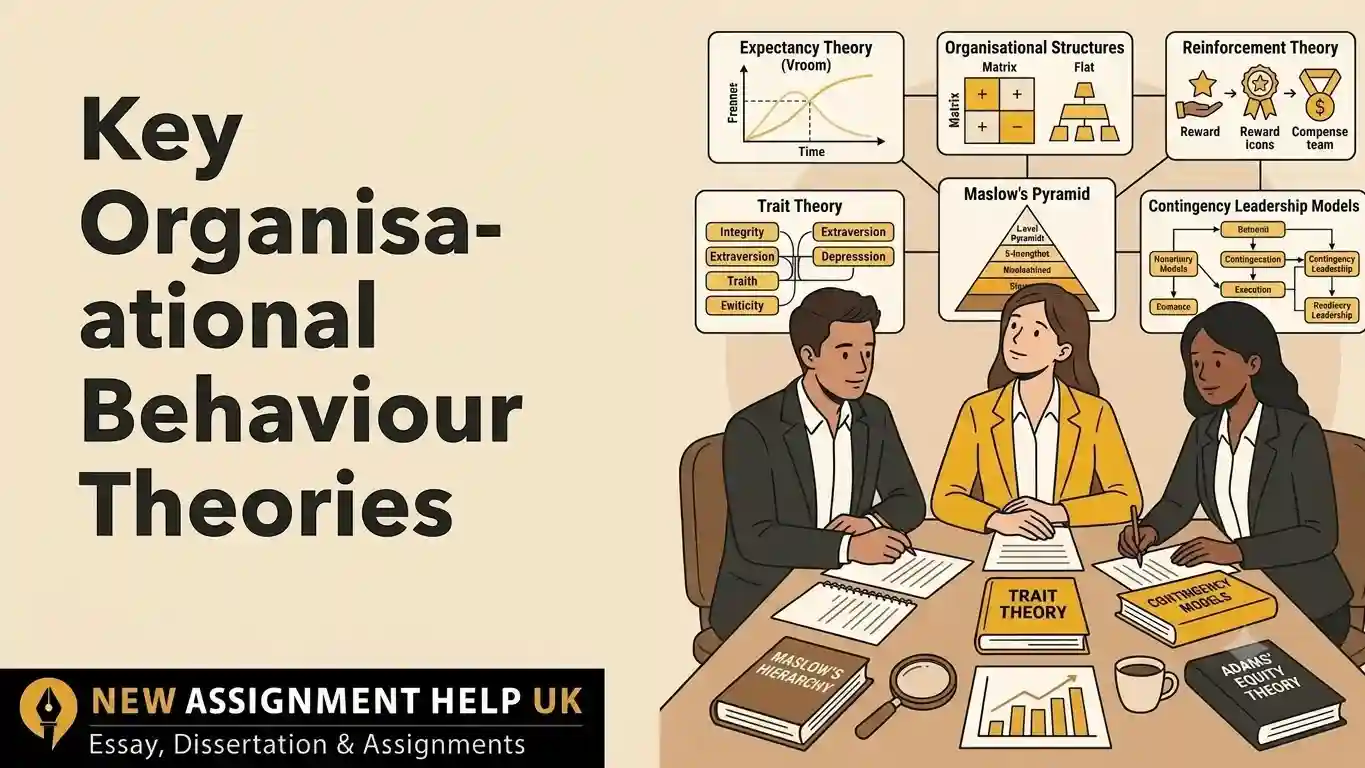
Key Organisational Behaviour Theories for Every MBA Student
- Key Organisational Behaviour Theories Every MBA Student Should Understand
- What Organisational Behaviour Actually Studies
- The Classical Theories That Still Shape Workplaces Today
- Motivation Theories You'll Come Back to Again and Again
- How Groups and Leaders Actually Behave
- What is the current scenario in organisational behaviour theory?
- Turning These Theories Into Actual Answers
Key Organisational Behaviour Theories Every MBA Student Should Understand
Ask any MBA student what part of their management assignment troubles them most in their first term, and organisational behaviour usually comes up. This is not because the subject is hard, but because it throws too many names at you, such as Maslow and Weber, and then suddenly you're comparing five motivation theories in one exam answer. If you've felt that mix of interest and overwhelm while trying to learn organisational behaviour theories, that's normal, and almost every student hits this wall at some point in time.
So this guide will help you with one thing: it covers the theories that actually show up in exams and case studies, which will help you clear all your concepts. With this, you will also get to know how to turn these theories into actual answers and take your assignment to the next level. So, let's get into it without wasting a single minute!
What Organisational Behaviour Actually Studies
It is basically a scientific study that analyses how an individual, group, and a structure interact with each other within a workplace. It pulls from psychology, sociology, and management thinking and explains and improves human behaviour to ultimately support the growth of the business. It is actually broken into three levels:
- At the individual level, it looks at personality, motivation, and perception – why one person succeeds under pressure while another doesn't.
- At the group level, it looks at teamwork, conflict, and communication; why some teams work together and others fall apart.
- At the organisational level, it looks at structure, culture, and change; why the same policy works beautifully in one company and flops in another.
For an MBA student, this isn't something you learn and forget after the exam. Every manager eventually deals with a demotivated team or a change nobody wants. OB helps you see these problems coming instead of reacting after they've already blown up. With that base in place, let's rewind and see where these ideas started.
The Classical Theories That Still Shape Workplaces Today
A lot of what we now call "management" started with three thinkers who never used the term OB.
Taylor's scientific management came from the factory floor. Break a job into its smallest parts, find the most efficient way to do each one, then train workers to repeat it. It sounds mechanical because it was, but it's also why time-and-motion studies still exist in manufacturing today.
Fayol's administrative theory zoomed out to the whole business. Fayol gave managers a working structure: clear authority, one boss per employee, and defined responsibilities. If your company has an org chart, you're working on Fayol's fingerprints.
Weber's Bureaucracy Theory was really about fairness through rules. Weber didn't want decisions made on a manager's mood; instead, he wanted consistent rules applied to everyone, which is where formal HR policies trace their roots.
These three built the skeleton for management theories. Once structure was sorted, a bigger question showed up: how do you get people to actually want to work hard? That's the motivation cluster, and where most exam weight sits.
Motivation Theories You'll Come Back to Again and Again
These theories explain what pushes people to work hard, stay engaged, or check out completely. This is the most tested part of OB, so here are the five you need to know.
Maslow's Hierarchy of Needs is the one that everyone has seen as a pyramid. The idea is simple: people take care of basic needs first, like food and safety, before they even start thinking about things like praise or personal growth. So a worker who's stressed about money won't feel motivated when you give him an "employee of the month" certificate.
Herzberg's Two-Factor Theory identifies two different conditions. Some things at work, like salary and job security, provide employees a temporary satisfaction, but they don't actually motivate them. In place of this, factors like growth and recognition are what genuinely inspire them to do their best work. Paying someone more won't automatically make them love the job.
McGregor's Theory X and Y are really about how a manager sees their team, not about the employees themselves. A Theory X manager believes people avoid work and need constant checking. A Theory Y manager believes people are happy to do good work if you trust them. The way a manager delegates usually gives away which one they believe.
McClelland's Theory of Needs says every person is mainly driven by one of three things: achievement, belonging, or power. Hand an achievement-driven person a boring, repetitive job, and they'll lose interest fast, not because they're lazy, but because it's the wrong kind of work for them.
Vroom's expectancy theory says people work hard only when effort leads to performance, performance leads to reward, and the reward is something they truly want.
A simple way to hold this in your head: Maslow, Herzberg, and McClelland explain what drives people. Vroom explains how that drive turns into a decision to work harder or coast. If you're building an assignment around this comparison and need structured support on management assignments, then you can seek our assistance to clear all your doubts.
How Groups and Leaders Actually Behave
Put five people on a project team, and you don't get five individuals, but you will get a completely different dynamic. OB has a few solid models for this.
Tuckman's Stages of Group Development maps five phases: forming, storming, norming, performing, and adjourning. New managers panic during "storming", thinking conflict means failure. It usually just means the team is figuring itself out.
Belbin's Team Roles says every team member naturally plays a certain role. Some people are great at coming up with ideas. Some are good at finishing tasks on time. Some just keep the team calm and working together. A team full of idea people with no one to finish the work will talk a lot but get little done.
Situational leadership rejects the idea of one correct leadership style. A brand-new employee needs a lot of guidance and clear steps. Someone who's been doing the job for years just needs freedom to get on with it. A good manager changes their style depending on the person, not just their title.
Groups explain how people function together and how teamwork matters for the growth of the company. If you're ever stuck turning one of these models into a full case analysis, review our samples to get an overview of these models.
What is the current scenario in organisational behaviour theory?
Older theories are solid, but they were built for a different type of workplace. Hybrid teams and mental health awareness have pushed OB into a wider scope:
Psychological safety, a term shaped largely by Amy Edmondson's research, describes a team where people can admit a mistake without fear of judgement. It sounds soft, but it focuses on the idea that safer teams consistently perform better and innovate more.
Self-Determination Theory, from Deci and Ryan, says people stay motivated when three things are present: autonomy, competence, and relatedness. It's become their go-to lens for why some hybrid teams get success and others quietly fall apart.
These rarely make it into older textbooks, but they come up often in current case discussions, and knowing them puts you a step ahead in your assignment. Want to know how you can use them in your answers? Here you go!
Turning These Theories Into Actual Answers
A theory sitting in your notes won't help much in an exam or interview. Here's how to actually turn one into a real answer.
- Name the real problem first, like motivation, structure, or leadership, before you pick a theory to fit it.
- Link the theory to an action, not just a definition. "Fix the pay gap first" beats "Maslow's theory applies here."
- Practise writing it out so the logic comes naturally under time pressure, not just in your head.
If your course also expects a full case-based report, try to include a strategic management report to structure each section step by step and achieve excellence in your submission.
Conclusion
By now, you've got a clear picture of the theories that actually matter, not just their names, but why each one exists and how it shows up in a real workplace. That's the difference between memorising OB and actually understanding it. Once the pattern clicks, these stop feeling like separate topics and start feeling like one connected way of reading people at work. And if you ever get stuck turning this understanding into a polished assignment or case study, New Assignment Help UK is there to guide you through it, step by step.

 10 | MBA in HR Management
David Carter is a performance-focused HR consultant and academic support specialist holding an MBA in Human Resources. For the past 10 years he has helped hundreds of UK students produce stronger HR coursework, reports, and dissertations that consistently hit First and high 2:1 standards. David’s strength lies in showing students how to align their work with specific module learning outcomes and grading rubrics. He has deep applied knowledge in performance management, reward strategies, change management, and contemporary issues such as hybrid working and DEI. Students particularly value his ability to turn basic ideas into critically evaluated, well-evidenced arguments while maintaining full academic integrity.
Frequently Asked Questions
What's the difference between organisational behaviour and organisational theory?
How do I remember so many OB theories without mixing them up?
Which theory should I use in a case study about low employee motivation?
Start with Herzberg. It separates what's causing dissatisfaction from what's actually missing for real motivation, and that split maps cleanly onto most low-motivation case studies.
- Check hygiene factors first: salary, safety, work conditions
- Then look at what motivators are missing: recognition, growth, meaningful work