
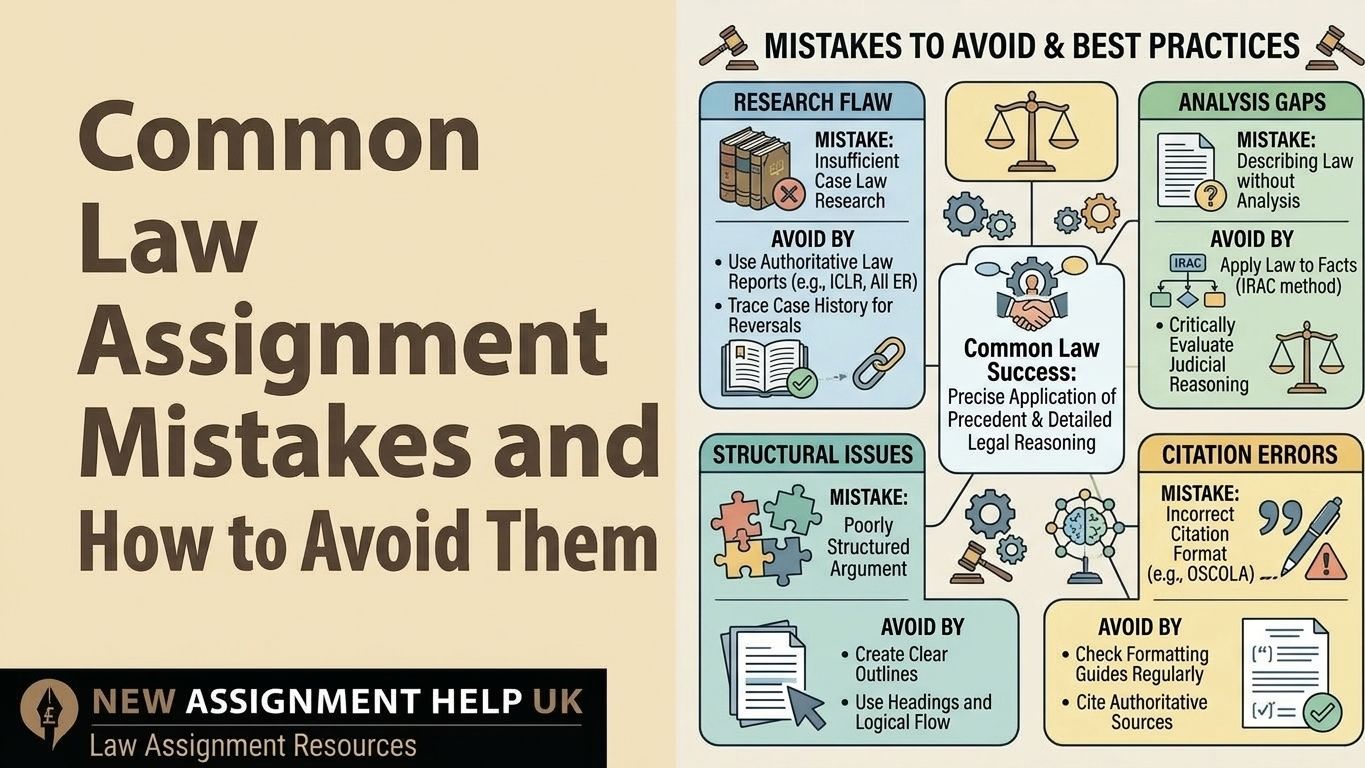
Common Law Assignment Mistakes and How to Avoid Them
- Why Do UK Law Students Lose Marks?
- Seven Common Law Assignment Mistakes and How to Fix Them
- 1. Answering a Different Question
- 2. Dropping Cases Without Applying Them
- 3. Skipping a Clear Structure
- 4. Using OSCOLA Incorrectly
- 5. Relying on Outdated or Wrong-Jurisdiction Law
- 6. Describing Instead of Analysing
- 7. Copying Too Closely From Sources
- Pre-Submission Checks for Your Law Assignment
- Final Thoughts
A student cites Donoghue v Stevenson in a negligence essay and moves on. The marker writes "Where is the application?" in the margin. And that single gap can cost valuable marks. Most common law assignment mistakes at UK universities come from habits, not weak knowledge. Here our 'Common Law Assignment Mistakes and How to Avoid Them' guide covers seven errors that markers on LLB and GDL courses flag again and again. Each one comes with a practical fix, based on the skills set out in the QAA Subject Benchmark Statement for Law.
Why Do UK Law Students Lose Marks?
Law markers reward reasoning, not recall. They want to see that you spotted the legal issue and supported your answer with the right authority. A page of correct facts without that rarely rises above a 2:2. Effort and length earn no credit on their own. First-class scripts show accurate law, sharp application and critical thought.
Most lost marks come from the same few errors, such as weak structure and cases named without application. Your module handbook lists the grade descriptors, so read them before you start writing. Students who learn these patterns early can avoid them. Those who only see them in feedback have already lost the marks.
Seven Common Law Assignment Mistakes and How to Fix Them
These errors show up from first-year essays to final-year scripts in the same exact ways.
1. Answering a Different Question
Many students write everything they know about a topic. A question on economic loss on negligence does not require the complete history of duty of care. So, underline the instruction word and the legal issue before you plan it. They test each paragraph against them. And if that paragraph does not help answer the question, just cut it down.
2. Dropping Cases Without Applying Them
Naming Caparo Industries plc v Dickman [1990] 2 AC 605 shows you read the case. However, it does not show you understood it. So, state the rule in one sentence, then link it to your facts accurately. Ask whether harm was foreseeable, whether proximity existed and whether a duty is fair, just and reasonable. This step is where most analysis marks are won.
3. Skipping a Clear Structure
In problem-based questions you need order. Apply IRAC to each issue: Issue, Rule, Application and Conclusion. In a contract problem, deal with offer, acceptance and consideration separately instead of in one long paragraph. Also, an essay will need a clear thesis in the introduction and an argument that follows it. So finish with a conclusion that answers the question directly. Keep it in a way that the marker can follow your reasoning without rereading.
4. Using OSCOLA Incorrectly
Most UK law schools require OSCOLA, the Oxford University Standard for Citation of Legal Authorities. Common slips include missing footnotes, wrong law report abbreviations and no table of cases. Keep the official OSCOLA guide open while you write. And check every citation once your draft is complete, because small errors show careless research.
5. Relying on Outdated or Wrong-Jurisdiction Law
England and Wales, Scotland and Northern Ireland have separate legal systems. A Scots law module expects different sources than an English tort module. Statutes change, and courts overrule earlier cases. It's best to confirm legislation on legislation.gov.uk and check a case's status on Westlaw, LexisNexis or BAILII before you rely on it. Wikipedia and general blogs are never authority in a law assignment, so don't prioritise them in any condition.
6. Describing Instead of Analysing
Descriptive answers stall at the pass level. After you state a rule, ask whether it works in practice or not. In an essay on psychiatric harm, explain why Alcock v Chief Constable of South Yorkshire Police set control mechanisms and whether they are fair. Do support your view with journal articles, Law Commission reports and judicial criticism. A balanced argument with counterpoints always reads stronger than one-sided praise.
7. Copying Too Closely From Sources
Judgements and textbooks use dense wording, and students often lift it with small changes. That is why Turnitin flags this quickly. So read the passage, close it and explain the point from memory. Then cite the source in OSCOLA, while keeping direct quotes short, and use them only when the exact words matter.
Fixing these seven habits takes little time and lifts your marks fast.
Pre-Submission Checks for Your Law Assignment
Run through this list before you upload your work to the virtual learning environment.
- Question match → Reread the question and confirm every section answers it.
- Authority check → Verify that each case and statute is current and relevant.
- Application → Link every case to your facts or your argument.
- OSCOLA accuracy → Review footnotes, abbreviations and your table of cases.
- Originality → Check that all paraphrasing is in your own words and properly cited.
- Conclusion → Confirm it gives a clear answer, not a recap.
Final Thoughts
Better law marks come from small, repeatable habits. Read the question closely, apply every authority, cite with OSCOLA and question the law you describe. If a tight deadline or a tricky problem question is holding you back, go for a professional law assignment support that can guide your structure, case application and referencing. This is also a smart option when you're extremely low on time and want to submit your project on time.

 9 | Law and LLB (Hons)
Yvette Cooper is a practising solicitor in England and Wales with an LLB (Hons) in Law and an LLM from a UK university. Her day-to-day work covers contract, tort and public law matters. That makes her well known for how legal reasoning works in real cases as well as in the lecture hall. Outside practice, she spends her spare time mentoring law students on case analysis, legal writing, OSCOLA referencing, internships and exam preparations. She writes clear, practical guidance that helps students turn legal knowledge into stronger assignments and excelling academic results.