
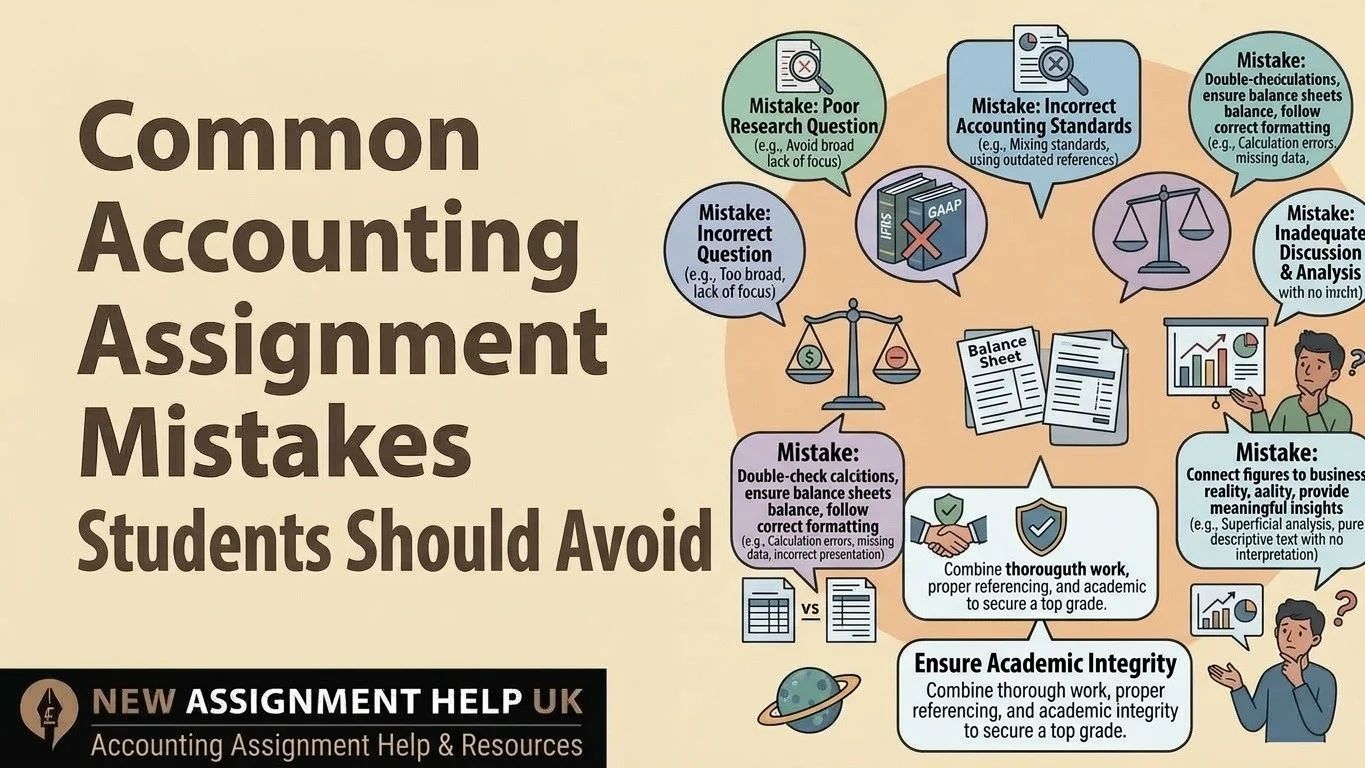
Common Accounting Assignment Mistakes Students Should Avoid
- Accounting Assignment Mistakes: 10 Errors That Cost Students Marks
- 10 Common Accounting Assignment Mistakes Students Should Avoid
- 1. Getting Debit and Credit Entries Wrong
- 2. Misclassifying Accounting Transactions
- 3. Mishandling Accruals, Prepayments and Other Adjustments
- 4. Making Calculation and Data-Entry Errors
- 5. Applying the Wrong Accounting Standard
- 6. Preparing Incorrect or Unbalanced Financial Statements
- 7. Failing to Reconcile Figures
- 8. Giving Correct Numbers Without Explaining Them
- 9. Using Inconsistent Accounting Terminology and Rounding
- 10. Relying Too Much on Templates, Spreadsheets or Accounting Software
- How to Check Your Accounting Assignment Before Submission
- Conclusion
Accounting Assignment Mistakes: 10 Errors That Cost Students Marks
Getting the final figure right is only part of an accounting assignment. You can still lose marks for wrong classification, weak journal entries, missed adjustments, bad workings or no explanation. These are different from general writing slips like poor grammar. Here are the most common accounting assignment mistakes, with simple ways to avoid each one.
10 Common Accounting Assignment Mistakes Students Should Avoid
One small error can spread into your ledger, your statements and your whole answer. Let's go through them one by one to build your next accounting assignment effectively.
1. Getting Debit and Credit Entries Wrong
Mixing up debit and credit is the classic slip. Some students learn the rules by heart without seeing how accounts move. Then one wrong journal entry lands in the wrong ledger and throws off the financial statements too.
Tips to Avoid: Find the accounts affected. Decide if each one goes up or down. Then record the entry. Once your entries are right, check where each item belongs.
2. Misclassifying Accounting Transactions
This is about where an item sits, not how you record it. Students often treat an asset as an expense. Others mix up capital and revenue spending. Current and non-current items get swapped. Income received early can be wrongly shown as revenue.
Ask what the transaction is and why it happened before you choose its place. Classification leads straight into timing, which trips up many students.
3. Mishandling Accruals, Prepayments and Other Adjustments
Many students record the cash that moved instead of the period the cost or income belongs to. This hits total expenses, prepaid expenses, total income, income received in advance and depreciation.
You can name the accounting period first. Then work out the adjustment needed. Next, let's look at plain number slips.
4. Making Calculation and Data-Entry Errors
Sometimes the method is right but the numbers are not. Watch for the wrong formula, swapped digits, misplaced decimal points, wrong percentages, copied figures and rounding too early. Make sure to write the formula first. Show your workings. Check key figures a second time in a different way. Even perfect numbers need the right rule behind them.
5. Applying the Wrong Accounting Standard
Knowing the standards is not enough. You must match the right one to the case. IFRS 15 covers revenue recognition. IFRS 16 covers leases. IAS 2 covers inventories. IAS 16 covers property, plant and equipment.
How to Avoid: Pick the standard that fits, then explain why its treatment applies. A wrong treatment often shows up later in the statements.
6. Preparing Incorrect or Unbalanced Financial Statements
Mistakes can appear in the income statement, statement of financial position, trial balance or cash-flow statement. An early error in a journal entry or adjustment flows into every later statement.
Trace each figure back to its first transaction. Check that your statements agree with each other.
Agreement between figures is what reconciliation is all about.
7. Failing to Reconcile Figures
Reconciling means proving that two sets of numbers match. Think of the trial balance, bank reconciliation, ledger balances and control accounts. A balanced trial balance can show some errors, but it does not catch every one.
Corrections: Reconcile as you work, not only at the end. Matching numbers still need a story.
8. Giving Correct Numbers Without Explaining Them
Say your current ratio is 1.8:1. That is a good start, but what does it mean? It tells you how well the business can pay its short-term bills. Markers want that meaning, not just the sum.
After each key calculation, add a short line on what it shows about the business. A clear explanation also needs clean presentation.
9. Using Inconsistent Accounting Terminology and Rounding
Small style slips look careless. Do not mix UK and US terms. Keep the decimal places the same. Include units and use the £ sign every time. Call the same item by the same name throughout.
Improving Tips: Follow the terms in your course notes and keep one format from start to finish.
Last, a word about the tools you use.
10. Relying Too Much on Templates, Spreadsheets or Accounting Software
Tools are great for calculations, tables, repeat tasks and double-checking. But they cannot tell you if the accounting treatment is right. They only follow what you enter. Understand the transaction, formula and treatment before you let software do the work.
These are the following steps which will help you improve your accounting assignment, and you can boost your academic score using these pointers every time you write.
How to Check Your Accounting Assignment Before Submission
Use this quick accuracy checklist. Use this in your next assignment, and you are all set to submit the best work.
Treatment
- Are transactions classified correctly?
- Are debits and credits right?
- Did you apply the correct standards?
Calculations
- Are the formulas correct?
- Were figures copied accurately?
- Is rounding the same throughout?
Adjustments
- Did you include accruals, prepayments and depreciation?
Statements
- Do figures flow from the journal to the ledger to the statements?
- Does the trial balance reconcile where needed?
Analysis
- Did you explain the key results?
- Do the numbers support your conclusions?
Conclusion
Strong accounting work needs accurate numbers, clear workings, the right treatment and a good explanation. A correct final figure alone is not enough. Run through this checklist and can seek accounting assignment support before every submission to detect most problems early.

 8 | BSc in Accounting
Lily Brown is an accounting tutor based in London, with more than eight years of experience helping university students with their coursework. She holds a BSc (Hons) in Accounting and Finance and is also an ACCA member. Lily has guided students through financial reporting, management accounting, auditing and taxation assignments, and also knows exactly where learners tend to get stuck. Her guides use plain language, UK standards such as IFRS and FRS 102, and real examples that make each step easier to follow. Outside of tutoring, she enjoys following changes in financial regulation and analysing them carefully.