
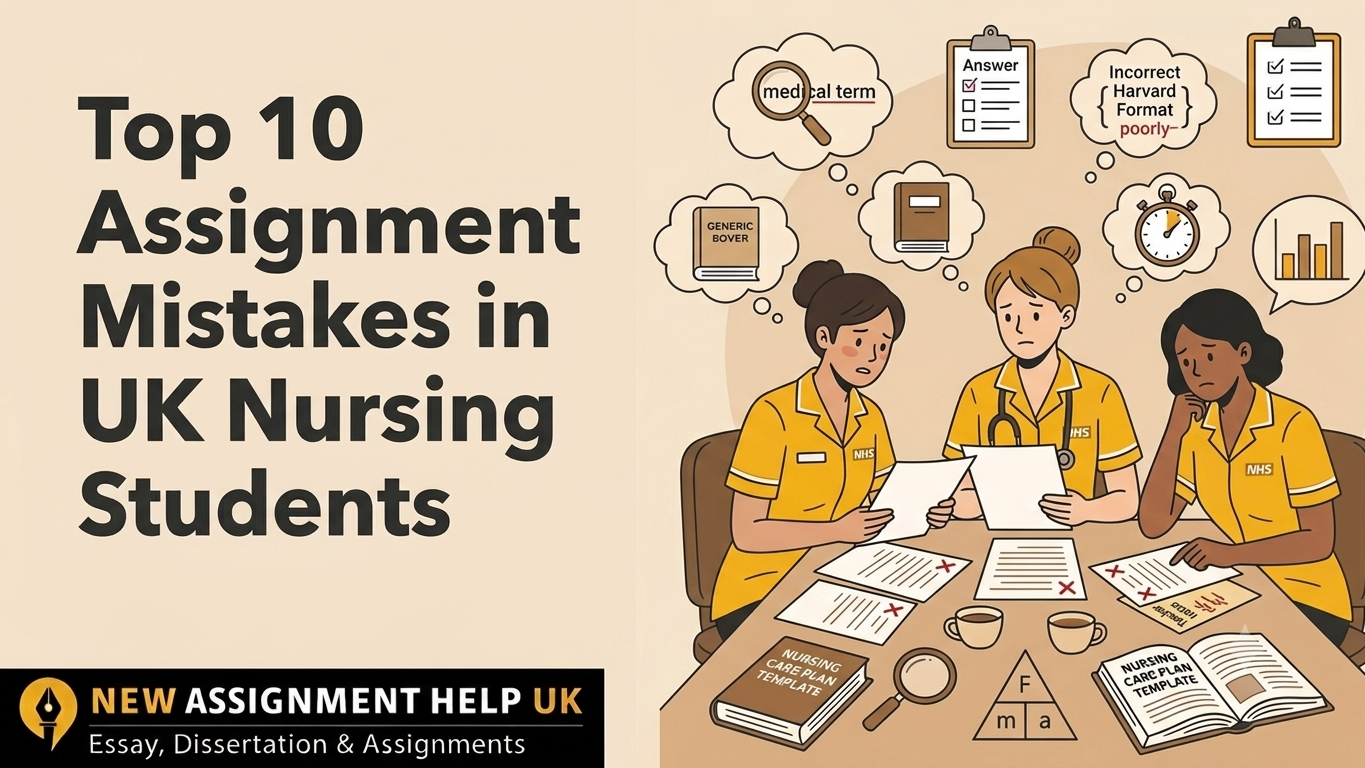
Top 10 Assignment Mistakes in UK Nursing Students
- Top 10 Mistakes UK Nursing Students Make in Academic Assignments (And How to Fix Them)
- 1. Misreading the Brief
- 2. Citation Blunders
- 3. Describing Instead of Thinking Critically
- 4. Weak or Outdated Evidence
- 5. Writing Generic Content Instead of UK-Specific Information
- 6. Reflective Essays That Read Like Stories
- 7. Getting the Voice Wrong
- 8. Care Plans That Don't Connect
- 9. Proofreading at the Last Minute
- 10. Not Learning From Past Feedback
- Quick Recap Table
- What is the biggest mistake nursing students make in academic assignments?
- Why do nursing students lose marks even with strong clinical knowledge?
- How important is proofreading for nursing assignment grades?
- Do UK nursing markers expect NHS or NICE references specifically?
Top 10 Mistakes UK Nursing Students Make in Academic Assignments (And How to Fix Them)
You know the clinical side. You've done the placements of your analysis correctly, memorised the drug charts, handled real patients under pressure. So why does the grade never quite match the effort? Most of the nursing students struggle with this thought over and over again, but can’t make it to the solution.
Students in the UK lose marks for the same handful of reasons, and it's rarely about knowledge. It's about small habits markers are trained to spot. Some of these feel obvious once you see them written down. Others are the kind of thing you only catch after a lecturer hands back a paper covered in comments you didn't expect. So here are the ten that come up frequently, plus what actually fixes them.
1. Misreading the Brief
Every assignment brief hides a verb that decides everything. "Describe." "Explain." "Critically analyse." Students skim past it and just start writing.
Here's the problem. "Describe" wants plain facts. That alone won't earn a strong grade. "Critically analyse" wants you to weigh evidence, question the research, and compare different views. Get the verb wrong, and you can hand in a well-researched piece that still misses the mark, because you answered a question nobody asked you to.
Tips: Circle that verb before you type a word. It changes how you write the whole piece.
2. Citation Blunders
Harvard referencing is standard across most UK nursing courses. A wrong year, a missing page number, a name spelled slightly off, none of it feels like a big deal in the moment.
But markers go line by line. Small errors pile up across a full assignment, and sloppy citations can even raise integrity questions that makes your work less credible.
Build a habit: author, year, page, matching reference list entry. Check it twice, not once, right before you submit.
3. Describing Instead of Thinking Critically
This one deserves its own spot because it's just that common. Students repeat events instead of asking why those events matter.
A nursing essay isn't a report of what happened. It's an argument. You're showing a marker how you think, not just what you know. If your paragraphs read like a summary, that thinking never gets seen and you end up with poor grades.
Try this after every claim: ask "so what?" then answer it in the next line. Small habit, big difference in grade bands. If you find it difficult, you can seek support on nursing assignments to clear everything from scratch.
4. Weak or Outdated Evidence
Not every source carries the same weight. When you mention a ten-year-old textbook rather than Cochrane reviews, RCTs, and NICE guidelines in your work, you are making it less authentic.
Run your sources through a quick appraisal; something like CASP works well. Ask how big the study was, whether bias crept in, and whether it's still current. Focus on following evidence-based practice in your work to make stronger source decisions every time.
5. Writing Generic Content Instead of UK-Specific Information
Here's a mistake that hides in plain sight. Students write about healthcare in a way that could apply anywhere, when UK markers are specifically looking for the NHS, NICE guidance, and the NMC Code.
Vague writing reads as thin, even when the research behind it is solid. It can also make an assignment feel copy-pasted from a generic template, which is the last impression you want to give.
For every big point in your assignment, check whether it's grounded in the UK system. If it isn't yet, it should be. For this, read and analyse the guidelines from your university and write accordingly. Also back it up with peer-reviewed sources to boost your work.
6. Reflective Essays That Read Like Stories
Reflective writing is where a lot of students lose marks. They spend paragraphs in describing a shift on the ward and barely a sentence on what they actually learned from that.
Markers don't grade the story. They grade your insight. So try to analyse the whole scenario, along with a clear understanding of NMC working guidelines. This will help you in writing a reflective essay critically.
Lean on a proper framework: Gibbs or Driscoll both work well, and give most of your word count to the "so what" and "now what" stages.
7. Getting the Voice Wrong
Academic essays generally want third person. Reflective pieces often allow first person. Mixing the two up, or letting an "I" slip into a research critique, happens more than you'd think.
It's an easy fix, but the effect on tone is bigger than most students expect. A single misplaced "I" in an otherwise formal essay can make the whole piece read as less rigorous than it actually is.
Check your module handbook before you start. If it's unclear, just ask your tutor which voice they want for that specific piece. This will avoid these vague mistakes.
8. Care Plans That Don't Connect
A good care plan draws a straight line: assessment, then intervention, then expected outcome. Students often list a diagnosis and move on, without showing how it actually connects to the care that follows.
For every diagnosis, spell out the finding, the action, and the result you expect from it. Same order, every time. It sounds repetitive on paper, but it's exactly what markers are scanning for, and it's usually the difference between a care plan that reads as thorough and one that reads as a checklist.
9. Proofreading at the Last Minute
Rushed work always shows weak analysis, even when the ideas underneath are solid. Typos, missing citations, formatting- all easy to fix and all easy to miss at 2 am before a deadline.
Set aside a full day just for proofreading, separate from writing time. Read it out loud if you can. It catches far more than reading silently ever does.
10. Not Learning From Past Feedback
Some students get the same comment on assignment after assignment and never actually change anything. It's an easy trap, especially when you're juggling placements and deadlines at once.
Before starting something new, go back and reread your last set of feedback. Pull out two or three things to fix this time. It's a small step that compounds fast over a whole degree.
None of these fixes takes a full rewrite of how you study. Most are small adjustments you can make on your very next assignment, starting with the brief in front of you right now. Also browse our sample papers to understand how it works in practice.
Quick Recap Table
| The Mistake | What It Costs | The Fix |
|---|---|---|
| Skipping the brief properly | Whole answer goes off track | Underline the task verb before anything else |
| Messy citations | Looks careless to markers | Sit with your reference list and check it twice |
| All description, no analysis | Thinking stays hidden | Follow every claim with "and this matters because..." |
| Old or weak sources | Argument falls flat | Swap anything over ten years old immediately |
| Nothing UK-specific | Reads as copy-paste effort | Drop in NHS, NICE, or NMC at every opportunity |
| Reflection that tells a story | No learning visible | Cut the narrative, double the insight |
| Voice inconsistency | Tone breaks mid-essay | Confirm first or third person before writing word one |
| Care plan without connection | Gaps confuse the marker | Link every diagnosis directly to an action and outcome |
| Proofreading before | Silly mistakes stay in | Block out the day before submission just for this |
| Binning old feedback | Same errors repeat | Pull out last semester's comments before you start |
The truth is that most of these mistakes are completely fixable and none of them requires starting from scratch. What they require is a bit of attention at the right moments. Read your brief properly. Question your sources. Actually use your old feedback. If you need support pulling any of this together under deadline pressure, New Assignment Help UK is here to help you get it right.

 14 | PhD in Clinical Nursing Practice
Dr James Whitfield has dedicated over 14 years to helping UK nursing and healthcare students guide the academic side of their professional training. With a PhD in Clinical Nursing Practice from the University of Birmingham and direct experience supporting students across adult nursing, mental health, and community care programmes. He has a sharp understanding of where students lose marks and why. Whitfield specialises in breaking down the nursing process, evidence-based practice, and academic referencing into clear, manageable steps that students can apply immediately in their written assignments and on clinical placement as well.
Get answers to the most frequently asked questions from students and make your decision to get better grades.