
Cable Stayed Bridge Design Assignment Sample
Comprehensive guidance on cable-stayed bridge design including structural analysis, modelling techniques, load evaluation, and performance assessment for engineering students projects.
- 92650+ Project Delivered
- 1500+ Experts 24x7 Online Help
- No AI Generated Content


- Introduction Of Cable Stayed Bridge Design Assignment
- Literature Review
- Static and Dynamic Performance of Cable-Stayed Bridges
- Seismic Reliability and Bridge Resilience
- Theoretical Frameworks in Cable-Stayed Bridge Design
- Methodology
- Computational Approach
- Modeling with the approach of FEA
- Performance Evaluation and Optimization
- Result and Analysis
- Conclusion
Introduction Of Cable Stayed Bridge Design Assignment
Cable-supported or cable-stayed bridges have been used for crossing from medium to long span distances because of their efficiency, elegance, and economy. These bridges are distinguished by the cable that links the deck directly to one or many pillars, hence exhibiting a structure in between the cantilever and suspension bridges. Through the use of dynamic tools, there have been improvements in fine-tuning cable geometry, decks and materials for better performance as well as durability.
One of the important choices concerning cables and the structural deck of the cable-stayed bridge is the layout of the cables as well as their stiffness to reduce the deflections and improve load distribution and stability. Questions about practical aspects of bridge engineering have recently returned to the focus of consideration due to the newly constructed Mersey Gateway Bridge.
This analysis focuses on analyzing various cable-stayed bridge structures by creating an FE model to analyze static force, dynamic response, and seismic response loads. As a result of this study, different cable spacing patterns and deck stiffnesses will be recognized to achieve an efficient design in terms of structure and material use. Hence, the findings of the study will add knowledge to bridge engineering practice and increase the safety and sustainability of engineering structures in such environments.
Assignment deadlines piling up? Let New Assignment Help ease your burden with expert Assignment Help UK tailored for student success.
Literature Review
Cable-stayed bridges have emerged as a preferred type of construction solution for the spans ranging from medium to long ones due to the use of cables. These bridges are composed of cables that are fixed on the pylon hence minimal subtitles such as piles and abutments. There are some basic differences between suspension and cable-stayed bridges where the latter is claimed to need fewer cables to be installed and is considered less costly when the length of the bridge is between 200 and 1000 meters. Negotiation of the cables, pylon design and the stiffness of the deck are some of the parameters that affect the performances of these structures.
Static and Dynamic Performance of Cable-Stayed Bridges
Sustenance to bears static and dynamic loads are other factors that must be put into consideration when designing cable-stayed bridges. The static behavior depends on the dead load and the live load as well as weather condition,s while the dynamic behavior depends on the wind load, the traffic load and the seismic load.
Zheng et al. 2024 investigated the influence of fire-damaged cables on the static and dynamic characters of cable-stayed bridges. From their work, they found out that localized cables damage affects load distribution, where deflections and internal stress increases. This is because there has been recurring concerns of cable-stayed designs giving way in one or the other in extreme situations and this calls for redundancy in design.
Kallingal and Singh 2021 have studied the impact of different types of pylons on the dynamic response of cable stayed bridges. Their research shows that H-shaped and A-shaped pylons have a better lateral strength than the diamond pylons but the later has better vertical rigidity. These are useful in determining the geometrical constructions of pylon that will be more suitable for the given loadings on the sites.
Seismic Reliability and Bridge Resilience
Seismic performance is a very important factor especially to contractors working in areas of earthquake vulnerability. Based on the literature review, Zhang et al. 2021 studied the implication of spatially varying ground motions on the seismic reliability of cable-stayed bridges and noted the critical influence of the interaction between the deck, cables, and pylons in the bridgework. Their study focused on the realization of the fact that the energy dissipation should be effectively done between the deck and tied-pylons.
Additionally, the current cable-stayed bridges still innately install special features such as base isolation systems, tuned mass dampers, and energy dissipation devices to enhance their seismic performance. These strategies improve the bridge endurance as far as the forces resulting from the occurrence of an earthquake is concerned, thus minimizing failure.
Theoretical Frameworks in Cable-Stayed Bridge Design
Several theories in structural engineering are used in the design and optimization of cable-stayed bridges.
- Finite Element Method (FEM): Used widely in the analysis of bridges, FEM allows the engineer to simulate interconnections of the bridge’s parts and establish their performance under certain loads.
- Eception Analysis Theory: This theory is useful for predicting the natural frequencies and vibration modes of the bridges hence enabling designs of bridges that will be competent to respond to dynamic force such as wind and earthquake forces.
- Alternative materials: Allows for the design of bridge members that will not exceed the acceptable stress ranges when subjected to normal or abnormal loads.
The studies, therefore, discuss cable spacing, pylon configuration, and cable-stayed bridge seismic resistance. One of the key differences between these types of analysis is that while the former highlights the structural triangle, the latter sheds light on such values as flexibility and damping. Both FEM and Modal Analysis offer great benefits for any engineering practitioner in the analysis of bridges to arrive and superior performance. It is, therefore, necessary to conduct more studies on incorporating high-performance material and intelligent assessment systems to improve the durability of cable-stayed bridges.
Methodology
This work employs a computational method to investigate the response of cable-stayed bridges and particularly on the parameters of cable spacing and deck flexibility. The procedure includes generating many bridge models, analyzing these models with the finite element method, and assessing the definite performance factors for selecting superior design.
Computational Approach
The study uses computational modeling to analyze cable-stayed bridges with a view of understanding their abilities to take different loads. It is worth assessing the contact between the deck and cables in addition to supporting pylons by utilising FEA (Ali et al. 2021). The dimensions are varied based on the configuration of cables and the stiffness of the deck based on a semi-fan configuration of cables which are common to modern cable-stayed bridges owing to strength, beauty of the structure and other such factors.
Bridge models accordingly are built with span length, deck width and height of the towers already standardized to allow for comparison. coefficients of elasticity, density, and Poisson's ratio are values arrived from basic structural characteristics. The conditions of support are made to be as realistic as possible for load distribution and the structure itself.
Modeling with the approach of FEA
This study benefits from the application of finite element analysis as this makes it possible to model the response of a bridge under static and dynamic loadings. The elements, which are the bridge deck, cable and pylon are divided into finite elements to enable better numerical analysis. The most common applications of mesh refinement are in areas like pylon to cables to ensure that there is a precise analysis of the stress distribution.
Loads are used in cases where one wishes to assess the response of the bridge under specific circumstances (Park et al. 2023). That is why the designs take into consideration both the dead loads which include the weight of the construction and the live loads which comprises of the traffic load in this case. The force due to wind loads is estimated from the standard wind pressure coefficients, whereas the seismic loads are applied to evaluate the necessary loads during an earthquake. The key structural responses that are used in the analysis are allowed maximum vertical deflection of the deck, maximum tension in the cables in scenario 2 at the central span, and maximum moment in the girder. These parameters are used in order to analyse the overall structural efficiency and stability of the bridge for different loading conditions.
Performance Evaluation and Optimization
The evaluation is carried out on static, dynamic and seismic analysis for the identification of the best design configuration. Evaluating loads includes carrying out a static structural analysis whereby deflections and weaknesses under dead and proposed live loads on the bridged are rendered. Modal testing is employed to conduct thrusts of dynamic analysis to ascertain the natural vibration modes of the bridge and its liability to traffic-induced oscillations, wind, and other dynamic loads (Guo and Guan 2023). Some measures are taken for controlling the vibrations of the structure in order to improve damping characteristics.
Seismic response simulation is conducted to test the resilience of the bridge under earthquake loading conditions. Time-history analysis is used to understand how the structure behaves during seismic events, evaluating its ability to dissipate energy and minimize stress concentrations. This helps in identifying design improvements that can enhance the bridge’s resistance to seismic forces.
Result and Analysis
The findings of the computational analysis enable understanding of the structural behavior of the cable-stayed bridge depending on the design considerations. Several software applications were employed in the process; among them is the Abaqus software that enabled users to pre-model in addition to permitting visualization of the bridge form regarding to organization of the cables, deck, and pylons (Sharry et al. 2022). This was beneficial as it empowered the design of body before engaging in extensive mathematical modeling.
In this research work, StAAD Pro software was used in a finite element analysis; the most important characteristics being the vertical deflection, cable tension, and bending moment. This means that the analysis found the preferable cable spacing and deck stiffness for the certain design. The analysis revealed that bridges should have their cables spread out optimally to reduce on deflection and hence distribute the loads evenly. More stiffness in the higher deck provided better structural integrity, this led to reduced stress raisers in areas of stress concentrations.
Abaqus Model of the bridge
Figure 1: Abaqus model of the bridge
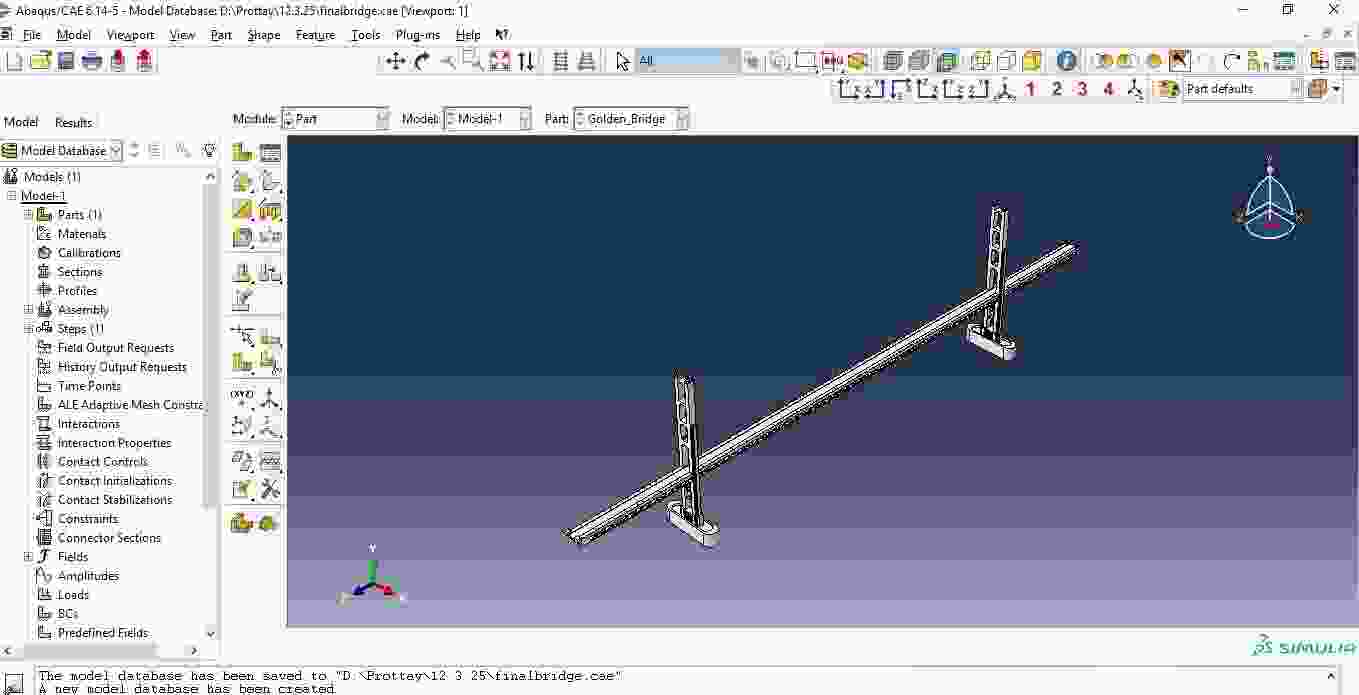
Figure 2: Bottom view of the bridge
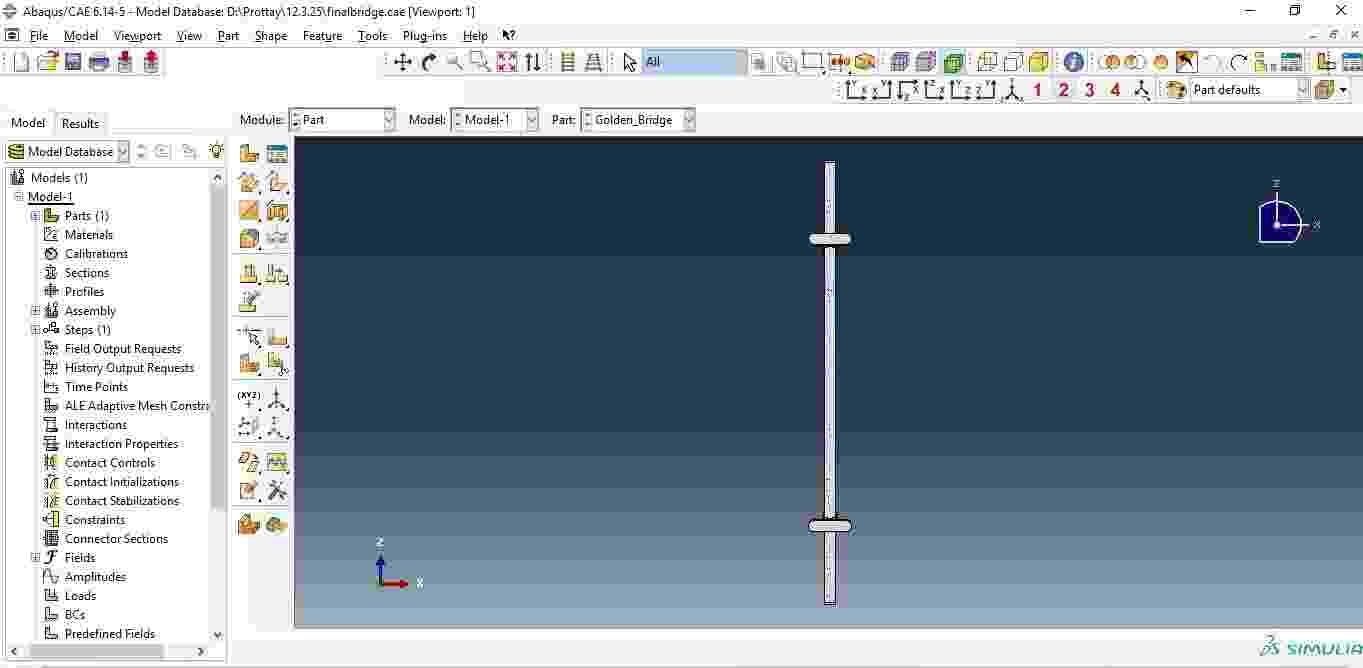
Figure 3: Side view of the bridge
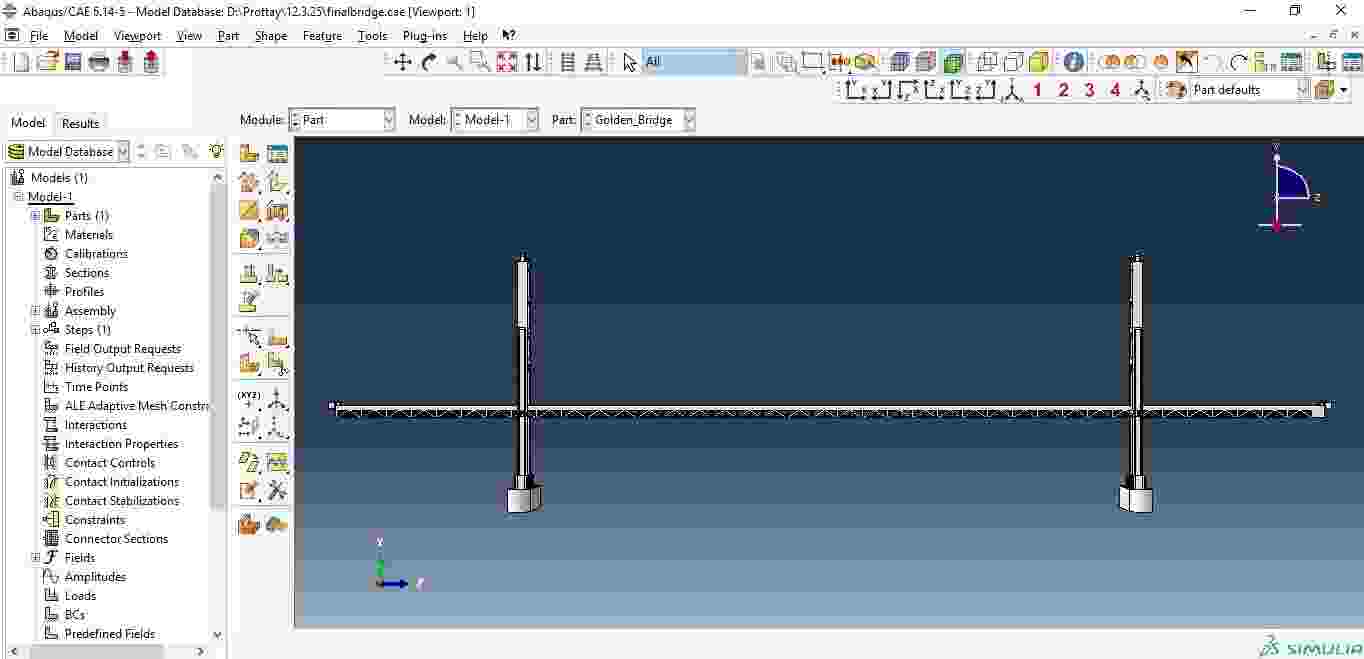
Figure 4: Side view of the bridge
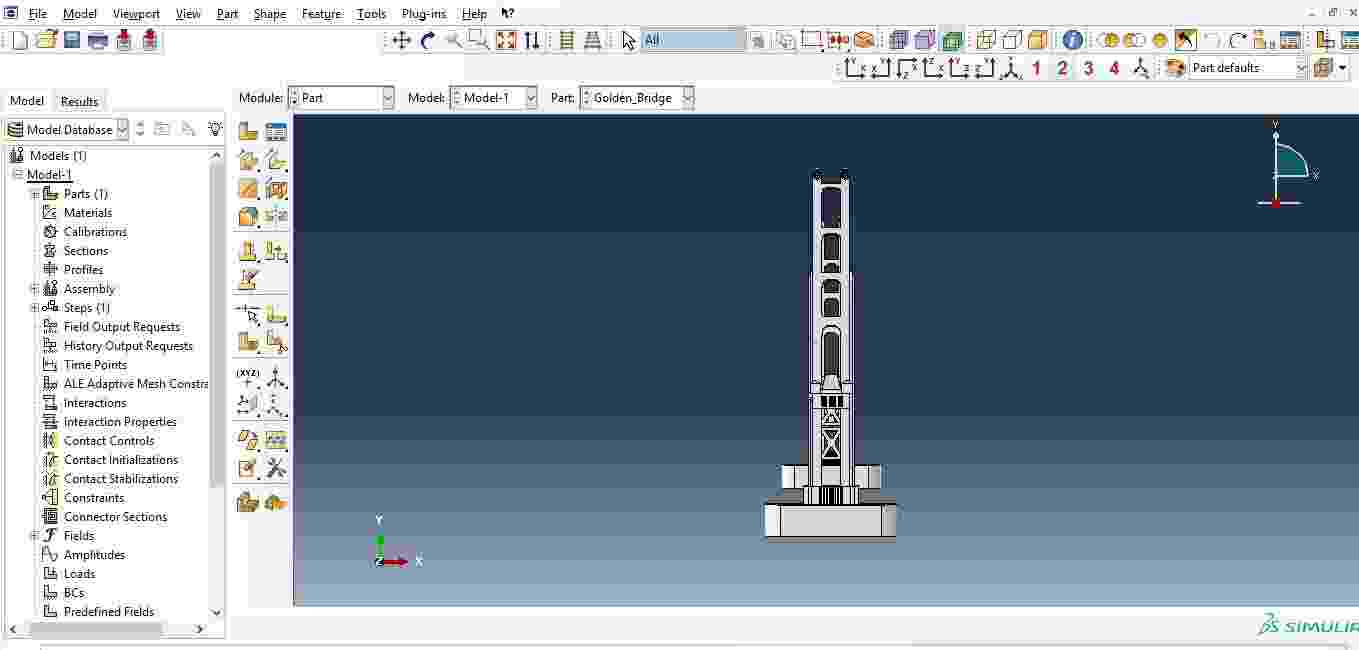
Figure 5: 3d view of the abutment
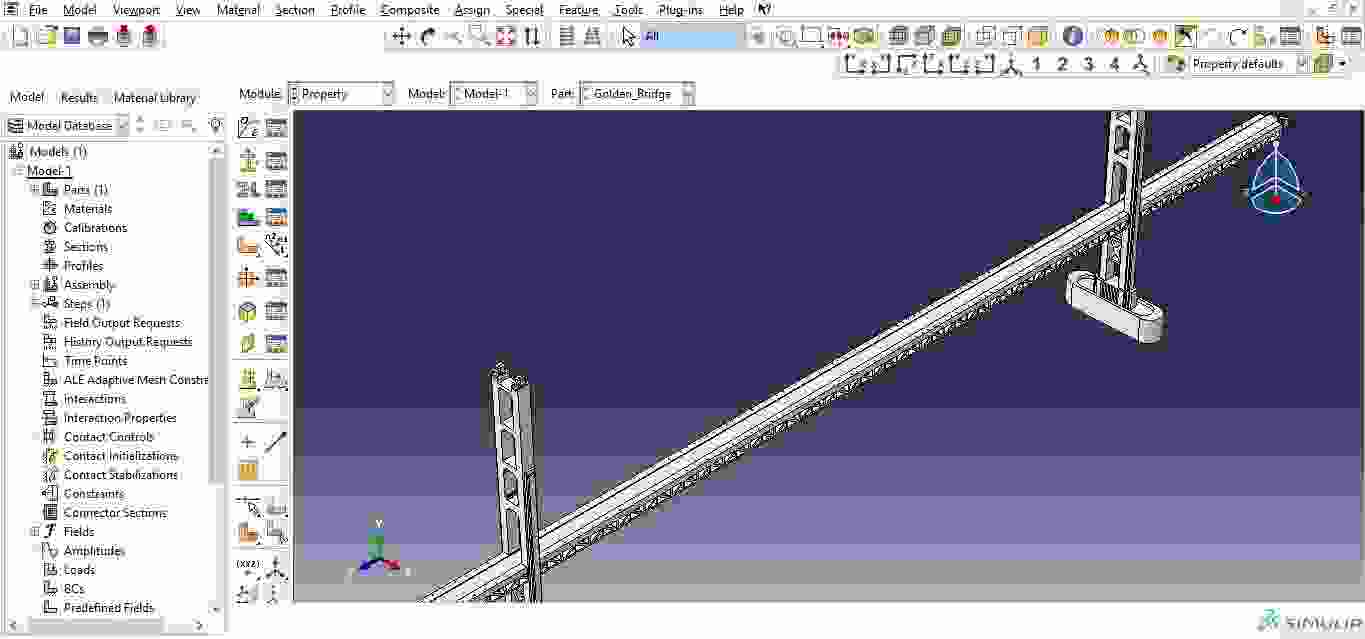
Figure 6: Top view
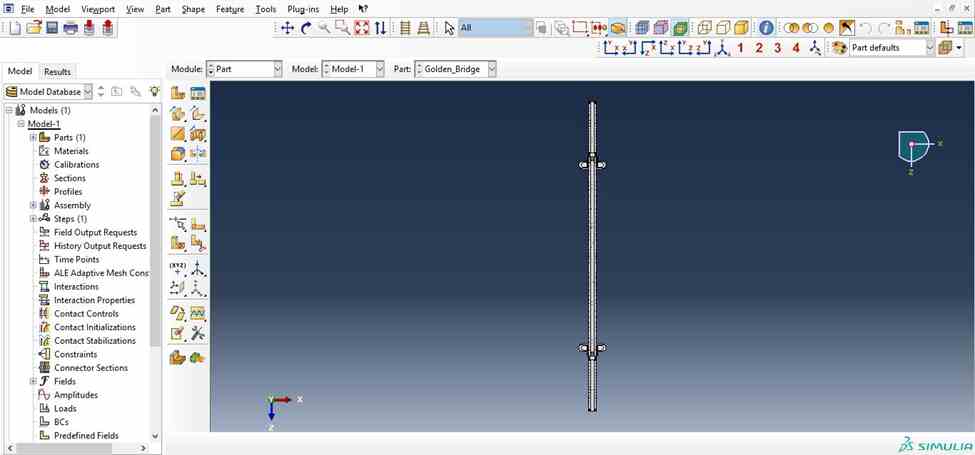
Figure 7: 3d abutment
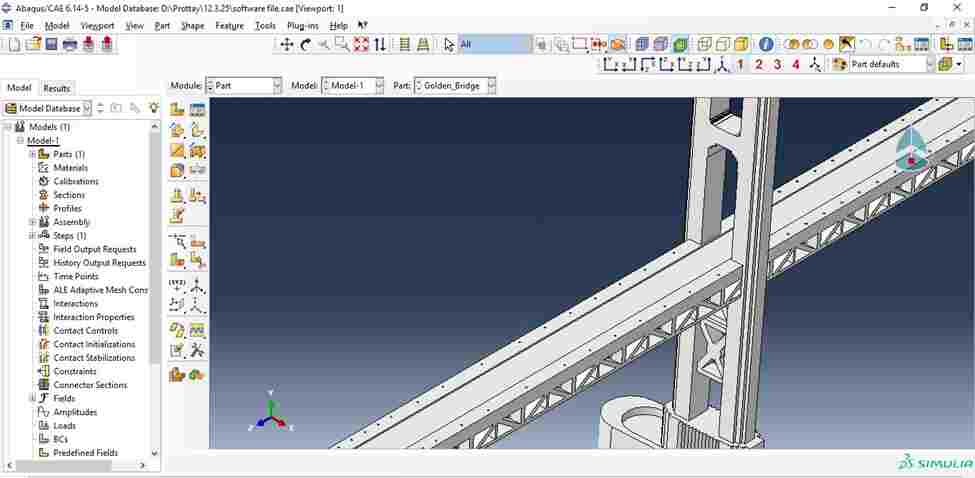
Figure 8: 3d abutment mesh
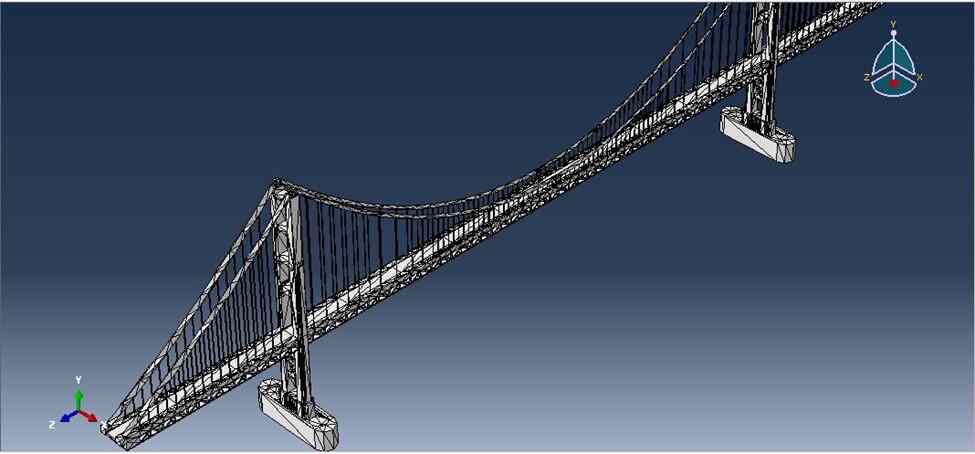
Finite Element Analysis of the Bridge
With the approach of the staad pro, there is a finite element analysis has been covered. The element of the bridge deck, column pire and cable has been attached with the static modeling of staad pro.
Figure 9: Properties of Beam, deck and Cable
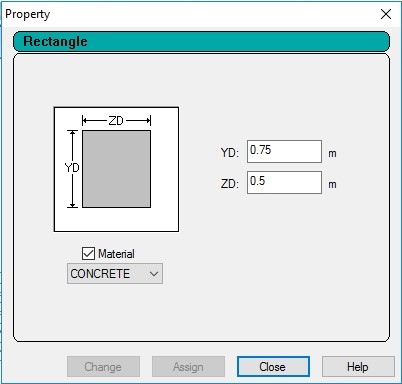
The adobe picture shows the properties of the beam, plate and cable with thickness (Lee et al. 2021). This measurement is used for the analysis orf the cable bridge as a whole system.
Figure 10: Nodes of the deck structure.
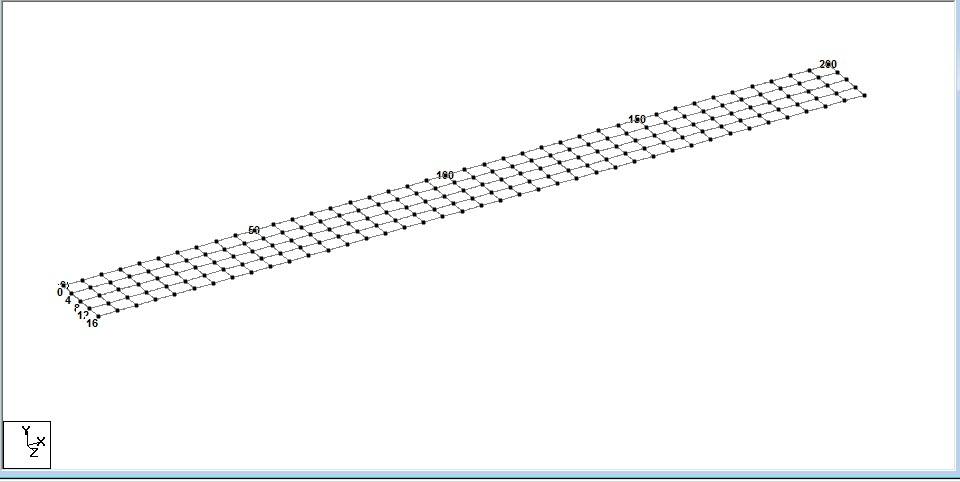
Figure 11: 3d static structure
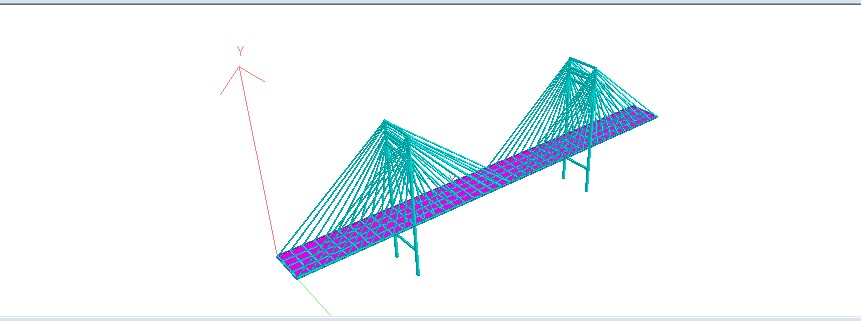
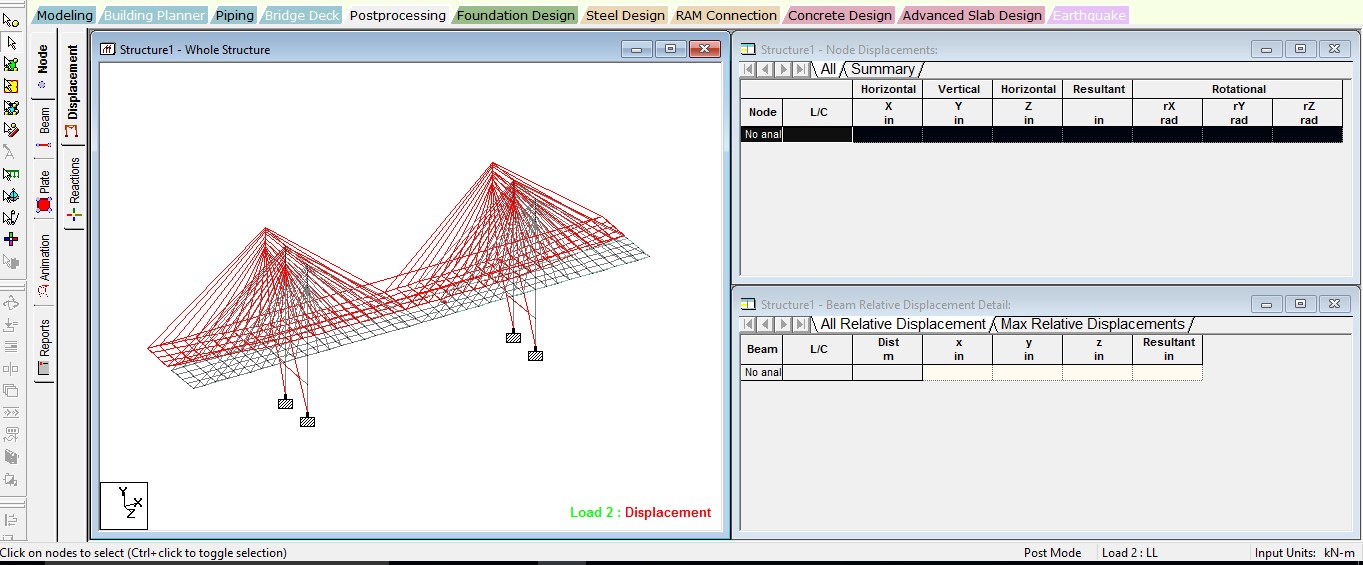
In the present design of the beam structure, the FEM analysis done by adopting STAAD Pro was relating to displacement and stress analysis. The displacement prediction also shows the maximum displacement at midspan, which is in concurrence with the theoretical analysis of a simply supported beam under loading (Zhong and Pai 2021). This means that the of the displacement image captured focuses on the applied load which had a evenly deformation pattern therefore .
The bottom stress analysis shows the maximum tensile stress at the bottom fiber of the beam, which proves the expected bending. It has only tension and compression forces as with all other structures, with maximum tensile stress experienced at the bottom part resulting from bending moments.
Altogether, the results confirm the stability of the beam structure under the assumed load, the displacement and stress values are acceptable. These outcomes are important to consider the behaviour of the beam and determine whether it fits with the design criteria and safety measures.
Figure 12: Stresses at deck
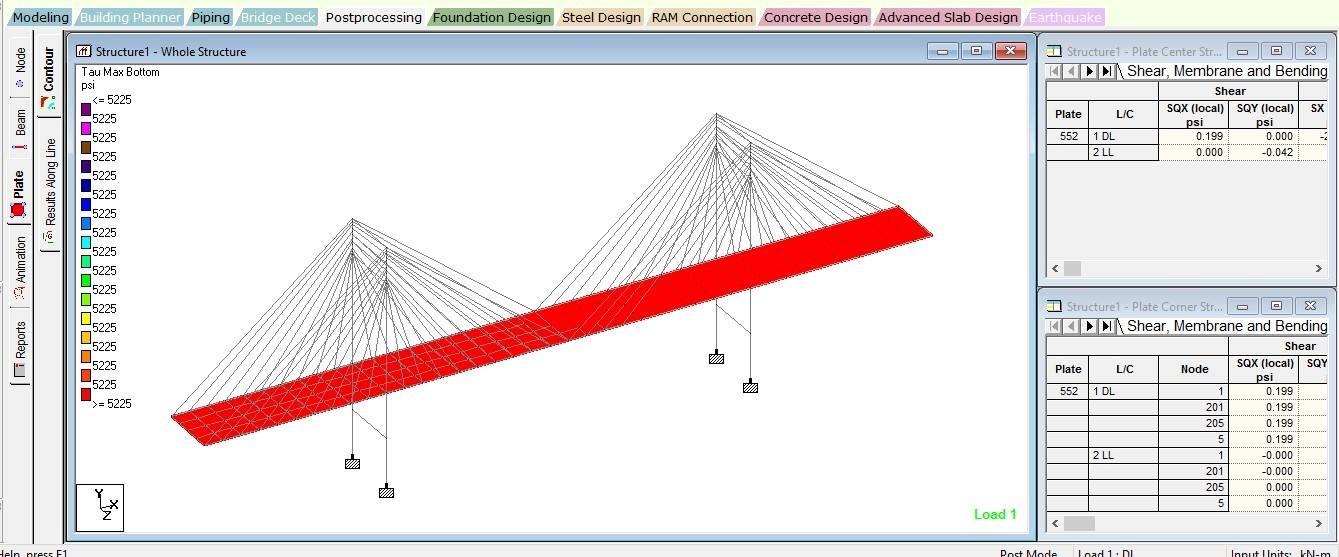
Figure 13: Displacement approach with bending
Conclusion
The FEM analysis corroborates the behavior of the beam under loads in terms of displacement and stress which are as expected. The maximum deflection will be at midspan while the maximum tensile stress happens at the bottom fiber due to the effect of bending. It confirms the design specifications of the beam and provides the green light that the beam is safe and relevant to the engineering practices. Therefore, the given analysis ratified the material remain structurally sound and fit for their intended purpose.
Reference List
Journals
- Ali, K., Katsuchi, H. and Yamada, H., 2021. Comparative study on structural redundancy of cable-stayed and extradosed bridges through safety assessment of their stay cables. Engineering, 7(1), pp.111-123.
Park, J., Yoon, J., Park, C. and Lee, J., 2023. Studying the cable loss effect on the seismic behavior of cable-stayed bridge. Applied Sciences, 13(9), p.5636. - Dong, F., Shi, F., Wang, L., Wei, Y. and Zheng, K., 2021. Probabilistic assessment approach of the aerostatic instability of long-span symmetry cable-stayed bridges. Symmetry, 13(12), p.2413.
- Guo, J. and Guan, Z., 2023, January. Optimization of the cable forces of completed cable-stayed bridges with differential evolution method. In Structures (Vol. 47, pp. 1416-1427). Elsevier.
- Kallingal, S.S. and Singh, P., 2021. Dynamic analysis of cable stayed bridge with various patterns of pylon. In E3S Web of Conferences (Vol. 304, p. 02005). EDP Sciences.
- Lee, Y., Park, W.J., Kang, Y.J. and Kim, S., 2021. Response pattern analysis‐based structural health monitoring of cable‐stayed bridges. Structural Control and Health Monitoring, 28(11), p.e2822.
- Sharry, T., Guan, H., Nguyen, A., Oh, E. and Hoang, N., 2022. Latest advances in finite element modelling and model updating of cable-stayed bridges. Infrastructures, 7(1), p.8.
- Yang, F., Zhao, H., Li, A. and Fang, Z., 2023. Experimental–Numerical Analysis on the Cable Vibration Behavior of a Long-Span Rail-Cum-Road Cable-Stayed Bridge under the Action of High-Speed Trains. Applied Sciences, 13(19), p.11082.
- Zeng, Y., Zheng, H., Jiang, Y., Ran, J. and He, X., 2022. Modal analysis of a steel truss girder cable-stayed bridge with single tower and single cable plane. Applied Sciences, 12(15), p.7627.
- Zhang, J., Chen, K.J., Zeng, Y.P., Yang, Z.Y., Zheng, S.X. and Jia, H.Y., 2021. Seismic reliability analysis of cable-stayed bridges subjected to spatially varying ground motions. International Journal of Structural Stability and Dynamics, 21(07), p.2150094.
- Zheng, X., Jian, J., Liu, L., Sun, B., Zhang, K. and Gao, H., 2024. Static and dynamic performance analysis of cable-stayed bridges with cables damaged fire. Buildings, 14(4), p.884.
- Zhong, R. and Pai, P.F., 2021. An instantaneous frequency analysis method of stay cables. Journal of Low Frequency Noise, Vibration and Active Control, 40(1), pp.263-277.