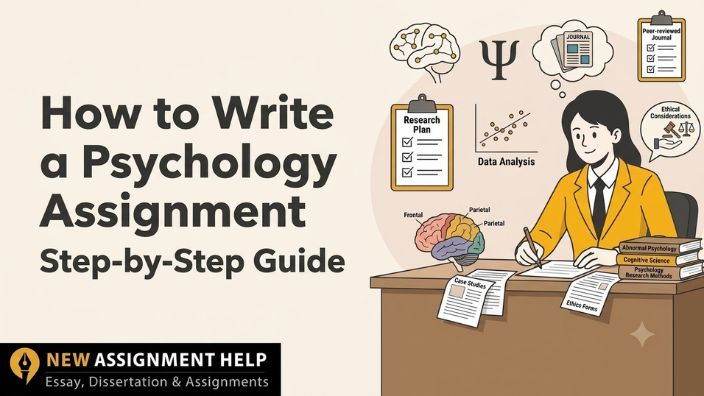
How to Write a Psychology Assignment: Step-by-Step Guide
Psychological conversation is easy, but what if you have to bring those concepts and analyses into writing? Because it is just not about drafting theory but showcasing what you can do with the knowledge. That's why every 2 out of 3 students struggle to craft a psychology assignment. The number is quite obvious because every subject question demands analysis, comparison, and relevant reason.
What if you don't have to spend countless hours on executing these practices to craft a meaningful project? That's what this blog is all about: guiding you with the steps to writing a psychology assignment in an effective way. You’ll explore key components that make it impressive and actual steps to do the great job. So, let's get started without any delay.
Key Components of a Psychology Assignment That Makes it Challenging
We're used to treating assignments like question-answer format, but that's what makes psychology projects difficult. The game completely changes when it comes to understanding the theory, finding supportive research, or something that challenges it. Here's what makes it complex:
- Understanding the Question: There are many times when you write an answer, but it doesn't satisfy the answer completely. It's because you often misread challenging works such as analyse, evaluate, discuss, compare, and critically assess. Dealing with them with the same approach makes answers ineffective.
- Selecting Relevant Theory: You have a question, but what if the answer can be several explanations? Now every theory is right; choosing the appropriate one becomes daunting, and going with the wrong one can ruin the project.
- Using Empirical Evidence: Even if you have outstanding knowledge of concepts, your answer should not be word of mouth. Psychological arguments need credible research behind them. What makes students locate relevant studies, and finding the appropriate evidence drives another job.
- Developing Critical Analysis: The work doesn't end with answering or incorporating evidence, but that's not what justifies analytical thinking. You need to demonstrate whether you can question evidence or not. Also, it requires comparing perspectives, identifying limitations, and considering alternatives.
- Maintaining a Clear Argument: Since the subject concepts are complex to understand, you cannot just use jargon or bombard them with information. Your evidence and analysis should work towards a clear response to the original question, but disconnecting points is common.
To deal with these challenges, you need a proven yet systematic approach to write the assignment. Let's explore it in the next section.
Expert Advice on Writing an Outstanding Psychology Assignment
If the question is about writing a top-notch psychology assignment, you should look at what works the best. Since many experts and educational practitioners provide many tips, we have gathered some of the best ones for you:
- Decode the Question First
Imagine how bad the answer could be when it doesn’t align with the question. Don't make that mistake and begin by understanding what you need to answer. Identify the main topic, the population or behaviour being discussed, and the command word.
- Research with a Purpose
Don’t assume researching means checking a range of documents or websites. Instead, look for evidence that helps answer your specific question. Pay attention to what each study investigated, how it was conducted, and what was found.
- Build Your Arguments
Professors will look to see whether your answers are justified or not. For this, you need to keep your arguments clear and supportive. Make sure they have a clear purpose and should move the discussion closer to answering the question.
- Use Studies as Evidence
Someone else's quote or studies don't make your answers strong directly because they assess your knowledge. That's why focus on using studies of others as evidence and explain what it tells you and how it relates to your argument.
- Evaluate the Meaning
One of the major mistakes you can ever make in a psychology assignment is relying on description. Don't make it central and see how to evaluate the answers. You can do it by looking at factors such as sample size, participant characteristics, research method, and ecological validity.
- Keep Your Analysis On Point
Just to make your analysis better, do not get off track to connect questions. After developing each major point, ask yourself: how does this help answer the question? If it's weak, reconsider whether the point belongs in the assignment.
- Don't Sound Clumsy
From each answer to analysis, everything should feel easier to consume. Sure, use psychological terminology where it adds precision, but explain ideas in a way that makes your reasoning easy to follow. Always remember that a clear argument supported by relevant evidence is more useful than a paragraph filled with impressive-sounding words.
Now you have the clear steps to begin crafting an outstanding psychology assignment. It's time to end this blog with some meaningful learning.
Conclusion
To wrap up, one thing is clear about a psychology assignment: it is more than writing. A subtle mindset change is needed to deliver a description to make the analysis clear. When writing a project on this subject, you should tend to see how the evidence leads to the argument. Start by understanding the question, research with purpose, choose evidence carefully, and then move beyond describing what a study found.
Since you have provided steps that are driven by years of expertise. Use them and start seeing a difference. To make your research and writing more academic and unique, our psychology assignment guidance can be prominent. That's when you’ll have clarity with precision to handle complex tasks.
.jpg)
 6 years | MSc Psychology (Dist.), Behavioural Studies
Hello Everyone I am Emma Harris a Psychology expert. I am also an expert in creating academic content. So if you are struggling with your Psychology papers then feel free to get connected with me. I will understand all your problems and we will work together on your Psychology papers.