Common Management Assignment Mistakes Students Should Avoid
- Top Management Assignment Mistakes That Cost UK Students Their Grades
- Why Management Assignments Get Marked Differently
- 1. Misreading the Assignment Brief
- 2. Describing Instead of Analysing
- 3. Using Frameworks as a Checklist, Not as a Tool
- 4. Weak or Disconnected Conclusions
- 5. Referencing Errors Under Deadline Pressure
- 6. Poor Structure and Presentation
- 7. Leaving It Too Late
- 8. Over-Relying on AI Tools Without Critical Input
- 9. Never Checking Work Against the Marking Rubric
- Quick Reference Table
Top Management Assignment Mistakes That Cost UK Students Their Grades
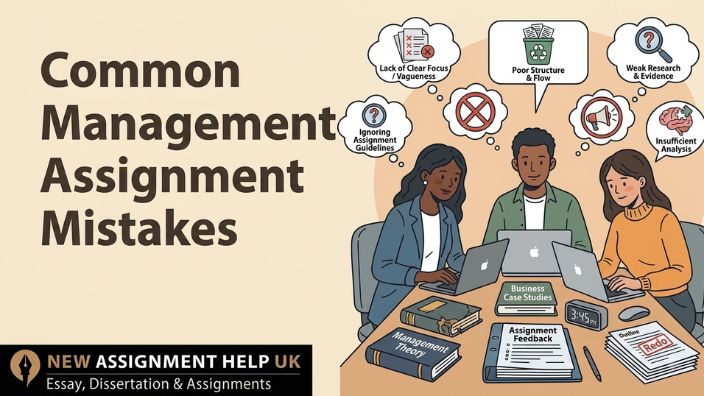
Most UK management students don't lose marks because they don't understand the subject. But they lose marks because of small, repeated habits from misreading the brief to describing instead of analysing their work. These are the same mistakes in management assignments that show up year after year, across every university and every module, and students get stuck in the middle of their management assignments.
In this blog, we'll walk through the nine most common management assignment mistakes UK students make and exactly how to fix each one with precision. You'll also find a quick reference table which will serve as a toolbox to deal with these mistakes in the right way. So keep reading this guide, and you'll walk into your next assignment knowing where students usually go wrong and how to stay ahead of it.
Why Management Assignments Get Marked Differently
This is mainly because these assignments evaluate messy, real-world judgement rather than fixed factual answers. Markers look for how well you apply abstract theories to shifting business contexts while balancing the needs of competing stakeholders. Along with this, it also covers other subjects like strategy, HR, marketing, operations, and more, and each area expects a different style of thinking.
A strategy essay wants you to weigh up options. An HR case study wants you to judge decisions against real workplace outcomes. That's why generic essay-writing tips don't always work here. You need advice built for how management assignments are actually marked. So let's start with the mistake that trips up more students with an effective solution to improve your grades.
1. Misreading the Assignment Brief
This is the single biggest reason students lose marks, and it often has nothing to do with how much they know. A brief might ask you to "critically evaluate" leadership styles, but the student writes a summary of leadership theories instead. That's a different task, and markers notice right away.
The fix:
- Underline the command word in your brief, such as 'evaluate', 'analyse', 'discuss', and 'compare'.
- Look up what your university expects from that word specifically, since it's usually explained in your module handbook.
- Getting this step right sets up everything else.
Once your brief is clear, the next challenge is making sure your writing actually does what that command word asks.
2. Describing Instead of Analysing
This is where a lot of good research still ends up with a low mark. The description explains what happened. Analysis explains why it happened and what it means.
Here is an example of the difference:
- Descriptive: "The company introduced flexible working hours for its staff."
- Analytical: "The company's flexible working policy likely improved retention, but it may have created coordination problems for teams working across different time zones."
The second sentence shows judgement. That's what markers actually require to be written in analysis.
The fix:
- Every time you write a fact, stop and ask yourself, "So what?"
- If you can't answer that question, you're probably still describing, not analysing.
- Try to turn at least one sentence per paragraph into a judgement, not just a statement.
Analysis gets even stronger when it's built on the right tools, which brings us to a mistake many students make with frameworks.
3. Using Frameworks as a Checklist, Not as a Tool
SWOT, PESTLE, and Porter's Five Forces are useful, but only when you apply them properly. A common mistake most students make is filling in every box with generic points that could apply to almost any company or treating every factor as equally important when some clearly matter more.
The fix:
- Pick the two or three points in your framework that are important for the actual company in your case study.
- Skip the rest, or mention them briefly instead of forcing equal detail everywhere.
- Explain why those points matter more, and that's what the part markers are really looking for.
- Remember: depth beats coverage every time.
Strong analysis needs a strong ending too. That's where the next mistake often shows up.
4. Weak or Disconnected Conclusions
Some assignments have excellent analysis in the main body, then a conclusion that seems to belong to a different essay. Recommendations appear out of nowhere, with no link back to the evidence above them.
The fix:
- Every recommendation should be taken from something you already argued earlier in the assignment.
- Before you write a recommendation, find the exact sentence in your body that supports it.
- If you're recommending a change in leadership style, then your body paragraphs should already contain the evidence for why that change makes sense.
Good ideas can still lose marks if the basics around them are messy. Referencing is a classic example of this.
5. Referencing Errors Under Deadline Pressure
Harvard referencing mistakes are one of the most common and also most avoidable reasons management students drop marks. Missing in-text citations, inconsistent formatting, or a bibliography that doesn't match your citations all signal carelessness, even when your ideas are strong.
The fix:
- Start using a reference manager like Zotero or Mendeley from day one of your research, not the night before submission.
- Double-check your university's exact Harvard style guide, since small variations exist between institutions.
- Match every in-text citation to an entry in your bibliography before you submit your work.
Referencing problems often show up alongside a bigger issue: how the whole assignment is put together.
6. Poor Structure and Presentation
Long, unbroken paragraphs make it hard for a marker to follow your argument, even if it is sound. So do inconsistent fonts, missing page numbers, and messy tables.
The fix:
- Plan your structure before you start writing, not after the completion of the work.
- Give each paragraph a clear heading so the marker knows what it's about straight away.
- Break up long paragraphs and follow your module's formatting guidelines exactly.
- Remember: a presentation isn't decoration, but it is part of how clearly your thinking gets communicated.
None of this matters if you don't leave yourself time to do it properly.
7. Leaving It Too Late
Time pressure is one of the most common causes of every mistake on this list. Rushed research, no time to plan a structure, and no time to proofread all trace back to starting too late.
The fix:
- Work backwards from your deadline and allocate fixed time to each task, including research, drafting, and proofreading.
- Build in a proofreading buffer of at least two days.
- A rough plan two weeks out will always beat a strong start with no time left to finish properly.
There's one more time-pressure trap worth calling out on its own, because it's becoming more common.
8. Over-Relying on AI Tools Without Critical Input
AI tools can help you check structure, but handing them your analysis entirely creates two problems. First, AI-generated writing tends to be generic and doesn't reflect the specific case study in front of you, which costs marks on its own. Second, UK universities use AI-detection tools alongside Turnitin, and unclear academic integrity policies are a real risk in your career.
The fix:
- Use AI tools to organise your thinking, brainstorm ideas, or check grammar.
- Keep the actual analysis and judgement your own.
- Remember that markers can often tell the difference, and so can detection software.
The last mistake on this list is the simplest to fix, yet almost nobody does it.
9. Never Checking Work Against the Marking Rubric
Most assignments come with a rubric or marking criteria, and most students never open it again after reading the brief once.
The fix:
- Before you submit, go through the rubric line by line.
- Check your draft against each point one at a time.
- If a criterion mentions "critical evaluation" and your draft doesn't clearly show it, this is your last chance to fix it.
You can also choose support on management assignments to review your draft specifically based on your topic and respective university.
Quick Reference Table
Here's a quick recap before you get started on your own assignment:
| Mistake | Fastest Fix |
|---|---|
| Misreading the brief | Underline the command word first. |
| Describing, not analysing | Ask "So what?" for every fact. |
| Generic frameworks | Focus on the 2–3 points that matter most. |
| Disconnected conclusions | Trace each recommendation back to evidence. |
| Referencing errors | Start using Zotero/Mendeley on day one. |
| Poor structure | Plan your structure before you write. |
| Leaving it too late | Work backwards from your deadline. |
| Over-relying on AI | Keep the judgement and analysis your own. |
| Ignoring the rubric | Check your draft against it line by line. |
Still worried about repeating these management assignment mistakes in your next submission? Don’t worry at all; New Assignment Help UK is here to connect you with experienced professionals who review your work and provide in-depth analysis so you can submit it with precision.

 9 | MSc in Management
Eleanor Whitfield is an academic consultant and management specialist at our Manchester headquarters. With her 9 years of experience, she has been supporting undergraduate and postgraduate students across UK universities. She holds an MSc in Management and has a particular passion for making strategic frameworks genuinely accessible to students who find them challenging. When she is not writing, Eleanor mentors first-year business students through their toughest assignments.