
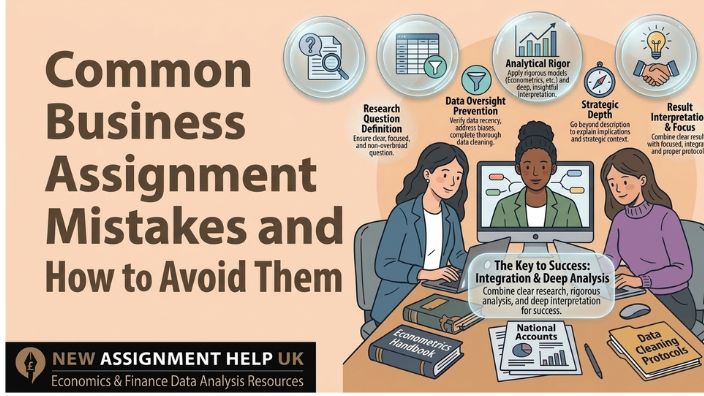
Common Business Assignment Mistakes and How to Avoid Them
- 10 Common Business Assignment Mistakes and How to Avoid Them
- 1. Misreading the Assignment Brief
- 2. Writing Description Instead of Analysis
- 3. Using Weak or Outdated Sources
- 4. Skipping a Proper Structure
- 5. Using Frameworks Like a Checklist
- 6. Weak Referencing
- 7. Flat Conclusions
- 8. Leaving Everything Until the Last Minute
- 9. Ignoring the Marking Criteria
- 10. Skipping Proofreading
- Quick Checklist Before You Hit Submit
- Final Thoughts
10 Common Business Assignment Mistakes and How to Avoid Them
Why do you keep losing marks even when you know the theory well? It happens to more students than you think. The problem is rarely a lack of knowledge. It is usually the approach and how the answer is put together. Business assignments feel difficult because they require you to combine complex theories, real-world data, and deep critical analysis all at the same time. UK universities care a lot about analysis, structure, and solid evidence, and small slips in these areas quietly pull your grade down. However, it is important to note that these common business assignment mistakes are also fixable when you correct the approach. So here are some of them with ways to fix them; let's go through them one by one.
1. Misreading the Assignment Brief
This is where most trouble begins. Analyse, evaluate, and discuss are not the same thing, yet plenty of students answer them in the same manner as if they are. And this results in answers that miss the actual question, even when the writing itself is good.
Fix it by breaking the question apart. Circle the command word, note the actual topic, and glance at the marking criteria before you start working on your assignment.
2. Writing Description Instead of Analysis
Explaining what a theory is is the easy part. But explaining why it matters to a business is what actually earns marks, and it's where a lot of assignments fall flat.
Try asking "so what?" after every point you make in your work. If you can't answer that, the point needs more depth. Compare different viewpoints where you can, and always connect the theory back to a real impact.
3. Using Weak or Outdated Sources
Wikipedia and random blog posts might feel convenient, but they weaken your credibility fast. They also tend to strip out any real-world grounding your argument needs.
Stick with journals, official reports, and reliable data sources instead. A recent case study, even a short one, adds more weight than five vague generalisations, which makes your argument strong.
4. Skipping a Proper Structure
Messy paragraphs and long sections often hide the important point of your work. Random flow and weak paragraphs confuse the marker about the layout.
Keep it simple. Introduction, then one clear idea per section in the body, then a conclusion. Clear headings also help; they make your work easier to follow at a glance.
5. Using Frameworks Like a Checklist
SWOT and PESTLE frameworks are treated like boxes to tick rather than tools to actually think with. This makes your answers more generic and sound identical.
Make sure to choose the parts of a framework that are genuinely relevant to your question and provide an in-depth description. Always explain what your findings actually mean for the business.
6. Weak Referencing
Missing citations do more damage than students realise, even when the ideas behind them are strong and original. It also raises the risk of a plagiarism flag, which isn't worth the stress.
Use Harvard or APA references as you go, not at the end. Cite every source you write and keep the list updated the whole time you're writing.
7. Flat Conclusions
Many students just repeat the introduction and forget to add recommendations. This makes their conclusion weak, leaving the reader without a real takeaway.
Link your ending directly to what you found in the analysis. Give one or two specific, practical suggestions instead of listing general statements in the end.
8. Leaving Everything Until the Last Minute
Late nights before a deadline rarely produce your best thinking. Research gets shallow, analysis gets rushed, and small errors slip through.
Split the work into stages. Research, then write, then edit, each with its own mini deadline. This will leave your final day for just refining your work.
9. Ignoring the Marking Criteria
You can write a genuinely good answer and still lose marks if it doesn't match what's actually being assessed. This mismatch happens more often when students ignore the grading rubrics.
Read the learning outcomes first. Keep checking your draft against the marking criteria as you write and make sure to match your work consistently.
10. Skipping Proofreading
Typos, grammar slips, and inconsistent formatting chip away at how professional your work looks, no matter how strong your ideas are underneath.
Read it more than once. Let a tool like Grammarly catch what you missed, but don't rely on it completely. Check your formatting stays consistent from start to finish.
Quick Checklist Before You Hit Submit
- Understand exactly what the brief is asking
- Analyse, don't just describe
- Use credible, recent sources
- Keep your structure clear and logical
- Apply frameworks with a purpose
- Reference properly every time
- Match your content to the marking criteria
- Proofread before you submit
Final Thoughts
Nearly every mistake here is avoidable once you know it exists. Doing well in a business assignment isn't about being the smartest person in your class. It's about slowing down, staying organised, and thinking the way a business strategist would. Keep this list nearby for your next assignment, and you'll likely notice the difference in your grade. Seeking business assignment support can also prove to be beneficial if you are looking for a deeper analysis.
.jpg)
 10 | MBA in Business Management
Rico Woods has spent over 10 years helping UK university students understand different concepts in business assignments. With an MBA degree in Business Management from the University of London and a background in corporate strategy consulting, he understands both sides of the process: what universities expect and where students usually get stuck. Rico has guided hundreds of students through case studies, reports, and research papers across marketing, finance, HR, and operations. He believes strong grades come from clear thinking, not complicated language. Rico reviews academic frameworks to keep his advice practical, current, and genuinely useful.