

How to Analyse a Marketing Case Study Step by Step
- how to Analyse a Marketing Case Study Step by Step (Complete Student Guide)
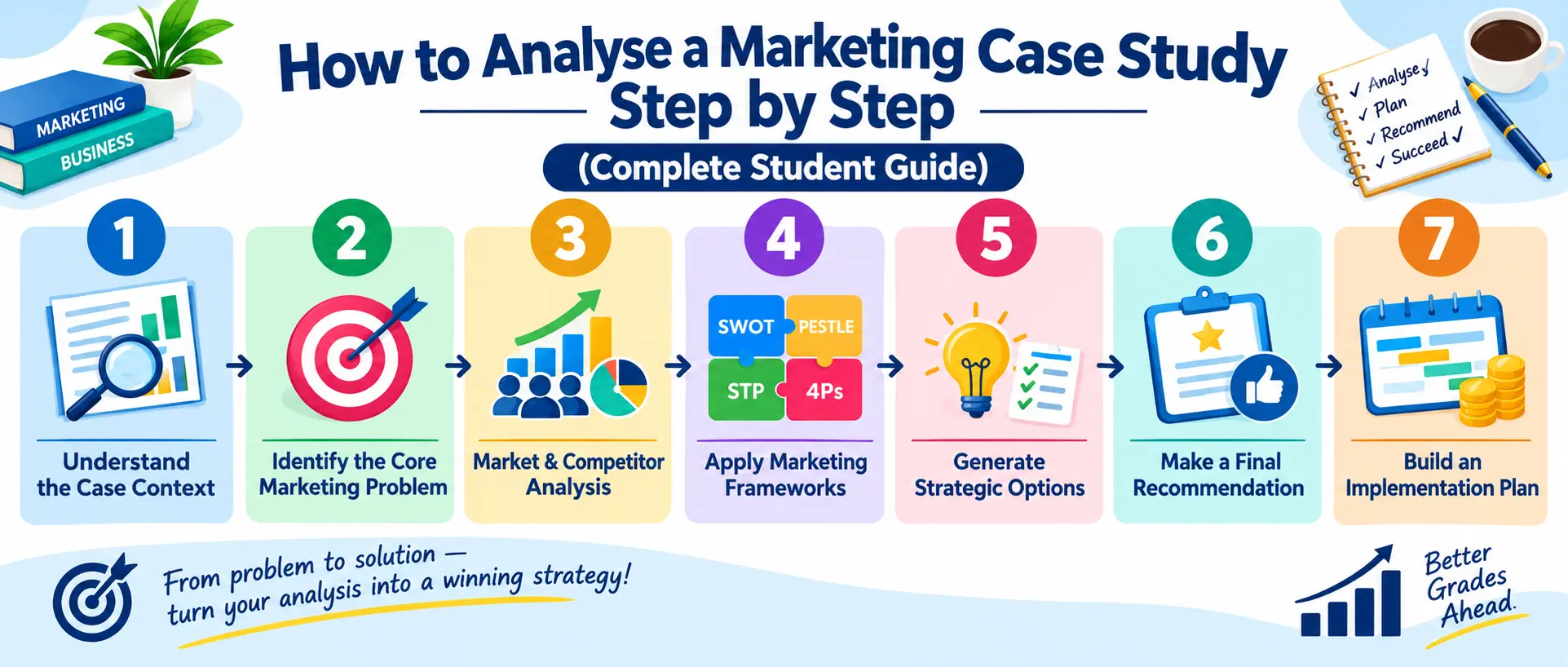
- Step 1: Understand the Case Context
- Step 2: Identify the Core Marketing Problem
- Step 3: Perform Market and Competitor Analysis
- Step 4: Apply Marketing Frameworks
- Step 5: Generate Strategic Options
- Step 6: Make a Final Recommendation
- Step 7: Build an Implementation Plan
how to Analyse a Marketing Case Study Step by Step (Complete Student Guide)
A marketing case study is an in-depth data report of a business that examines a specific problem to achieve measurable results. Marketing case study analysis trips up many students because it involves a structured way of evaluating real business challenges. They find it difficult to identify the main business problem and correctly apply theoretical frameworks to real-world scenarios. So here you are going to learn a simple method to fix it. This guide shows you how to analyse a marketing case study in seven clear steps. So, let’s begin with understanding the basics.
Step 1: Understand the Case Context
Before you write anything, read the case carefully by examining every section line by line. The first time, read for the big picture. The second time, read slowly and mark the details. Look for these things:
- Company background
- Industry
- Target market
- The main situation or problem
Also highlight the numbers, such as sales, customer figures, and competitors. Never start writing before fully understanding what the case is about. Once you know the story, you can hunt for the real problem.
Step 2: Identify the Core Marketing Problem
This step moves you from describing to analysing, and that is where the marks are. Many students list what happened, but you have to explain why it happened.
Start by telling symptoms first, apart from the real problem. Falling sales, for example, is a symptom. The cause might be weak positioning or poor targeting. Ask yourself two questions:
- What is the company struggling with?
- Why is it happening?
Common problems include low sales, weak positioning, poor targeting, and strong competition. Good case study answers focus on the root cause, not surface issues. With the problem being clear, look at the world around the business.
Step 3: Perform Market and Competitor Analysis
Now this is the most important step required here. Identify companies operating in the same niche as the business. Direct competitors sell the same thing. Indirect competitors solve the same need in a different way. For a UK coffee shop, Costa is direct. A cheap home coffee machine is indirect.
Next, look at these trends and analyse. Are customers changing their habits? Is the industry growing or shrinking? Then compare the brands on price, brand value, and product. Benchmarking competitors helps you to identify strategic gaps in the current market. Those gaps often point to your best ideas.
Step 4: Apply Marketing Frameworks
Here you have to work with different frameworks for analysing various situations. These tools help you to turn raw case information into structured insights, which is the core area of analysis. Here are the four you will use most.
- SWOT Analysis: List strengths, weaknesses, opportunities, and threats. This shows the company's inside and outside position.
- PESTLE Analysis: This tool helps you to study political, economic, social, technological, legal, and environmental factors. In the UK, the current factors can include inflation, Brexit rules, or green laws.
- STP Model: Segmentation splits the market into groups. Therefore, targeting helps you pick the best group. And positioning decides how that group sees the brand.
- The 4Ps: Check the product, price, place, and promotion. Ask which one is causing trouble.
Here is the key tip: Don't just define these models. Link each one to the problem you found in Step 2. For example, if your PESTLE shows rising costs, explain how that hurts the brand's pricing. That link is what earns top marks. Now you have insights, so it's time to think about answers.
Step 5: Generate Strategic Options
Don't jump straight to one solution. Instead, show the marker that you've listed a few choices first. This will prove you can think critically. Pick two or three options, such as:
- Entering a new market
- Rebranding
- Changing prices
- Growing digital marketing
Also provide one section for 'pro' and one for 'con' to make your analysis even stronger. Rebranding can refresh the image, but it costs a lot and may confuse loyal customers. Now it is the time to make final choices.
Step 6: Make a Final Recommendation
In the last step, you make the call. Pick the best option from your analysis and describe it in easy language. Then prove it with market data, your framework results, and customer behaviour to make a stronger conclusion.
You can go for a line like this: "The recommended strategy is digital marketing expansion because it fits market trends and solves the core problem found earlier." Keep it short and direct. Markers always praise a confident answer that links back to the evidence. A great choice still needs a plan, though.
Step 7: Build an Implementation Plan
A good strategy is only valuable when it is practically executable. So show how it will happen.
Split your plan by time. Short-term actions might start in the first three months. The medium-term plan may run for the next year. Add a light note on budget, such as "£10,000 for online ads". Then list your KPIs, like sales, engagement, and brand awareness. And make sure to keep your timeline simple and realistic. That’s it, and you are all set with a strong marketing case study analysis.
A structured approach transforms a simple case study into a high-scoring marketing analysis. Try it on your next practice case. It gets easier each time. You can also seek marketing assignment guidance for better understanding.
.jpg)
 9 | MBA in Marketing Management
Oliver White is a Manchester-based marketing academic and assignment specialist with an MBA in Marketing Management and more than nine years of hands-on experience. He works with university students at undergraduate, postgraduate and MBA level across the UK, helping them produce clear, practical coursework that meets what markers actually look for. His core strengths sit in marketing plans, case-study analysis, consumer behaviour, digital marketing and brand strategy. Oliver’s approach is straightforward: take the theory, ground it in real business thinking, and turn it into well-structured, persuasive work. The result is writing that feels confident and helps students achieve better grades.