
Employee Motivation Theories to Use in HRM Assignments
- Employee Motivation Theories to Use in HRM Assignments (With Simple Examples)
- Content Theories of Employee Motivation
- 1. Maslow's Hierarchy of Needs
- 2. Herzberg's Two-Factor Theory
- 3. McClelland's Need Theory
- Process Theories of Employee Motivation
- 4. Vroom's Expectancy Theory
- 5. Adams' Equity Theory
- 6. Locke and Latham's Goal-Setting Theory
- Contemporary and Behavioural Theories
- 7. Deci and Ryan's Self-Determination Theory (SDT)
- 8. Skinner's Reinforcement Theory
- 9. Elton Mayo's Human Relations Theory
- How to Choose and Apply the Right Motivation Theory
- Common Mistakes to Avoid
- Final Thoughts
Employee Motivation Theories to Use in HRM Assignments (With Simple Examples)
Not sure which employee motivation theories to use in your HRM assignment? There is no one-size-fits-all model, because people, workplaces and needs keep changing. These theories explain why people work hard, respond to rewards and care about company goals. They fall into three groups: content, process, and contemporary and behavioural. Pick the group that fits your question, then choose one or two theories from it. Let's start with content theories first.
Content Theories of Employee Motivation
This type of employee motivation theory focuses on the factors that drive human behaviour by identifying the specific internal needs and incentives which are responsible for how people act.
1. Maslow's Hierarchy of Needs
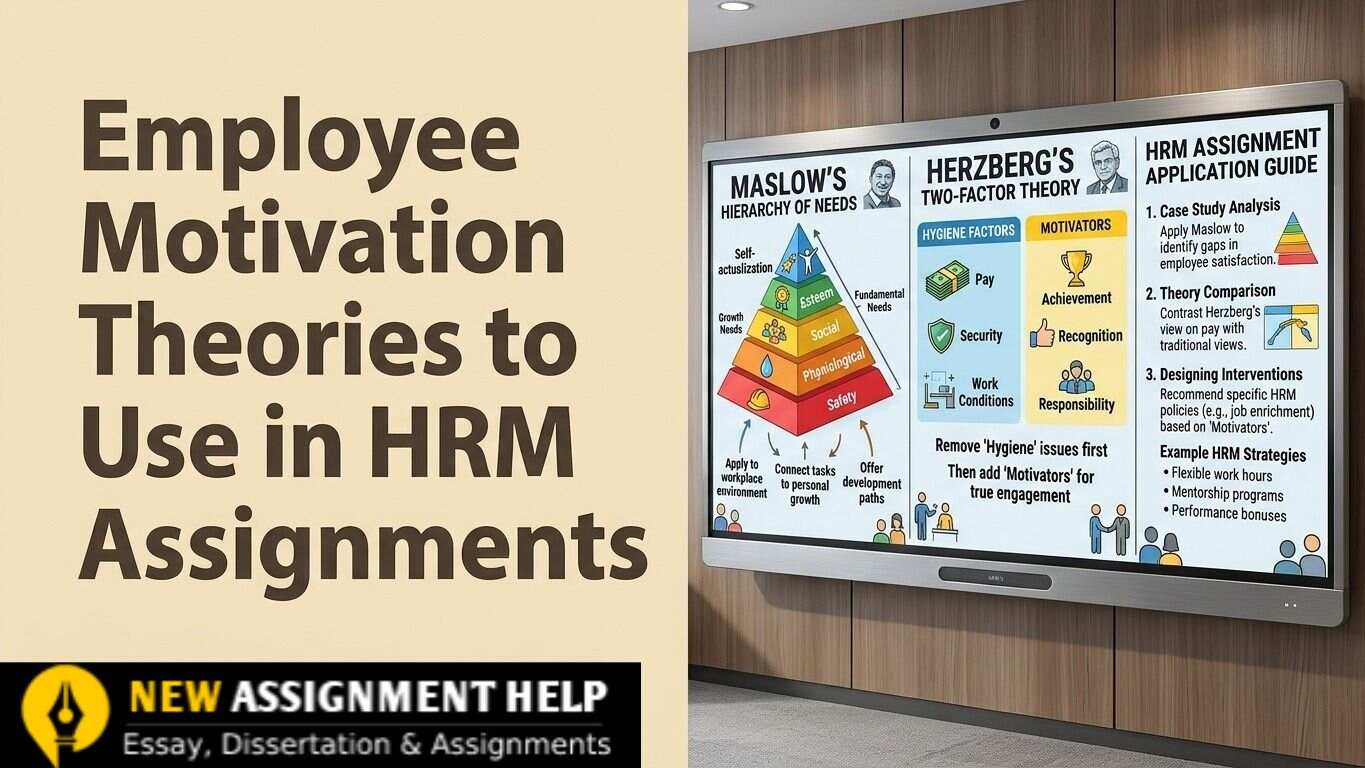
Maslow says people have five levels of needs: physiological, safety, social, esteem and self-actualisation. HR can link each level to daily practice. Fair pay meets basic needs. Job security provides employee safety. Teamwork builds belonging. Recognition supports esteem. Career growth helps people reach their full potential.
- Limitation: People do not always meet their needs in a fixed order, and cultures may differ.
- Best for: It is best suited for wellbeing, workplace needs and career development.
2. Herzberg's Two-Factor Theory
Herzberg split workplace factors into two types.
Hygiene factors: salary, working conditions and job security come under this. Poor ones cause unhappiness, but good ones do not motivate by themselves.
Motivators: They include achievement, recognition, responsibility and personal growth.
HR managers can use job enrichment, praise and development chances to boost motivators. However, the split may not work the same way for every person or workplace.
Best for: job satisfaction, reward management and retention.
3. McClelland's Need Theory
McClelland says people learn three main needs over time: achievement, affiliation and power. Achievement fits stretching targets. Affiliation fits teamwork. Power fits leadership roles. But many people show a mix of needs, so three neat groups can be hard to prove.
This theory is best when you are looking for leadership development, team management and performance.
Content theories tell you what people want. Next, let's see how people choose to act.
Process Theories of Employee Motivation
These theories look at how decisions, effort and results connect. Let's understand this in detail.
4. Vroom's Expectancy Theory
People work harder when three things are true:
- Expectancy: I believe my effort will improve my performance.
- Instrumentality: I believe good performance will bring a reward.
- Valence: I value that reward.
This can be used in performance-related pay, bonuses and reward systems, but people often value different rewards.
5. Adams' Equity Theory
Adams introduced this in 1963. It says people compare what they give and get with what others receive. If it feels unfair, motivation drops. This can cover pay, workload, praise and promotion.
HR use: Make sure of pay equity, clear reward rules and fair performance reviews.
Limitation: Fairness is often considered personal, so two people can see the same situation differently.
6. Locke and Latham's Goal-Setting Theory
This theory states that clear, challenging goals with regular feedback can increase the performance of the employee.
HR use: This can be used in performance management and productivity. However, targets that are too tough can cause stress, tunnel vision or poor behaviour.
Here is an easy way to remember all three. Expectancy theory is about expected rewards. Equity theory is about perceived fairness. Goal-setting theory is about goal-driven effort.
Now, let's look at a newer idea that adds depth to your work.
Contemporary and Behavioural Theories
These theories mainly focus on representing a structural shift in place of rigid, mechanistic views of work and move towards highly adaptive, human-centric models. It includes:
7. Deci and Ryan's Self-Determination Theory (SDT)
SDT says people stay motivated from within when they have three things:
- Autonomy: freedom to make choices
- Competence: a chance to learn and grow
- Relatedness: supportive relationships
It suits both engagement and job design. Remember that autonomy has limits, because roles and company rules still matter.
8. Skinner's Reinforcement Theory
Behaviour that brings good results gets repeated. So thanks, praise and bonuses can build habits you want. It can be used in recognition schemes and bonuses.
Limitation: It ignores inner motives and focuses on outside rewards, so it is weaker for explaining creativity or deep engagement.
9. Elton Mayo's Human Relations Theory
Mayo's Hawthorne studies suggested that attention, teamwork and good relationships lift output, not just pay. Thus, make sure to listen to staff and build team bonds.
Limitation: The studies faced criticism over their methods.
These are the major theories used in HRM assignments. Thinking of how to apply these in your assignment? Find this out in the next section.
How to Choose and Apply the Right Motivation Theory
Match the theory to your assignment focus.
| Assignment focus | Suitable theory |
|---|---|
| Employee needs and career growth | Maslow |
| Job satisfaction and recognition | Herzberg |
| Leadership and team motivation | McClelland |
| Incentives and rewards | Vroom |
| Pay fairness | Adams |
| Performance targets | Locke and Latham |
| Autonomy and engagement | SDT |
| Rewards shaping behaviour | Skinner |
| Team spirit and relationships | Mayo |
Then follow these five steps:
- Spot the motivation problem.
- Choose one relevant theory.
- Link its ideas to company evidence.
- Judge its limits.
- Give a recommendation you can defend.
Common Mistakes to Avoid
Many students lose marks here. Watch out for these:
- Describing a theory without applying it
- Picking a theory that does not fit the question
- Ignoring its limits
- Making advice with no evidence
Final Thoughts
Strong HRM assignments use motivation theories to explain behaviour, test HR practices and back up advice. Choose theories that fit, support them with evidence and always judge their limits. You can also seek HRM assignment support if these are feeling difficult.

 9 | PhD in Organisational Behaviour
Joey Batey is a Senior HRM Subject Expert with over nine years of experience in human resource management education and academic support. He holds a PhD in Organisational Behaviour and is a Chartered Member of the CIPD. Joey has guided hundreds of UK university students through HRM assignments, case study analysis and dissertation projects. His work covers employee motivation, talent management, employment relations and performance management. Before moving into academic writing, he spent four years in HR advisory roles with UK organisations. He now shares clear, evidence-based advice that helps students build stronger arguments, apply theory with confidence and meet university marking standards.