
How to Write an Economics Case Study Analysis
- What an Economics Case Study Analysis Actually Means
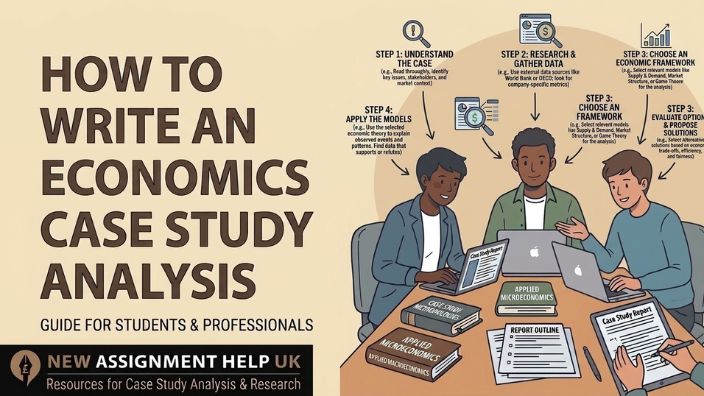
- The 5 Steps at a Glance
- Step 1: Read the Case Twice and Find the Real Problem
- Step 2: Choose the Right Economic Theory
- Step 3: Study the Data Like a Real Analyst
- Step 4: Structure Your Analysis Clearly
- Step 5: Write a Conclusion That Recommends, Not Repeats
- Bringing It All Together
To write an economics case study analysis, you must correctly apply economic models, theories and data to evaluate a real-life scenario. It is also used in analysing the core economic issue and purpose backed by proper evidence. Economic analysis is not a summary of the case. But it is proof that you understand how economic ideas work in the present situation. If you are staring at an economics case study assignment right now, here is exactly how to build one that actually earns marks.
What an Economics Case Study Analysis Actually Means
Think of a case study as a small business or policy story with a problem hidden inside it. Maybe a company is losing profit, or a country is dealing with inflation. Your job is to play detective and find the economic reason behind the problem, using theory and evidence to explain it clearly. That is what it means. An economics case study analysis is a structured study of real-world economic events, policy and markets using its theories and related data. In these further sections, you will get to know how to perform the economic analysis using clear steps.
The 5 Steps at a Glance
Before going deep into each part, here is the full picture. Writing a solid economics case study analysis comes down to five moves:
- Start by reading the case to find the real economic problem hiding in the question.
- Pick the right theory that actually fits that problem.
- Then study the data given in the case instead of relying on guesswork only.
- Structure your answer so a reader can follow your logic without getting lost.
- End with a recommendation, not just a summary of what you already said. No need to add any additional information here.
Now let's start understanding each step in detail.
Step 1: Read the Case Twice and Find the Real Problem
Most students lose marks in the very beginning of the analysis. Therefore, on your first read, just understand the story hiding behind. On your second read, underline numbers, dates, and any hint of a problem, such as falling demand, rising costs, or unemployment. Then write the core issue in one simple sentence.
This step sets the foundation of your work, so do not rush here.
Step 2: Choose the Right Economic Theory
This is the stage to build authority for your analysis. Popular theoretical frameworks in student case studies include demand and supply, elasticity, opportunity cost, different market structures, and fiscal or monetary policies. Pick the theoretical framework that fits the issue identified in step one. For example, if prices are going up, then the theoretical framework to consider would be elasticity of demand.
Naming the correct theory instantly shows your teacher that you know the subject very well.
Step 3: Study the Data Like a Real Analyst
The basic rule for any successful economics case study analysis is the use of facts rather than assumptions. Check the figures, tables, or charts included in the case. Make all necessary calculations and compute the percentages or differences. When the case says that the price has increased, make the calculations to show by how much the demand was affected.
Doing this step clearly will shape your answer to its best.
Step 4: Structure Your Analysis Clearly
A clean structure keeps your reader following all the steps without getting lost. A reliable format looks like this:
- Introduction: Mention the case and the economic problem.
- Theory Application: Define the economic concept and relate it to the case.
- Data Analysis: Use statistics or figures for supporting information.
- Discussion: Describe cause and effect in easy words.
- Conclusion: State your results and solution precisely without adding any additional information.
Key Tips: Keep paragraphs short. One idea per paragraph is enough for a reader to follow without confusion. Now that the structure is set, the final piece is your ending.
Step 5: Write a Conclusion That Recommends, Not Repeats
A weak conclusion just recounts the introduction. Whereas a strong one gives a recommendation based on your analysis. For example, instead of writing "inflation is a problem," write "the government should raise interest rates because it reduces spending and slows inflation." This shows judgment, which is exactly what builds authority in your writing.
Bringing It All Together
Writing a strong economics case study analysis is really about following a pattern: understand the problem, apply the correct theory, use real data, structure your points clearly, and end with a solid recommendation. Once you practise this pattern a few times, it will become your expertise. So keep practising or take additional economics assignment support and build your academic journey with much more clarity.

 9 | Master's in Economics
Archie Thomas is a UK-based economics tutor and academic writer at New Assignment Help UK. For the past nine years he has worked with university students on assignments, case studies and data-driven coursework. He holds a master's in economics from the University of Manchester and has supported undergraduates across topics from microeconomic theory to macroeconomic policy analysis. He takes the view that economics is best learned through clear thinking rather than memorising formulas. His writing and teaching focus on breaking complex ideas into straightforward, real-world explanations so that students understand the reasoning, not just finish the assignment.