
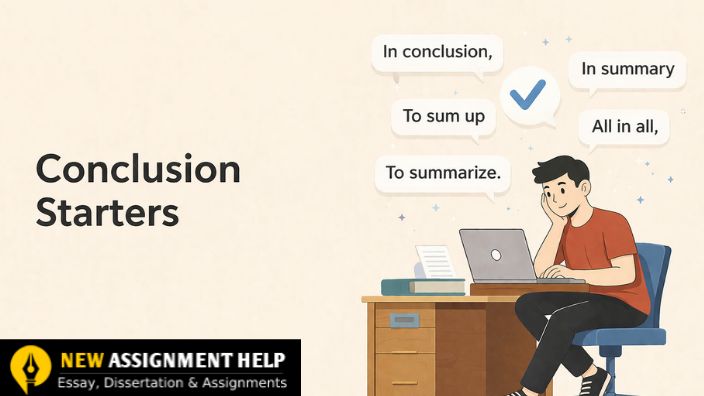
140+ Conclusion Starters for Essays: Examples & Writing Guide
- 140+ Conclusion Starters to Write a Powerful Essay Ending
- What Are Conclusion Starters?
- Why Conclusion Starters Matter in Academic Writing
- Essential Features of Effective Conclusion Starters
- A Step-By-Step Guide to Write a Powerful Conclusion
- From Basics to Advanced: Types and Ultimate List of Conclusion Starters
- General Conclusion Starters
- Argumentative Essay Conclusion Starters
- Analytical Essay Conclusion Starters
- Research Paper Conclusion Starters
- Reflective Writing Conclusion Starters
- Comparative Essay Conclusion Starters
- Problem-Solution Essay Conclusion Starters
- Persuasive Essay Conclusion Starters
- Advanced Academic Conclusion Starters
- Short and Impactful Conclusion Starters
- Common Conclusion Writing Mistakes That Lower Your Marks
- Overusing Generic Phrases
- Proven Tips For Better Conclusion Writing Skills
- Conclusion
140+ Conclusion Starters to Write a Powerful Essay Ending
Do you know that a strong essay is not only about crafting a clear introduction or presenting well-researched arguments? The ones that have powerful conclusions start to prove their excellence. Many of you might have struggled with beginning your conclusion without sounding repetitive, and that’s where conclusion starters become useful. They are used to create an impressive closure that connects arguments on a broader level.
In this blog, you will explore the importance, practical strategies, and techniques to use to give your essay a great closure. With over 140+ conclusion starters, you can write effective academic endings with confidence. So stay tuned to avail the benefit of learning from this guide!
What Are Conclusion Starters?
As the name suggests, the conclusion starters are the phrases used at the beginning of a final paragraph. They signal the ending of the discussion. They support your arguments by guiding readers from the main body of your essay to your final evaluation of the topic. Whether you are writing an essay, an assignment or a dissertation, it will provide a reader-friendly approach to prepare your project.
In simple terms, they are the words that provide a better way to understand the structure and the intent behind your work. Now, let’s move further to understand its importance in academic writings.
Why Conclusion Starters Matter in Academic Writing
Academic writing is judged on its research, argument quality, and structure. In this section, we will guide you on the importance of conclusion starters in your writing:
- They help to build a logical closure of the discussion, explaining its ending in a connecting manner.
- To support your arguments, they provide a refined way of writing without using repeated words.
- A good conclusion starter smooths your academic writing and works as a bridge between arguments and the final judgement.
- With an accurate conclusion, you can demonstrate your critical thinking rather than a simple summary.
- It is used in the final thought to create a positive impact on the examiner towards your work.
You might now understand that conclusion starters are not decorative phrases but structural tools to build credibility in an academic environment. Let's discuss in detail the essential features of conclusion starters in the next section.
Essential Features of Effective Conclusion Starters
To give a strong finish to your project, you should use conclusion starters rather than simply writing “In conclusion” at the end. At higher levels of study, examiners expect analytical closure instead of a basic summary.
In this section, we will guide you with its features in a detailed manner:
- Enhance Academic Tone: They maintain the formal academic tone of the assignments, which helps in strengthening analytical thinking. However, casual words, such as “So yeah,” weaken the credibility of your writing. So use phrases like “In light of the discussion” or “Based on the evidence presented” to reflect strong conclusions.
- Present Strong Closure: A powerful conclusion guides the reader with a clear judgement. Although if you finish the paragraph in a fragmented form, you will signal a weak ending. So words like "overall", "to summarise", or "taking everything into account” provide a smooth transition to complete the essay.
- Influential Synthesis: Many of you use the conclusion just to summarise the paragraphs, but it is not like that. You must frame them to reflect a deeper understanding and critical evaluation of the assignments. Therefore, combine your essays with phrases like “Taken together" or "Collectively" to show the connection between the ideas.
- Alignment with Assignment Type: Each writing has its own requirements, and not all the conclusion starters fit every type of assignment. So, for reflective work, use phrases such as “Upon reflection", whereas research-based essays benefit from “Based on the findings". This feature strengthens the overall impression of your work.
- Building Impactful Language: With a strong conclusion, you can refine your work by avoiding complex opening phrases. The goal of conclusion starters is to introduce the final paragraph efficiently while maintaining authority. Thus, a concise but powerful transition allows more space to develop meaningful closing insights
An effective opening to a conclusion influences your final argument, providing clarity and precision. To sum up the features, now let’s move to the next section to learn the steps to write a strong conclusion.
A Step-By-Step Guide to Write a Powerful Conclusion
An effective conclusion must be framed with critical thinking to support the ideas of your work. Therefore, in this particular section, we will guide you with the following steps to write an effective conclusion:
Step 1: Restate Your Thesis in Refined Words
Conclusions are the important pillars of your work; therefore, frame them without repeating the introduction. With this step, you can reflect progression in your thinking.
Step 2: Summarise Key Points
Summaries guide with the overall intent of the work; therefore, you must highlight only the important points of the arguments. So, focus on only the key features.
Step 3: Synthesise, Do Not Repeat
To connect your arguments, you must show their collective support for your thesis. So, reflect on how the evidence links rather than presenting isolated reminders.
Step 4: Provide Final Evaluation
Offer a concluding judgement or broader implication of your discussion. This will relate your work to real-world relevance, future research, or long-term impact.
Step 5: End with a Strong Closing Sentence
At the end, finish with a confident statement and avoid introducing new arguments. The final sentence should feel conclusive, thoughtful, and academically grounded.
After following these steps, you can build a powerful conclusion that clarifies and establishes the authority of your work.
From Basics to Advanced: Types and Ultimate List of Conclusion Starters
The use of conclusion starters depends on the purpose, tone, and academic level of your assignment. Here are some conclusion starters that you can use in your future coursework:
General Conclusion Starters
- In conclusion
- To conclude
- Overall
- In summary
- To summarise
- Ultimately
- All things considered
- Taking everything into account
- In closing
- As this discussion shows
- In brief
- On the whole
- To sum up
- In essence
- As demonstrated above
Argumentative Essay Conclusion Starters
- Therefore
- The evidence clearly suggests
- For these reasons
- This demonstrates that
- It is evident that
- In light of these arguments
- Accordingly
- Given these points
- This supports the view that
- Hence
- As a result
- From this perspective
- The argument ultimately shows
Analytical Essay Conclusion Starters
- This analysis demonstrates
- Taken together
- Collectively, these findings
- Upon analysing the evidence
- This evaluation highlights
- The analysis ultimately reveals
- When examined closely
- From this analysis
- These observations suggest
- This interpretation indicates
- The critical review shows The discussion illustrates
- Through this evaluation
- In analytical terms
- This breakdown confirms
Research Paper Conclusion Starters
- Based on the findings
- The results indicate
- The data suggests
- This study demonstrates
- The research confirms
- The findings provide evidence that
- From the research conducted
- The investigation reveals
- In concluding the study
- The outcomes highlight
- According to the results
- The analysis of data shows
- This research supports
- Overall, the findings suggest
Reflective Writing Conclusion Starters
- Upon reflection
- Looking back
- This experience has shown
- From this experience
- I have learned that
- This reflection highlights
- Through this process
- This situation taught me
- Reflecting on the experience
- In reviewing my actions
- As a result of this experience
- This reflection demonstrates
- Moving forward
- Overall, this reflection reveals
Comparative Essay Conclusion Starters
- In comparison
- When comparing both perspectives
- Both arguments demonstrate
- While both sides present
- On balance
- Despite their differences
- Considering both viewpoints
- From both perspectives
- The comparison highlights
- Overall, the similarities show A
- although contrasting
- When viewed together
- This comparison ultimately suggests
- Each perspective reveals
- In evaluating both
Problem-Solution Essay Conclusion Starters
- To address this issue
- To resolve this problem
- Based on the discussion
- The most effective approach is
- This issue can be mitigated by
- The proposed solution demonstrates
- Ultimately, the solution requires
- To overcome these challenges
- This strategy would result in
- In response to the issue
- Given these challenges
- A practical solution involves
- The recommended course of action is
- Addressing this concern requires
Persuasive Essay Conclusion Starters
- For these compelling reasons
- It is clear that
- One cannot ignore
- The importance of this issue
- This argument strongly supports
- There is no doubt that
- It becomes apparent that
- Therefore, action must be taken
- This clearly indicates
- The evidence overwhelmingly suggests
- It is reasonable to conclude
- This makes it evident
- The argument convincingly shows
- Thus, it is imperative
- Given the urgency
Advanced Academic Conclusion Starters
- Within the broader academic context
- This discourse ultimately demonstrates
- From a critical standpoint
- This examination substantiates
- When contextualised within
- This scholarly evaluation confirms
- In synthesising these arguments
- This comprehensive analysis reveals
- From a theoretical perspective
- The implications of this analysis suggest
- In addressing the core question
- The argument is substantiated by
- The academic discourse affirms
Short and Impactful Conclusion Starters
- In short
- Simply put
- At its core
- Fundamentally
- In the final analysis
- In the end
- Briefly
- To conclude briefly
- In closing remarks
- Ultimately speaking
- At its heart
- All in all
- Summing up
- In final consideration
- In conclusion, therefore
Common Conclusion Writing Mistakes That Lower Your Marks
Many students focus only on writing the information but often fail to give a smooth transition. In this particular section, we will discuss common conclusion mistakes that decrease the overall quality of your work:
- Introducing New Arguments Adding a new idea in the conclusion weakens the structure of your work. Therefore, the ending note should be short and close to the information mentioned above.
- Repetition of Words Repeated words in your thesis statement look vague, so instead of restating them, refine your wording to reflect progression in your work.
- Ending Without a Clear Conclusion Every work needs to end with a proper closing statement. Hence, the final sentence should clearly recognise that the discussion has reached a logical conclusion.
- Using Informal Language Emotional phrases reduce the academic tone of your assignment. So use conclusion starters in your essays to present a formal structure.
Overusing Generic Phrases
Repeated use of words in every assignment makes your writing predictable. Therefore, apply more refined phrases to develop curiosity in writing.
Therefore, by avoiding these common mistakes, you can significantly improve the clarity and impact of your conclusion. Also, you can refer to our checklist below to refine your conclusion writing skills.
Proven Tips For Better Conclusion Writing Skills
Writing a strong conclusion requires specific closing phrases at the end of your essay. For this, you can use the following points as an evaluation tool to refine your ending:
- Ensure your conclusion directly reflects the main argument to refine the language of your assignments.
- Highlight only the most important clauses discussed in your work to avoid repetition and show the real thought behind your work.
- Choose an appropriate conclusion starter that matches your assignment type and academic tone.
- Avoid conversational expressions in the final paragraph to maintain an analytical and professional tone in the essay.
- Your conclusion should close the discussion; therefore, avoid using new evidence to weaken your structure.
- Keep the conclusion clear and concise to present a stronger academic impression in the final insight.
- Finish your essay with a confident closing sentence, as the last line provides clarity and a sense of completion for the reader.
By applying the following checklist, you can transform your conclusion from basic to a confident final statement. Using them will not only improve your arguments but also demonstrate academic maturity in your assignment-related work.
Conclusion
After reading this blog, you might have developed a clear understanding of the conclusion starters in detail. These are crucial, and you can consider them as your final opportunity to strengthen your arguments and demonstrate academic clarity. However, if you are still confused and want assistance in learning, New Assignment Help UK is your trusted academic partner to boost your performance. Here, we provide comprehensive assistance that will improve the overall performance of your assignment. So, no need to take an extra burden when you have elite academic support.

 7 | Masters
Amelia Ryder is an academic writing consultant holds Masters with over 7 years of experience in higher education support, specialising in composition and discourse strategies. She excels in helping students shape coherent paragraphs, strong arguments, and effective conclusions across disciplines. Her writing has appeared on established educational platforms, where she offers actionable insights to elevate essay structure and academic voice. When not writing about conclusion starters and persuasive techniques, Amelia enjoys analysing exemplary academic work and mentoring students on citation integrity and critical thinking. Her focus remains on empowering learners to communicate ideas clearly and finish their assignments with confidence and precision.
Frequently Asked Questions About Conclusion Starters
What are 7 ways to start a sentence?
- Using transition words (however, therefore),
- Starting with a subject,
- Beginning with a question,
- Using a quotation,
- Opening with a dependent clause,
- Starting with an adverb,
- Using a prepositional phrase.