
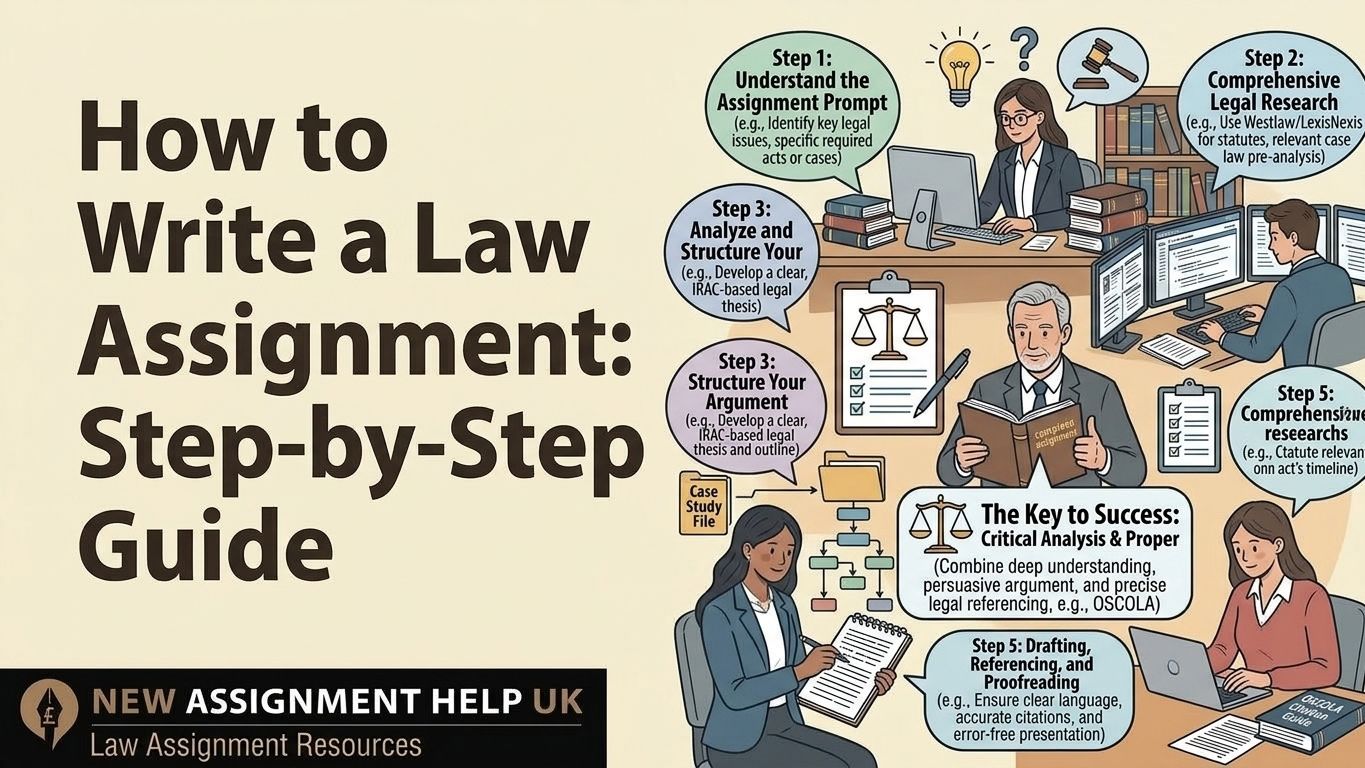
How to Write a Law Assignment: Step-by-Step Student Guide
- How to Write a Law Assignment: Step-by-Step Guide
- Step 1: Break Down the Question First
- Step 2: Use the IRAC Method to Structure Your Answer
- Step 3: Research With Purpose, Not Panic
- Step 4: Master OSCOLA Referencing Early
- Step 5: Write the First Draft Without Editing
- Step 6: Edit for Precision, Not Just Grammar
- Step 7: Proofread Like a Marker, Not a Writer
How to Write a Law Assignment: Step-by-Step Guide
What if it's 11pm and your law assignment is due tomorrow and you're still staring at a case brief? Sounds familiar? A lot of students in the UK experience this at least once during their degree. A law assignment is a structured piece of academic writing that applies legal principles, case law, and statutes to answer a specific question. Here this guide will show you how to write a law assignment with exact steps UK law markers expect, from breaking down the brief to referencing under OSCOLA correctly.
Step 1: Break Down the Question First
Before you open a single textbook, read the question three times. Along with that, underline the command words such as "discuss", "critically evaluate", or "advise". Because each one demands a different style of answer. "Advise" wants a client-focused conclusion, while "critically evaluate" wants you to weigh competing academic views.
A common mistake is writing everything you know about a topic instead of answering the specific question asked. If the brief says "advise Sarah on her contractual rights", your entire answer should focus on Sarah's position under contract law, not general theory.
So, write a one-sentence summary of what the question is really asking. If you can't do this, you're not ready to research yet.
Step 2: Use the IRAC Method to Structure Your Answer
Most UK law schools, including those following SQE-aligned assessment criteria, expect answers built around IRAC. Below are the proper stepwise IRAC instructions to follow:
- Issue → Identify the specific legal problem raised in the facts.
- Rule → State the relevant law, including statutes and binding case authority.
- Application → Apply that law directly to the facts, citing precedent like Donoghue v Stevenson for negligence or Carlill v Carbolic Smoke Ball Co for contract formation.
- Conclusion → Give a clear, reasoned answer to the question.
The above-provided structure keeps your draft focused and also stops your drifting into unrelated theory. Markers often use IRAC as an unofficial checklist when grading, so if you follow it closely, you can directly improve your mark.
Step 3: Research With Purpose, Not Panic
Start with your core textbook and module reading list before touching Google. Primary sources come first: statutes, case law, and law reports. Secondary sources like textbooks and journal articles help you interpret them.
Use databases like Westlaw or LexisNexis for verified citations, since blog summaries often misstate a case's actual ratio decidendi. Cross-check any case you cite against the original judgement where possible.
Keep a running list of every source as you go. Chasing citations after finishing your draft wastes hours you don't have near a deadline.
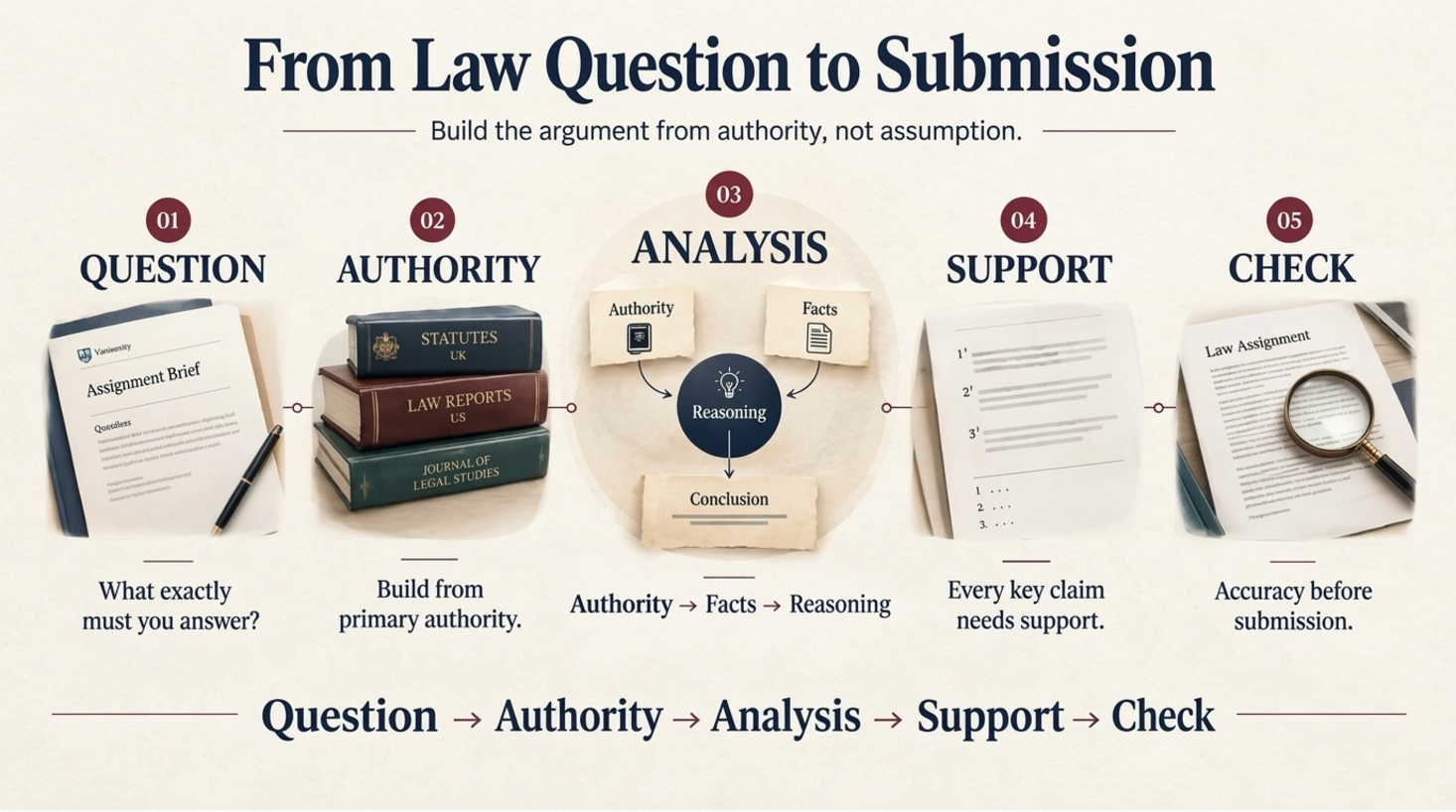
Step 4: Master OSCOLA Referencing Early
Majorly in UK law assignments, students are required to follow OSCOLA (Oxford Standard for Citation of Legal Authorities), which is completely different from Harvard or APA style.
Below are the key OSCOLA rules to remember:
- Case names appear in italics, followed by the citation in brackets, for example, R v Brown [1994] 1 AC 212.
- Footnotes carry citations, not in-text brackets, with pinpoint page or paragraph references where relevant.
- A bibliography closes the assignment, split into cases, legislation, and secondary sources, each in its own section.
If you get this wrong, then it's one of the fastest ways to lose easy marks. Since referencing accuracy is often graded separately from legal content and can also raise academic integrity flags if sources appear misaligned. So if you want, you can look for professional law assignment support to avoid losing marks and making the references accurately.
Step 5: Write the First Draft Without Editing
Once your research and structure are ready, write the whole draft in one sitting, if you can. Don't stop for perfect sentences or meeting the word count yet. Also start with the body sections, not the introduction, because your introduction will get easier to write once you know your answer's conclusion.
Along with that, aim to get the full argument down before polishing. Editing an unfinished argument wastes more time than refining a complete but rough one.
Step 6: Edit for Precision, Not Just Grammar
In legal writing, markers reward precision over flair. So check each paragraph, questioning yourself, Does this sentence move the legal argument forward or not? Cut all the unnecessary and illogical repetition and replace the vague phrases like “it could be argued” with a direct stance backed by named authority.
At last read your conclusion and make sure it mirrors your introduction's issue without introducing the new arguments at the last minute.
Step 7: Proofread Like a Marker, Not a Writer
Read your assignment aloud to catch awkward phrasing; your eyes skip over when reading silently.
Check every case cited appears in your bibliography, and every bibliography entry is cited somewhere in the text. Mismatches here are common and easily avoidable.
Finally, check your word count against the brief's requirements, since going significantly over or under often signals weak planning before a marker reads a single word.
A strong law assignment isn't about sounding clever. It's about answering the exact question asked, backing every claim with named legal authority, and presenting your argument in a structure the marker can follow without effort. Get those three things right, and the marks tend to follow.

 9 | Law and LLB (Hons)
Yvette Cooper is a practising solicitor in England and Wales with an LLB (Hons) in Law and an LLM from a UK university. Her day-to-day work covers contract, tort and public law matters. That makes her well known for how legal reasoning works in real cases as well as in the lecture hall. Outside practice, she spends her spare time mentoring law students on case analysis, legal writing, OSCOLA referencing, internships and exam preparations. She writes clear, practical guidance that helps students turn legal knowledge into stronger assignments and excelling academic results.