
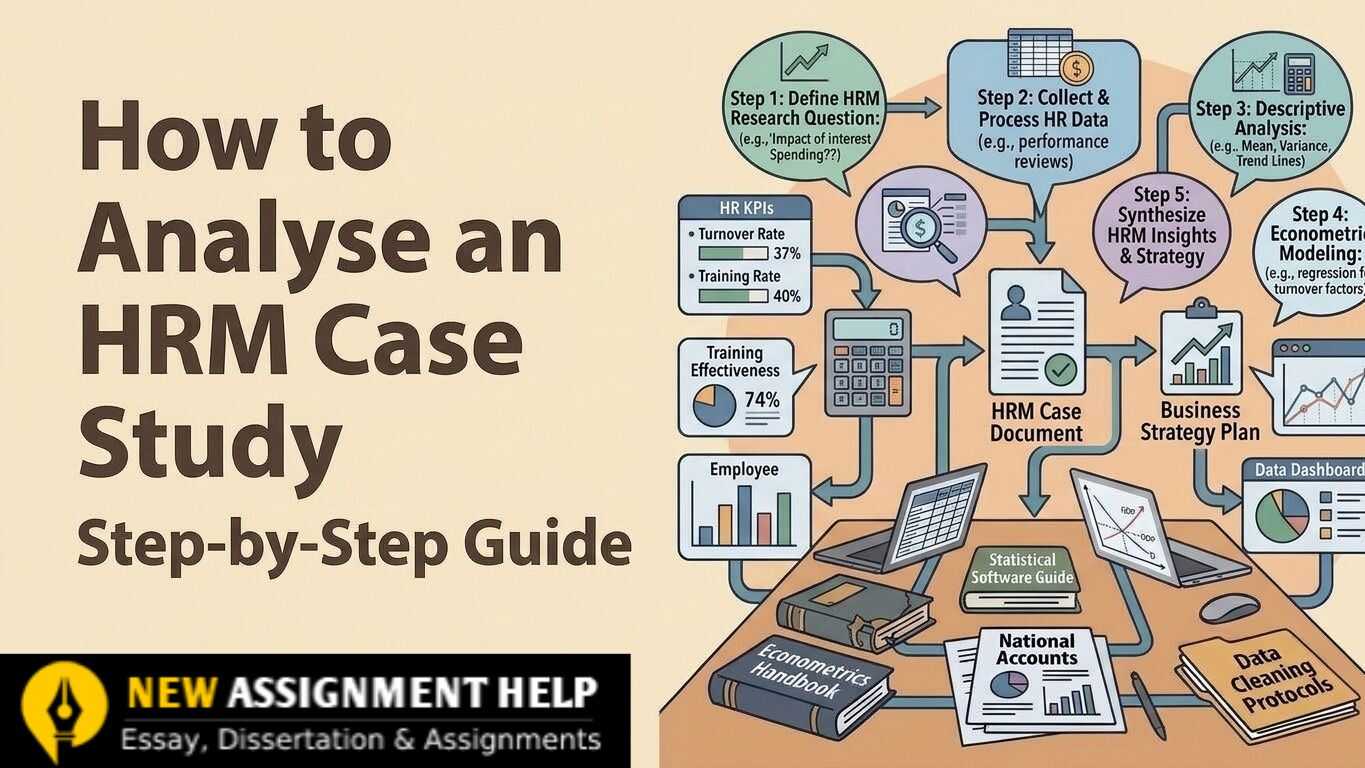
How to Analyse an HRM Case Study: Step-by-Step Guide
- How to Analyse an HRM Case Study: A Simple 7-Step Method
- Step 1: Understand the Case Study Brief
- Step 2: Read the Case and Identify Key Evidence
- Step 3: Identify the Main HRM Problem and Its Root Causes
- Step 4: Select and Apply Relevant HRM Theories
- Step 5: Critically Evaluate the Evidence and Possible Solutions
- Step 6: Develop Evidence-Based HRM Recommendations
- Step 7: Structure the Analysis and Write the Conclusion
- Worked Example: Analysing High Employee Turnover
- Final Thoughts
How to Analyse an HRM Case Study: A Simple 7-Step Method
How do you analyse an HRM case study? Read the brief, find the main problem, check the evidence, apply a theory, compare fixes and back your advice. An HRM case study gives you a workplace problem, real or imagined, and asks you to explain it with evidence and HR ideas. Most students get stuck on one thing: telling a symptom from a root cause. This guide shows you each step at a time.
Step 1: Understand the Case Study Brief
To start, find the task words in the brief, such as analyse, evaluate, critically discuss or recommend. They tell you what the marker wants.
Then note the organisation, the HR area, any theories you must use, the word count and the marking criteria. Always follow your own brief, because not every case study has the same structure.
Also check what kind of question you have:
- Explain the problem: You need to diagnose what went wrong and why.
- Propose solutions: Then you should suggest and defend a fix.
Once you know the task, you can dive into the case itself.
Step 2: Read the Case and Identify Key Evidence
Read the case thoroughly. Look for facts on staff numbers, turnover, absence, employee feedback, hiring, training, performance and manager choices. Keep real facts apart from your guesses. Also list who is affected, such as employees, line managers, HR teams and senior leaders. A simple evidence table keeps you organised:
| Case evidence | Why it may matter | Questions to check |
|---|---|---|
| Turnover rose last year | May signal low satisfaction | Which teams are leaving? |
| Staff say there is no career path | May link to limited growth | Is this true for all roles? |
With your evidence ready, you can find the real problem.
Step 3: Identify the Main HRM Problem and Its Root Causes
A symptom is what you can see. A root cause is why it happens. High staff turnover, for example, is often a symptom, not the problem itself.
Possible causes include poor line management, limited development, weak reward, heavy workload or poor hiring. But do not state them as facts. Test each one against the case evidence. Also, focus on the problems that matter most for your question, not every issue in the case. Here is a simple cause-and-effect chain:
Weak manager support → low motivation → more exits → lost skills → lower service quality
Next, you need a lens to explain what is going on. Theory gives you that.
Step 4: Select and Apply Relevant HRM Theories
Pick your theory after you find the problem. Then use it to explain the evidence. Do not just define it.
| HR problem | Possible theory | Question it helps answer |
|---|---|---|
| Low motivation | Herzberg's Two-Factor Theory | Are recognition and growth missing? |
| Weak performance | Goal-setting theory | Do staff have clear, fair targets? |
| Training results | Kirkpatrick's model | Did the training change behaviour? |
For strategic issues, the Harvard Framework or the resource-based view can also help.
Step 5: Critically Evaluate the Evidence and Possible Solutions
Critical evaluation means comparing the case facts with research and asking whether they agree. If your brief wants advice, compare at least two possible fixes. For each one, look at:
- The likely benefits
- The limits
- How realistic it is
- The effect on staff and results
Choose the fix that best fits the evidence, not the one that sounds nice. For example, a pay rise will not help if people leave because of a poor manager. It treats the symptom and ignores the cause.
Once you have chosen, it is time to turn ideas into action.
Step 6: Develop Evidence-Based HRM Recommendations
Good recommendations are specific, realistic and linked to your analysis. For each one, say what the action is, why it helps, who leads it, when it happens and how you will measure success. Here is a short action plan:
| Action | Reason | Owner | Timeframe | Success measure |
|---|---|---|---|---|
| Review career paths | Staff report limited growth | HR team | 3 months | Lower turnover |
| Train line managers | Weak support found | Senior leaders | 6 months | Higher engagement scores |
Which actions you pick depends on your evidence. Turnover rates, engagement results and retention after the change can all show whether the plan worked.
Step 7: Structure the Analysis and Write the Conclusion
A flexible structure with introduction and case context, problem analysis, theory application, evaluation of options, recommendations and conclusion always works well.
Use headings only if your brief asks for a report. Support every analytical paragraph with case facts and academic references. Your conclusion should answer the main question and follow from your analysis. Do not add new evidence there.
Let's see all seven steps working together.
Worked Example: Analysing High Employee Turnover
This is an imaginary example, not a real company.
- Evidence: Turnover is rising, and staff feedback mentions few chances to grow.
- Diagnosis: Limited development may be one cause, but you need more evidence to rule out others.
- Theory: Use Herzberg to ask whether missing recognition and growth explain the exits.
- Evaluation: Does the evidence support this? Could workload or management also play a part?
- Recommendation: Run a focused development review and track retention or engagement afterwards.
Final Thoughts
A strong HRM case study analysis mixes careful reading, root-cause thinking, the right theory, honest evaluation and practical advice. Before you submit, check that every conclusion follows from the case evidence and your brief. With this, support for HRM assignments is also available to solve all your queries.