
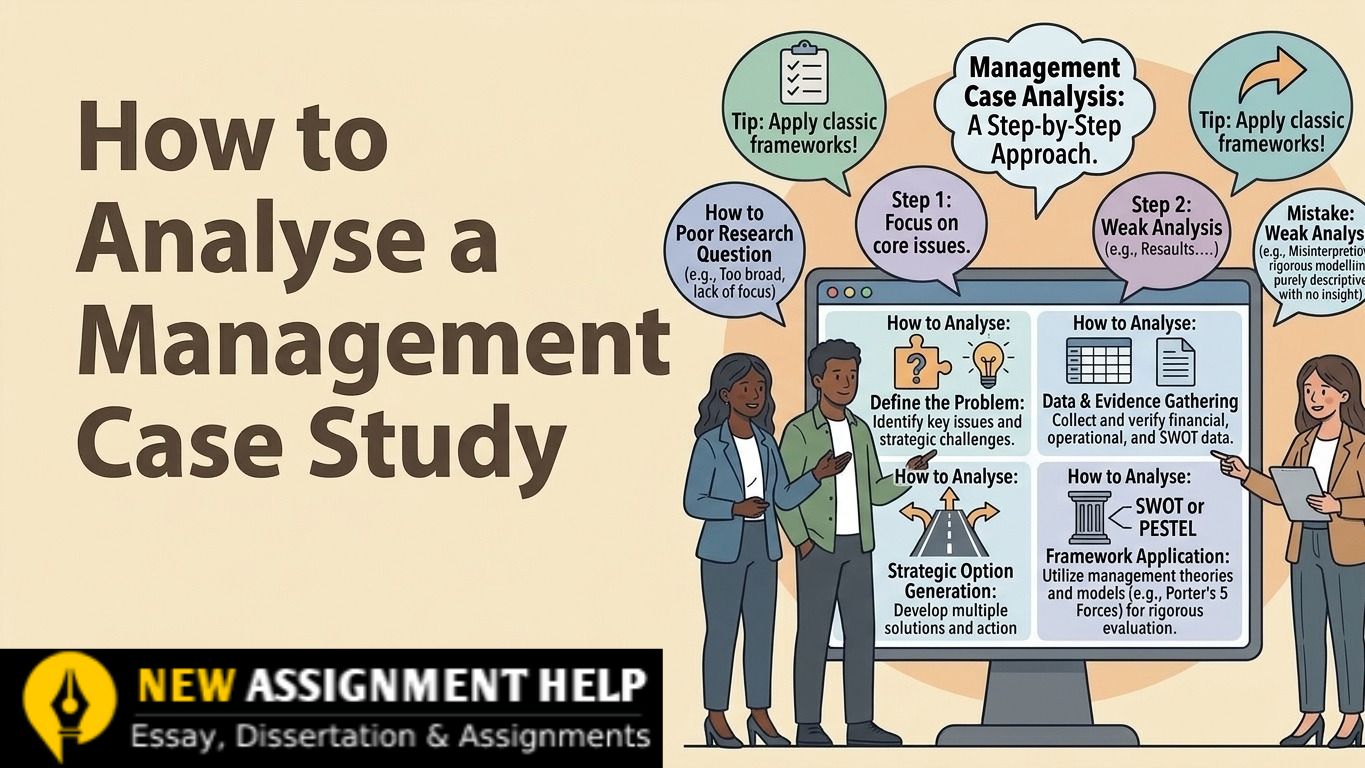
How to Analyse a Management Case Study
- How to Analyse a Management Case Study in 6 Simple Steps
- What Is Management Case Study Analysis?
- Step 1: Identify the Main Management Issue
- Step 2: Choose the Right Management Theory
- Step 3: Apply Management Theory to the Case Evidence
- Step 4: Critically Evaluate Management Practices
- Step 5: Assess the Organisational and Employee Implications
- Step 6: Structure Your Management Case Study Analysis
- Common Mistakes to Avoid in Management Case Study Analysis
- Conclusion
How to Analyse a Management Case Study in 6 Simple Steps
When you are working on a management case study, you need to follow a structured process that moves beyond retelling the story. Find the main issue, pick a fitting theory, match it to the evidence, judge what you see and reach a clear conclusion; this is the whole process of working. A management case study looks at real decisions, leaders, teams and workplace habits. Many students just retell the story and lose marks, but their tutors want you to explain why things happened, along with the grounded solution to every problem. Let us show you how to work, one step at a time.
What Is Management Case Study Analysis?
It requires you to study a real or sample workplace to understand how and why management choices lead to certain results. For this, use theory and evidence to explain what went right or wrong.
It is slightly different from general business case analysis. That one often looks at markets, profits and big strategy. But here, you stay focused on people, leadership and how work is managed. Now let us start with the first step for analysing a management case study.
Step 1: Identify the Main Management Issue
Read the case more than once to understand what the case study is actually asking. Then analyse, What is the real problem here? Look for issues linked to:
- Leadership
- Employee motivation
- Culture
- Communication
- Change
- Decision-making
Next, separate the problem you see from the reason behind it. Say many staff are leaving. That is only what you can see. The real reason could be a bad manager, no chance to grow or too much work. Also note who is involved, such as managers, teams and anyone else the problem affects.
Finish with one clear problem statement that answers your assignment question. With the problem named, you can pick your theory easily.
Step 2: Choose the Right Management Theory
Your theory must fit your problem. Think of it as a tool. You would not use a hammer to cut paper. This applies in selecting a theory as well; here is what matches:
- Leadership theories: for how managers behave
- Motivation theories: for staff engagement
- Culture models: for workplace values and habits
- Change models: for company transitions
Check your brief and your module notes first, because sometimes your tutors expect the theories they taught you. Please do not stack many unrelated models just to look clever. One or two well-chosen theories beat five weak ones. Got your theory? Let us put it to work.
Step 3: Apply Management Theory to the Case Evidence
This is the main section of your assignment. Do not just define a theory. Show how it explains the case. Follow this order for better application:
- Pick a clear piece of evidence, like a manager's action or a staff reaction.
- Link it to a part of your theory.
- Say what the link shows about the problem.
- Back it up with a credible academic source.
Here is a quick example for your understanding. Staff morale is low. The manager gives orders and never asks for ideas. Under a leadership theory like transformational leadership, leaders should inspire and involve people. This manager does neither. So the theory helps explain why motivation has dropped. A source on engagement can support that point.
Evidence → theory → meaning. This is the pattern you have to follow for each key point, and you will apply theory accurately. Next, we test your own argument.
Step 4: Critically Evaluate Management Practices
Ask, Is this approach really working here? Do not accept the first answer. Try these checks:
- Is there another reason for the problem?
- Does any evidence point the other way?
- Where does the theory fall short?
- Do staff needs or working conditions differ?
- Is each claim backed by proof, or is it a guess?
Let us see what this looks like in practice. You might write, The manager's style explains the low morale. However, the case also mentions pay cuts, so the style may not be the only cause. That small sentence shows real thinking.
Step 5: Assess the Organisational and Employee Implications
What does your analysis mean for the workplace? Think about how your findings affect employees, managers and teams. Consider communication, engagement, teamwork, performance and resistance to change. Then say what could improve.
Remember one thing. Every implication must come from your evidence. If the case never mentions pay, do not build a point about pay. Strong points are grounded, not guessed. Now you can shape all of this into a clear layout.
Step 6: Structure Your Management Case Study Analysis
A clean order helps your reader follow your analysis clearly, and here is the one:
- Introduction: name the case and the main issue
- Main analysis: link your theory to the case evidence
- Critical evaluation: judge the practices and their effects
- Conclusion: answer the question directly
- References: use your university's required style
Always follow your assessment brief for headings and format. It comes first, whatever any template says. Now that you know how to analyse your management case study, understand the mistakes students often make.
Common Mistakes to Avoid in Management Case Study Analysis
Check your assignment before submitting your final draft:
- Retelling events instead of judging decisions
- Naming theories without using them
- Ignoring evidence that disagrees with you
- Making big claims with weak proof
Conclusion
Good analysis links theory, case evidence and honest evaluation. Keep your assessment criteria beside you at every step. If you ever feel stuck, you can seek management assignment support for clearing all your doubts.