How to Apply Scientific Methods in University Assignments
- Understanding Scientific Methods and How to Apply Them in University Assignments
- What Does the Scientific Method Really Mean?
- The Steps of the Scientific Method (Broken Down Simply)
- How to Apply Scientific Methods to University Assignments
- Common Mistakes Students Make While Applying Scientific Methods
- How to Reference the Scientific Method Correctly
Understanding Scientific Methods and How to Apply Them in University Assignments
Say the words "scientific method" out loud, and most students picture a lab coat and a bubbling test tube. But that’s not what it actually means. If you've ever written a research methodology section or explained why you tested something a certain way. You have certainly come across these methods while working on your science assignments.
This isn’t limited to science itself. It shows up everywhere from psychology essays and business case studies to nursing reports and engineering write-ups. Because it is less about chemistry sets and more about how you think. Once you see it that way, it stops feeling like a science-class relic and starts feeling like a tool you can actually use in your university assignments.
So let's break down what the scientific method actually is and how you need to tackle it if it shows up in your next assignment.
What Does the Scientific Method Really Mean?
At its core, the scientific method is just a fair way to test an idea. You notice something. You ask a question about it. You guess an answer. Then you check if your guess holds up. That's it; that is what the scientific method is.
Scientists use this process because it keeps guesswork and personal opinion out of the picture. A philosopher named Karl Popper had a simple rule for this. A good scientific idea has to be provably wrong, not just provable right. If your idea can never fail a test, it's not really science. It's just a belief.
For students, this matters because your lecturers want to see if you can think in a structured, evidence-based way. That's exactly what this method teaches you. History too backs this up. Alexander Fleming didn't set out to discover penicillin. He noticed mould-killing bacteria in a petri dish by accident. He questioned it, tested it, and confirmed it before publishing his findings. That's the scientific method at work even through a happy accident.
The Steps of the Scientific Method (Broken Down Simply)
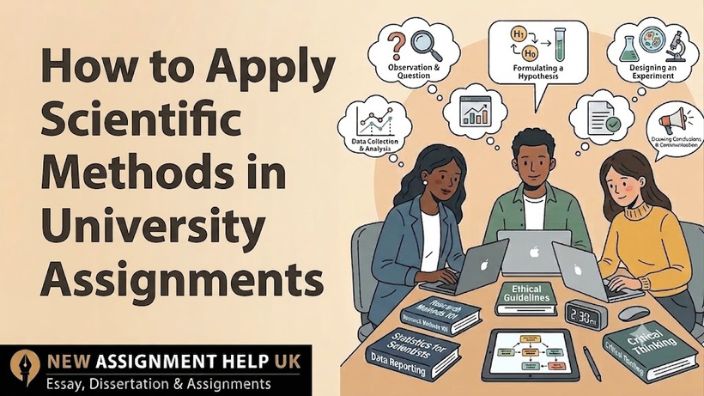
Every version of the scientific method looks a little different depending on where you read it. But most agree on these seven steps:
- Observation. An interesting question comes up from an observation, which may be anything from a pattern to a problem or something strange in the data.
- Question. This observation is formed into a specific question, not "What is going on between sleep and grades?" but something such as "Does less sleep affect test scores?"
- Hypothesis. This is an educated guess, often made in the form of an "if-then" statement. For example: "If the students get less than six hours of sleep, then they will get poor test scores."
- Experiment. This hypothesis is tested through experimentation, surveys, or a review of other studies.
- Analysis. You look at what you found. Does the evidence support your guess, or not?
- Conclusion. You state what the results actually mean. Be honest, even if they don't match what you expected.
- Share and Repeat. You write it up so others can check your work. If needed, you go back and try again with a new hypothesis.
These steps rarely happen in a perfectly straight line. Real research loops back and forth all the time. But don't worry, that's normal too. Knowing the steps is one thing. Using them in your actual coursework is where most students get stuck. Let's fix that next.
How to Apply Scientific Methods to University Assignments
This is the part most guides skip. They explain the steps and leave you to figure out the rest. But not us. We will show you the practical side as well.
In your assignment, the scientific method usually lives inside your methodology or introduction section. This is to show your marker how you approached your research question, step by step. As mentioned above, this is not specific to the science discipline only. Here is what it looks like across different subjects.
- Psychology: A hypothesis may be based on behaviour, something that talks about how screen time influences attention. Explain observation, form a hypothesis and describe research.
- Business/Management: As an alternative to experimentation in a laboratory, the "test" could be a case study or a survey. But you will still follow the same logic: observe the problem in business, form a hypothesis about the cause and analyse the data to confirm.
- Nursing: You may form an observation about a deficiency in patient care and form a hypothesis about the treatment. In this case, use clinical studies as your "experiment".
- Engineering: Test design ideas based on performance data following the same logic: observe, hypothesise, test, and conclude.
Notice the pattern? The steps stay the same. Only the tools change. Let's make this concrete:
Say your dissertation asks whether remote work lowers team productivity. Your observation might come from reports showing slower project delivery. Your hypothesis would state that remote teams complete fewer tasks per week. Your experiment could be a survey of forty employees across both groups. That's the scientific method dressed up as a methodology chapter.
Or let’s say, if your course is more lab-based than essay-based, the scientific method usually takes a slightly different shape. Instead of a methodology section inside a longer essay, you're often writing a full scientific lab report from start to finish, with its own structure for hypothesis, method, results, and discussion.
Here's a tip that markers love. Always link each step back to your actual assignment brief. Apply it directly to your specific research question. That's the difference a good science assignment helper tends to make. It helps most when you're juggling deadlines.
Common Mistakes Students Make While Applying Scientific Methods
A few mistakes show up again and again. They're easy to avoid once you know what to look for.
- Writing a hypothesis that can't actually be tested. If there's no way to prove it wrong, it's not a real hypothesis.
- Describing the steps generically instead of applying them. Explaining what a hypothesis is isn't the same as writing your hypothesis.
- Skipping the "why". Markers want to know why you picked this method. Just listing steps without justification loses marks fast.
- Forgetting to connect the conclusion back to the original question. Your ending should answer the question you started with, not drift off into something new.
If any of these sound familiar, don't panic. Nearly every student trips over at least one of them and looks for professional science assignment support online. Fixing it usually just takes a second look with fresh eyes, not a full rewrite. With the mistakes out of the way, there's one last piece that often gets ignored: referencing.
How to Reference the Scientific Method Correctly
Here's something almost nobody mentions. If you're referencing a source about the scientific method itself, you still need proper citations. Treat it like any other academic claim.
In Harvard style, a typical citation might look like this:
Popper, K. (1959) The Logic of Scientific Discovery. London: Routledge.
If your course uses APA instead, the same source would look like this:
Popper, K. (1959). The logic of scientific discovery. Routledge.
Always check whether your university wants Harvard, APA, or another format. UK universities often have their own house style. And never just paraphrase a textbook definition without crediting where it came from. That's an easy way to lose marks for weak referencing, even if your content is solid.
Conclusion
The scientific method isn't just something scientists use in a lab. It's a way of thinking that shows up in nearly every subject you'll study at university. Once you understand the steps and how to apply them, assignments start to feel more structured and a lot less overwhelming. If you still feel stuck figuring out how to fit all this into your next paper? That's what New Assignment Help UK is here for. Practical support, real guidance, and a bit less stress on your plate.
.jpg)
 7 Years | MSc Science (Dist.), Research Methods
I am a professional academic writer for science. I have a deep understanding of science and with that, I have been helping students for 5 years. Just like others, you can rely on me to solve your academic problems. I am happy to help you and offload your academic stress. Please feel free to connect with me.