

How to Write a Finance Assignment: Step-by-Step Guide
- The Step-by-step Structure to Write Finance Assignments
- Step 1: Decode the Question and Pick Your Format
- Step 2: Research With the Right Sources
- Step 3: Build Your Structure
- Step 4: Show Your Calculations the Right Way
- Step 5: Write the Interpretation: Where the Marks Actually Live
- Step 6: Tie Your Conclusion to the Evidence
A high-quality finance assignment can be written by following a structured workflow that balances accurate calculations with clear written analysis. A finance assignment is not judged the same way as an essay. Nobody is scoring you on how nicely you argue a point. You are scored on whether your numbers are correct, whether your workflow is accurate, and whether you can explain what your results actually mean.
In this guide on how to write a finance assignment, you will understand the workflow for these assignments, which includes an introduction, background, analysis, interpretation, conclusion, and references. Get these six pieces right, in the correct order, and your assignment will read like the work of someone who understands finance sharply. Let's walk through each section, one at a time for more clarity.
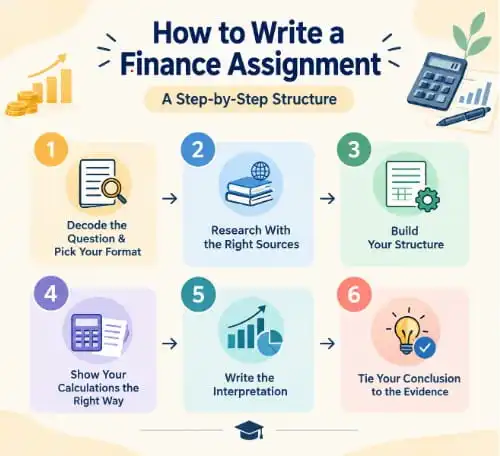
The Step-by-step Structure to Write Finance Assignments
For writing a finance assignment, you must work in planned manner and use reliable sources to make your assignment credible. So here is the writing process and once you know what each one is meant to achieve, filling them in becomes far easier.
Step 1: Decode the Question and Pick Your Format
Before researching or calculating anything, first read your brief carefully and find the command word. By doing this, you will know exactly what kind of answer is expected.
- Discuss: present different viewpoints, backed by evidence
- Analyse: break financial information down and examine it closely
- Evaluate: weigh strengths, weaknesses, and implications
- Critically assess: form a balanced judgement supported by evidence
The command word also points to your format. Questions asking you to "calculate", "analyse", or "evaluate" performance usually expect a report. Questions asking you to "discuss" or "critically evaluate" a concept may expect continuous essay writing instead. And if your brief doesn't make this clear, check with your tutor before you start to avoid unnecessary stress during submission.
Step 2: Research With the Right Sources
Once you know what you're answering, gather reliable sources a marker will trust. You can look at:
- Company annual reports
- Financial databases such as Bloomberg, FAME, or Statista
- Peer-reviewed finance journals
- Data from the IMF, OECD, or World Bank
Also make sure to use proper referencing in your work. If a figure came from an annual report or a database, cite it the same way you'd cite a journal article. Numbers without any source can look designed to a marker, even when they are not.
Step 3: Build Your Structure
A finance assignment usually requires following six parts. For a 2,000-word assignment, here's the roughly targeted word count for your clear understanding.
| Section | Purpose | Approx. Words |
|---|---|---|
| Introduction | State what you're analysing and your methods. | 200-250 |
| Background | Give context on the company or issue. | 250-300 |
| Analysis | Show your working and results. | 450-550 |
| Interpretation | Explain what the results mean. | 450-550 |
| Conclusion & Recommendations | Summarise findings, and suggest next steps to be taken. | 200-250 |
| Reference List | Cite every source. | Not counted |
Use this table for your reference and adjust it according to your assignment requirement. Notice that analysis and interpretation together take up nearly half the assignment, and that's where most of your effort should go too.
Step 4: Show Your Calculations the Right Way
This is where easy marks quietly disappear. In finance, you're usually graded on your method as well as your final answer, which means a marker needs to see how you reached a number, not just the number itself.
For every calculation, show three things:
- The formula
- The substitution the real numbers plugged in
- The result, labelled clearly with its unit
For example:
Formula: Current Ratio = Current Assets ÷ Current Liabilities Substitution: £480,000 ÷ £300,000 Result: 1.6
A correct answer with no visible working can score lower than a wrong answer with clear steps, because the marker can reward the method in one case and not the other.
Step 5: Write the Interpretation: Where the Marks Actually Live
A number on its own earns almost nothing until it is written with an explanation. It needs a benchmark, a trend, or a link to financial theory before it means anything. Compare these two lines, written about the same result.
Weak: "The profit margin was 8%. This is reasonable."
Strong: "The profit margin of 8% is a two-point drop from last year and sits below the industry average of 11%, suggesting the company's cost control is weakening."
The strong version compares the number to something real, which is a past year and an industry figure. It draws out what it means. Thus, after every result, ask yourself: compared to what, and so what? If you can answer both, you're interpreting. If not, you're only reporting.
Step 6: Tie Your Conclusion to the Evidence
A weak recommendation could have been written without doing any analysis at all. A strong one names the exact result sitting behind it. See the explanation below for clear understanding.
Generic: "The company should reduce costs."
Evidence-based: "The company should reduce its reliance on short-term debt, given a gearing ratio of 68%, well above the sector norm, which raises its financial risk."
The second version is something a marker can actually reward, because it's anchored to a figure you calculated by yourself.
A finance assignment isn't difficult because of the maths. It's difficult because it asks you to do two jobs at once: one is to calculate correctly, and the other is to explain clearly. Work through these six steps in order, keep your calculations visible, and if these numbers trouble you, then seeking finance assignment support can benefit you specifically.
.jpg)
 11 years | PhD in Financial Studies
Best Day Students. I am Thomas Ellwood and PhD (Financial Studies) certified from the University Of London. I like teaching students and taking them out of difficult academic situations and that is why I opt for the role of academic writer. You can connect with me here and get all the solutions appropriately. I have 10 years of experience in creating dissertations, assignments, essays, and reports for finance