
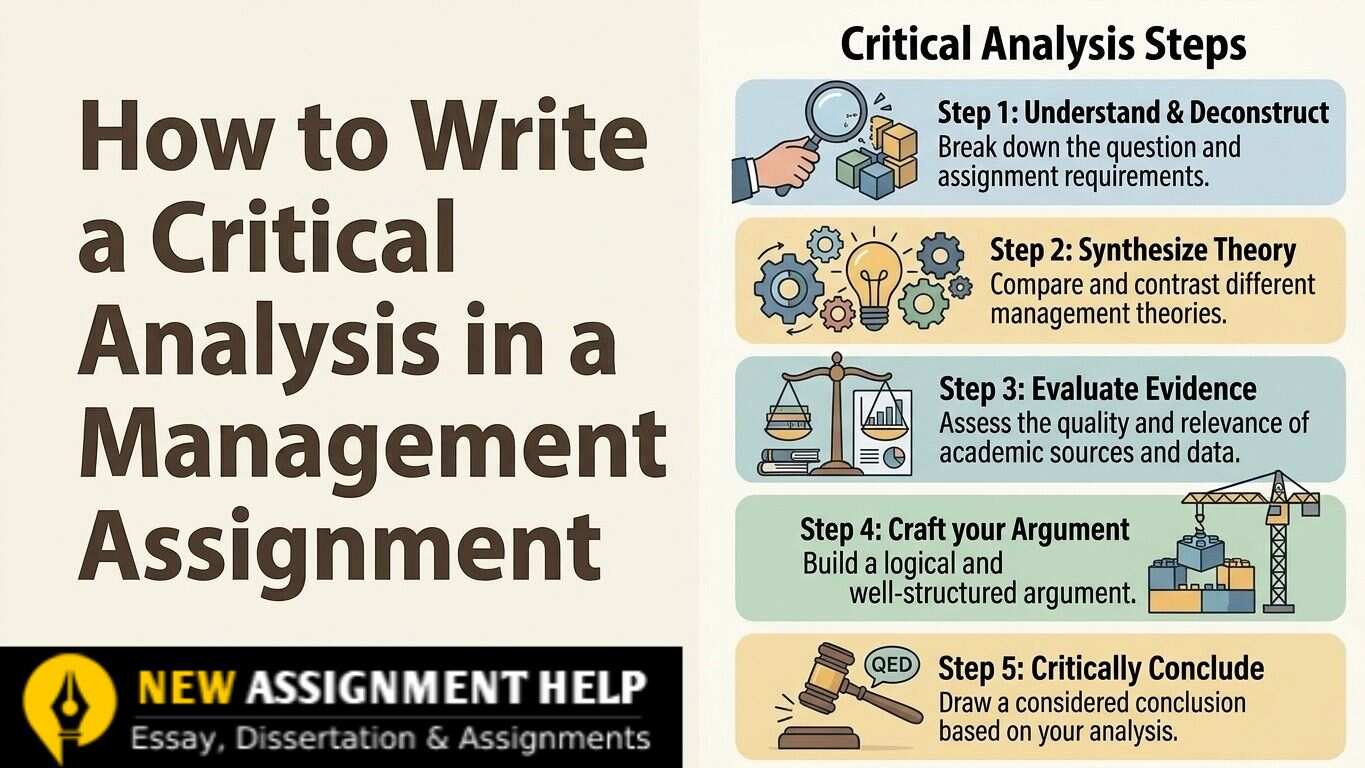
How to Write a Critical Analysis in a Management Assignment
- How to Do Critical Analysis in a Management Assignment for University Students
- What Is Critical Analysis in a Management Assignment?
- How to Write a Critical Analysis Step by Step
- 1. Understand the assignment question
- 2. Research credible academic sources
- 3. Evaluate management theories and arguments
- 4. Compare different viewpoints
- 5. Build a clear, evidence-based argument
- 6. Reach a reasoned judgement
- How to Structure a Critical Analysis Paragraph
- Common Critical Analysis Mistakes to Avoid
- Final Checklist Before Submitting Your Assignment
- Bringing it All Together
How to Do Critical Analysis in a Management Assignment for University Students
Critical analysis in a management assignment requires you to judge beyond a simple description of an idea, not just explain it. You have to analyse your question and evaluate business claims, strategies or theories altogether. Your tutor wants to see your ability to think. That is where the top marks lie. And in this guide, you will learn this skill step by step. Let's start with the basics.
What Is Critical Analysis in a Management Assignment?
Critical analysis means looking closely at a management idea, checking the proof behind it, and reaching a fair judgement. Instead of asking "what happened", a critical approach asks "why it matters", "how well it worked", and "what evidence supports it".
A strong answer usually does these things:
- Examines management theories, arguments, and real practices
- Checks how strong and relevant the evidence is
- Compares different viewpoints
- Finds strengths, weaknesses, and hidden assumptions
- Ends with a judgement you can defend
Many students mix up three words, so here is the difference:
- Description tells what something is.
- Analysis explains how it works and why it matters.
- Evaluation judges how well it works.
So when you are doing your next critical analysis, make sure to use these points. Now let's see how to do it.
How to Write a Critical Analysis Step by Step
To write a critical analysis, you have to read the question closely, find good sources, test each idea, compare views, build your argument, and finish with a clear judgement. Here is how each step works differently.
1. Understand the assignment question
Start with the command words in the very beginning. Phrases like "critically evaluate," "analyse," "discuss," and "to what extent" all ask for different things. Some want you to compare views. Others want you to judge how well something works. Highlight these words first, because your whole answer depends on them.
2. Research credible academic sources
Use peer-reviewed journal articles, academic books, and trusted industry reports from UK bodies like CIPD and CMI. Then ask four quick questions about each source. Is it relevant? Is it recent? Is it credible? What are its limits? Not every source deserves the same trust. Also note the referencing style your UK university asks for, such as Harvard.
3. Evaluate management theories and arguments
Look at what a management theory does well and where it falls short. Ask what it assumes and if it works in real workplaces. For example, does a leadership style suit a small team and a large company going through change? Often the answer is "it depends". Say what it depends on.
4. Compare different viewpoints
Put two or more views side by side and ask questions like, 'Where do they agree?' Where do they clash? Think about context too, such as company size or culture. Then decide which view is stronger and explain your reason.
5. Build a clear, evidence-based argument
Every paragraph should support your main argument. Therefore, make sure to explain what your evidence means for managers. Admit its limits. Then link back to the question. This keeps your answer focused.
6. Reach a reasoned judgement
Weigh the evidence and say which idea is more convincing in this case. Do not just write "I think"; instead, mention the reason behind your opinion to make your work even stronger. Also, do not add brand new points in your final lines; this will decrease the credibility of your work.
With the steps clear, let's look at how to shape each paragraph.
How to Structure a Critical Analysis Paragraph
Use this simple five-part frame in every paragraph:
- Point: State your argument or judgement.
- Evidence: Back it up with a source or a real example.
- Analysis: Explain what the evidence means.
- Evaluation: Judge its strength, limits, or other explanations.
- Link: Tie it back to the question.
Here is a short example.
A weak sentence says, "Employee recognition improves motivation." A stronger version says, "Recognition can lift motivation" (Author, Year). However, it works best when pay and workload feel fair. If staff are overworked, praise alone may not help. So recognition is useful, but only when other support is in place."
See the difference? The second version explains and judges. Next, let's look at what to avoid.
Common Critical Analysis Mistakes to Avoid
Even smart students slip up here. Watch out for these:
- Describing theories without judging them
- Treating every source as equally reliable
- Making claims with no evidence
- Ignoring views that disagree with yours
- Giving personal opinions with no reason
- Listing strengths and weaknesses but never reaching a conclusion
- Using evidence that does not answer the question
The fix is simple. After each paragraph, ask yourself, "Did I only tell, or did I explain and judge?" If you only said that, add more thinking. And you will result in the best suitable work so far.
Final Checklist Before Submitting Your Assignment
Before you hit submit, run through this quick list:
- Have I answered the exact question?
- Are my key claims backed by credible evidence?
- Have I judged theories, sources, and other viewpoints?
- Have I explained why my evidence matters?
- Does my conclusion follow from my analysis?
- Have I checked my university's Harvard referencing and academic integrity rules?
If you can say yes to all six, you are in good shape.
Bringing it All Together
Critical analysis is about evidence, comparison, evaluation, and a judgement you can defend. Practise the above-mentioned points for every paragraph, and your marks will climb. If you want expert help, you can look for management assignment support for guidance tailored to your task.

 12 | PhD in Organisational Behaviour
Martin Lewis is a management academic and writing mentor based in Manchester. He holds a PhD in Organisational Behaviour from the London Business School (LBS) and has spent more than twelve years teaching business and management at UK universities. His work covers leadership, strategy, human resource management and case study analysis. Over the years, he has marked hundreds of undergraduate and postgraduate assignments, so he knows exactly where students lose marks and how to win them back. He has also published research on workplace motivation and change management which benefits students the most. At New Assignment Help UK, Lewis guides students on theory application, critical analysis and academic writing required by most UK universities.