
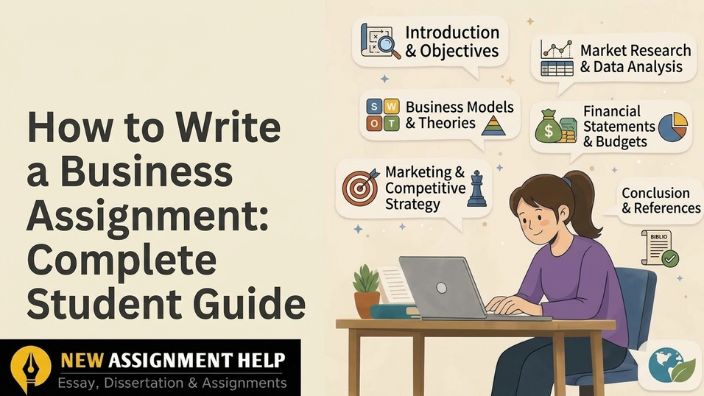
How to Write a Business Assignment Complete Student Guide
- How to Write a Business Assignment That Actually Earns Marks
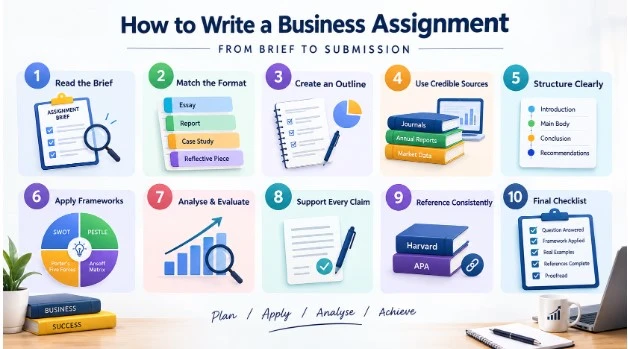
- 1. Read the brief properly before anything else
- 2. Match the format to the task
- 3. Outline before you research
- 4. Gather credible business evidence
- 5. Structure the work clearly
- 6. Apply frameworks instead of just describing them
- 7. Move past description into analysis and evaluation
- 8. Support every claim
- 9. Reference consistently
- 10. Final checklist before submission
- Closing point
How to Write a Business Assignment That Actually Earns Marks
Most students understand the theory, but the problem starts when they have to apply it practically in the assignment. If you’ve ever stared at a blank page wondering where to begin, you’re not alone. This guide walks through the practical steps of how to write a business assignment that turns a vague brief into a clear, well-argued piece of work that markers actually reward. Let’s start by understanding each step from reading the brief to submitting your final draft.
1. Read the brief properly before anything else
Follow the instructions carefully given in your brief before starting anything. Then look at the command words such as "analyse", "evaluate", and "discuss", which are not interchangeable. Each one demands a different approach, so work according to that.
Ask yourself three questions:
- Is this an essay, a report, or a case study?
- What’s the scope: one company, an industry, a specific period?
- What problem or decision is the question really asking you to address?
Rewrite the question in your own language. If you can’t explain it simply, you haven’t understood it yet. That single habit prevents a lot of wasted effort for future actions.
2. Match the format to the task
Different assignment types need different structures and tones. Therefore, always match the format with the required project. Here is what you need to do:
- Case study: apply theory to a real company or situation.
- Report: clear sections, headings, and practical recommendations.
- Essay: build a coherent argument using theory and evidence.
- Reflective piece: connect personal experience to business concepts.
A common error is writing an essay when the brief asked for a report. The structure, headings, and even the voice change. Get the type right early, and everything else becomes easier later.
3. Outline before you research
Jumping straight into reading feels productive. But it is actually not. Sketch a simple outline first and allocate the word count roughly like this:
- Introduction: around 10%
- Main body: 70–75%
- Conclusion (and recommendations if required): 10–15%
Once you know what each section needs, research stays focused. You stop collecting material you will never use.
4. Gather credible business evidence
Always use authentic academic journals, company annual reports, and reliable market data to back your research. This will boost the credibility of your work and make your business assignment more genuine. Avoid unattributed blog posts. Where it fits the brief, bring in real companies, especially UK-based examples.
5. Structure the work clearly
A solid business assignment usually follows this type of writing structure, so focus on using the style mentioned below:
- Introduction: set the context, state the aim, and briefly outline the approach in which you are going to work.
- Main body: one clear point per section, supported by data or a framework, under sensible headings.
- Conclusion: summarise the key findings and answer the original question directly.
- Recommendations: only if the brief asks for them, and keep them realistic and specific to your business topic.
Even when the formal format is an essay, business writing often benefits from a more report-like clarity.
6. Apply frameworks instead of just describing them
Defining a model is not enough. Markers want to see it used. Common ones that work well:
- SWOT for internal strengths/weaknesses and external opportunities/threats
- PESTLE for the broader environment
- Porter’s Five Forces for competitive pressure
- Ansoff Matrix for growth options
Take PESTLE as an example. If you’re looking at market conditions for a retailer such as Tesco, spend most of the space applying the factors rather than explaining what each letter stands for.
7. Move past description into analysis and evaluation
You must write under three levels of writing in your work:
- Description: “SWOT looks at strengths and weaknesses.”
- Analysis: “Applying SWOT to Company X highlights its heavy reliance on a single supplier.”
- Evaluation: “That dependence raises supply-chain risk during shortages, which weakens the firm’s position relative to competitors with more diversified sourcing.”
UK universities reward this type of analysis in business assignments. Show how the theory works in a real situation and then weigh its usefulness or limitations.
8. Support every claim
Use a simple pattern: make the point, give the evidence, then explain why it matters. Never leave a claim floating without any proof, as unsupported statements are one of the quickest ways to lose marks.
9. Reference consistently
Stick to one style as mentioned in your university brief, which is usually Harvard or APA. Cite every source you draw on. Proper referencing protects your work against plagiarism and signals to the marker that the work is carefully prepared.
10. Final checklist before submission
Before you submit your business assignment, make sure to check it under a few points:
- Does the piece fully answer the question set?
- Has at least one framework been applied, not just defined?
- Are real examples or data included?
- Is referencing consistent and complete?
- Has the whole draft been proofread?
Closing point
Strong business assignments rest on two things: application and critical thinking. Theory without proper analysis rarely earns the top grades. Therefore, practise using frameworks on real situations, keep the structure tight, and answer the exact question asked. You can also seek business assignment guidance for getting the grades you deserve.
.jpg)
 7 years | PhD in Business Admin. (DBA)
My name is Charles and I am a Ph.D. holder in business administration studies. I have written many research papers which have good recognition among researchers. My educational and professional experience has inculcated impressive writing and research skills in me. That is why I believe I can be your best mentor in drafting excellent assignments or any other type of academic document.