
_compressed.webp)
How to Prepare a Balance Sheet For UK Accounting
- How to Prepare a Balance Sheet: A Beginner's Guide for UK Accounting Students
- What is a balance sheet? A Brief Financial Snapshot
- The 3 Core Building Blocks of Every Balance Sheet
- How to Prepare a Balance Sheet in the UK: Step by Step
- Step 1: Decide Your Date and Gather Your Records
- Step 2: Identify Your Assets
- Step 3: List and Total Your Liabilities
- Step 4: Calculate Shareholders’ Equity
- Step 5: Check the Balance and Format Correctly
- Step 6: Check Submission Requirements
- FRS 102 and the Balance Sheet: What Every UK Accounting Student Must Know
- What is the difference between a balance sheet and a profit & loss account?
How to Prepare a Balance Sheet: A Beginner's Guide for UK Accounting Students
Most accounting students can talk about a balance sheet, but only a few can actually build an accurate one. If you are studying AAT, A-Level Accounting, or an undergraduate finance course in the UK, the balance sheet will follow you through every module and assessment. It is not optional knowledge. It is a core financial skill that underpins everything from ratio analysis to understanding cash flow. According to the CFO Pulse Survey 2024, 83% of financial leaders said they could not find qualified accounting talent who have practical financial fundamentals.
So this guide covers the real question of the students: “how to prepare a balance sheet”, and what it is about. With this, you will get to know the steps to write one and the latest FRS 102 changes that came into effect in 2026. Keep reading this blog till the end and prepare a balance sheet without any guesswork.
What is a balance sheet? A Brief Financial Snapshot
You have probably seen the term 'balance sheet' mentioned in every accounting textbook you own. But what does it actually mean, and why does it matter so much? A balance sheet is a financial statement that shows a business's financial position on a specific date. It is divided into three primary sections, which are:
- Assets: what the business owns
- Liabilities: what the business owes to others
- Equity: what belongs to the owners after debts are settled
The accounting equation always connects these three elements:
Assets = Liabilities + Equity
This is known as the accounting equation, which you can use while preparing your balance sheet. With this, it works alongside two other factors, which are critical financial statements, the income statement and the cash flow statement, to give a complete picture of business health.
The 3 Core Building Blocks of Every Balance Sheet
Every balance sheet is an analysis of the financial health of a business at a specific point in time. Once you understand each of its parts, the whole thing starts to click. These three blocks are:
Assets: What Does the Business Own?
Assets are everything a business owns that holds financial value. In UK accounting, they fall into two main groups.
- Non-current assets are things the business holds onto for more than one year, which can be property, machinery, computers, or vehicles. These are not bought to be sold on.
- Current assets are more fluid. They shift regularly and can be turned into cash within a year. Your stock in a warehouse, money customers still owe you (trade debtors), and cash in the bank come in this.
Liabilities: What Does the Business Owe?
Liabilities are the debts and financial obligations that are owed by a business to others, such as banks and HMRC. It is also divided into two groups:
- Current liabilities must be cleared within one year. Trade creditors, VAT payable to HMRC, and corporation tax all fall here.
- Long-term liabilities are debts that stretch beyond one year, such as a bank loan or a mortgage on business property.
Equity: What's Left for the Owners?
Once you subtract all liabilities from all assets, what remains is equity. That remainder belongs entirely to the owners.
- For a sole trader, it is called the capital account, which includes the owner's original investment, plus profit earned during the year, minus any personal drawings taken out.
- For a limited company, equity breaks into two parts: share capital (money brought in by selling shares) and retained earnings (profits the business has kept rather than paid out).
These three blocks are the foundation of everything you will do in financial reporting. If any of them still feel confused, you can seek support from accounting assignment help services to make it clearer.
How to Prepare a Balance Sheet in the UK: Step by Step
Here are the 5 steps which you can follow to create a balance sheet for any business or organisation. When you understand the whole step from beginning to end, you will be able to spot potential errors in your work.
-
Step 1: Decide Your Date and Gather Your Records
The balance sheet always begins with a specific date. In UK accounting, this is typically 31st March or 31st December, the final day of the financial year. From there, collect your trial balance, bank statements, stock listings, VAT records, and your accounts payable and receivable ledgers. Without these, you cannot prepare a balance sheet.
-
Step 2: Identify Your Assets
Start with your non-current assets such as property, vehicles, machinery, and office equipment. Then move to current assets, including stock, trade debtors, and cash. Always list them in order of liquidity, least liquid first.
-
Step 3: List and Total Your Liabilities
Now do the same as you have done for what the business owes. Current liabilities first: trade creditors, corporation tax, and VAT payable to HMRC. Then long-term liabilities: bank loans and commercial mortgages. Add them together for your total liabilities.
-
Step 4: Calculate Shareholders’ Equity
This one is straightforward:
Equity = Total Assets − Total Liabilities
For a limited company, this breaks into share capital and retained earnings. For a sole trader, it is simply the capital account, which includes the opening balance, plus profit, minus drawings.
-
Step 5: Check the Balance and Format Correctly
Add your total liabilities and equity together. If it matches your total assets, you have done it correctly. In the UK, balance sheets follow a vertical format under UK GAAP, which is:
Total Assets − Total Liabilities = Net Assets
Net Assets = Capital and Reserves
If the figures do not match, go back to Step 2. A misclassified item or an arithmetic slip can be the reason for the error.
-
Step 6: Check Submission Requirements
If you are preparing this for a real limited company rather than a classroom exercise, UK law requires the balance sheet to be included in the year-end statutory accounts filed with Companies House and HMRC. It must carry a director's printed name and signature.
These are the steps to be taken when you prepare a balance sheet. And if you want to practise before your next assessment? Download our free financial statement templates and work through a full balance sheet exercise with real UK figures.
FRS 102 and the Balance Sheet: What Every UK Accounting Student Must Know
The vertical format under UK GAAP tells you how to lay out a balance sheet. FRS 102 tells you what the rules are behind every figure you put in it. If you are studying accounting at any level in the UK, these standards will follow you throughout your entire academic journey.
- What FRS 102 is: FRS 102 is the Financial Reporting Standard applicable in the UK and the Republic of Ireland. Think of it as the official rulebook behind every balance sheet prepared under UK GAAP.
- The 2026 update that changed everything: The FRC issued amendments in March 2024, effective from 1 January 2026.
- The biggest shift: Operating leases and finance leases are no longer treated differently for lessees. Most leases now sit directly on the balance sheet.
- Two new balance sheet line items to know: A right-of-use asset appears under non-current assets. A lease liability appears split between current and non-current liabilities.
- Revenue recognition shifted too: FRS 102 now follows a structured five-step model aligned with IFRS 15, which can affect when income is recorded and, in turn, what retained earnings show on the balance sheet.
One important practical note: any balance sheet example in study materials published before 2026 may not reflect these rules. So always check your module before starting to write a balance sheet.
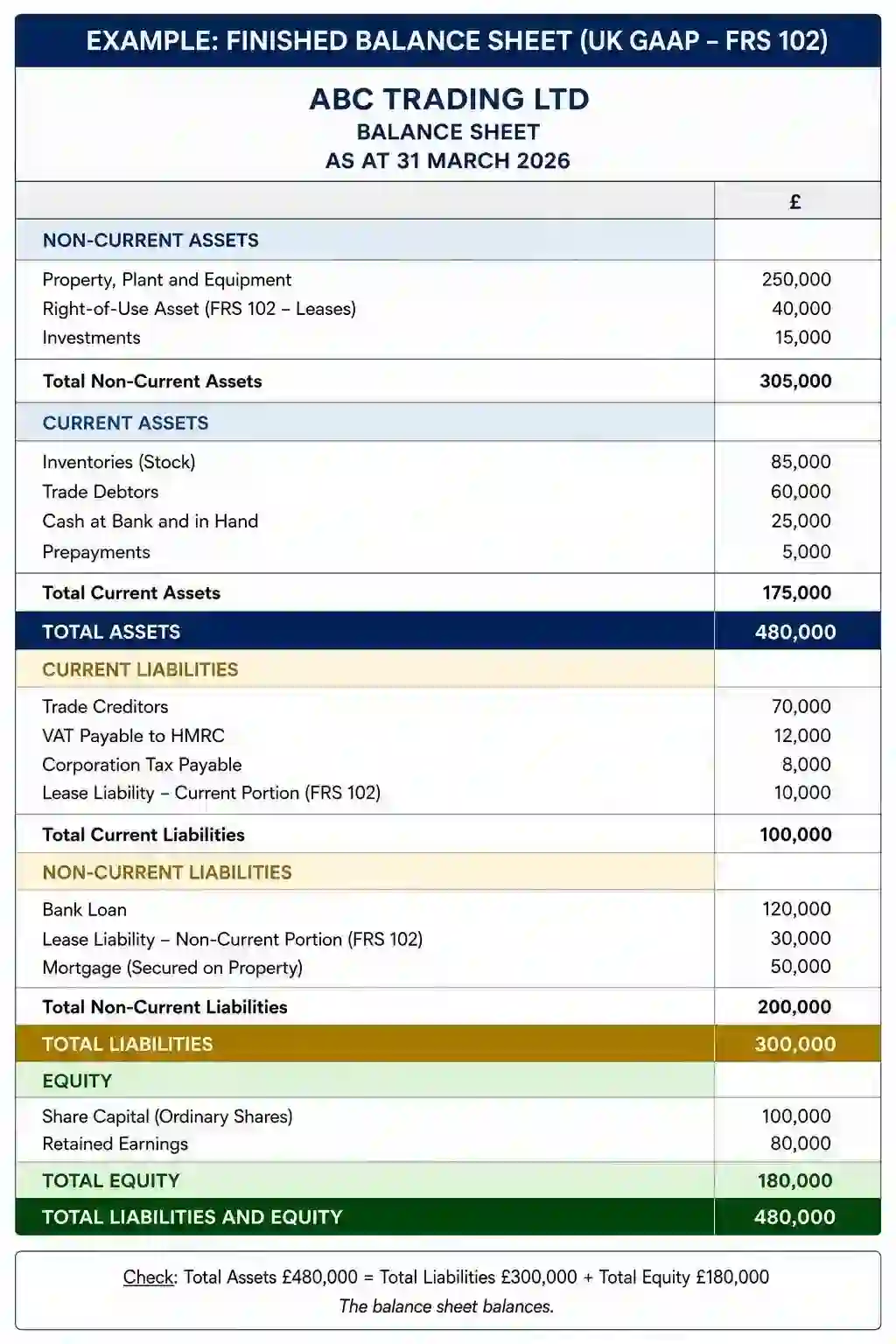
Conclusion
Learning how to prepare a balance sheet is one of those skills that pays off every single time in your assignments and in your career. It is not just a topic you study once and move on from. It is a financial literacy that sits at the heart of UK accounting, from your first AAT paper right through to professional practice.
Go back through this guide whenever something feels unclear. The steps are there. The FRS 102 context is there. Everything you need to build confidence around balance sheets is on this page. And if you need additional support, New Assignment Help UK is ready to guide you in your academic journey.

 9 | MBA
James Pemberton has spent the better part of a decade helping UK students make sense of accounting both in the classroom and through written academic support. CIMA qualified with an MBA from a leading UK business school, James brings real industry experience to everything he writes. His approach is to provide students with clear and honest explanations that help them perform at their best.
Frequently Asked Questions
Find answers to common questions about balance sheets, profit and loss accounts, current assets, UK accounting formats, and balance sheet investing. These FAQs will help you understand key accounting concepts used in UK university assignments.