
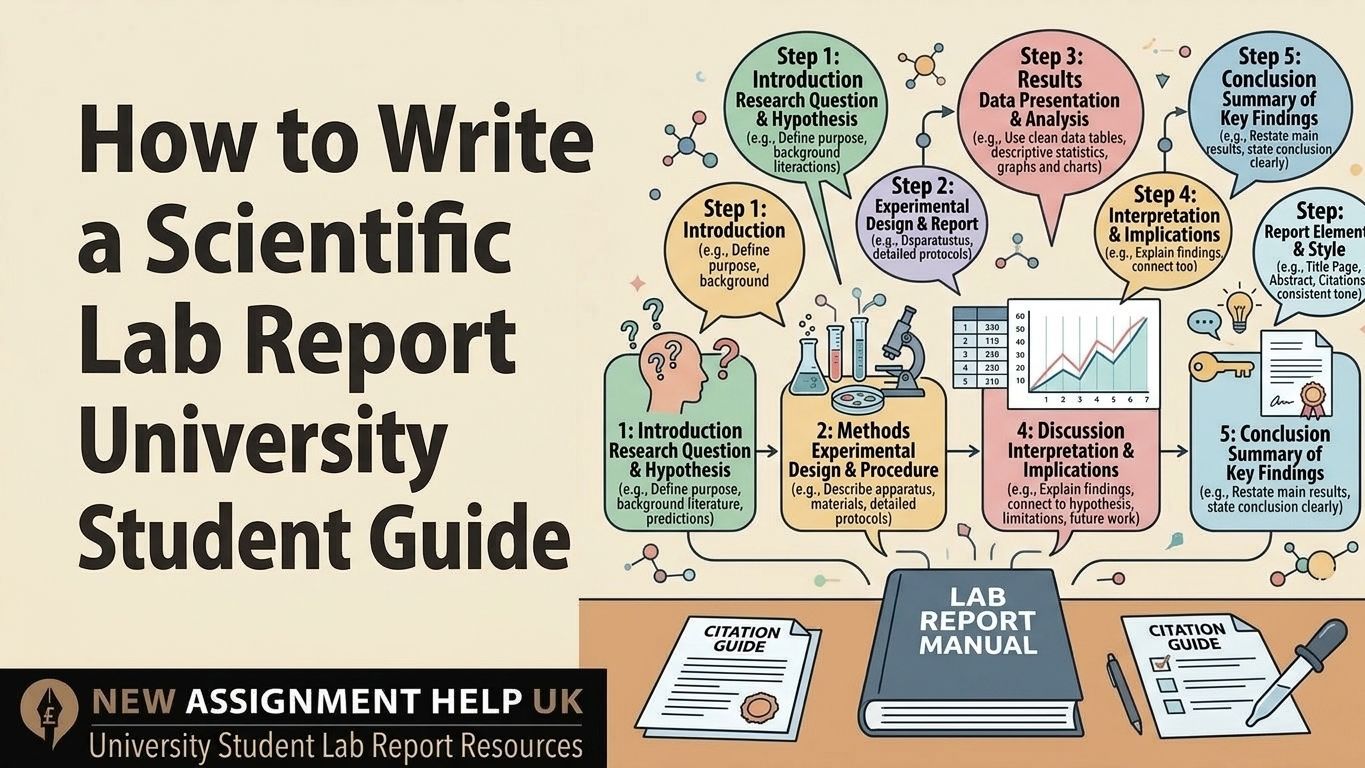
How to Write a Scientific Lab Report University Student Guide
Nobody teaches you how to write a scientific lab report. They just hand you the data and expect you to figure it out on your own. And that is where most UK university students hit a wall. Whether you are in your first year studying biology, chemistry, physics, or psychology, the pressure to get the lab report format right is very real. One wrong structure and you lose your mark, not because your science was poor, but because the presentation let you down.
A scientific lab report is a structured document where you record your experiment, your findings, and what they mean. In this guide, you will know how to apply the correct scientific lab report format for UK universities. With this, you will also understand what the demands of each section are and how to avoid the mistakes that cost students easy marks. So think of this blog as a friendly mentor, and prepare your scientific lab report format for a UK university in a way that actually makes sense.
The Standard Scientific Lab Report Format for UK Universities
Before you write a single word, you should understand that UK universities follow a recognised structure called IMRaD. It stands for Introduction, Methods, Results, and Discussion. It mirrors the way scientists actually think. You ask a question, you test it, you record what happens, and then you make sense of it. Once you understand that logic, the whole structure clicks. If you are finding the science side of things difficult alongside the writing, our support on science assignments is always there to guide you. Here is every section explained clearly, so you know exactly what to write and why.
1. Title Page
This is the first thing your examiner will see when he reads about your experiment. Your title should be short but informative. It should tell the reader exactly what the experiment was about. Below, please include your name, your student ID, the date it was submitted and the name of your lab partner or supervisor if applicable.
2. Abstract
The abstract is a short summary of your entire report. Most UK universities ask for 150 to 300 words. In those words, you need to cover four things:
- What was the aim of the experiment?
- How did you carry it out?
- What were the key results?
- What did you conclude?
Now here is something that trips up a lot of students. The abstract appears at the very beginning of your report, but you should write it last. Why? Because you cannot summarise a report you have not finished yet. Write everything else first, then come back and write this. If things are not clear to you yet, check out our nursing sample papers so that you can get a brief idea of them.
3. Introduction
Your introduction must answer one simple question: why did this experiment need to happen? It has three parts, and each one builds on the last:
- Background: Start by explaining the science behind your experiment. What do we already know about this topic? And where this information comes from.
- Cite your sources here: textbooks, journal articles, whatever you used.
- Aim of your experiment: After the background, state clearly what your experiment was trying to find out. Keep it simple and direct.
- Hypothesis: What did you predict would happen, and why? Base it on the background science you just explained, not a random guess.
4. Materials and Methods
This section needs to be so clear and detailed that someone who was not in your lab could read it and repeat your experiment exactly, step by step, without asking you a single question.
Two rules that UK universities are strict about:
- Write in past tense because the experiment has already happened.
- Write in third person because scientific writing avoids personal language.
For example, write "10 ml of solution was added" instead of "I added 10ml" in your experiment.
5. Results
This section is purely for presenting your data. No opinions. No explanations. No analysis. Just the numbers, clearly laid out. You can display your data using tables and graphs. Each table and graph must have a number and a descriptive title so that your tutor knows exactly what they are looking at.
Additional Tips: Do not write into this section if you have large amounts of raw data, long calculations or big data sets. You can put them in an appendix at the back of your report and refer to them in the text.
6. Discussion
This is the most important section of your entire lab report. It is where your tutor sees whether you actually understand the science or follow the instructions carefully. In this, your discussion needs to cover a few things:
- Did your results support your hypothesis?
- What went wrong or could have been better?
- Was your equipment perfectly calibrated?
- Were conditions completely controlled?
Tutors do not expect a flawless experiment. They expect honest, thoughtful analysis. That is what separates a good discussion from a great one.
7. Conclusion
Your conclusion must be short, usually within one paragraph. This is where you end up with everything cleanly. Summarise your main finding, confirm whether your hypothesis was supported or not, and briefly mention what the result means in a wider scientific context. That is it. Do not introduce any new information here. Everything in your conclusion should have already appeared earlier in the report. This is your closing statement, not a place to start a new point.
8. Citation and book list
You must mention every source in your report in any section, whether it is the introduction or the discussion, in a correctly formatted list. In most UK universities, Harvard citation is the standard format. But this is not universal. Some departments use APA. Others use Vancouver, particularly in medical and health sciences. Always check your module handbook before you format your citation. Not sure which citation style applies to you? Our guide on APA or Harvard citations breaks down the differences so you can get it right the first time.
This is how you can structure your scientific lab report to get a distinction mark. When you look at the report in that way, it is not an overwhelming document. It is just a logical story which is told in a scientific way.
Useful Tips for Writing a Strong Lab Report
Most students know the format. But knowing the format and writing it well are two different things. These tips will help you close that gap.
- ✅ Write your abstract last, always. It is a summary, so finish the report first.
- ✅ Separate your results and discussion. Never mix data with analysis. Your tutor will notice immediately.
- ✅ Use the past tense and third person throughout your method.
- ✅ Label every figure and table; an unlabelled graph is a lost mark. Number them, title them, and done.
- ✅ Reference as you write. Do not leave it for the end. You will forget where things came from.
- ✅ Proofread once for science, once for language. Two separate reads catch twice as many mistakes.
These small habits can make a big difference in your final mark. So think of these tips as your checklist and secure the excellent grades which you have always dreamed of.
Final Thoughts
Writing a scientific lab report does not have to feel like climbing a mountain. After reading this blog post, you must have understood how to write a scientific lab report format for UK university students from beginning to end. Just follow the structure, keep each section focused, and always proofread before you submit.
That is just how you need to prepare your report to get an A+ score. And if you ever feel stuck, whether it is the discussion section, citation, or simply where to begin, New Assignment Help UK is here for you. Our experts understand exactly what UK university tutors expect and are ready to help you in the best way possible. You do not have to figure it all out alone. Reach out to us today and we will handle the rest!
.jpg)
 7 | BSc in Healthcare
Greetings I am Cleo and I have done BSc (Hons) Medical Science + PGDip. I am a professional academic writer who can guarantee that your work will be done on time. I can help you draft your healthcare assignments according to your requirements. I assure you that every word written in your assignment will be fresh and unique.