
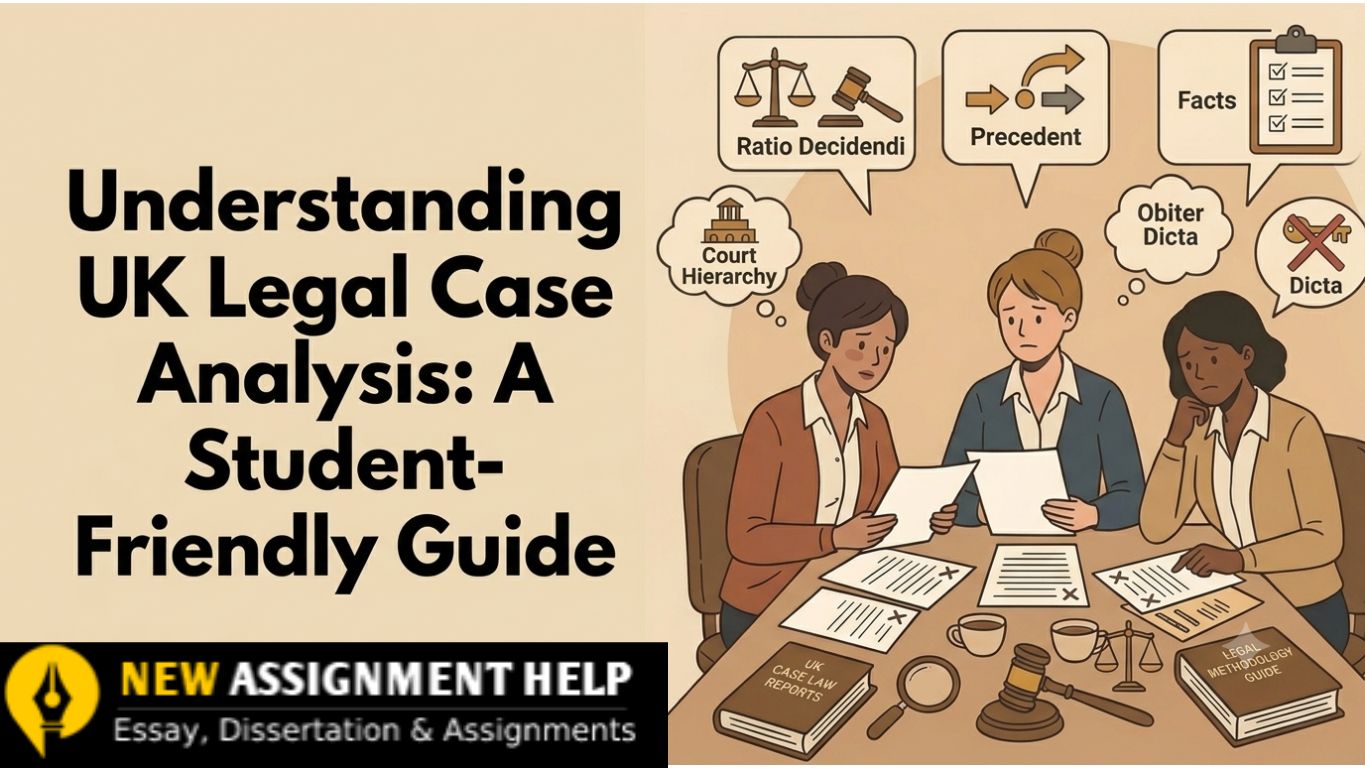
Understanding UK Legal Case Analysis: A Student-Friendly Guide
Struggling to make sense of a court judgement for your law assignment? Most law students in the UK lose marks because they don't know how to break a case down properly. Legal case analysis is a structured process of deconstructing a court judgement to find out the core legal reasoning, material facts and binding precedents. In simple terms, it refers to reading a decided court case, pulling out the facts and legal reasoning, and explaining why the case matters.
In this guide, you will get to know how to perform legal case analysis in the UK and what the steps are. By the end, you'll know how to read a UK judgement properly, understand precedent and court hierarchy, follow a clear framework for breaking down any case, and avoid the mistakes that cost students the most marks. So keep reading this blog and boost your legal analytical skills.
What Is Legal Case Analysis?
Legal case analysis refers to the study of real cases and explains three things: what happened, what the court decided, and why the decision matters for future cases.
It's easy to mix this up with a problem question, so let's clear that up first.
- A case analysis looks at a real, already-decided case. You are the examiner.
- A problem question gives you a made-up scenario. You act as the lawyer and advise a client using real law.
They use some of the same skills, but they are not the same task. Your reading list or module handbook will usually tell you which one you're being marked on, so check that first.
Getting this difference right matters more than most students think. Marking criteria for a case analysis often reward you for spotting the reasoning behind a decision, not just describing what happened. If you are struggling to understand your assignment briefs, then our support on law assignments is always there for you.
How to Read a UK Judgement (Without Getting Lost)
Judgements can be long and wordy. But every UK judgement has the same basic building blocks. Once you know what to look for, reading gets much faster and easier.
Here's what to spot in any case you read:
- Citation – the reference number that identifies the case, such as a neutral citation (for example, [2023] UKSC 12)
- Headnote – a short summary at the start. It's useful for a quick overview, but never quote it as your only source before starting anything
- Material facts – the facts that actually affected the legal outcome
- Ratio decidendi – the core legal reasoning the court relied on to reach its decision.
- Obiter dicta – comments the judge made along the way that are not binding but can be useful and persuasive
- The judgement or order – the actual outcome for the parties involved
A good habit is to read the case twice. The first read is just for the story. The second read is for the legal reasoning. This second read is where the real marks are won.
If the case went to the Court of Appeal or the Supreme Court, more than one judge may have written an opinion. Watch out for concurring judgements (judges who agree with the outcome but for different reasons) and dissenting judgements (judges who disagree). Dissenting opinions often hint at where the law might shift next, so they're worth a mention in stronger analyses.
Why Precedent and Court Hierarchy Matter
Before you can judge how important a case is, you need to know where it sits in the UK court system.
Here's the basic order, from most to least authoritative:
- Supreme Court
- Court of Appeal
- High Court
- Lower courts (County Court, Magistrates' Court)
A decision from a higher court is binding on lower courts. A decision from a court at the same level, or a lower one, is only persuasive, meaning it can be considered but doesn't have to be followed.
There's one exception worth knowing. Since the 1966 Practice Statement, the Supreme Court (and its predecessor, the House of Lords) can depart from its own earlier decisions when it feels it is right to do so. This small detail often gets missed, but it shows real understanding of how UK precedent works, so it's worth including if the case allows for it.
A Step-by-Step Framework for Case Analysis
Many guides tell you to use IRAC (Issue, Rule, Application, Conclusion) while performing your legal case analysis. It's a decent starting point, but it was built for American law schools. So for a better UK case analysis, work with this framework, as it is built around ratio decidendi.
- Facts
Sum up only the facts that matter to the legal outcome. First identify who is involved in the case, what happened, and what claims were made in proceeding.
- Legal issue
What was the exact question before the court? Be specific. If your legal issue is "Was there a contract?", rewrite it as "Did the exchange of emails form a legally enforceable offer and acceptance?"
- Rule or legal principle
State the rule or principle of law that applied in the case. It might be a statute, legal principle or a precedent.
- Reasoning (ratio)
Mention the reasoning behind the court’s decision and look at how the court applies the legal rules to the specific facts.
- Judgement or outcome
What was the actual decision of the court and the ratio decidendi (the binding legal reason)? In other words, what happened to the parties in this case?
- Significance
Why was the case important? Is it a precedent to follow, distinguish from, or criticise?
A quick example:
Take Carlill v Carbolic Smoke Ball Co (1893).
The facts: a company advertised a reward for anyone who used its product and was still caught with the flu. Mrs Carlill did and claimed the reward. The legal issue: could an advertisement count as a binding offer? Court's reasoning: the advert was specific and showed clear intent to be bound, so it was a valid offer, not just a marketing claim. The outcome: Mrs Carlill won. The significance: the case still shapes how UK courts decide whether a promise counts as a genuine contractual offer or not today.
Still finding it hard to turn your analysis into a polished essay? Our essay writing help team can guide you through it.
Common Mistakes Students Make
Most of the students lose marks during legal case analysis because they describe only facts instead of critically analysing them. Here is the list to watch out for:
- Writing a long, detailed retelling of the facts instead of analysing them
- Mixing up the ratio (binding) with obiter comments (not binding)
- Explaining the law but never connecting it back to the specific facts of the case
- Forgetting to mention how later cases have treated the decision
- Ending with a weak, vague conclusion instead of a clear, confident one
If you find yourself doing any of these, go back and ask: "Am I explaining the reasoning or just repeating the story?"
Quick Tips for Stronger Case Analysis
- Use OSCOLA referencing correctly and consistently throughout
- Check case law on free, reliable sources like BAILII instead of relying only on secondhand summaries
- Keep a simple case-brief template for each case you study. It saves huge time during revision
- Read the dissenting judgement when there is one. It often shows where legal thinking is heading next
Final Thoughts
Legal case analysis is not about memorising every fact of a case. It's about explaining, clearly and confidently, why a decision matters. Once you get comfortable with the framework above, it becomes second nature, and it's a skill that stays useful well beyond your degree.
If you'd like a second pair of eyes on your case analysis or want feedback before you submit, the team at Assignment Help UK is always there to help you sharpen your work.
References
- Carlill v Carbolic Smoke Ball Co [1893] 1 QB 256 (CA).
- Practice Statement (Judicial Precedent) [1966] 1 WLR 1234 (HL).
- Courts and Tribunals Judiciary, 'Structure of the Courts' (Judiciary.uk) <https://www.judiciary.uk/about-the-judiciary/the-justice-system/court-structure/>, accessed 29 August 2026.
- British and Irish Legal Information Institute, 'BAILII' <https://www.bailii.org\> accessed 29 August 2026.
- Faculty of Law, University of Oxford, OSCOLA: Oxford University Standard for Citation of Legal Authorities (4th edn, Hart Publishing 2012).

 6 | LLB in Commercial Law
Allen Luther holds an LLB (Hons) from the University of Manchester and an LLM in Commercial Law from King's College London. He spent six years as a paralegal in a London litigation firm before moving into legal education, where he now writes and tutors on case analysis, contract law and legal research methods. Allen has spent over eight years helping students turn dense judgements into work they actually understand. His approach is simple: strip the jargon out first, then build the structure back up, so students walk away able to read a case on their own long after the assignment is graded.