
Gibbs' Reflective Cycle: The 6 Stages Explained (With Examples)
- Gibbs Reflective Cycle 2026: A Practical Guide To Writing High-Scoring Assignments
- What are the 6 stages of Gibbs's reflective cycle?
- 1. Description — What actually happened?
- 2. Feelings — What were you thinking and feeling at the time?
- 3. Evaluation — What was good and what went wrong?
- 4. Analysis — Why did it happen this way?
- 5. Conclusion: What have you learned from this experience?
- 6. Action Plan — What will you do differently next time?
- How To Turn Gibbs Cycle Into A Structured Assignment
- Step 1: Start with a Clear Introduction
- Step 2: Present the Experience (Description)
- Step 3: Add Personal Insight (Feelings)
- Step 4: Evaluate the Situation
- Step 5: Develop Critical Analysis
- Step 6: Draw a Clear Conclusion
- Step 7: Create a Practical Action Plan
- Ready-To-Use Gibbs' Reflective Cycle Template
- Where Gibbs's Reflective Cycle Is Used in UK Courses (Nursing, Business, & More)
- Here are some of the major areas where the Gibbs Reflective Cycle is commonly applied.
- Strengths and Limitations of Gibbs Reflective Cycle
- Where This Model Comes From
- Final Thoughts
Gibbs Reflective Cycle 2026: A Practical Guide To Writing High-Scoring Assignments
Most students who lose marks on a Gibbs reflection aren't missing the six stages — they've got all six there. What's usually missing is the jump between describing what happened and explaining why it happened. A tutor can tell within a paragraph whether a student worked through that or just filled in a template.
In this guide, we will take you beyond surface-level understanding, explaining how to use each stage strategically. With this, we will also break down the six stages with real, ready-to-use writing prompts to turn a basic reflection into a high-scoring assignment. So stay in touch with us till the end to demonstrate real learning instead of just ticking boxes.
What are the 6 stages of Gibbs's reflective cycle?
Before using the Gibbs Reflective Cycle in an assignment, you need to learn about its origin first. It is a structured framework developed by Graham Gibbs in 1988 to help professionals and students learn from their experiences. This method also guides you to improve your thinking and academic writing style.
In UK higher education today, it is widely used in universities, especially in professional courses, to develop real-life experiences and turn them into learning outcomes. However, simply knowing the six stages is not enough. What actually improves grades is knowing what to write at each stage and how to think while writing it.
Below is a practical analysis of all six stages using real writing prompts. You can apply them directly in assignments instead of just memorising them.
1. Description — What actually happened?
This is the starting point of your reflection, where you present the situation clearly and factually. At this stage, you do not have to analyse or judge anything.
Write with these prompts:
- What exactly happened during the experience?
- Who was involved?
- When and where did it occur?
- What was your role?
The key here is clarity, not storytelling. So, avoid adding opinions or emotions in your reflection. You briefly describe the situation in a focused way so the reader can understand the context without confusion.
2. Feelings — What were you thinking and feeling at the time?
This stage is often underdeveloped because students either ignore emotions or write them too vaguely. So, reflect on your emotional response during the experience to connect personal awareness with professional learning.
Write with these prompts:
- What were your initial reactions?
- How did your feelings change during the situation?
- Why do you think you felt that way?
The goal is not just emotion but awareness of how emotions influence your behaviour.
3. Evaluation — What was good and what went wrong?
This stage requires a balanced judgement of your experience. Therefore, try to identify both strengths and weaknesses without being biased.
Write with these prompts:
- What worked well in this situation?
- What didn't go as expected?
- What impact did your actions have?
For strong reflections, always include both positive and negative aspects. Avoid blaming or being overly emotional to get better outcomes.
4. Analysis — Why did it happen this way?
This is the most important stage for scoring higher marks in the final submission, yet it is where most students fail. Here, you must move beyond description and start explaining the reasons and the meaning of your reflection.
Write with these prompts:
- Why did the situation unfold the way it did?
- What knowledge, theory, or practice explains it?
- What factors influenced your actions or decisions?
At this point, students are expected to demonstrate an academic depth to their reflection. So, linking your experience to learning or theory is essential for achieving strong grades.
5. Conclusion: What have you learned from this experience?
Here, you need to concentrate on summarising the key learning outcomes from the experience. It should clearly show how your understanding has changed.
Write with these prompts:
- What did you learn about yourself or your practice?
- What could you have done differently?
- What will you take forward from this experience?
Avoid vague statements like "I learnt a lot." Be specific and reflective to show progression in your learning.
6. Action Plan — What will you do differently next time?
This final stage focuses on future development and improvement. It demonstrates how reflection can lead to action.
Write with these prompts:
- What specific steps will you take in future situations?
- How will you improve your approach?
- What skills or knowledge do you need to develop?
A strong action plan is realistic, specific, and focused on future improvement, so avoid using general promises to make your reflection practical.
If you use all six stages correctly, your reflection becomes more than a written requirement. It will become a clear record of what you learned and how you will improve during the process. The key is not just completing each stage but ensuring each one focuses on depth and progression in your thinking.
How To Turn Gibbs Cycle Into A Structured Assignment
Most students understand the stages of the Gibbs Reflective Cycle but struggle to turn them into a high-scoring assignment. This problem isn't because of the model, but it lies in its execution. For writing a strong reflective assignment, you should focus on a logical flow of writing where each stage builds on the previous one.
Have a look at the practical steps which will help you to structure your assignment effectively.
Step 1: Start with a Clear Introduction
Your introduction should briefly state the purpose of the reflection with the context, such as placement, project or task. This will indicate that you are using the Gibbs cycle in your assignment.
Additional tips: Keep it concise. Don't explain the whole model here.
Step 2: Present the Experience (Description)
Now begin the Gibbs cycle with a focused description of the situation by explaining what happened. Keep it relevant to your topic of reflection to avoid unnecessary information in your work.
Additional tips: This sets the direction for the entire assignment.
Step 3: Add Personal Insight (Feelings)
After describing the situation, move into your thoughts and emotions to show your awareness. For this, explain your initial reaction and show how your feelings influenced your actions.
Additional tips: This experience connects with personal awareness.
Step 4: Evaluate the Situation
Now analyse what worked and what didn't. With this, you should also identify positive and negative perspectives to avoid one-sided judgement in your assignment.
Additional tips: Markers specifically look for balance here; one-sided evaluations (all positive or all negative) are one of the fastest ways to lose marks at this stage.
Step 5: Develop Critical Analysis
When you critically analyse your assignment, it becomes academically sound. So, explain why things have happened and then connect your experiences to theory or practice to make it more credible.
Additional tips: Without this step, your work remains descriptive and low-scoring.
Step 6: Draw a Clear Conclusion
Summarise your learning from the experience you have drawn. Also, highlight the key lessons and reflect on what could have been improved for future coursework.
Additional tips: Avoid vague conclusions; be specific.
Step 7: Create a Practical Action Plan
For the final touch, end your assignment by defining the future improvement. Explain what you will do differently while focusing on the realistic aspects.
Additional tips: This shows growth, which is the purpose of reflection.
For effective writing, each section should connect logically without repeating the same ideas across stages. Use this cycle accurately to demonstrate clear improvement for writing a strong assignment.
Ready-To-Use Gibbs' Reflective Cycle Template
Many students often lose marks because their reflection lacks organisation, depth, or progression. So here is a ready-to-use template designed to help you translate the model into a structured piece of writing. You can follow it directly and use the prompts to ensure each stage meets your academic expectations.
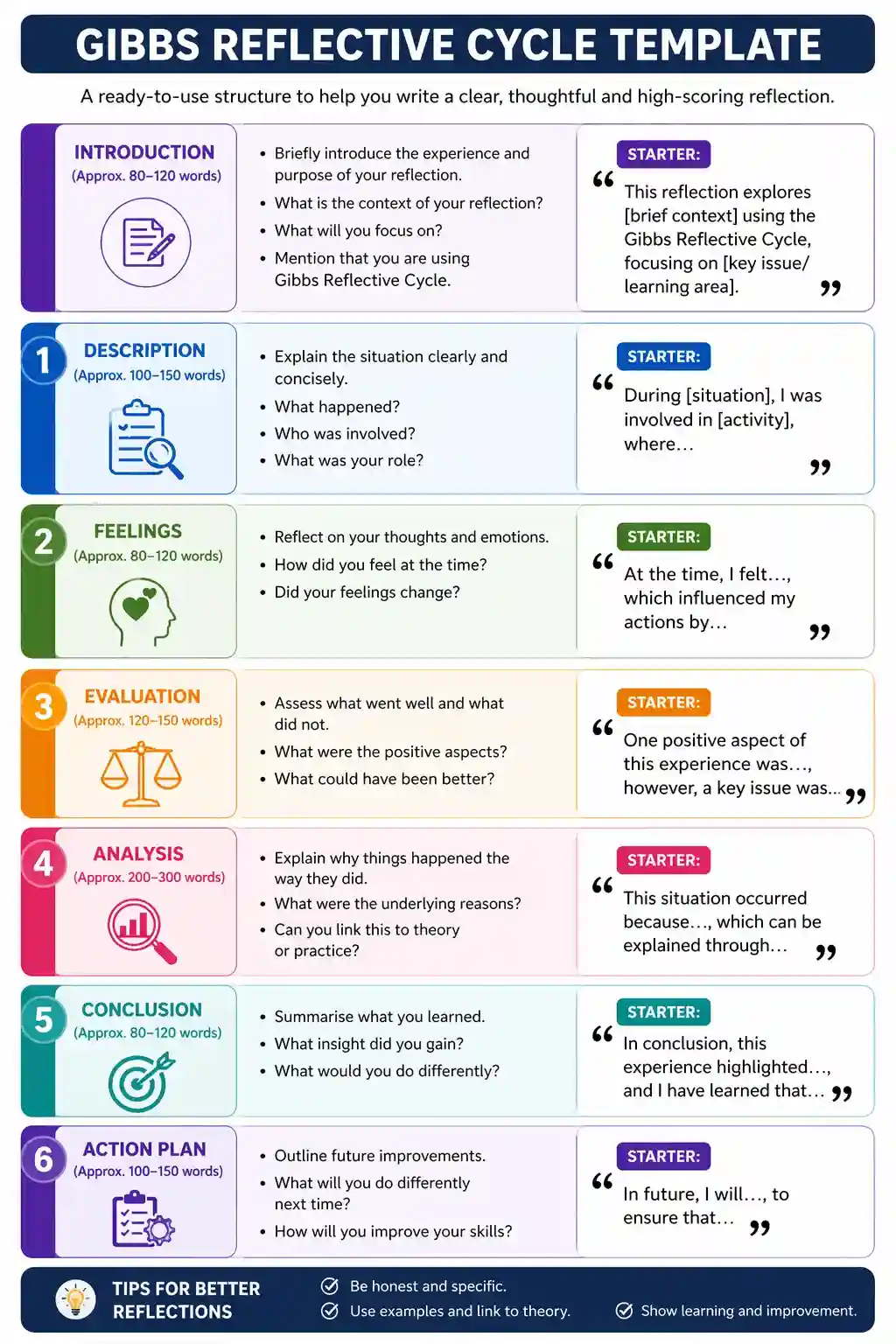
This template is a guide to help you structure your thinking and writing effectively using the Gibbs Reflective Cycle. However, the real value comes from how clearly you connect your experience to learning and improvement.
Where Gibbs's Reflective Cycle Is Used in UK Courses (Nursing, Business, & More)
The Gibbs Reflective Cycle is not limited to one subject. It is widely applied across higher education in the UK, wherever a discipline demands learning based on real-time experiences. This model helps students in analysing real situations and reflects professionalism in their work, whether it is about clinical placements or business case studies.
Here are some of the major areas where the Gibbs Reflective Cycle is commonly applied.
Nursing and Healthcare Courses: Most nursing programmes require reflective writing after placements, and Gibbs is usually the default model taught in the first year because it maps onto how clinical incidents actually unfold: something happens on shift, you have a reaction, and you need a structured way to turn it into a lesson.
- A student notices a medication timing change overnight; the handover never mentioned it. Simple incident. The reflection only gets good once you ask why handover missed it, not just what happened. And the fix isn't 'be more careful'; it's something you'd actually do differently, like checking charts yourself every shift.
Business and Management Studies: In these subjects, students reflect on group projects or leadership experiences. Therefore, the Gibbs Cycle helps them to evaluate their performance in decision-making, teamwork and problem-solving skills.
- For example, a student could reflect on a group project where deadlines were missed and analyse how the group's communication or leadership affected the results.
Education and Teaching Courses: In education courses, reflection is an important part of becoming an effective teacher. As a result, the Gibbs Reflective Cycle has been used to evaluate classroom teaching sessions and students' engagement while teaching.
- For example, a trainee teacher might reflect on a lesson that had not engaged students well and consider how teaching methods might be improved.
Social Work and Psychology: These fields also require reflection, allowing students to observe themselves in terms of both professional behaviours and emotional reactions. This matters as these fields demand critical thinking and emotional intelligence.
- For instance, a student in social work might analyse difficult interactions with a client, considering ways of communicating and emotional responses.
Engineering and Technical Courses: Gibbs' Reflective Cycle is used here in project-based learning and technical tasks. It helps bridge the gap between technical knowledge and practical application while analysing the teamwork.
- For example, an engineering student might look at why a project didn't meet expectations and identify improvements in planning or execution.
These are some of the fields in which the Gibbs Reflective Cycle is used. However, many more subjects across the UK involve this reflection, as it develops critical thinking, self-awareness and professional skills. So if you know how to apply it in your field, your reflection becomes more relevant to what UK universities require in high-scoring assignments.
Strengths and Limitations of Gibbs Reflective Cycle
Gibbs' Reflective Cycle is a six-stage framework that provides a clear and structured way to reflect on experiences. In this section, let's understand the negative and positive aspects of it to identify your learning gaps in the assignments.
Advantages of the Gibbs Reflective Cycle
- Provides a simple and structured framework, making it easy to organise your reflection
- Assists beginners in learning how to begin reflective writing in just a few steps
- Encourages students to move from description to analysis
- Useful for a range of disciplines, including nursing, business, and education
- The action plan phase encourages continuous learning.
- Promotes self-awareness and professional growth that will be beneficial for future coursework
Disadvantages of Gibbs Reflective Cycle
- Can get too rigid, resulting in mechanical and repetitive writing
- Often leads to over-description and weak analysis
- It doesn't clearly guide you on how to develop critical thinking or link theory.
- May seem like following a formula, which leads to less originality in writing
- Not always appropriate for complex or changing circumstances
- Students may be more concerned with completing the stages rather than showing real insight in their work.
The Gibbs Reflective Cycle can give a good start to making your reflection effective. However, its effectiveness will depend on how you apply it to your coursework. So, use it as a guide and apply your critical thinking to produce high-quality assignments.
Where This Model Comes From
Gibbs' Reflective Cycle was first published by Graham Gibbs in 1988 in Learning by Doing: A Guide to Teaching and Learning Methods, and it was shaped around professional and clinical practice before spreading into other disciplines. In UK nursing programmes, it's often taught alongside structured handover tools like SBAR (Situation, Background, Assessment, Recommendation), since both are built around turning an unstructured clinical moment into something you can act on.
Final Thoughts
To sum up, the Gibbs Reflective Cycle is more than just a framework. It is a method which you can use to turn your experience into structured learning and improvement. After reading this guide, you must have developed an ability to structure a high-scoring assignment by avoiding common mistakes across all UK courses. This guide is reviewed against current UK nursing and business placement reflection requirements. If a stage doesn't match how your course structures it, check your module handbook, as some universities adapt Gibbs slightly.
If you are still confused about how to turn a basic description into an analytical reflection, expert assistance at New Assignment Help UK is just one click away. Here, we provide effective support to refine your reflective writing and improve your grades. So, stop guessing and start writing your reflection with confidence today.

 10 | PhD
Exploring the intersection of theory and practice drives this is Thomas Avery’s approach to academic writing holds PhD. He focuses on guiding students through reflective frameworks that strengthen critical thinking and professional development. In this blog on Gibbs Reflective Cycle, Thomas demonstrates how structured reflection can help learners analyse experiences systematically, identify lessons, and improve future performance. His work emphasises clarity, analytical depth, and practical application, encouraging students to engage with reflection not as a checklist, but as a meaningful academic exercise. Through his guidance, learners are equipped to enhance both understanding and skill development while maintaining rigorous academic standards.
Frequently Asked Questions about Gibbs' Reflective Cycle
What are the 6 stages of Gibbs' Reflective Cycle?
- Description – What happened?
- Feelings – What were you thinking and feeling?
- Evaluation – What was good or bad about the experience?
- Analysis – What sense can you make of the situation?
- Conclusion – What else could you have done?
- Action Plan – What will you do next time?