
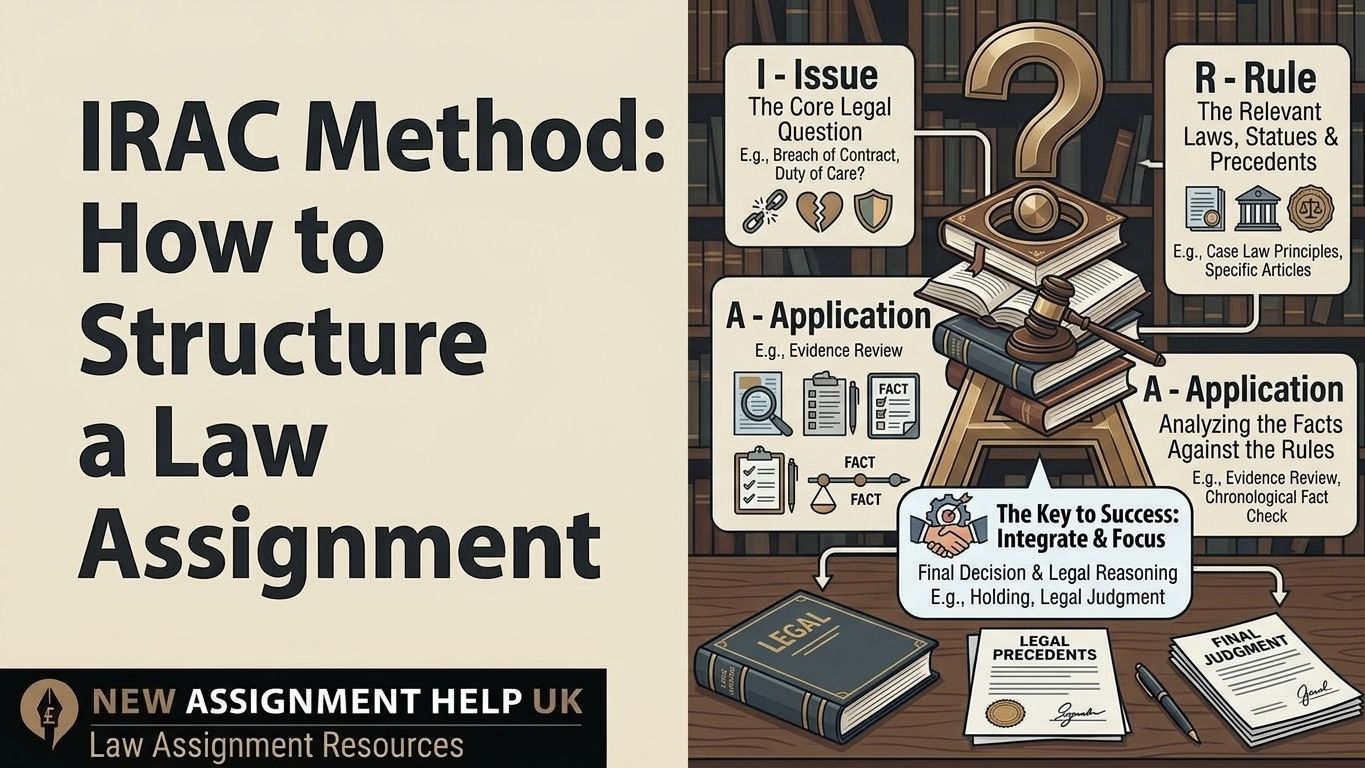
IRAC Method: How to Structure a Law Assignment
IRAC Method: How to Structure a Law Assignment
In the UK most law students lose marks on structure, not on knowledge. The IRAC method structures a law assignment in four steps: Issue, Rule, Application, and Conclusion. Well, UK law schools often call it ILAC, and problem questions are where it earns the most marks. Here professors reward reasoning they can trace, and IRAC makes that trace more visible. This IRAC method guide follows UK marking expectations and OSCOLA conventions, helping you to structure your law assignments accurately.
Every authority in the worked examples can be checked on legislation.gov.uk.
IRAC Method Explained: The Four Steps in a Law Assignment
IRAC is a reasoning framework that takes you from the legal question to the answer in a fixed order. This acronym was popularised by American law schools, yet the logic suits English law just as well.
Many UK marking schemes give the largest share of marks to application rather than recall. Problem questions appear in core modules such as contract, tort, criminal law, and land law. That's why essay questions need to be structured around the thesis.
- Issue: State the exact legal question in one sentence, naming the parties and the area of law. Vague issues lead to vague answers.
- Rule: Give the governing statute or case with a pinpoint reference and an OSCOLA footnote. Keep it short, since the marker already knows the law.
- Application: Match each element of the rule to a fact in the scenario. This step earns most of the marks, so give it the most words.
- Conclusion: Answer the issue directly. Use cautious terms such as "likely" where the outcome is arguable.
It will get easier to understand with a worked example that connects all 4 steps practically.
A Worked IRAC Example Using UK Consumer Law
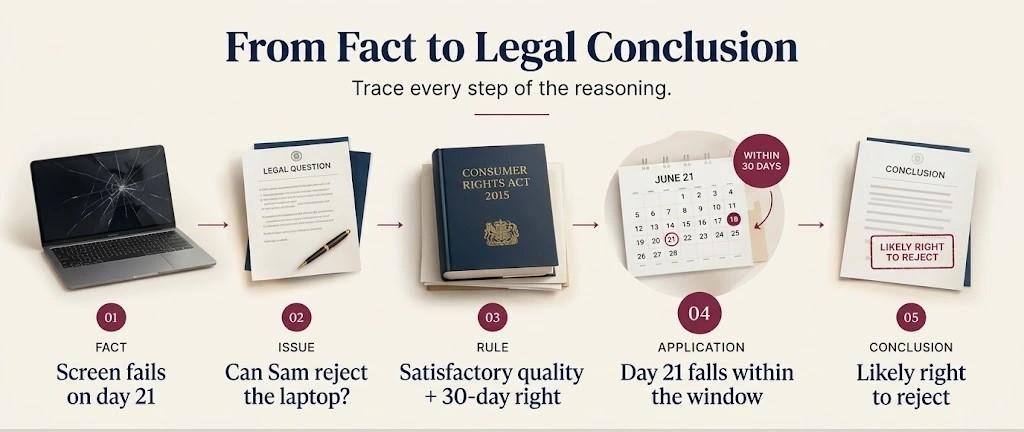
Here this example is going to apply all four steps to a common consumer dispute. Which is: Sam buys a laptop online from a UK retailer, and the screen fails on day 21 automatically.
- Issue: Whether Sam can reject the laptop under the Consumer Rights Act 2015.
- Rule: Section 9 requires goods to be of satisfactory quality, and durability is one factor. A short-term right to reject applies within 30 days of delivery.
- Application: A screen failure on day 21 points to poor durability. Sam is inside the 30-day window, so the retailer cannot insist on a repair first.
- Conclusion: Sam can likely reject the laptop and claim a full refund.
In the below-provided example, every fact links to a legal element before the answer appears. Real questions rarely stop at one issue, so the method needs adapting.
How to Adapt IRAC for UK Law Modules
UK university departments have different formatting rules, so adjust your style and approach based on the specific assignment type and word limit.
Match the method to the question → IRAC suits problem questions only. Essay questions need an argument-led structure, and forced IRAC labels weaken your analysis.
Repeat the block for every issue → Give each issue its own IRAC sequence, ordered by the timeline of the facts.
Signpost each block Open with a line such as "The first issue is whether". This keeps a long answer easy to follow.
Split your words inside each block → Issue and Rule: 30%. Application: 60%. Conclusion: 10%.
Follow your handbook → Some departments prefer ILAC or plain headings without labels. Check the marking criteria before you format.
Remember one thing: even a good structure fails when the reasoning inside it slips.
Common IRAC Mistakes That Cost Marks
Below are the common five errors and the solutions to fix them. So you don't lose any grades.
- Retelling the facts earns nothing, because copying the scenario back to the marker adds no legal reasoning. Link each fact to a legal element instead.
- Naming cases without reasoning leaves the marker guessing, since "See Caparo" does not show why the case applies. Explain the principle first, then apply it to the facts.
- Ignoring the other side costs marks because markers expect a counterargument. State how the opposing party would argue, then weigh it against your own view.
- Stopping at liability leaves the answer half finished, as contract and tort problems need a remedy. Add damages, a refund, or an injunction where relevant.
- Writing a one-line conclusion such as "Sam wins" gives no reasoning. Add the legal basis and note any doubt.
Read it carefully to fix it before submitting the final report.
Final Checks Before You Submit
Start with the question itself. Its final line usually names the party you are advising, so confirm that every issue ends with a conclusion for that person. Then read the first sentence of each issue on its own. If it does not state the legal question clearly, rewrite it before anything else.
Next, verify your sources. Check each statute section and case citation on legislation.gov.uk or BAILII, and confirm your footnotes follow OSCOLA and your module guide. Last, read only your conclusions in order. They should sound like advice a client could act on. Time yourself on one past problem question, then compare your answer with tutor feedback. IRAC works when the marker never has to guess your reasoning. And if you're struggling to meet the expectations or not having much time, then approach professional law assignment support to avoid losing marks.

 9 | Law and LLB (Hons)
Yvette Cooper is a practising solicitor in England and Wales with an LLB (Hons) in Law and an LLM from a UK university. Her day-to-day work covers contract, tort and public law matters. That makes her well known for how legal reasoning works in real cases as well as in the lecture hall. Outside practice, she spends her spare time mentoring law students on case analysis, legal writing, OSCOLA referencing, internships and exam preparations. She writes clear, practical guidance that helps students turn legal knowledge into stronger assignments and excelling academic results.