How to Write a Computer Science Assignment Step-by-Step Guide
How to Write a Computer Science Assignment: 9 Steps That Actually Work
Writing a computer science assignment requires you to work with excellent coding skills. Most students write a programme that runs perfectly on their computer but fail to achieve the grades they desire. This is simply because they directly jump into the code editor, get it working, hand it in, and then wonder where the marks went.
The answer is usually that a CS assignment isn't only a coding task. It's also a writing task. Your marker wants to see how you got to your answer, not just the code you used to get there. So let's walk through how to write a computer science assignment which can help you improve your grades.
So what's different about a CS assignment?
In a CS assignment, you are expected to use a mix of functional code, rigorous testing and clear written documentation which can explain your technical decisions. Most assignments expect you to:
- use algorithms and data structures sensibly
- show a clear way of approaching the problem
- document what you did
- test your work and say how it went
Once you know that, the rest gets a lot easier. Now let’s talk about steps to be followed while writing it.
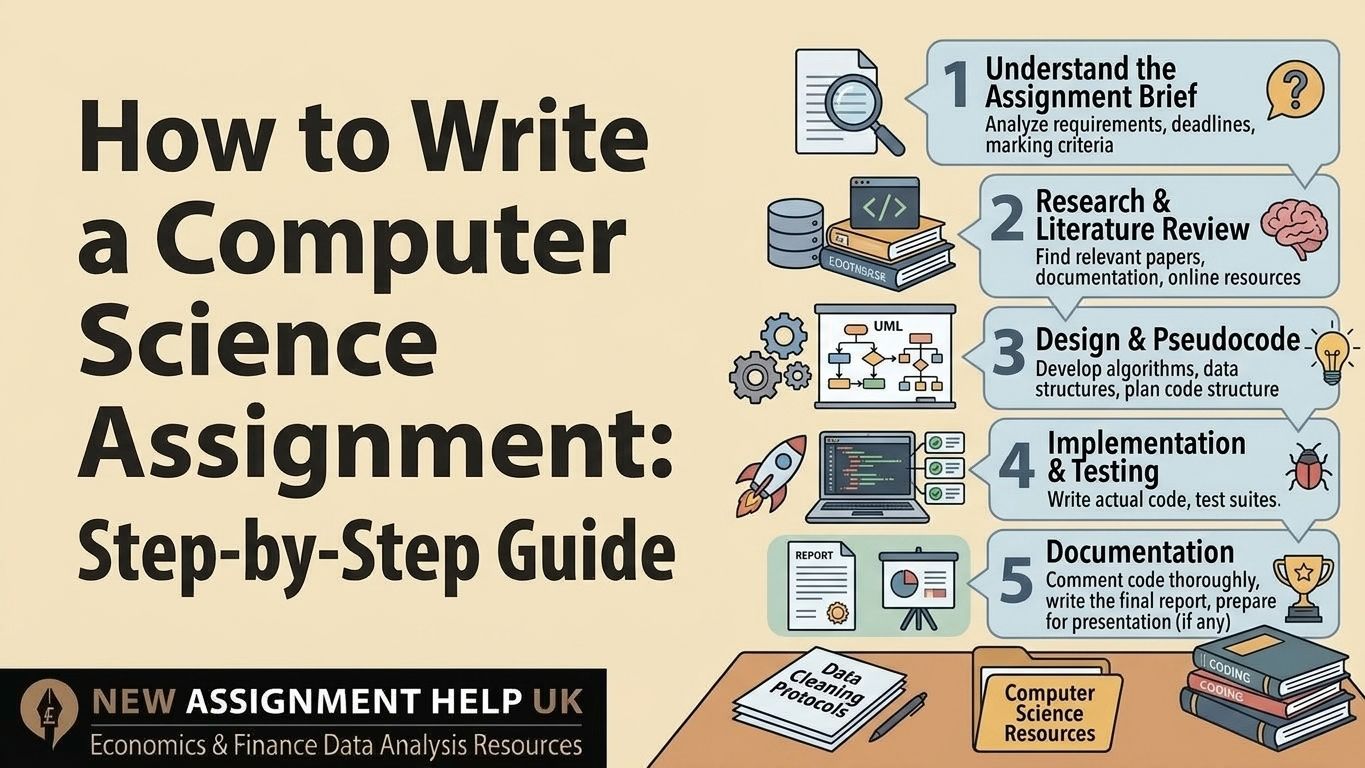
The step-by-step process of writing a CS Assignment
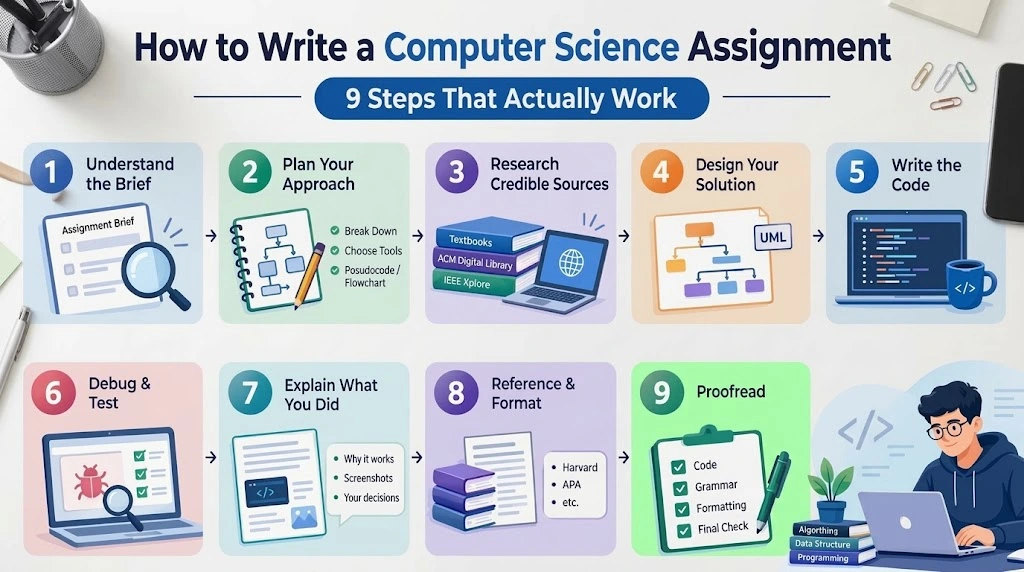
- Read the brief properly. Before writing code, make sure you read your assignment brief carefully. Watch for words like "analyse," "design," or "implement," because they don't mean the same thing. Then write down everything you actually have to hand in: code, a report, diagrams, whatever it is. Missing a deliverable is a painfully easy way to lose marks.
- Planning is the first step of writing. Break the big problem into small chunks and decide on your language and tools. Then sketch some pseudocode or a quick flowchart. It feels slow, but it saves you from tangled code that you end up rewriting late at night.
- Research from credible sources. Check your lecture notes, your textbook, ACM Digital Library, and IEEE Xplore Digital Library. Looking at similar solved problems is fine and often useful, but using data from trusted sources makes your work even more stronger.
- Design your solution. Decide which algorithm and data structures suit the problem, and think about how data flows through your program. A UML diagram or flowchart is a great way to show that visually.
- Write the code. Keep it clean and tidy. Give variable names that make sense, comment on the tricky bits, and split things into small functions so nothing turns into a giant wall of text.
- Debugging and testing. This step makes sure that you not only passed the test but also actually solved the problem and corrected it. Fix every bug you find, even the small ones to verify your work.
- Explain what you did. This is the part people skip. Say why your code works, include screenshots of the output, and explain the choices you made along the way.
- Reference and format. Use whatever style your teacher asks for (Harvard, APA, etc.) and give the report clear headings so it's easy to follow.
- Proofread. Check the code, check the grammar, and check the formatting. Do it once more than you think you need to, as this is the last and most important step in a CS assignment.
Practice these steps in your daily routine and give yourself the best CS assignment you could ever write.
Where students usually slip up
- Coding without a plan. You'll spend more time fixing a mess than you saved by starting early.
- Forgetting edge cases. Your program works fine until someone gives it something unusual.
- Copying code you don't understand. Markers can usually tell, and you won't be able to explain it anyway.
- Thin documentation. Great code with no explanation still loses marks.
- Skipping testing. Untested code almost always has a simple bug hiding in it.
Fix those five, and you're already ahead of a lot of people. These tips will benefit you from doing the mistakes which you can actually correct without any trouble.
A few tricks for a higher grade
Use diagrams to show your logic. Keep your code readable. Justify your decisions, even the small ones. Add a short note on time complexity. And stick to the assignment guidelines exactly, because small details are often what separate a good mark from a great one.
Check this before you submit
- Does the code actually run?
- Have you answered every question?
- Is your explanation clear?
- Are your references in?
- Is the work genuinely your own?
If all these five questions give you the right answer, then you are in a good position. Keep checking your work on these criteria, and what you will get is a CS assignment that meets your requirements.
Wrapping up
Good CS assignments come down to three things: planning, coding, and explaining. The code is only part of it. What counts is showing your solution in a way someone else can follow. Try these steps on your next one and see how it feels. And if you get stuck, seek CS assignment support without any stress.

 8 | MSc in Software Engineering
Daniel Marcus is a computer science writer and academic mentor based in Manchester, UK. He holds a BSc in Computer Science and an MSc in Software Engineering, and he has spent over eight years helping UK university students with programming, algorithms, and technical reports. Daniel has guided thousands of learners through Python, Java, and C++ assignments, from first-year basics to final-year projects. He knows what markers look for because he has seen where students gain and lose marks. His goal is simple: make hard ideas easy to understand. When he is not writing, Daniel enjoys open-source projects and coaching beginners.