
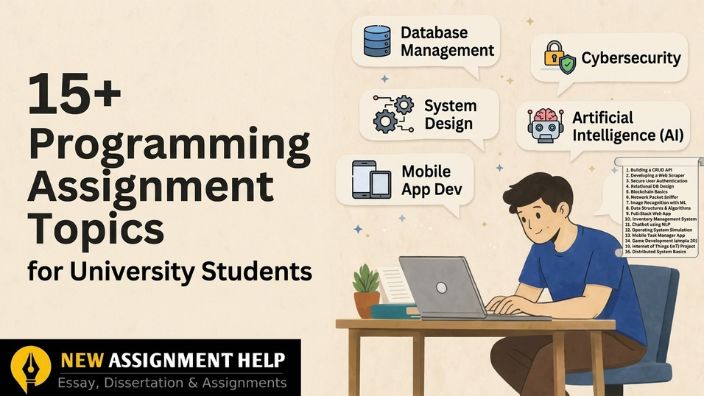
15+ Programming Assignment Topics for University Students
- 15+ Programming Assignment Topics Curated by UK Universities Module
- How Programming Assignments Are Actually Marked
- Topic List by Module
- Programming Fundamentals and OOP (Years 1 to 2)
- Python, Data Structures and Algorithms (Year 1 to 2)
- Databases and SQL (Year 2)
- Web Development (Year 2 to 3)
- Software Engineering and Group Projects (Final Year)
15+ Programming Assignment Topics Curated by UK Universities Module
Programming assignments require you to work in a structured way, from planning to testing. Whether it is in the code comments or a project report, you should highlight a balance of technical competencies and problem-solving methodologies. When it comes to topics, it changes a lot depending on your module and your year of study. A Year 1 task looks nothing like a final-year project.
In this guide on programming assignment topics, you will get lists of real topic ideas matched with your university module. Topics will help you know how UK computer science and software engineering courses are actually structured, along with quick notes on grading. Let's look at how these assignments get marked first, since that shapes which topic makes sense for you.
How Programming Assignments Are Actually Marked
Most programming modules split marks between coursework and exams, though coursework often carries more weight in coding-heavy units. Some assignments are individual. Others are group projects with a shared mark plus an individual component.
Originality matters a lot when it comes to marking a programming assignment. UK universities run your code through similarity checkers like Turnitin, so copied or AI-generated solutions get flagged fast. Therefore, pick a topic you can genuinely build and explain, and you protect your grade either way. Now, here is the list of topics, grouped by the kind of module you are likely taking.
Topic List by Module
Programming Fundamentals and OOP (Years 1 to 2)
These modules test whether you understand the basics of structuring a program.
- Library system tracking books, members and due dates with classes: Research class design and real library borrowing rules first.
- Bank account simulator with deposit, withdrawal and balance checks: In this, study encapsulation and how banks handle transaction limits.
- Student record tool storing and validating grades using lists: Research validation rules and list handling in your language.
- Inventory tracker for adding and removing stock in a shop: Study stock logic and how low-stock alerts usually work.
This is the topic coverage for year 1 to year 2 students, and once you are comfortable with objects and functions, the next step is thinking about data and logic at a larger scale.
Python, Data Structures and Algorithms (Year 1 to 2)
These assignments push you to think about how your code performs and work on a large scale, not just whether it runs.
- Sorting visualiser showing bubble sort, merge sort and quicksort: Go for time complexity and how each sort compares in speed under this topic.
- Pathfinding tool using Dijkstra or A* on a grid: Study graph basics and how A* uses heuristics.
- Linked list or stack built without built-in structures: Analyse the concept of memory handling and core operations like push and pop when you write on this.
- Recursive solver for mazes or the Tower of Hanoi: It includes base cases and stack overflow risks before you start coding.
These are the areas where you understand how to store and process data well. The next list covers learning to manage it properly in a database.
Databases and SQL (Year 2)
Database modules focus on structure, accuracy and real-world data handling. The topics under this are:
- Normalised schema for a hotel or event booking system: Research for normalisation rules and how to avoid duplicate data here.
- CRUD app built with an ORM like SQLAlchemy: Focus on studying ORM syntax and how it replaces raw SQL.
- Library database linking books, authors and borrowers: In this look at different join types and indexing for faster queries.
- Sales report tool showing totals and trends from data: Study aggregate functions and GROUP BY for summaries.
With data sorted and stored, many courses move on to putting that data online through a website or app. The next section covers the topics related to that only.
Web Development (Year 2 to 3)
It is a technical process of building, coding and designing websites and web applications.
- Portfolio site with a working contact form and backend → Research form validation and secure server-side storage.
- REST API with login authentication for a task manager → Under this, study token-based login and how to protect routes.
- E-commerce page with cart and checkout logic → It requires session handling and basic payment integration.
- Blog platform with a simple content management system → Study admin permissions and database-driven content structure.
By your final year, most of this comes together in one large, team-based project.
Software Engineering and Group Projects (Final Year)
These modules test how you can work as part of a team, not just how you code individually.
- Agile team app built through sprints and stand-ups – Here, you can research Scrum roles and how to log sprint progress.
- CI/CD pipeline automating testing for a group codebase - Analyse the study version control and deployment pipeline basics.
- Client-brief project completed with a full final report – The topic requires you to research requirement gathering and how to document decisions.
That covers the whole category of the topics under this section. But picking a topic from a list is only half the job. So choose the topic which can match with your module. Also check for the learning outcomes before picking the best one for you.
If you want more guidance on planning, coding or documenting your assignment, you can seek programming assignment assistance for better clarity.

 10 | MSc in Computer Science
With a decade of hands-on experience, Anne Franklin works as a UK-based programming tutor and academic writer who supports university students through their coding assignments. She holds a Master's in Computer Science and has spent years working closely with students on Java, Python and C++ modules. Anne has helped hundreds of students tackle debugging, documentation and assignment planning, breaking down dense or unclear briefs into clear, practical steps they can actually follow. Her writing prioritises exam-ready, usable guidance over abstract theory. Outside of tutoring, she regularly reviews open-source projects and keeps pace with the coding practices currently taught in UK universities.