.jpg)
Common Programming Assignment Mistakes Students Should Avoid
- Why These Mistakes Keep Happening
- Misunderstanding the Assignment Requirements
- Starting Without Proper Planning
- Weak Testing and Ignoring Edge Cases
- Poor Code Structure and Readability
- Lack of Documentation and Comments
- Poor Time Management and Last-Minute Work
- Ignoring Submission Guidelines
- Misusing AI Tools and External Code
- Final Checklist Before Submission
If your code runs fine but your grade still drops, the problem usually isn't your coding skill. It can be the small stuff around the code. Programming assignment mistakes like weak testing, messy formatting, and missing comments cost students marks every single day, even when the logic is correct.
This guide walks through the common coding mistakes students make, why they happen, and how you can fix each one before your next submission. So let’s understand each of them in a detailed manner, starting with the reason behind these mistakes.
Why These Mistakes Keep Happening
Almost every student struggles with programming assignment mistakes because of the conceptual gaps, unclear instructions, and a rush to write code before planning an algorithm. It happens because assignments feel like a race against the clock, and small steps like planning or testing get skipped along the way.
However, these can be fixed by small efforts once you see the pattern clearly. So here is a list of each mistake below that builds on the last one. A rushed reading of the brief leads to poor planning, poor planning leads to weak testing, and weak testing leads to messy code that's hard to fix later. Let's look at them closely, starting from where most problems actually begin.
Misunderstanding the Assignment Requirements
Programming assignment mistakes happen before a single line of code is written. Students often skim the brief, miss a format rule, or overlook an edge case buried in the instructions. That means solving a slightly different problem than the one being asked.
So read the rubric twice before starting anything. Then rewrite the problem in your own words. If you can explain it simply and you understand it, then you already know what to work on in the assignment. Once the requirement is clear, the next step is planning it out properly.
Starting Without Proper Planning
Even if you have read the question carefully, you cannot produce excellent work without planning every task. Diving straight into code often leads to messy logic and constant rewrites. A little planning saves hours later.
Try this before typing any code:
- Sketch out pseudocode
- Draw a simple flowchart to understand your tasks
- Break down the problem into small functions
This structure keeps your thinking organised and you can fix your code more easily later. With a plan ready, testing becomes the next place students slip up the most.
Weak Testing and Ignoring Edge Cases
Testing only with the sample input given in the question is one of the most common coding mistakes students make. Real evaluation systems check further than that.
Therefore, always test for:
- Empty input
- Very large values
- Invalid or unexpected data
If your code only works for the "nice" example, then consider it unfinished. Good testing naturally leads to better structured code, which is the next area to watch.
Poor Code Structure and Readability
Long functions, confusing variable names, and no indentation make your code hard to read and hard to mark. Clean code always shows clarity in mind; thus, you should aim for:
- Writing meaningful variable names
- Short and focused functions
- Make sure the spacing and formatting are consistent
Readable code often creates a difference between a good grade and an average one. So read your code well and explain everything clearly.
Lack of Documentation and Comments
Skipping comments is an easy way to lose marks that should have been simple to earn. Make sure you document code using inline comments, short function descriptions, and a brief README when needed.
Write comments that explain why you did something, not just what the line does. Anyone can see what a loop does. Not everyone knows why you needed it.
Poor Time Management and Last-Minute Work
Starting close to the deadline leaves no room for testing or fixing bugs. Break your work into stages: plan, code, test, then document.
Smaller deadlines throughout the week keep panic away and maintain the quality of the assignment.
Ignoring Submission Guidelines
Wrong file formats, missing files, or incorrect naming can cost marks even when the code itself works perfectly. Always check the submission checklist one final time before you upload anything.
This one small habit protects all the effort you already put in. Make sure you clearly read all the guidelines to avoid any kind of last-minute errors.
Misusing AI Tools and External Code
Just copying AI-generated code without understanding or checking is the most genuine concern today. This can affect your grades and lead to academic penalties or code that quietly fails under certain conditions.
Therefore, make sure to use AI tools for guidance and idea generation purposes only. Do not use them as a replacement for your own understanding.
These common mistakes will help you refine your code and achieve better grades in the final submission. Read the checklist given below for a quick reminder.
Final Checklist Before Submission
Ask yourself these questions before you submit your programming assignment:
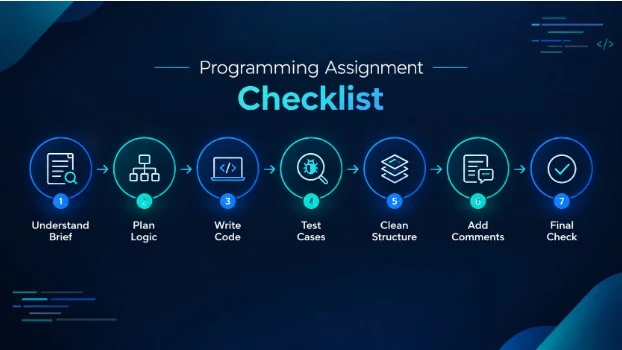
- Do I fully understand the requirements?
- Have I tested edge cases, not just examples?
- Is my code structured and easy to read?
- Did I add comments and documentation?
- Have I followed the submission guidelines?
If you can say yes to all five, you're in good shape. Practise them in every task, and you are all set to outperform your next programming assignment. If you are still making the same mistakes, then consider programming assignment guidance to avoid them and improve your coding skills significantly.

 10 | MSc in Computer Science
With a decade of hands-on experience, Anne Franklin works as a UK-based programming tutor and academic writer who supports university students through their coding assignments. She holds a Master's in Computer Science and has spent years working closely with students on Java, Python and C++ modules. Anne has helped hundreds of students tackle debugging, documentation and assignment planning, breaking down dense or unclear briefs into clear, practical steps they can actually follow. Her writing prioritises exam-ready, usable guidance over abstract theory. Outside of tutoring, she regularly reviews open-source projects and keeps pace with the coding practices currently taught in UK universities.