
Innovation and Commercialisation Assignment Sample
Innovation is considered as one of the significant procedure of implementation of new idealisation within existing products and services for growth and bringing success.
- 92650+ Project Delivered
- 1500+ Experts 24x7 Online Help
- No AI Generated Content


- SECTION 1
- Introduction - Innovation and Commercialisation Assignment
- MAIN BODY
- Background of company and its commercial potential
- Explain the differences between invention and innovation
- Source of innovation
- Link between innovativeness of Booths with its LCTI
- Explain 4Ps of innovation
- Innovation funnel and frugal innovation
- SECTION 2
- 1. INNOVATION CASE
- 2. METHODS OF PROTECTING INNOVATION
SECTION 1
Introduction - Innovation and Commercialisation Assignment
Innovation is considered as one of the significant procedure of implementation of new idealisation within existing products and services for growth and bringing success. On the other hand, commercialisation is significant for identifying the process which are implement by the companies for launching the new or innovative products within the specific target market. Additionally, innovation and commercialisation is important because it leads to new goods and services that are advantageous to the public and enhance the economy. This report will be based on innovation and commercialisation of one of leading retail company of the UK i.e. Booths. Additionally, this report will highlights connect of innovation and invention, 4Ps of innovation, influence of innovation on culture, leadership, vision and teamwork of the chosen organization.
Transform your grades with New Assignment Help! Our experienced writers deliver high-quality, plagiarism-free assignments tailored to your requirements. Academic success is just a click away!
MAIN BODY
Background of company and its commercial potential
Booths is one of leading health and beauty Retailer Company. This organization was founded in 1849 by Joh Boot. The headquarter of Booths is situated in London, UK. The portfolio of chosen organization includes beauty and retail products (Booths, 2024). Apart from this, to provide the better services and high quality of products this company is also emphasis on innovation. This innovativeness of Booths is beneficial for it because it facilitates to create localised ranges down to store particular level and implement more effective and end-to-end processes. Furthermore, this innovativeness of the chosen business helps in gaining the competitive advantage over competitors by improving the experience of the customers. This innovative technique helps in attracting the customers over the competitors which leads to increase sales, profitability and productivity. This innovativeness of Booths will also have advantage in the future by attracting customers, gaining competitive advantages and develop brand reputation over competitors. Apart from this, bringing the innovation and using commercialisation is not an easy task for the companies. For example, emphasis on innovation and commercialisation (I&C), Booths is facing the issue related to high competition and digital transformation. For example, Tesla is one of leading automobile company within the UK and it also face the issue related to regulatory compliance and economic uncertainty while developing innovative products in comparison to GSK. At the time of developing innovative and sustainable clothing, Next plc is also facing the challenges related to information security and digital transformation as comparison to other companies which losses the trust of the consumers.
Explain the differences between invention and innovation
Invention is defined as happening of idea for the product and process that has never been made before. On the other hand, innovation refers to process by which product, domain and services are brought and renewed up-to-date by applying new process, developing successful ideas and introducing new techniques in order to create the new value.
|
Basis for comparison |
Invention |
Innovation |
|
Meaning |
Invention is majorly focuses on launching the new products and services in the market according to the choice of the customers (Lian, Xu and Zhu, 2022). |
Innovation is generating the new ideas in relevant to new products and services. |
|
What is it ? |
Creation of new product |
Adding value to something that already exists. |
|
Skills needs |
For the invention of products and services it is important to have scientific skill. |
For the innovation of products and services it is important to have set of technical, marketing and strategic skills. |
|
Concerned with |
Invention is concerned with single product or process. |
Innovation is concerned with combination of several products and processes. |
|
Activities |
Invention is limited to department of R&D |
Innovation is spreading across the organization |
|
Example |
Artificial intelligence is invention |
Introducing dunnhumby AI powered assortment solution for improving the experience of customers is innovation. |
Invention is creation of new product and services that didn’t exist before. For inventing the new product and services the researchers and scientist have the competency to introduce new concepts, ideas and complete products that will serve the particular purpose. It has been determine that for inventing the new products and services it is important for the researchers to have scientific skills from which they are able to think innovative and unique ideas (Magomedov, Bagov and Zolkin, 2020). For example, Booths is also emphasis on converting the invention into innovation in order to enhance the shopping experience of the customers. With the help of AI, Booths is launching AI and machine learning to enhancing the experience of the customers and encourage them to make repeat purchase.
On the other hand, in simple words innovation is the application procedure of innovation but it requires creativity. For developing the innovative product it is important for the researcher or scientist to have marketing, technical and strategic skills. The innovation of Booths helps in attracting wide range of customers which leads to increase profitability, sales and productivity.
Source of innovation
According to Peter Drucker, innovation refers to the efforts in order to create focuses and purposeful change in social and economic potential within companies. According to Drucker, seven significant sources of innovation are incongruities, industry and market changes, process needs, and changes in perception as well as demographic changes and new knowledge (Shahid et al, 2023). Along with this, the innovative ideas are comes from the several sources such as employees, customers, industry changes, new knowledge, demographic changes, collaboration and open innovation. Process need is considered as one of the critical sources of innovation and it has positive influence on developing existing packaging and including new logos which helps in engaging majority of the customers (Kitsios and Kamariotou, 2021). Demographic is another source of innovation that positively influence on the companies by launching the new range of goods and services according to the age groups and income conditions. On the critical note, new knowledge can be adversely influence on the business because wrong information from the market leads to deliver ineffective products which results in poor satisfaction and experience of customers.
Booths is introducing AI for enhancing the shopping experience of the customers by getting the right medicines or vaccines is the example of process innovation. In addition, new knowledge can be significant for the chosen organization while it is trying to introduce or launch new products in the market instead of delivering existing products. On the other hand, whenever the selected company is trying to introduce organic or healthy medicines in the market can be considered as example of demographic source of innovation.
Apart from this, it has been recommended that, Booths should need to adopt more self-check-out tills which facilitates faster checkout, fewer employees, and improved customer experience and increase productivity of staff. This innovation will be considered as example of process innovation. This idea come in mind because the customers are standing in long lines or purchasing products and processing transactions (McGahan et al, 2021). To make the business operation more innovative Booths can need to emphasis on creating the positive and right environment by attracting diverse employees.
Link between innovativeness of Booths with its LCTI
Innovation of the organization has direct link with their leadership, culture, teamwork and innovation network (LCTI).
Leadership is considered as one of the critical factor that directly affects the innovation. Leaders have competency to inspire trust, promote collaborative culture and influence growth mind-set from which employees feel encourage to think innovative ideas to develop innovative products (Lee et al, 2020). For example, for bringing the innovation, Booths is adopting participative leadership style in which leaders are consider the ideas and opinions of employees which helps in making effective decision related to it.
Organizational culture is another critical factor that has direct link with the innovation (Lam et al, 2021). To introduce the innovation, Booths is developing the positive culture from which its employees feel influence and motivate to think out-of-box.
Teamwork is another important factor that has direct interrelationships with the innovativeness of the companies. The companies which are emphasis on teamwork are able to develop innovative and unique products and services to improve experience and increase satisfaction of the customers (Hadjielias et al, 2021). Booths is also focusing on teamwork from which the employees are engaging in more innovative and collaborative activities that outperform others in new goods and services. Booths can implement various effective team working models like Tuckman’s model for enforcing the business process and encourage the innovation.
Innovation network is another factor that directly influence the overall innovation and invention of the companies. This network is group of agents that are associated through relationships that facilitates exchange of information and resources.
Explain 4Ps of innovation
4Ps of innovation is considered one of the critical model that is used by the companies in order to understand and implement the innovation in successful manner. This framework is consist of product, process, position and paradigm (Tavakoli and Karimi, 2024). Adoption of this framework can be beneficial for Booths because it helps in making informed decisions in order to grow and develop in long-run.
Product: This innovation is important for the companies to introduce new ideas regarding medicines and vaccines that are concerned to a specific business. Fresh food is old product since so many years. Booths has introduce organic or healthy food in its products which can be effective to determine the product innovation and helps in attracting customers.
Process: Process innovation is business procedures by which companies are delivering the goods and services (Franken et al, 2020). Emphasis on process innovation is critical for companies because it helps in enforcing productivity and meet the needs and demand of customers. As per Booths introducing dunnhumby AI powered assortment solution is example of process innovation. In addition, the suggested innovation i.e. adopt self-checkout till will be process innovation because it helps in delivering the services to the customers in better and successful way.
Position: Position innovation helps in creating re-positioning of existing products in order to gain effective branding. Booths is also introducing the product with new logo instead of previous one that contain some changes which helps in attract more customers.
Paradigm: This innovation is important for utilising some mental model that can help in bringing success to the companies. For Booths, this innovation can be important with the help of introducing several organic and healthy food products at lower rates.
Apart from this, incremental innovation is critical procedure of making small enhancement to existing process, goods and services. While, radical innovation refers to procedure of creating new goods and services that significantly modify the landscape of market.
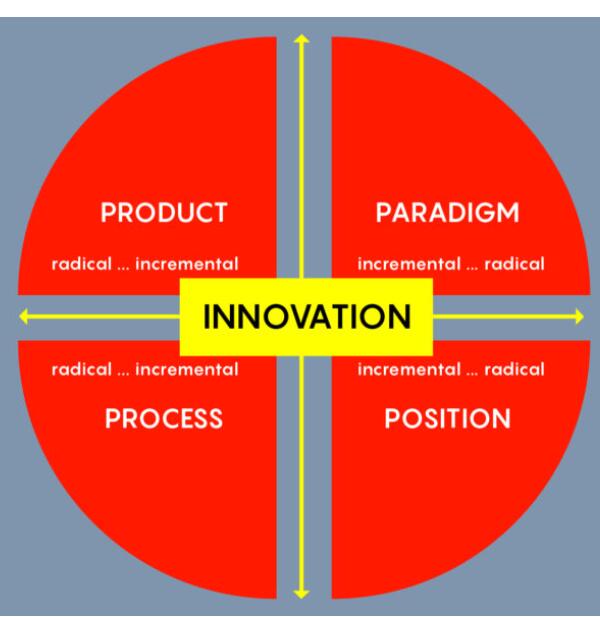
Figure 1: 4Ps of Innovation
Innovation funnel and frugal innovation
Innovation funnel (IF) is a structured procedure that helps the organizations to generate, build and screen ideas into products and services that fulfil the demand and drive the growth and development. This process is consisting of various stages such as idea generation, screening, development of concept, feasibility analysis, testing, market launch etc (Mamasioulas, Mourtzis and Chryssolouris, 2020). This concept is need for successful innovation and new product development because it helps in determining promising ideas, allocate resources and asses market potentials. IF is directly link to the new product and service development process because it helps in developing and managing the new ideas in successful manner consisting of new services by screening, prioritizing and testing them. Additionally, for Booths in case of new idea there is the effectiveness of developing self-checkout till. For introducing this innovation it is important for selected organization to take significant information regarding marketing needs. After generating the idea next activity is screening in which self-checkout till will be introduce in market. Finally, the needed resources will be collected for effective commercialisation of the new services that helps in attract huge number of customers.
On the other hand, frugal innovation (FI) is a concepts that includes introducing the affordable goods and services for the low-income consumers in the environment of resource-constrained. Adoption of this innovation can be beneficial for companies because it helps in reduce costs, facilitates accessibility, agility and gaining competitive advantage over competitors (Minatogawa et al, 2022). For example, the FI of Booths is that it has reduced the prices of its existing products and launch its new items at low prices in order to attract the customers. The frugal innovation will be relevant to Booths because it help it in reduce production costs, offer affordable products and optimize processes. Organization can easily implement this FI in its existing products and services in order to attract customers. On the other hand, yes different types of companies have different approaches to FI ideas and IF such as top-down vs. bottom up, planned vs. unplanned, prioritization and idea generation methods (Osterwalder et al, 2020).
CONCLUSION
In the end it has been concluded that, invention and innovation are diverse from each other and both are important for the companies to gain success and competitive advantage over competitors. Process need, knowledge, demographic etc., are significant sources of innovation at are adopted by the companies. LCTI of Booths can have massive impact on its innovativeness which helps in developing new products and services in effective way.
SECTION 2
1. INNOVATION CASE
The need
For growth and success as well as attracting wide range of customers, Booths will need to make significant investments in emerging technologies in order to develop new and innovative products and services. Booths will need to adopt self-check-out tills to improve experience of customers. Chosen organization will need to develop this service because the customers are standing in long time for purchasing products and processing the transaction which leads to negative influence on their purchasing behaviour and decisions. This innovative and new service of Booths will be beneficial for the customers because it aids in complete their purchase faster and more effectively without waiting in the long lines. The customers are need this innovative service because it helps in scan and rescan the items at their own place, check the bill before paying and customize their order (Cebeci, Ertug and Turkcan, 2020). Apart from this, in current times, due to this type of innovation the customers are facing the problems related to waiting for long hours in lines for processing transactions. To solve this problem of the customers, selected organization will need to adopt self-check-out tills
The solution
Booths will need to solve this problem in order to attract and retain the customers by enhancing their shopping experience. Adoption of this innovative solution will be beneficial for the companies because it helps in reduce labor costs, improve efficiency, increase security and fraud prevention and better customer experience and increase sales as well as revenue. Without admittance to self-checkout tills the customers are facing the problem related to waiting in lines, staff assistance, scanning and bagging etc. Self-checkout tills will be the best solution of all the problems that helps in enhancing the experience of customers (Sachani, Anumandla and Maddula, 2022). Adoption of this innovation will be useful for Booths because it helps in fulfilling the needs and requirements of the customers by providing high-quality and better services to them.
Why it is innovative
The innovative idea i.e. develop self-checkout tills will be new and different. In current times, all the activities become digitalized in order to enhance experience and increase satisfaction of the customers. The NSD of Booths will be evolved with the new innovations and technologies which includes artificial intelligence, barcode scanners, smart carts and mobile scanning. This innovative idea will allow customers to scan the times and make payment of their purchase without need assistance from the staff. Along with this, the innovative idea of Booths will have values in the eyes of consumers because it helps in reducing their waiting times, have more control, enable user friendly and enhance accuracy. With the help of this innovative idea, the customers can check out faster and more effectively without waiting in the long lines (Jie and Kamsin, 2021). Customers are in control of inputting of their order which can minimize the risks of errors. Furthermore, self-checkout will have unifiedPOS (UPoS) which allow customers to scan and pay without the assistance of any people. On the other hand, this NSD will be valuable for Booths because it helps in attracting customers and enhance their loyalty, reduce labor costs and minimize the risk of abandoned purchases.
Evidence that customers want innovation
The customers of Booths may appreciate the self-checkout tills for its speed, privacy, convenience and accessibility. This innovative solution will allow the customers to scan and bag their products quickly which reduce their waiting lines and time. This will also allow customers to make their payment independently (Bocanegra et al, 2020). The customers will appreciate the innovative solution of Booths because it will provide control and privacy to them over their transactions.
Actions required to implement innovation
Developing the innovation is not an easy task for the companies they will need to take corrective actions and adopt various approaches like innovation funnel or stage-gate. To design and implement the innovative idea in successful and effective manner, the selected organization will need to choose right automation system whether full or partial. For the successful development of NSD Booths also need to arrange significant items like cameras, QR scanner, model server etc. Additionally, the selected organization will also need to concentrate on meeting the regularity regulations and compliances such as DSA, GDPR, COPPA, CPA etc.
Apart from this, to organize NSD in effective and successful manner, Booths will need to adopt stage-gate approach. This approach is value creating risk model and business process that is design to transform the new and innovative ideas into business profitably and quickly (Mykoniatis et al, 2020). Adoption of this approach will be beneficial for Booths because it helps in accelerating speed-to-market, increase new service success rates, decrease failure of new service and improve alignment across new business leaders.
Risks associated with innovation
At the time of implementing innovative idea of solution, Booths may face the risks of increasing theft, high costs, hygiene concerns, shrink rates and customer confusion. For execution of self-checkout system, companies can require to make significant investment which leads to high costs. The shrink rates from the self-checkout system is expected to be in between 3.5% and 4% as compare with a rate of less than 1% for cashiers (Pandit, 2024).
Way to control new service development (NSD)
To control and monitor the success of NSD i.e. self-checkout system, Booths will use net promoter score (NPS). It is considered as one of the critical key performance indicator (KPIs) that helps in measuring the satisfaction and loyalty of the customers by asking them how likely they are suggest company to others. This KPI helps in measuring the effectiveness of self-checkout by gauging the experience and satisfaction of the customers (Baehre et al, 2022).
What investment is required and possible sources
For adoption of self-checkout system in successful manner, Booths will need to make significant investment and arrange possible sources. For developing the innovative solution, the estimated cost for Booths will be approx. £ 30000.
|
Resources |
Costs (In £) |
|
Research and development (R&D) |
6,000 |
|
Human resources |
4000 |
|
Fixed costs |
4000 |
|
Administrative expenses |
6000 |
|
Other expenses |
10,000 |
|
Total |
30,000 |
To access the funds for developing the innovation, Booths will use various sources such as retained earnings, venture capital, loans etc.
Benefits of innovation
The innovative solution will be financially, socially and environmentally beneficial for Booths. In modern era, developing self-checkout system will be financially beneficial for the organizations because it helps in reduce labour costs, increase checkout, reduce error and increase staff productivity. In the context of social, this innovative solution facilitates accessibility, privacy and control. Additionally, self-checkout system will have positively influence on the environment because it helps in reducing waste of papers, energy efficiency, minimize dependency on physical resources as well as alignment with corporate social responsibility.
2. METHODS OF PROTECTING INNOVATION
For growth and success it is important for the companies to protect their innovation because it assist in encouraging creativity, gaining competitive advantage, securing revenue and lowering costs (Grimaldi, Greco and Cricelli, 2021). To protect the NSD i.e. self-checkout, Booths will use various tools or methods such as copyrights, patents, trademarks etc.
Patent: As the new service will be invented in Booths in order to protect it from the rivalries the patent right of the inventor is created. The expiring period of patent will be after 20 years so it is important for the organizations to fill application form to protect the innovation (Obradović, Vlačić and Dabić, 2021). However, taking the patent of services is time consuming and expensive process as well as require to disclose invention in detail manner.
Trademark: For developing self-checkout system, Booths will use different design so it can use trademark to protect it from competitors. On the other hand, the disadvantages of trademark are geographical limitations, abandonment and descriptive marks.
Branding: Booths can emphasis on branding in order to develop and retain the intellectual property from the competitors. Adoption of this tool can be beneficial because it aids in preventing infringement, establishing legal rights and managing reputation. On the other hand, protecting the intellectual property, branding will be disadvantageous because of high costs, fixed image, relevance threats etc.
For protecting the NSD, Booths will need to use patent from all of these because it helps in protecting intellectual property, foster innovation as well as provide market access. As critically said by Dahlander, Gann and Wallin (2021), by protecting the innovation patents helps organizations to access in the new markets which helps in attracting customers and build the position within open market.
On the other hand, in the open market, for developing the new service in effective and successful manner it will be important for Booths to recognize the ideas of open source and open innovation. Open source is critical framework for intellectual property policy and economic exchange that allows people to admittance, use and copy the software platforms and programs. In addition, to develop the innovation in the open market, it is important for companies need to seek ideas from external and internal sources (Bamakan et al, 2022).
REFERENCES
Books and Journals
- Baehre, S., O’Dwyer, M., O’Malley, L. and Lee, N., 2022. The use of Net Promoter Score (NPS) to predict sales growth: insights from an empirical investigation. Journal of the Academy of Marketing Science, 50(1), pp.67-84.
- Bamakan, S.M.H., Nezhadsistani, N., Bodaghi, O. and Qu, Q., 2022. Patents and intellectual property assets as non-fungible tokens; key technologies and challenges. Scientific Reports, 12(1), p.2178.
- Bocanegra, C., Khojastepour, M.A., Arslan, M.Y., Chai, E., Rangarajan, S. and Chowdhury, K.R., 2020, September. RFGo: a seamless self-checkout system for apparel stores using RFID. In Proceedings of the 26th Annual International Conference on Mobile Computing and Networking (pp. 1-14).
- Cebeci, U., Ertug, A. and Turkcan, H., 2020. Exploring the determinants of intention to use self-checkout systems in super market chain and its application. Management Science Letters, 10(5), pp.1027-1036.
- Dahlander, L., Gann, D.M. and Wallin, M.W., 2021. How open is innovation? A retrospective and ideas forward. Research Policy, 50(4), p.104218.
- Franken, R., Heringa, M.B., Oosterwijk, T., Dal Maso, M., Fransman, W., Kanerva, T., Liguori, B., Poikkimäki, M., Rodriguez-Llopis, I., Säämänen, A. and Stockmann-Juvala, H., 2020. Ranking of human risk assessment models for manufactured nanomaterials along the Cooper stage-gate innovation funnel using stakeholder criteria. NanoImpact, 17, p.100191.
- Grimaldi, M., Greco, M. and Cricelli, L., 2021. A framework of intellectual property protection strategies and open innovation. Journal of Business Research, 123, pp.156-164.
- Hadjielias, E., Dada, O.L., Cruz, A.D., Zekas, S., Christofi, M. and Sakka, G., 2021. How do digital innovation teams function? Understanding the team cognition-process nexus within the context of digital transformation. Journal of Business Research, 122, pp.373-386.
- Jie, N.X. and Kamsin, I.F.B., 2021, September. Self-checkout service with rfid technology in supermarket. In 3rd International Conference on Integrated Intelligent Computing Communication & Security (ICIIC 2021) (pp. 495-502). Atlantis Press.
- Kitsios, F. and Kamariotou, M., 2021. Artificial intelligence and business strategy towards digital transformation: A research agenda. Sustainability, 13(4), p.2025.
- Lam, L., Nguyen, P., Le, N. and Tran, K., 2021. The relation among organizational culture, knowledge management, and innovation capability: Its implication for open innovation. Journal of Open Innovation: Technology, Market, and Complexity, 7(1), p.66.
- Lee, A., Legood, A., Hughes, D., Tian, A.W., Newman, A. and Knight, C., 2020. Leadership, creativity and innovation: A meta-analytic review. European Journal of Work and Organizational Psychology, 29(1), pp.1-35.
- Lian, G., Xu, A. and Zhu, Y., 2022. Substantive green innovation or symbolic green innovation? The impact of ER on enterprise green innovation based on the dual moderating effects. Journal of Innovation & Knowledge, 7(3), p.100203.
- Magomedov, I.A., Bagov, A.M. and Zolkin, A.L., 2020. Internet of things: future business. European Proceedings of Social and Behavioural Sciences.
- Mamasioulas, A., Mourtzis, D. and Chryssolouris, G., 2020. A manufacturing innovation overview: concepts, models and metrics. International Journal of Computer Integrated Manufacturing, 33(8), pp.769-791.
- McGahan, A.M., Bogers, M.L., Chesbrough, H. and Holgersson, M., 2021. Tackling societal challenges with open innovation. California Management Review, 63(2), pp.49-61.
- Minatogawa, V., Franco, M., Rampasso, I.S., Holgado, M., Garrido, D., Pinto, H. and Quadros, R., 2022. Towards systematic sustainable business model innovation: What can we learn from business model innovation. Sustainability, 14(5), p.2939.
- Mykoniatis, K., Shirzaei, S., Katsigiannis, M., Panagopoulos, A.A., Deb, S., Potter, T. and Angelopoulou, A., 2020, September. Society 5.0: A simulation study of self checkout operations in a grocery store. In Proceedings of the 32nd European Modeling & Simulation Symposium, Virtual (pp. 16-18).
- Obradović, T., Vlačić, B. and Dabić, M., 2021. Open innovation in the manufacturing industry: A review and research agenda. Technovation, 102, p.102221.
- Osterwalder, A., Pigneur, Y., Smith, A. and Etiemble, F., 2020. The invincible company: how to constantly reinvent your organization with inspiration from the world's best business models (Vol. 4). John Wiley & Sons.
- Sachani, D.K., Anumandla, S.K.R. and Maddula, S.S., 2022. Human Touch in Retail: Analyzing Customer Loyalty in the Era of Self-Checkout Technology. Silicon Valley Tech Review, 1(1), pp.1-13.
- Shahid, M.S., Hossain, M., Shahid, S. and Anwar, T., 2023. Frugal innovation as a source of sustainable entrepreneurship to tackle social and environmental challenges. Journal of Cleaner Production, 406, p.137050.
- Tavakoli, N. and Karimi, F., 2024. A Review of Marketing Mix Models in the Digital Economy: Measuring the Effectiveness of 4Ps in E-Commerce. Business, Marketing, and Finance Open, 1(1), pp.63-74.