
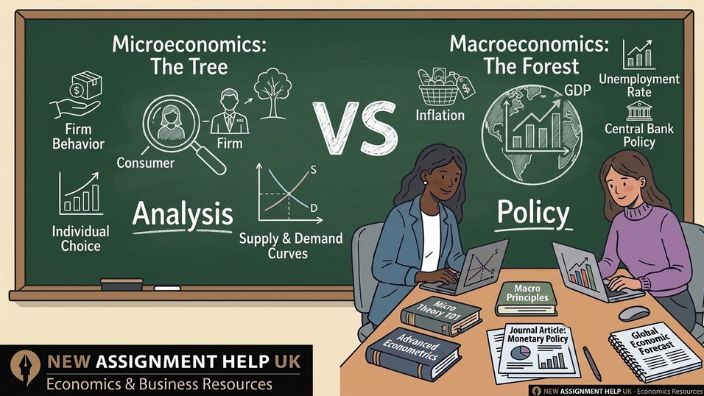
Microeconomics vs Macroeconomics: What Students Need to Know
Picture two students looking at the same news headline about rising petrol prices. One asks why the petrol station down the street charges more than the one across town. The other asks why prices are climbing everywhere in the country at once. Same headline, two completely different questions, and that's really the whole split between microeconomics and macroeconomics in a nutshell.
Microeconomics needs small, individual choices, one person, one business, one market. Whereas macroeconomics deals with the whole economy moving together, across a country or even the globe. That's the whole story behind both of them. If you want to get a detailed look, let's slow down and read this guide on microeconomics vs macroeconomics to clear all your doubts.

What Microeconomics Studies Actually Is
Microeconomics is the branch of economics which analyses the behaviour and decision-making of small and individual units. It includes people, households, and businesses regarding the allocation of resources which are limited in number.
Here's a small example. A coffee shop bumps its price up by 50 pence. A few regulars grumble and switch to the place down the street. Most just keep buying coffee like nothing happened. That reaction, small as it is, is exactly what microeconomics studies: supply and demand, why prices move, and how competition between shops nudges people's choices one way or another. So microeconomics zooms way in. One shop. One buyer. One decision at a time. Once that small picture makes sense, it's worth seeing what happens when you pull the camera all the way back.
Understanding Macroeconomics Studies in Detail
Macroeconomics looks at the economy of an entire country, sometimes the whole world. This branch of economics deals with the study of behaviour, performance and structure of the entire economy on a regional, national or global scale. Forget one coffee shop. Think every business in the country, added together.
It tracks the big numbers: GDP (the total value of everything a country produces), inflation (how fast prices climb across the board), and unemployment (how many people are out of work). It's also the lens for what governments and central banks do, like raising or cutting interest rates to manage spending.
In short, microeconomics asks why one shop raised its price and macroeconomics analyses why prices are climbing everywhere, all at once. Put them next to each other, and the split gets even easier to see.
Microeconomics vs Macroeconomics at a Glance
Here is a short distinction between the two branches of economics for your clear understanding:
| Criteria | Microeconomics | Macroeconomics |
|---|---|---|
| Scope | Individuals, households, firms | Entire economies, nations, the world |
| Main topics | Supply, demand, price, competition | GDP, inflation, unemployment, policy |
| Sample question | Should I buy coffee today? | Should the government lower interest rates? |
| Who uses it? | Shoppers, business owners | Policymakers, central banks, economists |
Both branches are chasing the same root problem, really: limited resources, endless wants. They just study it at different zoom levels.
How Microeconomics and Macroeconomics Are Connected
They are not two separate worlds sitting side by side. They lean on each other constantly.
Millions of small, individual choices add up into the national picture. Enough families cut back on spending at once, and the whole country's growth slows down. It works the other way too. When a central bank raises interest rates, that's a macro-level move, but it lands on one family deciding to hold off on buying a car this year.
This connection is part of why macroeconomics developed as its own area of study. In the 1930s, during the Great Depression, economists found that looking at individual markets alone didn't explain how a whole economy could decline at once. That period is often pointed to as a major reason economists began focusing more closely on national-level patterns like output, employment, and prices.
Which Is Harder, Microeconomics or Macroeconomics?
Honestly, there's no clean winner here. It comes down to how your brain likes to work. Microeconomics uses a lot of graphs and maths, like figuring out a firm's profit or drawing a cost curve. If you like problems with one clear answer, this can feel easier to follow.
Macroeconomics is tricky in a different way. You have to think about several things happening at once, since one change, like an interest rate going up, can affect jobs, prices, and trade all at the same time. Students who enjoy big-picture thinking often find this style more interesting than the graph-heavy work in micro.
In the UK, you don't sit separate exams for each. A-level Economics covers both within one qualification, split across papers. So it's less "which subject is harder" and more "which half of the syllabus suits you better."
Which Should You Study First?
Most UK schools and colleges teach microeconomics first, and that's not random. Ideas like scarcity, opportunity cost, and supply and demand are the foundation macroeconomics gets built on top of later.
One practical tip: don't move on until the supply and demand curve actually makes sense to you, not just as a memorised shape, but as a logic you can explain out loud. Once that's solid, the bigger macro models stop feeling so overwhelming.
Key Takeaway
Microeconomics looks at small choices, like one shop or one buyer. Macroeconomics looks at the whole economy, things like GDP, inflation, and jobs. They're not separate stories, since individual choices shape the economy, and the economy quietly reshapes individual choices right back. Understand both, and the news and your exam start making a lot more sense. If you need additional support on this topic, economic assignment guidance services can help you develop your overall understanding.

 11 Years | PhD in Applied Economics
I am Eleanor and I am PhD holder in applied economics. I am a specialised academic writer with a high-profile educational background. I have been helping students for 9 years or more in writing excellent assignments. I aim to provide the best quality work to students so that they can achieve high grades. If you want to end your struggles, let me help you submit desirable assignments.